On this page
- How the projects were chosen
- Summary table
- 1. Ghostty: a native terminal for macOS and Linux
- 2. Kiri: a small Docker-compatible container runtime
- 3. Tabularis: a SQL client with notebooks and an MCP server
- 4. Hoppscotch: an API client for the browser, desktop and CI
- 5. Tauri: desktop and mobile apps with a web frontend
- 6. Ponytail: rules that keep coding agents' changes small
- 7. landmines: lint rules for AI-written tests
- 8. Sim: AI agent workflows you can deploy as an API or MCP server
- 9. Langfuse: tracing and evaluation for LLM applications
- 10. Huginn: self-hosted agents that watch the web and act
- 11. Zerobyte: a web interface for Restic backups
- 12. TelltaleDNS: a DNS resolver that explains each answer
- What did not make the list
- Sources
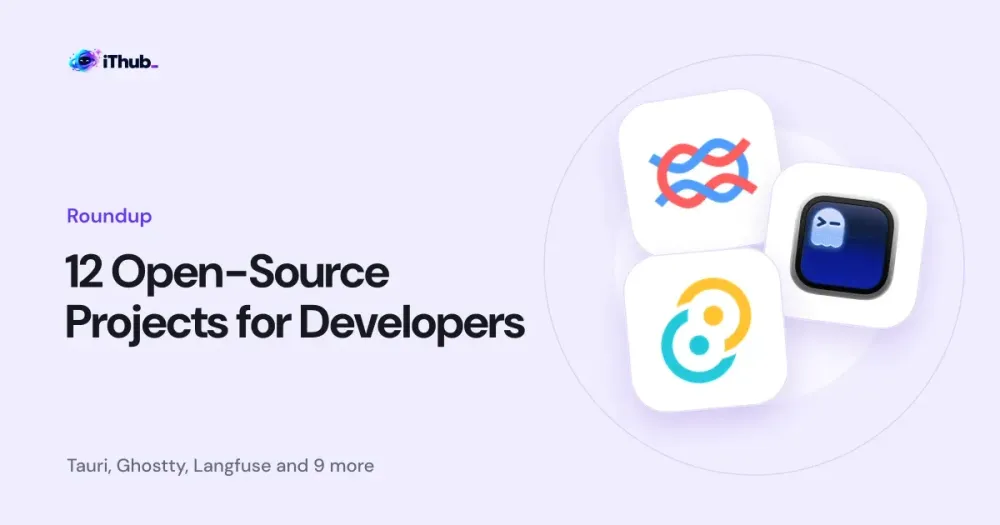
The open source projects for developers that made this list at the end of 2026 are Ghostty, Kiri, Tabularis, Hoppscotch, Tauri, Ponytail, landmines, Sim, Langfuse, Huginn, Zerobyte and TelltaleDNS. Each covers a different job, from the terminal and the local container engine to tracing LLM calls and backing up a home server, and each had a recent commit and a tagged release when we checked on November 20, 2026.
This is not a popularity ranking. Several picks are young projects below version 1.0, and their entries say so. Every project has a listing in the iThub directory with installation details, platforms and links. If you came for the best open source developer tools of 2026 for one specific job, start with the summary table.
How the projects were chosen
We started from open source tools listed on iThub and kept those that met four conditions:
- Maintained in the last 30 days: at least one commit on the default branch after October 21, 2026, checked through the GitHub API on November 20, 2026.
- An OSI-approved license, or a clear label where part of it is not. Eleven picks use MIT, Apache-2.0, AGPL-3.0 or a dual Apache-2.0/MIT license. Langfuse is MIT apart from its enterprise directories, which have their own license.
- Real releases: tagged versions with release notes, not only a moving main branch. Ghostty tags versions in Git and publishes its release notes on its own site.
- Usable documentation: installation and configuration covered beyond a short README. For landmines and Ponytail the README is the documentation, and it covers every rule or command.
We kept to one project per need and mention close alternatives inside each entry. Six picks are below version 1.0: Kiri, Tabularis, landmines, Sim, Zerobyte and TelltaleDNS. Ponytail is on version 5, but its repository dates from June 2026. Try these on a side project before a team depends on them.
Summary table
| Project | Category | License | Latest version | Best for |
|---|---|---|---|---|
| Ghostty | Terminal emulator | MIT | 1.4.0 (Oct 27, 2026) | A fast native terminal on macOS and Linux |
| Kiri | Container runtime | Apache-2.0 | v0.2.2 (Nov 19, 2026), beta | A lighter local engine for Docker and Compose |
| Tabularis | Database client | Apache-2.0 | v0.33.1 (Nov 19, 2026) | SQL work with notebooks and an MCP server |
| Hoppscotch | API client | MIT | 2026.10.1 (Nov 5, 2026) | Testing REST, GraphQL and realtime APIs |
| Tauri | App framework | Apache-2.0 or MIT | tauri v2.12.7 (Nov 18, 2026) | Small desktop and mobile apps with a web UI |
| Ponytail | Coding agent ruleset | MIT | v5.3.3 (Oct 29, 2026) | Smaller changes from coding agents |
| landmines | Lint rules | MIT | 0.1.1 (Nov 18, 2026), new | Catching mocked and flaky agent-written tests |
| Sim | AI agent workflows | Apache-2.0 | v0.9.63 (Nov 19, 2026) | Agent workflows served as an API or MCP server |
| Langfuse | LLM tracing and evaluation | MIT, enterprise code separate | v4.83.0 (Nov 19, 2026) | Debugging cost, latency and quality of LLM apps |
| Huginn | Self-hosted automation | MIT | v2026.11.19 (Nov 19, 2026) | Watching sites and feeds, then acting |
| Zerobyte | Restic backup interface | AGPL-3.0 | v0.44.2 (Nov 9, 2026) | Scheduled encrypted backups at home |
| TelltaleDNS | DNS resolver and ad blocker | Apache-2.0 or MIT | v0.7.0 (Nov 16, 2026) | Per-device DNS filtering |
1. Ghostty: a native terminal for macOS and Linux
Ghostty is a terminal emulator with a shared core written in Zig and a native interface on each platform: Swift, AppKit and Metal on macOS, GTK4 and OpenGL on Linux. Its core is also published as libghostty, a zero-dependency C and Zig library for parsing terminal output or embedding a terminal in another program.
It suits developers who live in a terminal on macOS or Linux. If you build a CI log viewer or an editor panel that displays terminal output, libghostty gives you the escape-sequence parser and terminal state so you do not write your own. There is no Windows version, and on Linux you install it from your distribution's packages, since the project ships no Linux binaries.
- License MIT. Latest: 1.4.0, October 27, 2026. Maturity: stable since 1.0 in December 2024, fiscally sponsored by the non-profit Hack Club.
- Links Ghostty on iThub, GitHub repository, 1.4.0 release notes. More in Code Editors & IDEs.
2. Kiri: a small Docker-compatible container runtime
Kiri is a Rust container runtime that serves the Docker Engine API, so the docker CLI, Compose and buildx work against it unchanged. On macOS it runs containers in one small Linux VM that sleeps when idle, on Linux it uses the host kernel directly, and on Windows it runs inside WSL 2. It adds local domain names with HTTPS and a one-command Kubernetes cluster.
It is for developers who use Docker Desktop or OrbStack mainly as a local engine for Compose projects and want something lighter. In practice you start a Compose stack and reach each service by name over HTTPS instead of tracking localhost ports. The website labels Kiri beta, and v0.2.2 fixed several privately reported security problems plus Compose and Testcontainers issues, so keep your current engine installed until your stack runs cleanly on it.
- License Apache-2.0. Latest: v0.2.2, November 19, 2026. Maturity: young, beta.
- Links Kiri on iThub, GitHub repository, documentation. Established engines such as Docker and Podman are in Containers & Kubernetes.
3. Tabularis: a SQL client with notebooks and an MCP server
Tabularis is a desktop SQL workspace built with Tauri, with a React interface and a Rust backend that handles connections and credentials. It supports PostgreSQL, MySQL/MariaDB and SQLite out of the box and reaches other databases through driver plugins (the README counts 30, including DuckDB, ClickHouse and Redis). It adds SQL notebooks, visual EXPLAIN plans, ER diagrams and a built-in MCP server.
It is for developers who want one open source client across several databases. A practical case: run tabularis --mcp, or the one-click setup in settings, so Claude Desktop or Cursor can read the schema of your development database instead of guessing column names from code. The project began in January 2026 as an experiment in AI-assisted development and ships a release or nightly build every few days, so expect the interface to keep changing.
- License Apache-2.0. Latest: v0.33.1, November 19, 2026. Maturity: young, pre-1.0.
- Links Tabularis on iThub, GitHub repository, wiki. For a longer-established client, see Beekeeper Studio in Databases. New to MCP? Read what an MCP server is.
4. Hoppscotch: an API client for the browser, desktop and CI
Hoppscotch builds and tests requests over REST, GraphQL, WebSocket, Server-Sent Events, Socket.IO and MQTT, with collections, environments and pre-request and post-request scripts. The same client runs as a web app, as desktop apps for Windows, macOS and Linux, as a CLI and as a self-hosted Community Edition in Docker.
It suits teams that want a free API client they can also host themselves. One good pattern is to keep contract tests for your API in a shared collection and run that collection on every pull request with the @hoppscotch/cli package. In the browser, CORS applies unless you use an interceptor or the desktop app.
- License MIT, with some features reserved for the paid Enterprise edition. Latest: 2026.10.1, November 5, 2026. Maturity: established, with monthly feature releases.
- Links Hoppscotch on iThub, GitHub repository, documentation. Bruno keeps collections as plain-text files in Git, and Insomnia also covers gRPC; both are in API Clients, Testing & QA.
5. Tauri: desktop and mobile apps with a web frontend
Tauri builds applications with an HTML, CSS and JavaScript interface and a compiled Rust core. Instead of bundling a browser engine, it renders in the webview the operating system provides (WebView2, WKWebView, WebKitGTK or Android System WebView), which keeps installers small. Version 2 added iOS and Android, and a capability system controls which system APIs the frontend may call.
It is for web developers who need to ship a desktop app and for teams moving off Electron. A common job is to package an internal dashboard written in Svelte or React as a Windows and macOS installer, with one Rust command for what a browser cannot do, such as reading a local configuration file. Tabularis and the Hoppscotch desktop app are built with it. The cost is that each platform renders with a different engine, so test on every target system.
- License Apache-2.0 or MIT. Latest: core crate tauri v2.12.7, November 18, 2026 (the CLI and other packages are tagged separately). Maturity: established.
- Links Tauri on iThub, GitHub repository, guides. Pake wraps an existing website with one command on top of Tauri, and Flutter suits teams that would rather draw the whole interface in Dart.
6. Ponytail: rules that keep coding agents' changes small
Ponytail is one prompt, a skill file with a compact AGENTS.md copy, plus adapters that load it into more than 30 coding agents, including Claude Code, Codex, Cursor, Copilot and OpenCode. It makes the agent read the code a change touches, then take the first option that works: reuse existing code, the standard library or an installed dependency before writing anything new. Validation, error handling, security and accessibility are listed as never to be cut, and /ponytail-review and /ponytail-audit check a diff or a whole repository.
It is for developers who already use a coding agent and spend review time deleting code that did not need to exist. After installing it in Claude Code with two /plugin commands, ask for a cache on a slow API call and the agent reaches for the standard library's memoization before writing a cache class or adding a package.
- License MIT. Latest: v5.3.3, October 29, 2026, also the last commit when we checked. Maturity: young repository, fifth major version.
- Links Ponytail on iThub, GitHub repository. Supported agents include OpenCode and goose. More rule packs are in AI Skills & Plugins, and our Claude skills explainer shows how skill files load.
7. landmines: lint rules for AI-written tests
landmines is a set of ten Oxlint rules in four plugins, aimed at the shortcuts coding agents take to turn a build green. The testing plugin flags module mocks and stubbed globals, fixed sleeps, test retries and raised timeouts, polling on spy state, and MSW setups that let unmocked requests reach the network. Each error message says what to do instead, so an agent can fix the finding in the same loop.
The audience is TypeScript teams where agents write a growing share of the tests. Typical use: register only the landmines-testing plugin in CI and adopt no-fixed-sleep through its per-file allowlist, which takes an exact count, so existing tests do not block the rollout while new sleeps fail. The other plugins are opinionated, with rules against prose comments and explicit return types, so add them one at a time.
- License MIT. Latest: 0.1.1, November 18, 2026, one day after the first release. Maturity: very new; needs Oxlint 1.81 and Node 22.18 or later.
- Links landmines on iThub, GitHub repository, npm package.
8. Sim: AI agent workflows you can deploy as an API or MCP server
Sim builds AI agent workflows from blocks: Agent blocks call a model and use tools, Function blocks run code, and Condition, Router, Loop, Parallel and Human in the Loop blocks control the flow. You can assemble a workflow on a visual canvas, describe it in chat or create it through the API, then deploy it as a REST endpoint, a chat page or an MCP server.
It suits developers who want agent workflows with run logs and deployment handled, with the option to self-host. For example, build a workflow that answers questions from an internal knowledge base and deploy it as an MCP server that Claude Code or Cursor can call like any other tool. Self-hosting starts with npx sim-setup for Docker Compose, or a Helm chart. Sim shipped three versions on November 17, 2026 alone, so pin the version you deploy.
- License Apache-2.0; the hosted Sim Cloud has paid plans, and SSO, SCIM and audit logs are Enterprise features. Latest: v0.9.63, November 19, 2026. Maturity: young, pre-1.0.
- Links Sim on iThub, GitHub repository, documentation. Related tools are in LLM App Platforms & RAG.
9. Langfuse: tracing and evaluation for LLM applications
Langfuse records what an LLM application does as traces of nested steps, such as model calls, retrievals and tool calls, each with latency, token usage and cost. On that data it adds versioned prompt management, evaluations, datasets and dashboards. It accepts OpenTelemetry traces, so a framework that already emits them needs no Langfuse SDK.
Its audience is developers running LLM features or agents in production who need to see why a response was slow, expensive or wrong. Typical use: trace an agent, find the tool call that accounts for most of the latency, then run a dataset through the old and new prompt before shipping the change. Self-hosting is the heaviest on this list, with PostgreSQL, ClickHouse, Redis or Valkey, and S3-compatible storage. ClickHouse acquired Langfuse in January 2026, and the announcement says it stays open source with no licensing changes planned.
- License MIT, except the enterprise (
ee) directories. Latest: v4.83.0, November 19, 2026. Maturity: established, several releases a week. - Links Langfuse on iThub, GitHub repository, documentation. Similar tools are in MLOps & LLMOps.
10. Huginn: self-hosted agents that watch the web and act
Huginn runs rule-based agents on your own server. Each agent is a configured instance of a built-in type, such as a Website Agent that scrapes a page or an Email Digest Agent, and agents pass JSON events along a graph. Its README calls it a hackable IFTTT or Zapier on your own server; "agent" here means a configured rule, not a language model.
Huginn fits developers who want monitoring and notification automations under their own control and are fine with JSON options and Liquid templates instead of a drag-and-drop editor. A classic setup watches a vendor's changelog, keeps only entries that mention your stack and sends them as a daily email digest. Huginn is a Ruby on Rails app from 2013, maintained by a volunteer, and starts with one docker run command; it does not run natively on Windows.
- License MIT. Latest: v2026.11.19, November 19, 2026. Maturity: established, one main maintainer.
- Links Huginn on iThub, GitHub repository. For a visual editor and a large integration catalogue, n8n is the usual choice, but its Sustainable Use License is fair-code, not OSI-approved; see our n8n guide and Workflow Automation.
11. Zerobyte: a web interface for Restic backups
Zerobyte puts a web interface and scheduler on top of Restic, the encrypted, deduplicating backup program. You define sources (local folders, NFS, SMB, WebDAV, SFTP or rclone), repositories (local disk, S3-compatible or other cloud storage, SFTP or a Restic REST server) and jobs that connect them with a cron schedule and a retention policy.
It suits developers with a homelab or small server who want Restic without maintaining cron entries and shell scripts. A realistic setup backs up a NAS share over SMB every night to an S3-compatible bucket, then restores a single file from the browser when someone deletes it. The README is direct about the limits: it is 0.x and can change a lot between versions, it should not face the internet without a tunnel and authentication, and its data directory must not sit on a network share.
- License AGPL-3.0; the bundled Restic binary keeps its BSD-2-Clause license. Latest: v0.44.2, November 9, 2026. Maturity: young, repository created in August 2025.
- Links Zerobyte on iThub, GitHub repository, documentation. More in Backup & Disaster Recovery.
12. TelltaleDNS: a DNS resolver that explains each answer
TelltaleDNS is a filtering DNS resolver and ad blocker written in Rust. Each query in its log is tied to a named device and stored with the reason it was answered, blocked or forwarded, and rules apply per device or group. It supports DoT, DoH and DoQ, DNSSEC validation and full recursion, and runs on a Raspberry Pi, in Kubernetes or on both as one cluster.
It is built for homelab owners who want ad blocking with per-device visibility and automation through a REST API, a CLI and MCP tools. With it you can find the device that keeps calling a telemetry domain, block it for that device's group only, and test the rule against yesterday's traffic before saving. TelltaleDNS is pre-1.0 with one maintainer, and its README states that Claude Code writes much of the code, tests and documentation while the maintainer approves every release.
- License Apache-2.0 or MIT, at your option. Latest: v0.7.0, November 16, 2026. Maturity: young, repository created in October 2026.
- Links TelltaleDNS on iThub, GitHub repository, guides. The long-standing option is Pi-hole, in DNS, DHCP & IPAM.
What did not make the list
- n8n Appears under Huginn but was not a main pick because its license is fair-code.
- CCPM Turns product requirements into GitHub issues and runs parallel agents in Git worktrees, but has no tagged releases.
- unkernel Runs arm64 Linux programs in a browser on a kernel compiled to WebAssembly. Worth watching, still an experiment at version 0.2.
- gridstack.js , a library for draggable dashboard grids, is well maintained but serves one kind of interface.
If you maintain a project that meets the same criteria, you can submit it to iThub. For the operations side, see 50 IT tools every sysadmin should know.
Sources
- ghostty-org/ghostty and Ghostty 1.4.0 release notes, Ghosttygithub.com · ghostty.org
- libracoder/kiri and Kiri v0.2.2 release, Kirigithub.com
- TabularisDB/tabularis and Tabularis v0.33.1 release, Tabularisgithub.com
- hoppscotch/hoppscotch and Hoppscotch 2026.10.1 release, Hoppscotchgithub.com
- tauri-apps/tauri and tauri v2.12.7 release, Taurigithub.com
- DietrichGebert/ponytail and Ponytail v5.3.3 release, Ponytailgithub.com
- interfere-inc/landmines and landmines 0.1.1 release, Interferegithub.com
- simstudioai/sim and Sim v0.9.63 release, Simgithub.com
- langfuse/langfuse, Langfuse v4.83.0 release and Langfuse is joining ClickHouse, Langfusegithub.com · langfuse.com
- huginn/huginn, Huginn v2026.11.19 release and requirements, Huginngithub.com
- nicotsx/zerobyte and Zerobyte v0.44.2 release, Zerobytegithub.com
- paimonsoror/telltaledns and TelltaleDNS v0.7.0 release, TelltaleDNSgithub.com
Frequently asked questions
How can I tell whether an open source project is still maintained?
Look at four things on the repository: the date of the last commit on the default branch, the date and notes of the last tagged release, how quickly issues and pull requests get a reply, and whether more than one person merges code. A project with steady commits but no releases means you will be tracking the main branch. A long silence with open security reports, or an archived repository, is a reason to look elsewhere.
What is the difference between open source and fair-code or source-available licenses?
An open source license approved by the Open Source Initiative, such as MIT, Apache-2.0 or AGPL-3.0, lets anyone use, modify and redistribute the software for any purpose, including commercial use. Fair-code and source-available licenses also publish the code but restrict some uses, typically selling it as a hosted service or redistributing it commercially. Internal use is often allowed, but read the license before you build a product on top of such a project.
Is it safe to use a pre-1.0 open source tool at work?
It can be, where a breaking change is cheap to absorb: a local database client, a lint rule on a branch, a DNS server for a test network. Pin the version, read the release notes before each upgrade and keep a working fallback. Avoid making a 0.x tool the only thing standing between you and data loss until you have tested a full restore or rollback with it.
Which of these projects can AI agents use through MCP?
Tabularis has a built-in MCP server, started with tabularis --mcp, that lets clients such as Claude Desktop or Cursor read schemas and run queries over saved connections. Sim can deploy any workflow as an MCP server and also runs an MCP server for managing Sim Cloud. TelltaleDNS provides MCP tools with plans and approval steps. Ponytail and landmines work on the agent differently: one as rules loaded into the agent, the other as lint rules that check the code it writes.
Which of these tools work without an account or a cloud service?
Ghostty, Tabularis, Kiri, Tauri, Ponytail and landmines run on your own machine with no account, although Kiri's optional Share links go through the project's relay. Huginn, Zerobyte and TelltaleDNS are self-hosted, with no hosted version offered. Hoppscotch, Sim and Langfuse have hosted services and self-hosted editions, and the Hoppscotch web app also works without signing in, keeping data in browser storage.
Why are GitHub stars not part of the selection criteria?
Stars measure attention, not maintenance or fit. A project can collect thousands in a launch week and go quiet a month later, while a mature tool may grow slowly for years. Commit and release dates, the license and the documentation are things you can check yourself on each repository, so those are what we used.
Tools in this article
 GhosttyNative, GPU-accelerated terminal emulator for macOS and Linux, with an embeddable Zig and C core
 KiriRust container runtime for macOS, Windows and Linux with the Docker Engine API, k3s and Kiri Share tunnels
 TabularisOpen-source desktop SQL workspace with notebooks, visual EXPLAIN, driver plugins and a built-in MCP server
 HoppscotchOpen-source API client for REST, GraphQL and realtime protocols, on the web, desktop, CLI or your own server
 TauriRust framework for small desktop and mobile apps with a web frontend rendered in the system webview
 PonytailRuleset and plugin that makes AI coding agents reuse code and write the smallest complete change
- LlandminesOxlint plugins from Interfere that flag mocks, fixed sleeps, test retries and other shortcuts in AI-written code
 SimOpen-source workspace to build, deploy and monitor AI agents and workflows on a visual canvas or through chat
Facts link to their official sources. Product details can change after publication: report an error or read the editorial methodology.

Written by
Emanuel DE ALMEIDA
Geneva-based entrepreneur, IT consultant and creator of SuniPDF and SuniCapture. Emanuel shares practical IT, cybersecurity and software insights on iThub.