What is Tech Interview Handbook?
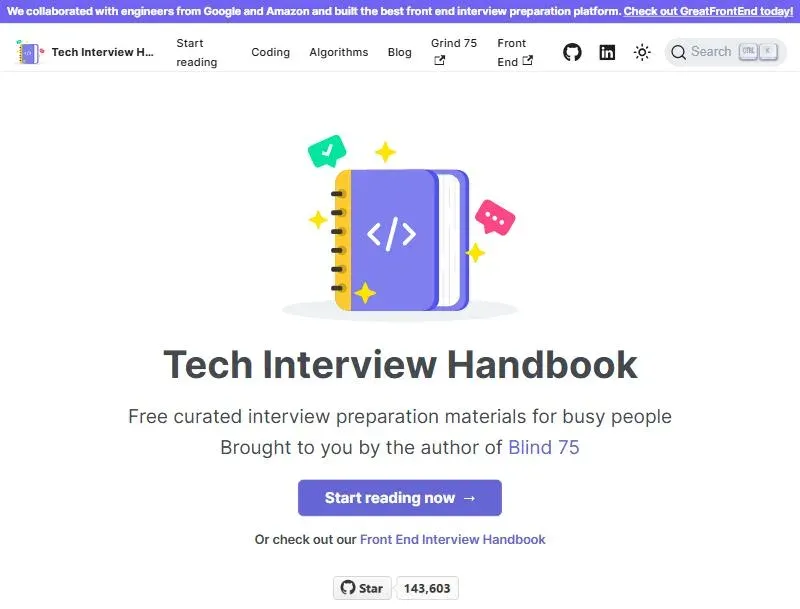
Tech Interview Handbook is a free collection of coding interview preparation materials, maintained in the yangshun/tech-interview-handbook GitHub repository. Its README describes it as curated material for busy engineers, written by the author of Blind 75, identified on the official website as Yangshun Tay, a former Meta staff engineer. The repository's LICENSE file places the code and written content under the MIT License, copyright Yangshun Tay, and GitHub's own license detection reports the same MIT identifier, so the text content and the site's source code share one license.
The material is read either as Markdown files directly in the repository or through the companion techinterviewhandbook.org website, built with Docusaurus. The repository is a pnpm-managed monorepo with two applications: apps/website, the Docusaurus site that renders the handbook pages, and apps/portal, a separate Next.js application on the T3 stack with its own Prisma database, used for salary-offer and resume-review community features. The portal is a different codebase from the handbook content and is not required to read any of the guides.
There is no versioned software release for this project. GitHub reports no published release, and the single existing git tag, named legacy, dates from April 2022 and does not correspond to a content version. The repository's most recent push was recorded on August 7, 2026, and individual pages such as the study plan and the company interview-format guide carry a matching "Last updated on Aug 7, 2026" note, which is the clearest signal of how current the published text is.
Page content covers algorithm and data-structure study material, a multi-week study plan built around the Grind 75 problem list, a software engineer resume guide, behavioral interview questions with rubrics, salary and offer negotiation guidance, and a page summarizing interview stages reported at nine named companies. The README states that original system design content is not yet available; the system design section instead curates links to third-party resources, most of them paid courses. Front-end-specific interview content has been moved out of this repository into a separate sibling project by the same author, Front End Interview Handbook, published at frontendinterviewhandbook.com.
The official website repeatedly promotes GreatFrontEnd, described on its own homepage as a front-end interview preparation platform built with engineers from Google and Amazon, and sold as a paid product. GreatFrontEnd is a separate commercial product by the same author and is not part of this repository's MIT-licensed content; several handbook pages also carry affiliate or referral links to GreatFrontEnd and to other third-party courses. Within iThub's Tutorials & Courses category, freeCodeCamp is a broader, project-based coding curriculum with certifications, a different format from this reference-style interview handbook.
Key capabilities
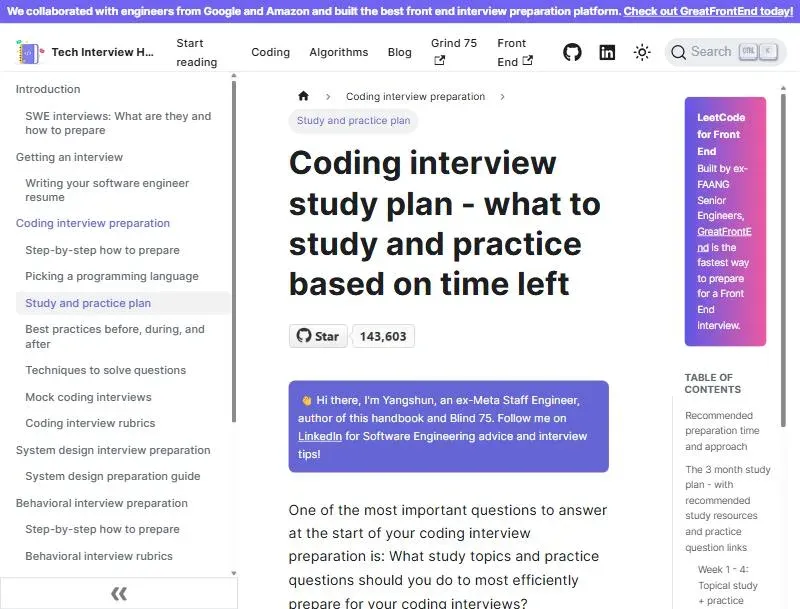
- Coding interview study plan A page lays out a 3-month plan at roughly 11 hours a week, comparing breadth-first, depth-first and mixed approaches. Weeks 1 to 4 list topics such as Array, Linked List, Graph, Heap, Trie, Interval and Dynamic Programming with a priority and time estimate for each; weeks 5 to 12 assign practice problems from the Grind 75 list. The page carries a last-updated date of August 7, 2026.
- Grind 75 practice list Grind 75 is a separate tool by the same author listing 75 LeetCode problems grouped by topic, with an adjustable study-duration slider that redistributes the problems across a chosen number of weeks. The handbook study plan links directly into specific weeks of this list.
- Algorithm cheatsheets Per-topic pages summarize technique and complexity notes for Array, String, Hash Table, Recursion, Sorting and Searching, Matrix, Linked List, Queue, Stack, Tree, Graph, Heap, Trie, Interval, Dynamic Programming, Binary and Math and Geometry categories, each with a short written explanation rather than a video.
- Coding interview best-practice checklist A dedicated cheatsheet page lists concrete actions before, during and after a coding interview, including how to clarify requirements, talk through an approach out loud, and discuss time and space complexity once a working solution is reached.
- Techniques for optimizing time and space complexity Two separate pages collect named techniques, such as using a hash map to trade memory for lookup speed or two pointers to avoid nested loops, each tied to the complexity class it targets.
- Mock interview guidance A page explains why mock interviews matter and names interviewing.io as a platform for anonymized practice sessions with engineers from large technology companies; the outbound link is a referral link. The page also suggests practicing with a friend by taking turns interviewing each other.
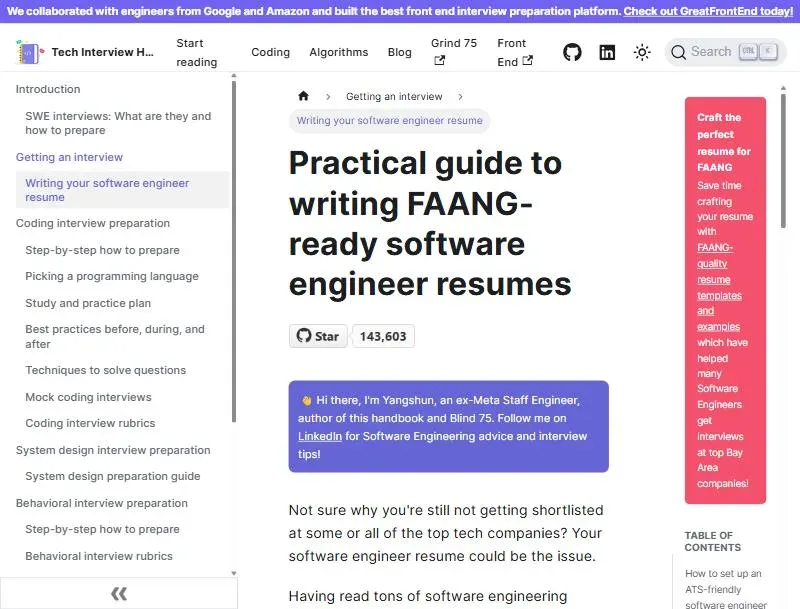
- Software engineer resume guide A long-form guide covers structuring an ATS-readable resume, writing achievement-based bullet points, and formatting choices, illustrated with a documented before-and-after example resume.
- Behavioral interview preparation Separate pages cover a step-by-step preparation method, published rubrics, a bank of common questions, guidance aimed specifically at senior candidates, how to prepare a self-introduction, and example questions to ask the interviewer at the end of a round.
- Limited system design material The system design section explains four interview formats (back end, API, object-oriented and front end) and lists about ten common back-end prompts, but the README and the page itself state that most of the section is a curated list of external resources, mainly paid courses from other providers rather than original Tech Interview Handbook content.
- Company interview-format reference One page lists the reported interview stages for nine named companies (Airbnb, Asana, Dropbox, Google, Indeed, Lyft, Meta, Palantir and WhatsApp), based on individual candidates' accounts rather than official company documentation; some entries reference older practices, such as COVID-era remote interviewing and discontinued coding tools, that may not match a company's current process.
- Engineering levels overview A page explains general software engineering career levels from Junior to Distinguished Engineer and states that specifics vary by company, linking out to individual company level and salary references such as a Dropbox career framework rather than summarizing them.
- Salary and offer negotiation guidance A dedicated page covers how to approach compensation discussions and negotiate a job offer once one is extended.
- Front End Interview Handbook pointer Front-end-specific interview preparation is not covered in this repository; the site links out to the separate Front End Interview Handbook project by the same author for that material.
- Open, forkable Markdown source Every page's underlying Markdown file can be read, copied or adapted under the MIT License directly from the GitHub repository, without going through the website.
- Separate community portal code The repository's apps/portal folder contains a distinct Next.js and Prisma application originally built for salary-offer and resume-review community features. It is a separate codebase from the handbook content, documented in its own README as bootstrapped from the T3 stack.
- Community channels The README links a Discord server, a Telegram channel, an X (formerly Twitter) account and a Facebook page for following updates and discussing the content. There are no formal contribution guidelines; the README invites issues and pull requests and says the maintainers are still deciding how to structure further content.
- Interview-course pointers with disclosed affiliate links Several pages, including the study plan, mock interview and system design pages, link to named third-party paid courses such as AlgoMonster and Design Gurus' Grokking the Coding Interview, and to GreatFrontEnd. A number of these outbound links carry referral or affiliate parameters rather than pointing to the plain product page.
Where Tech Interview Handbook fits
Building a study plan around available time
The coding interview study plan page asks how much preparation time is available and divides a 3-month timeline into topical study weeks followed by practice weeks built around the Grind 75 list, with a priority and estimated duration attached to each topic. The page recommends keeping some breadth practice throughout so earlier topics are not forgotten by the final weeks.
Writing a software engineer resume
The resume guide walks through setting up an ATS-friendly document structure, then rewriting bullet points around concrete outcomes rather than duties. It is illustrated with a documented example resume shown in an earlier and a revised version, so the specific wording changes being recommended are visible rather than only described.
Preparing behavioral and self-introduction answers
Separate pages cover a step-by-step method for behavioral preparation, published interview rubrics, a bank of common questions, a page aimed at senior candidates, and guidance on preparing a short self-introduction together with questions to ask the interviewer. Content here does not require a programming background to use.
Reviewing a company's reported interview stages
The company interview-formats page lists the stages reported for nine named companies, broken down by round type such as phone screen, algorithms, system design or behavioral. The page states its content comes from individual candidates' accounts, so a given company's current process can differ from what is listed. Most handbook pages carry a "Last updated" date near the bottom, matching the repository's August 7, 2026 push, but that date applies to the page as a whole rather than to each contributed stage description individually.
Looking up algorithm techniques by topic
The algorithms section groups cheatsheets by data structure and technique, from arrays and hash tables to graphs, tries and dynamic programming, plus separate pages on optimizing time and space complexity. Each page is a short written reference rather than a full course.
Finding system design and negotiation resources
The system design page explains interview formats and common prompt types, then links out to third-party courses and free resources for deeper coverage, since the project states it has not published original system design material. A separate page covers offer and salary negotiation once an offer has been extended, including how to compare a base salary, equity and sign-on bonus across competing offers.
Reviews of Tech Interview Handbook
Be the first to share your experience with Tech Interview Handbook.
Write a review
Loading review form…
Found Tech Interview Handbook useful? Upvote it todayYour vote helps other IT teams find it in the daily ranking.