What is freeCodeCamp?
freeCodeCamp is a free, self-paced learning platform for programming, run at freecodecamp.org by Free Code Camp, Inc., a donor-supported, tax-exempt 501(c)(3) public charity in the United States (federal tax ID 82-0779546). The organization's about page states that Quincy Larson started the freeCodeCamp community in 2014, and its legacy-gift wording describes Free Code Camp, Inc. as a charitable corporation organized under the laws of Delaware, located at a PO box in Plano, Texas. The stated mission is to help people learn to code for free through videos, articles and interactive coding lessons. On November 17, 2026 the repository README stated that the community had helped more than 100,000 people get their first developer job.
The platform has several parts: the interactive curriculum at freecodecamp.org/learn with free certifications, a course catalog, a daily coding challenge, the freeCodeCamp News publication with tutorials and full-length books, the freeCodeCamp.org YouTube channel with full-length video courses, a forum for programming help and project feedback, a Discord server, and official mobile apps for iOS and Android. Everything on the learning side, including the courses, projects and certifications, is free; the organization is funded by donations, and the homepage credits its monthly donors for keeping it free.
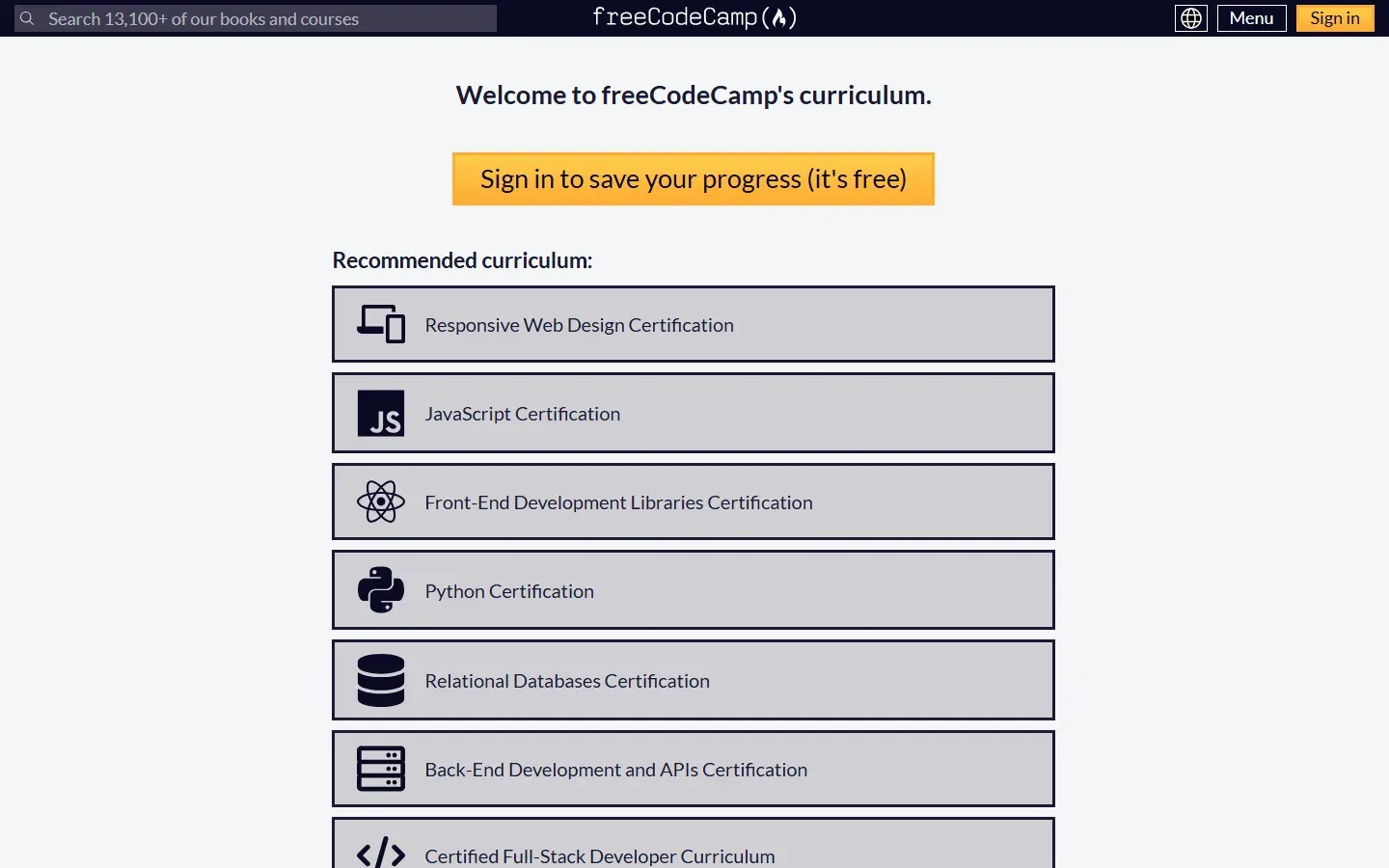
The curriculum was restructured around the Certified Full-Stack Developer Curriculum, whose version 9 certifications are Responsive Web Design, JavaScript, Front-End Development Libraries, Python, Relational Databases, and Back-End Development and APIs. Each of these combines lessons, workshops, labs, reviews and quizzes, requires five projects to qualify for an exam, and is earned by passing that exam. Passing all six qualifies a learner for the Certified Full-Stack Developer Exam. Language certifications in beta (A2 and B1 English for Developers, A1 Professional Spanish, A1 Professional Chinese), interview preparation material and a Foundational C# with Microsoft certification complete the current list, while earlier certifications such as Scientific Computing with Python, Data Analysis with Python, Machine Learning with Python and College Algebra with Python are kept on an archive page and no longer updated.
The code that runs the platform is developed in the open in the freeCodeCamp/freeCodeCamp monorepo, which describes itself as the open-source codebase and curriculum. It is a TypeScript project managed with pnpm and Turborepo: the learner-facing client is built with Gatsby 5 and React 18 and uses the Monaco editor for the in-browser coding environment, and the API is a Fastify 5 server that accesses MongoDB through Prisma. Curriculum content lives as files in the curriculum directory. The repository publishes no GitHub releases or tags; development happens on the main branch. The companion mobile app repository contains the Flutter (Dart) app.
Licensing is split. The software in the repository is under the BSD-3-Clause license, while the README states that the learning resources in the /curriculum directory are copyright freeCodeCamp.org and are not covered by that license. The curriculum folder also carries a separate Creative Commons Attribution-NonCommercial-ShareAlike 4.0 license for The Odin Project material used in the freeCodeCamp Remix. The contributor documentation explains how to run the platform locally for development; it is not packaged or documented as a product for self-hosting. Other learning platforms listed on iThub include LearnHouse and DeepTutor.
Key capabilities
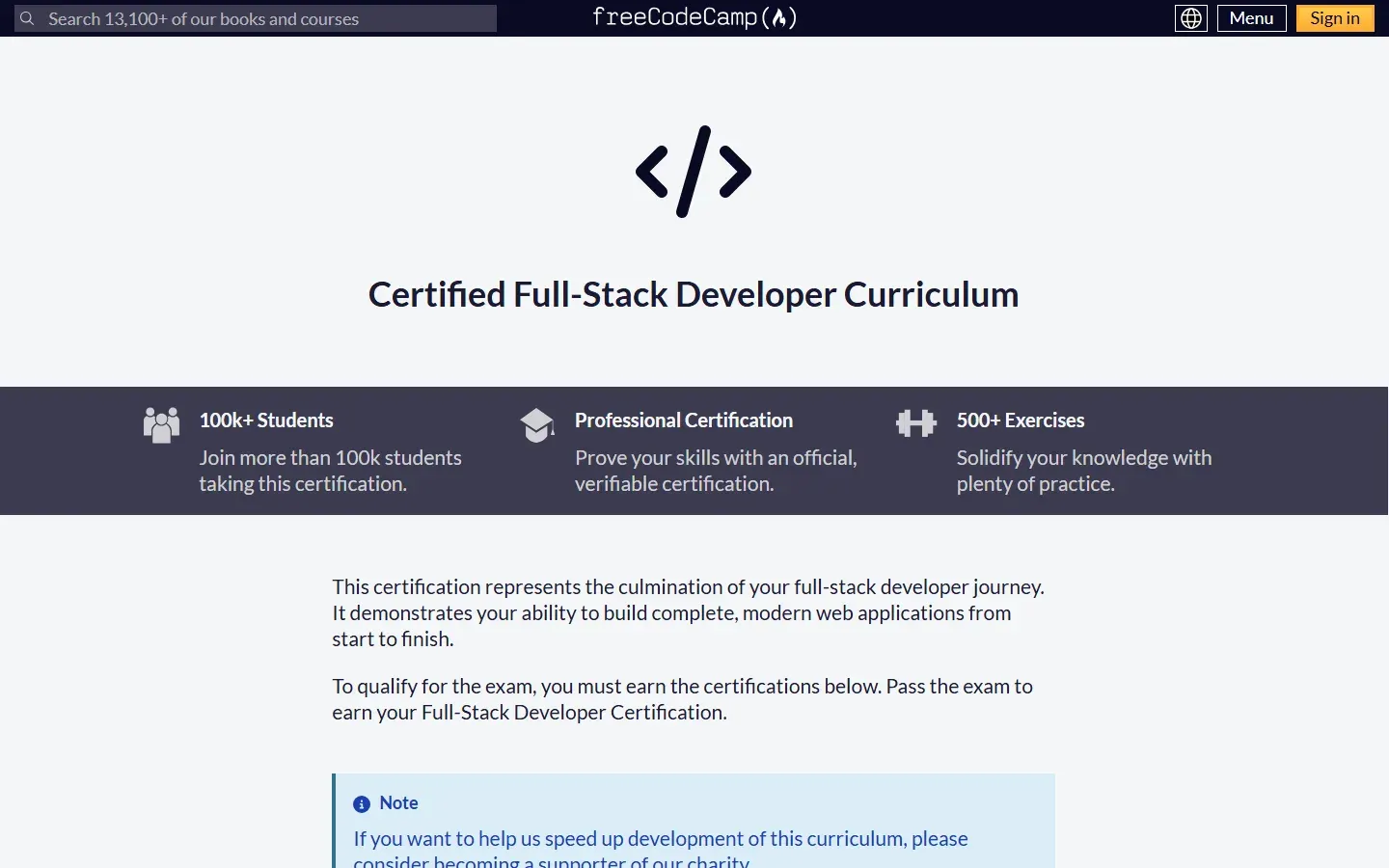
- Certified Full-Stack Developer Curriculum The full-stack curriculum page groups six certifications (Responsive Web Design, JavaScript, Front-End Development Libraries, Python, Relational Databases, and Back-End Development and APIs) that must all be earned before the Certified Full-Stack Developer Exam. On November 17, 2026 the page stated more than 100k students and 500+ exercises. A note on the page asks for supporters to help speed up development of the curriculum.
- Certification structure Each version 9 certification mixes theory lessons, step-by-step workshops, labs, review pages and quizzes. Learners complete five required certification projects to qualify for the certification exam, then pass the exam to claim the certification. The Responsive Web Design certification, for example, is organized into HTML, Computers and CSS courses, with workshops such as a cat photo app and labs such as a recipe page and a survey form project.
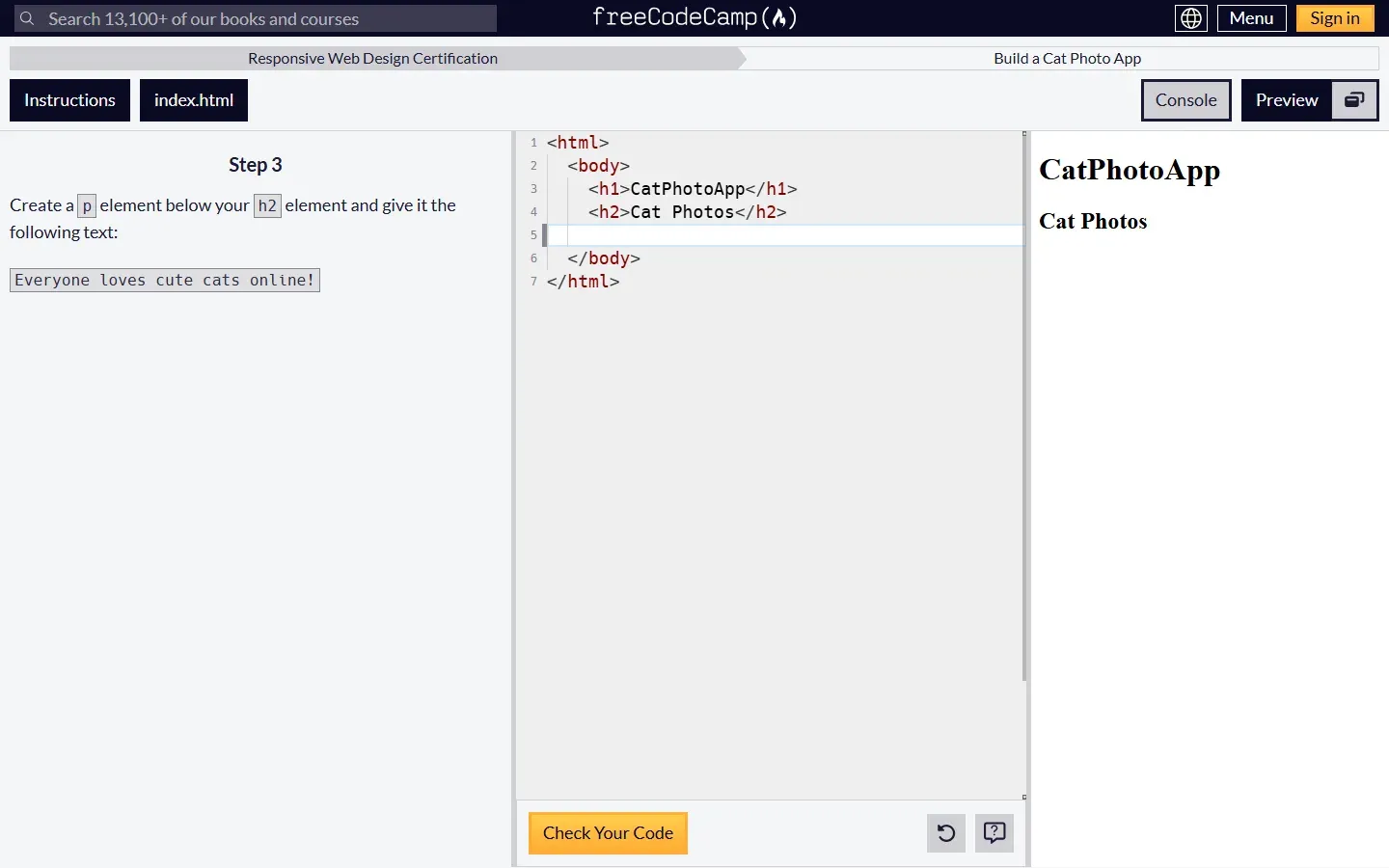
- In-browser coding environment Workshop steps and challenges open in a split view with instructions, a code editor, a console and a live preview, with a Check Your Code button that runs the step's tests. The editor is based on Monaco. Progress is saved to the learner's account when signed in; without an account the curriculum can still be browsed and worked through.
- Verified certifications Earned certifications are permanent and get a public, verifiable URL that can be linked from a resume or LinkedIn profile. The README states that certifications are revoked and accounts banned when plagiarism is found under the Academic Honesty Policy.
- Language certifications A2 English for Developers and B1 English for Developers, A1 Professional Spanish and A1 Professional Chinese are listed as beta certifications. They are organized into modules with warm-ups, lessons, practice, review pages and quizzes; all quizzes must be completed to qualify for the final exam.
- Interview preparation and professional certification The learn page lists The Odin Project (freeCodeCamp Remix), Coding Interview Prep, Project Euler and Rosetta Code for interview and job-search preparation, and a free Foundational C# with Microsoft certification under professional certifications.
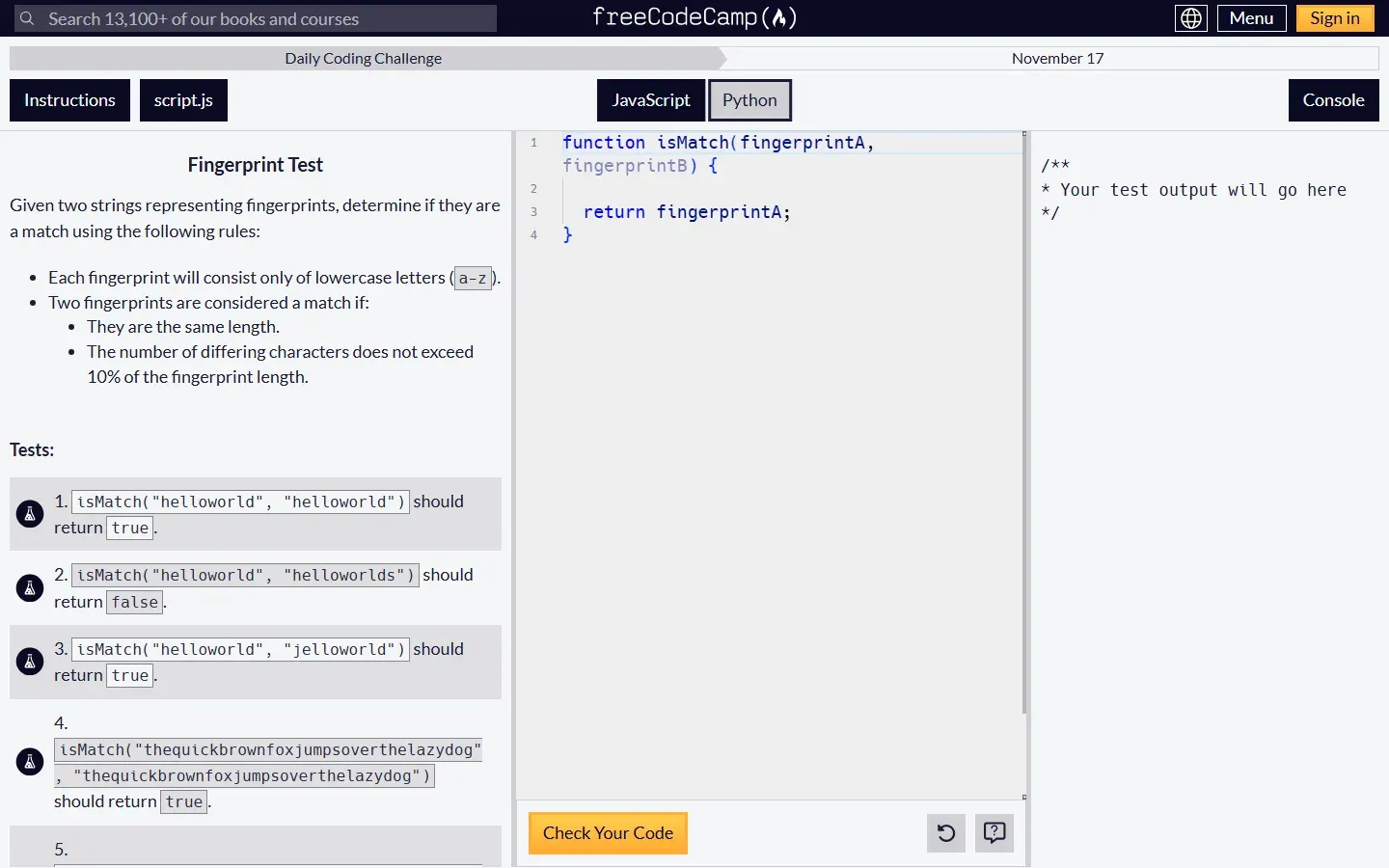
- Daily coding challenge A new short algorithm challenge is published every day and can be solved in JavaScript or Python in the browser, with tests shown next to the editor. The challenge changes at midnight US Central time, and the daily challenge archive lists past challenges by calendar month; the November 17, 2026 challenge was number 99.
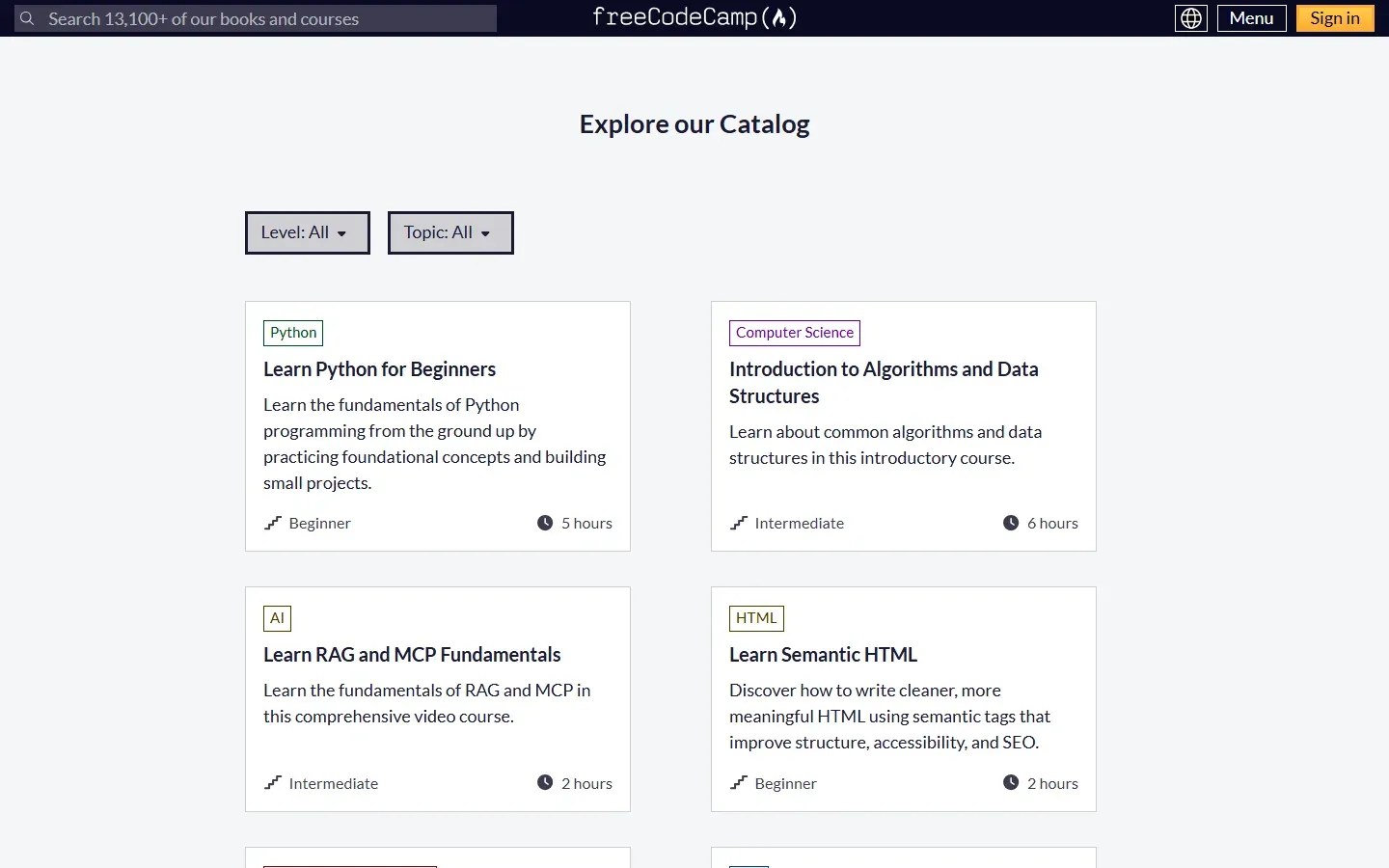
- Course catalog The catalog lists shorter courses with filters for level and topic, each with an estimated duration. Examples on November 17, 2026 included Learn Python for Beginners (5 hours), Introduction to Algorithms and Data Structures, Learn RAG and MCP Fundamentals, Introduction to Git and GitHub, Learn Bash Scripting, Introduction to SQL and PostgreSQL and Introduction to Precalculus.
- Archived coursework Earlier curricula remain available on the archive page, which states that this content is no longer updated. It includes the V8 versions of Responsive Web Design, JavaScript Algorithms and Data Structures, Front-End Development Libraries, Data Visualization, Relational Database and Back-End Development and APIs, plus Quality Assurance, Scientific Computing with Python, Data Analysis with Python, Information Security, Machine Learning with Python, College Algebra with Python and Legacy Python for Everybody.
- freeCodeCamp News and books freeCodeCamp News publishes programming tutorials, handbooks and articles from many authors, including mathematics and computer science topics. The site search covered 13,100+ books and courses on November 17, 2026, and the donate page lists 850 text-based tutorials and 5 free books through freeCodeCamp Press among recent achievements.
- YouTube courses The freeCodeCamp.org YouTube channel hosts full-length video courses on Python, SQL, Android development and many other technologies. The donate page credited the organization with 193 full-length YouTube courses among its recent achievements when read on November 17, 2026.
- Forum and Discord The freeCodeCamp Forum runs on Discourse and is where learners ask for programming help and project feedback; the README says answers usually arrive within hours. A Discord server is also linked from the README and the contributor documentation for chat with other learners and contributors.
- Mobile apps for iOS and Android Official apps are distributed on the App Store (seller Free Code Camp, Inc., iOS and iPadOS 15.0 or later) and on Google Play (1M+ downloads on November 17, 2026). The App Store listing mentions challenges, tutorials and podcasts, and the about page says progress syncs with the freeCodeCamp account. The app is built with Flutter and is open source under BSD-3-Clause.
- Interface languages The client and curriculum are configured for 12 locales: English, Spanish, Chinese, Traditional Chinese, Italian, Portuguese, Ukrainian, Japanese, German, Swahili, Korean and Arabic, selectable from a language menu. Localized curriculum content is pulled in through an i18n-curriculum submodule.
- Donations and Supporter benefits The donate page offers monthly donations of 5, 10, 20 or 40 USD, and the FAQ covers one-time gifts, employer matching, stock, legacy gifts and cryptocurrency. Supporters get no donation popups while signed in, a Supporter badge and profile styling, access to Supporter Discord channels and higher usage limits for select beta features. Donations are charitable contributions, are non-refundable and are tax-deductible in the United States.
- Open-source codebase The freeCodeCamp/freeCodeCamp monorepo holds the client, the API, the curriculum, shared packages, Playwright end-to-end tests and Docker files. The root package requires Node.js 26 or later and pnpm 12. The software is BSD-3-Clause; the curriculum content is copyright freeCodeCamp.org.
- Local development setup The setup guide supports macOS and Linux (WSL2 on Windows) and offers three ways to run the project: a local machine with Node.js, pnpm, Git and Docker Compose; a Dev Container; or GitHub Codespaces. A local machine needs 4 CPU cores, 8 GB of RAM and 10 GB of disk. Docker Compose starts MongoDB as a replica set and Mailpit for outgoing email,
pnpm run seedcreates test users, andpnpm run developserves the client on port 8000 and the API on port 3000. - Contributor documentation The contributor site has guides for coding challenges, quizzes, review pages, theory lessons, labs, workshops, the component library, the mobile app, localized versions and language curricula, Playwright tests and documentation, plus moderator handbooks. Security reports go through the documented security policy.
Where freeCodeCamp fits
Learning web development from zero
The learn page presents the six certifications of the full-stack curriculum as the recommended path, starting with Responsive Web Design. A learner signs in to save progress, works through theory lessons and workshops in the browser editor, builds the five required projects and takes the certification exam. Earning all six certifications unlocks the Certified Full-Stack Developer Exam described on the full-stack curriculum page.
Practicing with short, daily exercises
The daily coding challenge offers one algorithm problem per day in JavaScript or Python, with tests that run in the browser. Past challenges stay available in the archive by month. The course catalog adds short courses of a few hours, filtered by level and topic, for topics such as Git, Bash, SQL, data structures, AI and precalculus.
Learning English, Spanish or Chinese for work
The language certifications are built around internationally recognized proficiency levels: A2 and B1 English for Developers, A1 Professional Spanish and A1 Professional Chinese, all marked beta. Learners go through modules of warm-ups, lessons, practice and quizzes, and must complete all quizzes before the final exam.
Preparing for technical interviews
Coding Interview Prep, Project Euler and Rosetta Code problems are available in the same editor, alongside The Odin Project freeCodeCamp Remix. The freeCodeCamp News handbooks and the YouTube courses cover topics outside the core curriculum, and the forum is the place the README names for programming help.
Learning on a phone
The official iOS and Android apps provide curriculum challenges, tutorials and podcasts. According to the mobile app README, the app targets people without regular access to a computer or high-speed internet and those who learn on the go, and progress syncs with the web account.
Contributing to the platform and curriculum
Volunteers fork the repository, set up a development environment from the setup guide and open pull requests against the main branch. Curriculum authors can build a single superblock, block or challenge with FCC_SUPERBLOCK, FCC_BLOCK or FCC_CHALLENGE_ID to shorten build times. Other contributions listed on the contributor site are answering questions on the forum and giving feedback on learner projects. Related community sites on iThub include DEV Community and Discourse, the software behind the freeCodeCamp Forum.
Reviews of freeCodeCamp
Be the first to share your experience with freeCodeCamp.
Write a review
Loading review form…
Found freeCodeCamp useful? Upvote it todayYour vote helps other IT teams find it in the daily ranking.