

What is DEV Community?
DEV Community, also called DEV, is the developer community at dev.to. Its about page describes it as a community of software developers getting together to help one another, where members write articles, take part in discussions and build their professional profiles. DEV is led by the co-founders of Forem, named on that page as Ben Halpern, Jess Lee and Peter Frank, and it has announced a partnership with Major League Hacking (MLH). The site footer reads DEV Community 2016 to 2026, and on November 10, 2026 the sign-up page stated a membership of 4,204,798 developers.
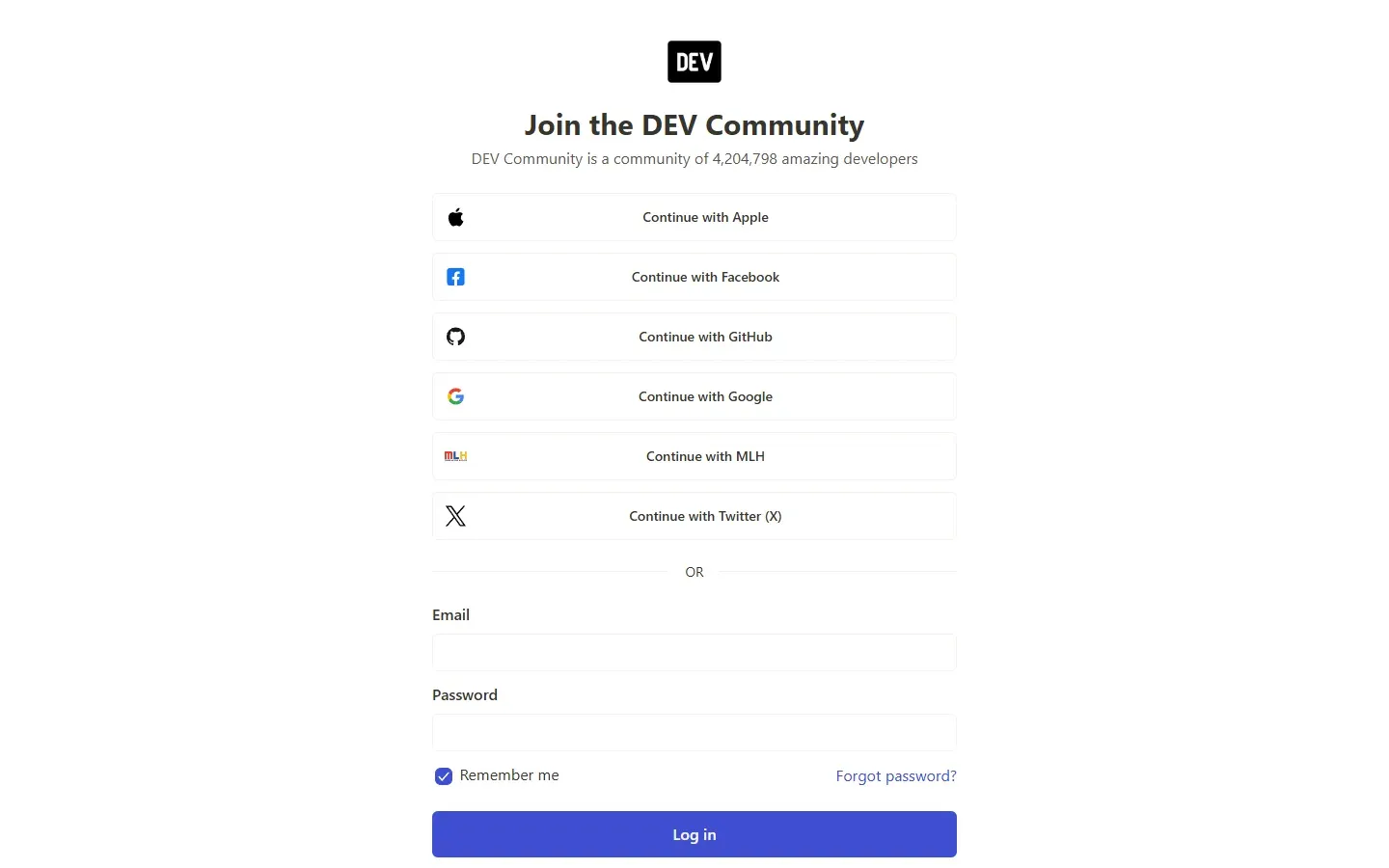
DEV is built on Forem, open source software for building communities, developed in the forem/forem repository. The Forem README describes dev.to as hosted by Forem and Forem as software for communities of peers, customers, fans or other groups. Anyone can inspect the code or deploy Forem for a separate community. The DEV account itself is free to create; sign-in options shown on the registration page are Apple, Facebook, GitHub, Google, MLH, Twitter (X) and email with password.
Forem is a Ruby on Rails application. The repository pins Ruby 3.3.0 and Rails 8.0.5, requires Node.js 22 for the frontend build and is transitioning to a Preact-first frontend. The stack overview lists Puma, PostgreSQL for data and full-text search, Redis for caching, Sidekiq and Active Job for background workers, Fastly for edge caching, Cloudinary or Imgproxy for images and Redcarpet with Rouge for Markdown. The README states that PostgreSQL must have the pgvector extension 0.8.0 or later because feed generation uses embeddings with HNSW indexing; a Gemini API key for generating those embeddings is optional.
Forem does not publish versioned releases on GitHub; the most recent tag is stable.20211129.1 from November 2021, and development happens continuously on the main branch. For self-hosting, the README documents deployment with Kamal 2, marked beta, to cloud providers such as AWS, DigitalOcean, Hetzner and GCP or to bare metal, with separate web, job, database and Redis hosts. Local development guides cover macOS and Linux without containers, and the project is configured for Gitpod and Ona development environments.
Forem is licensed under AGPL-3.0, with details on the licensing page of the developer documentation. Content published on dev.to is governed by the DEV terms, code of conduct and guidelines rather than by the software license. Other community platforms in this directory include Discourse, Mastodon and WordPress.
Key capabilities
- Markdown post editor Posts are written in a Markdown-based editor. DEV offers two editor versions: a rich plus Markdown editor with separate title and tag fields, and a basic Markdown editor that uses front matter for title, tags, publish state, cover image and canonical URL. The editor guide covers Markdown basics, accessibility, Liquid tags and embeds.
- Drafts and scheduled publishing Posts can be saved as drafts, edited from the user dashboard and published when ready. A schedule option sets a date and time in the author's local time zone for a post to go live, as described in the writing and scheduling help.
- Series Authors can link articles into a series with its own title and page. The series table of contents appears once a series has at least two entries.
- RSS import and canonical URLs In the extensions settings, an author can enter a blog's RSS feed URL to import posts as drafts, with options to mark the RSS source as the canonical URL or replace links with DEV links. Individual posts can also carry a canonical URL so search engines treat the original publication as the source.
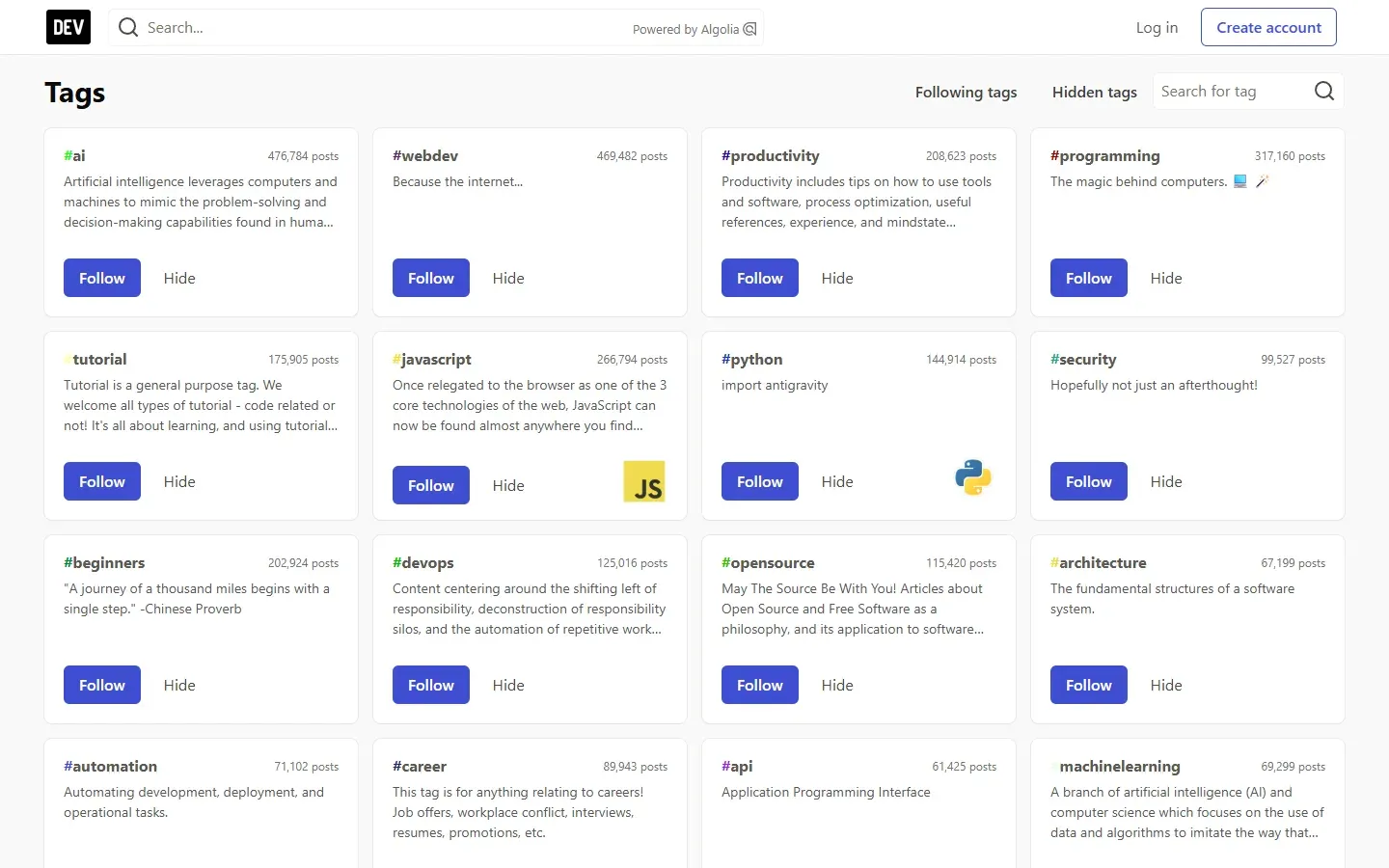
- Tags Posts are organized by tags such as #webdev, #javascript, #python, #devops and #security. Each tag page shows a description and post count, and members can follow or hide tags to shape their feed.
- Feed, reactions and comments Members can react to and comment on posts and follow other members and organizations. The help center has sections on customizing the feed, reacting, commenting and engaging, and badges earned for contributions.
- Post analytics Authors can open analytics for each published post from the user dashboard.
- Organization accounts Organization accounts are free for companies, open source projects and groups. According to the organizations help, they provide a landing page with members, organization branding and a call-to-action box on posts, analytics with views, reactions and CTA clicks, and followers who are notified of new posts. Content can be imported from an existing blog.
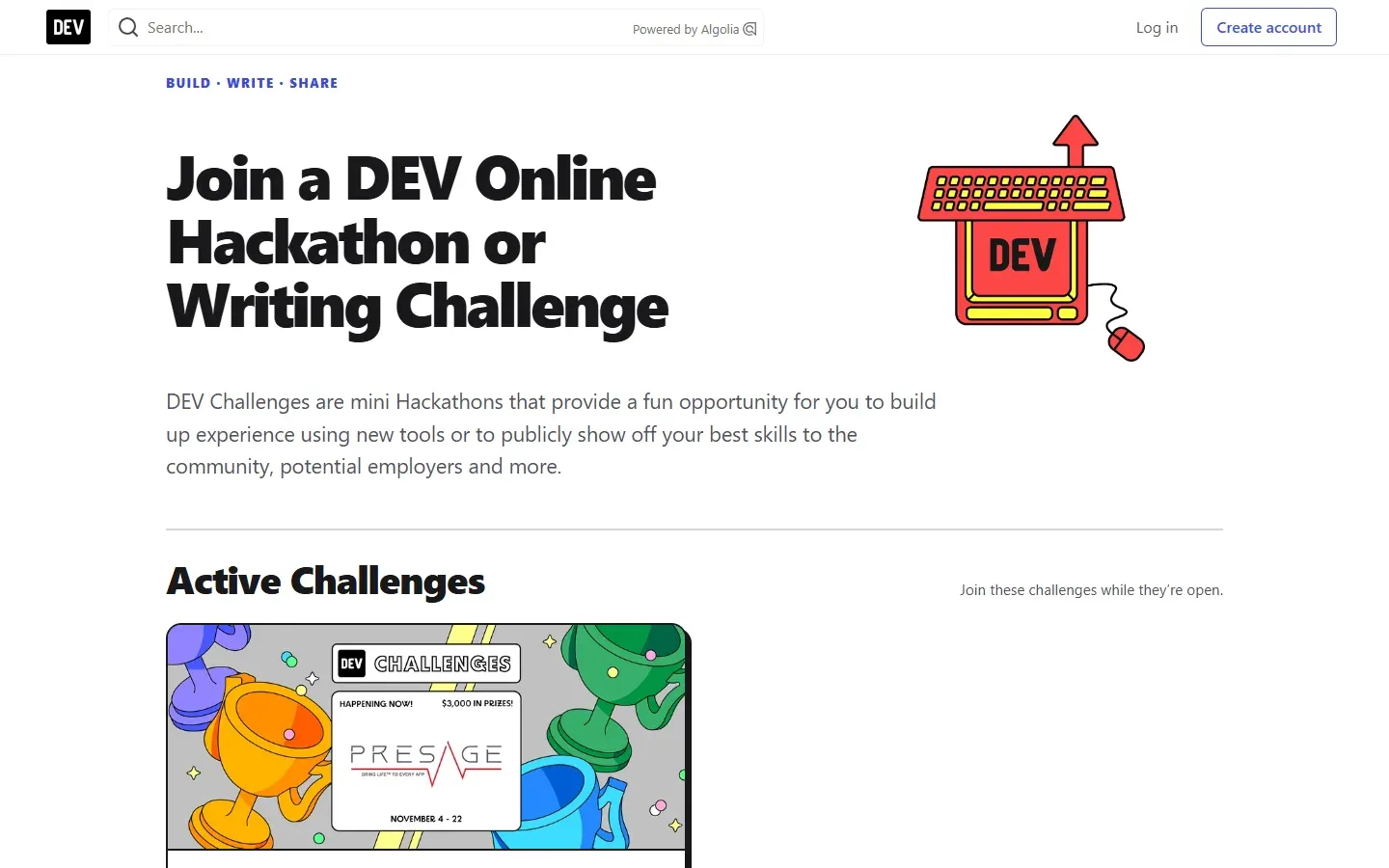
- DEV Challenges DEV Challenges are described as mini hackathons and writing challenges. The page lists active challenges, such as a sponsor SDK challenge with cash prizes and a monthly MLH x DEV writing challenge paying 100 USD per selected project, and an archive of past challenges such as the Hacktoberfest series, weekend challenges and frontend challenges.
- DEV++ DEV++ is a membership that, according to its page, is now available only as a prize for participation in challenges, hackathons and other DEV achievements. Listed benefits are partner discounts, a natural-language feed customization setting, reduced spam filtering of posts and a ++ badge.
- Search Site search on dev.to is powered by Algolia, as shown in the search box, and tags can be searched on the tags page.
- Community guidelines and moderation DEV publishes a code of conduct, guidelines for AI-assisted articles that require labelling, and plagiarism guidelines. Members can report spam, abuse and plagiarism through the channels in the help center.
- Forem API The Forem API uses
https://dev.to/apias its production server on DEV. Requests authenticate with anapi-keyheader, some endpoints are public, and resources include articles, comments, users, organizations, tags, followers, reactions, reading list, podcast episodes and videos. Pagination defaults to 30 items per page. - Forem as self-hosted software The same codebase can run a separate community. Requirements are a Rails runtime with PostgreSQL including pgvector 0.8.0 or later and Redis, and the README documents deployment with Kamal 2 (beta) using Docker on the target servers.
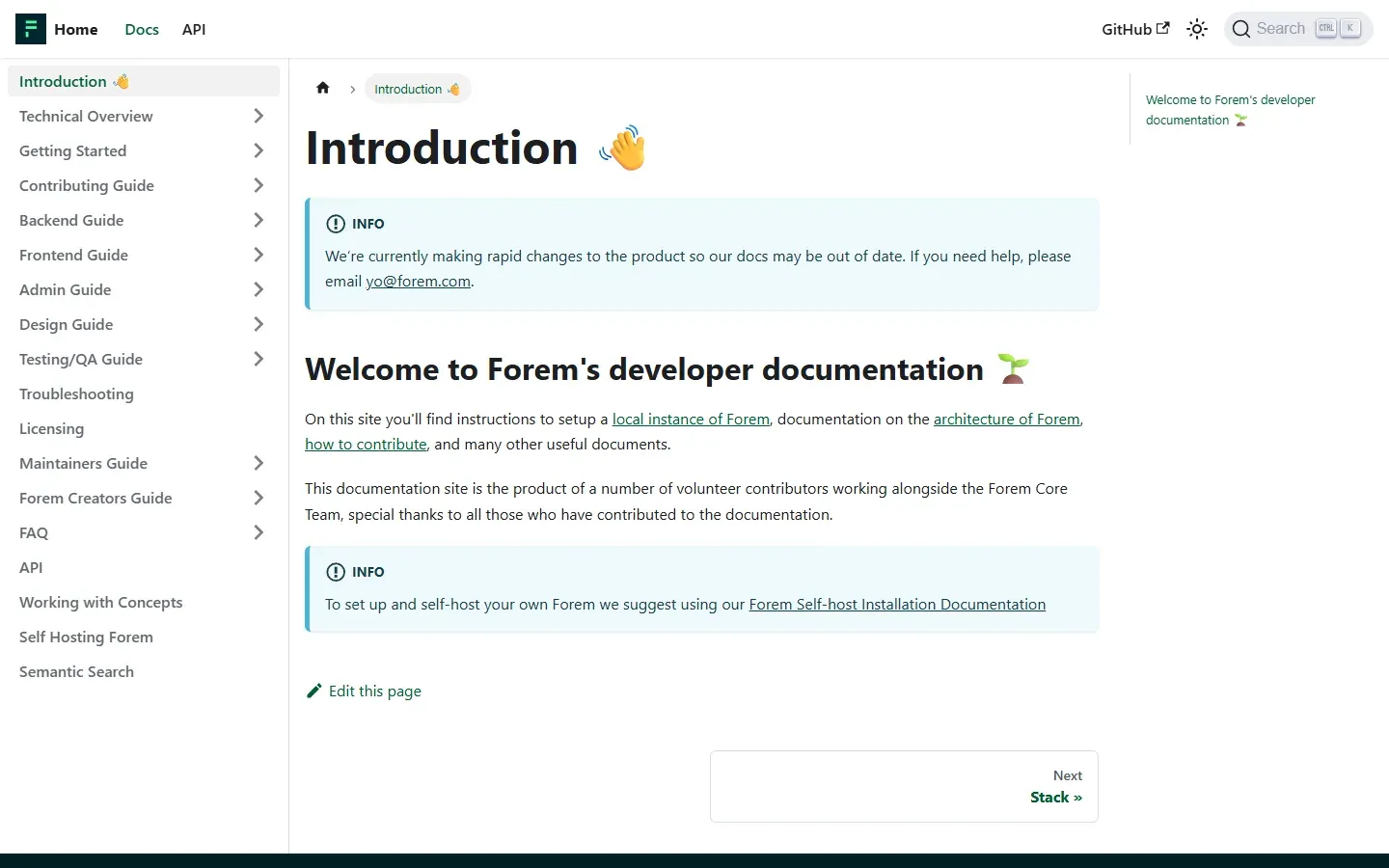
- Developer documentation The Forem developer documentation covers the technical overview, getting started, contributing, backend, frontend, admin, design and testing guides, a Forem creators guide, self-hosting and semantic search. The docs note that parts may be out of date while the product changes.
- Account deletion The help center includes instructions for deleting a DEV account.
Where DEV Community fits
Publishing technical articles
A developer writes a post in the DEV editor using Markdown, adds tags and an optional cover image, and saves it as a draft or publishes it. The post appears on the author's public profile and in tag feeds, and per-post analytics are available from the dashboard.
Cross-posting from a personal or company blog
Authors who already publish elsewhere configure their blog's RSS feed in the DEV extensions settings. Imported posts arrive as drafts, can be edited before publishing and can keep the original URL as canonical, either for all imported posts or per post through the editor settings or front matter.
Following topics and discussions
Readers follow tags such as #devops or #security and hide others, follow authors and organizations, and react to and comment on posts. The help center describes options for customizing the feed, and DEV++ adds a natural-language feed customization setting for its members.
Taking part in challenges and hackathons
DEV Challenges are listed with their theme and prizes while they are open, and finished challenges move to an archive. The monthly MLH x DEV Writing Challenge, for example, asks participants to publish the story of a project built at an MLH hackathon on DEV with the #mlhacks tag.
Publishing as an organization
Companies, open source projects and groups create a free organization account, which gives them a landing page, branding and a call-to-action box on their posts, and per-post analytics. Followers of the organization receive notifications for new posts, and existing blog content can be imported.
Running a separate community on Forem
Groups that want their own community software deploy Forem from the forem/forem repository. The documented route uses Kamal 2 with Docker on one or more servers, a PostgreSQL database with pgvector and Redis, and the developer documentation covers administration, configuration and contribution.
Reviews of DEV Community
Be the first to share your experience with DEV Community.
Write a review
Loading review form…
Found DEV Community useful? Upvote it todayYour vote helps other IT teams find it in the daily ranking.