What is Keep?
Keep is an open-source AIOps and alert management platform. It receives alerts from monitoring, logging and cloud tools through provider integrations, shows them in one feed, deduplicates and enriches them, groups related alerts into incidents and runs automated responses defined as YAML workflows. The project was started in 2023 by Keep Alerting Ltd, a Tel Aviv company from the Y Combinator Winter 2023 batch, and its documentation names BigPanda, Splunk ITSI and ServiceNow ITOM as the existing AIOps tools for which its authors found no open-source counterpart. The backend is a Python FastAPI service, the web interface is a Next.js application, a Soketi server pushes real-time updates, and data is stored in SQLite, PostgreSQL, MySQL or SQL Server.
On May 7, 2025, Elastic announced an agreement to acquire Keep Alerting Ltd, describing Keep as available as open source, as enterprise software and as a cloud service, and stating that Keep will integrate with Elasticsearch and Kibana and "remain open source". Elastic announced the completion of the acquisition on May 21, 2025. The keephq.dev website still carries a banner about Keep joining forces with Elastic and links to that announcement. The repository remains under the keephq GitHub organization and continues to receive commits and releases from Keep maintainers and outside contributors.
The keephq.dev pricing page lists three plans: Startup at $0 per month for personal or non-commercial projects (1 user, 1 integration, 5 workflows), Growth from $199 per month (10 users, 20 integrations, 100 workflows, 200 deduplicated alerts per month with unlimited ingested alerts and two weeks of data retention), and Enterprise + AI at prices on request, which adds AIOps alert correlation, RBAC, SAML and SSO, high availability and managed on-premises or cloud deployment. As of November 21, 2026, the Keep Cloud address platform.keephq.dev, the target of the free trial and sign-up links on keephq.dev, does not serve the application (its host reports the deployment as not found, behind a TLS certificate that expired on June 17, 2026), and the playground at playground.keephq.dev returns HTTP 404. No official source describes a replacement hosted service.
The LICENSE file (copyright 2024 Keep) applies the MIT license to all content outside the ee/ directory. Code under ee/, currently the identity managers for Auth0, Azure AD and Keycloak, falls under the Keep Enterprise Edition license (copyright 2024-present Keep Alerting LTD), which permits production use only with acceptance of the Keep Subscription Terms of Service and a valid Enterprise Edition subscription for the correct number of user seats. The documentation also marks features by edition: the AI correlation engine runs on a proprietary model hosted by Keep and is available only in Keep Cloud and Keep Enterprise, while the AI incident assistant, AI semi-automatic correlation and AI workflow builder are experimental in the open-source edition.
The current release is v0.55.0, published on November 3, 2026. It adds a generic OIDC authentication type (AUTH_TYPE=OIDC) for providers such as Dex, Authentik, Zitadel and Authelia, clears the Auth.js session before OAuth2 Proxy logout, normalizes AUTH_TYPE values and fixes the Cilium, Sentry and Graylog providers. Releases in 2026 run from v0.48.1 in January to v0.54.3 in September, and the Helm chart in the keephq/helm-charts repository reached version 0.1.97 with application version 0.54.3. Comparable alerting and incident tools listed on iThub include Grafana alerting and OneUptime; Elastic's own products are listed as Elasticsearch and Elastic Cloud.
Key capabilities
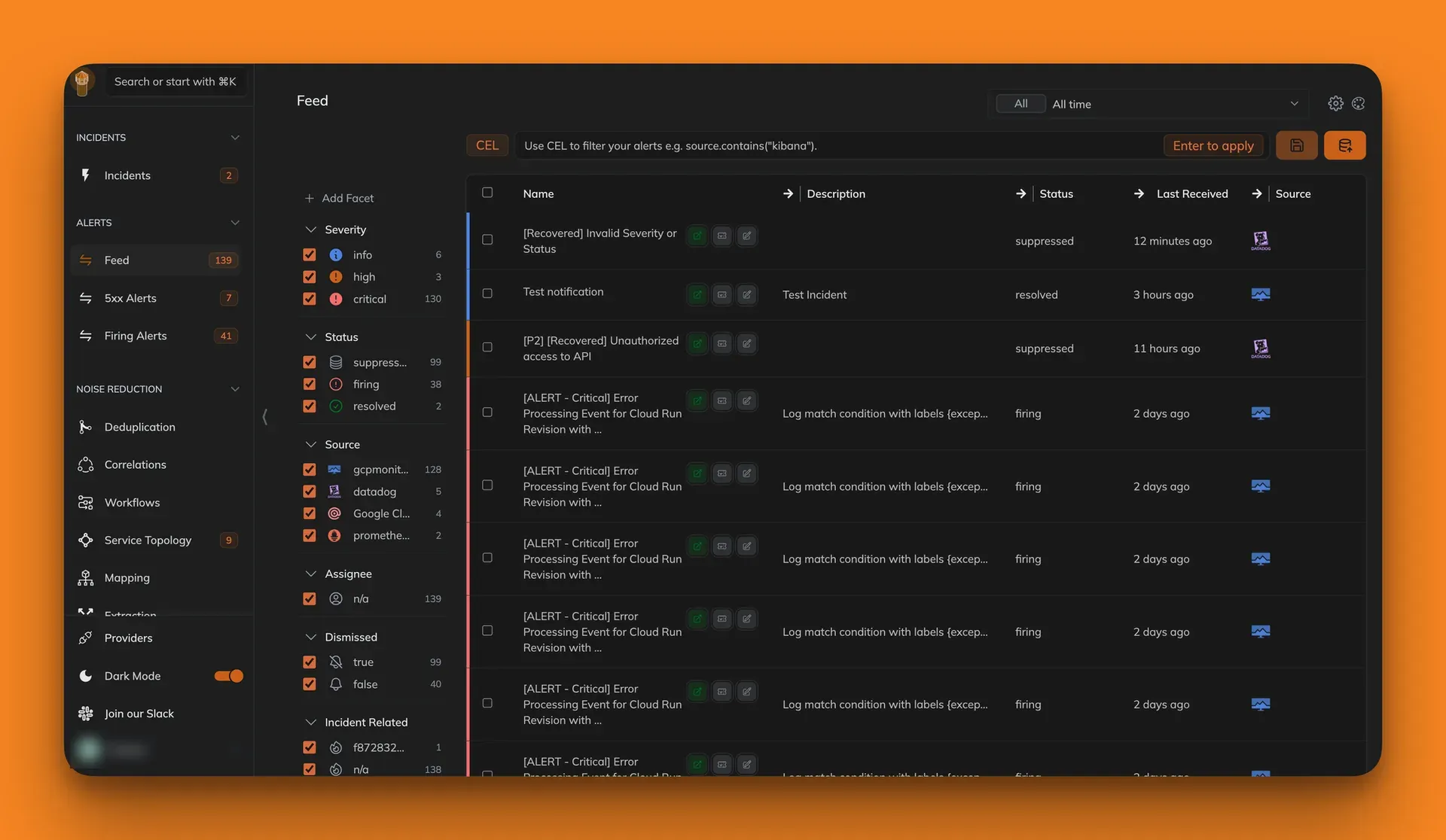
- Unified alert feed All incoming alerts land in one table with facets for severity, status, source, assignee, dismissed state and incident relation. Queries use the Common Expression Language (CEL), and an Import from SQL dialog converts a SQL WHERE clause into CEL. Saved queries become presets that are private to their author or shared across the account.
- Provider integrations Integrations are Python providers that can receive alerts, query data, send notifications or change tickets. The keephq.dev home page counts more than 110 providers, and the provider documentation covers observability tools (Datadog, Prometheus, Grafana, CloudWatch, Zabbix, Sentry, Elastic, Splunk, Dynatrace and others), incident tools (PagerDuty, OpsGenie, Incident.io, Grafana OnCall), ticketing (Jira, ServiceNow, GitHub, GitLab, Linear), chat and messaging (Slack, Microsoft Teams, Discord, Telegram, SMTP), databases (PostgreSQL, MySQL, ClickHouse, BigQuery, Snowflake), Kubernetes platforms and queues such as Kafka and Amazon SQS.
- Push and pull ingestion When a provider is connected, Keep can install a webhook in the source tool, for example a Grafana contact point and notification policy, so alerts are pushed. Pulling is the alternative: its interval is set by
KEEP_PULL_INTERVALand it can be disabled withKEEP_PULL_DATA_ENABLED. The documentation notes that pulled alerts lack some features, including workflow automation. - Deduplication Deduplication has two modes. Partial deduplication merges alerts that share fingerprint fields, which each provider defines by default; full deduplication discards events that are identical apart from ignored fields. By default, identical events that differ only in their last-received time are dropped.
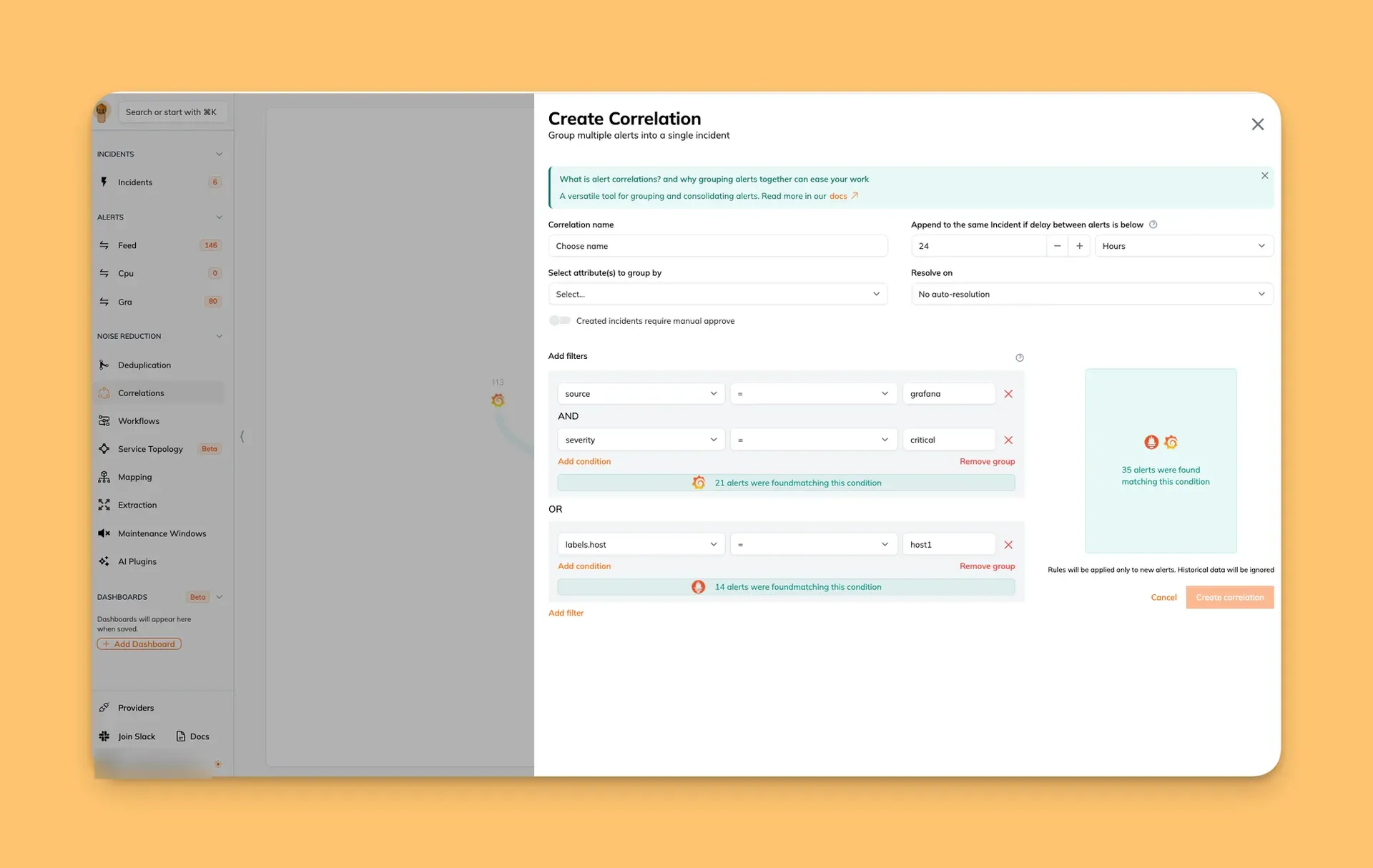
- Manual correlation rules Correlation rules combine attribute conditions with AND and OR groups, choose attributes to group by and set a time window within which new alerts are appended to the same incident. Rules can create confirmed incidents or incident candidates that need manual approval, can resolve incidents automatically, and can name incidents from alert fields with templates such as
{{ alert.service }}. - Topology-based correlation The topology processor, disabled by default and enabled with
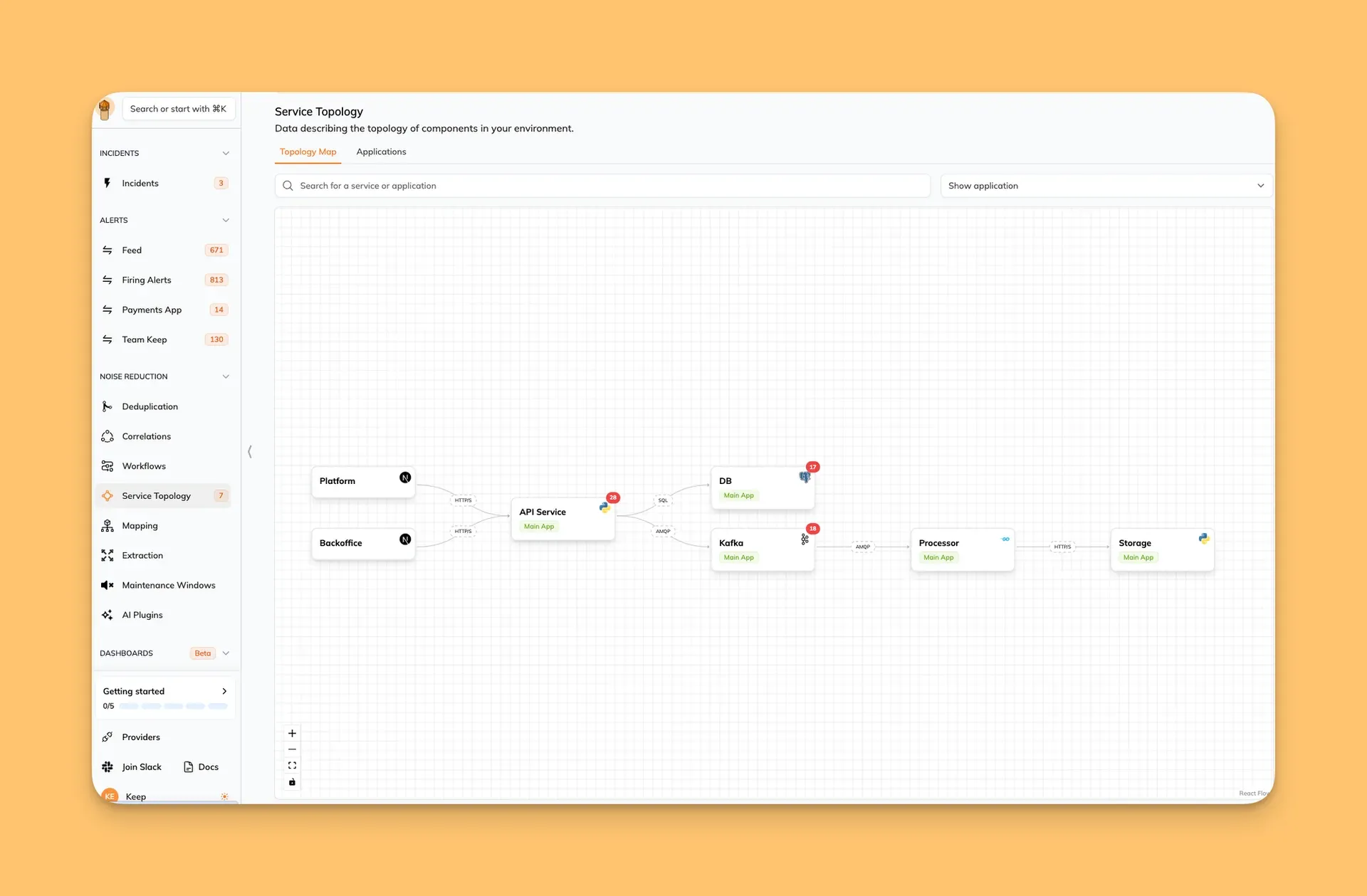
KEEP_TOPOLOGY_PROCESSOR=true, checks recent alerts every 10 seconds against a 15-minute look-back window. When several services of one application have active alerts, it opens an application-level incident and links the alerts to it. - Service topology The Service Topology view maps services, applications and the protocols between them as a graph, with active alert counts on each node. Topology data can be pulled from providers including Datadog, PagerDuty, ArgoCD and Cilium, and services and dependencies can be added by hand or imported and exported as YAML.
- AI correlation In Keep Cloud and Keep Enterprise, the AI correlation engine trains a proprietary, Keep-hosted model on a tenant's past alerts and incidents, evaluates it and assigns unassigned alerts to incidents above a confidence threshold, in cycles of 5 to 15 minutes. The documentation states that training data is not mixed between tenants. It is not available in the open-source edition.
- AI assistants The semi-automatic correlation feature sends selected alerts to an LLM and returns incident candidates for review, aimed at teams with fewer than 100 alerts per day. An incident assistant chat on the incident page passes alerts, descriptions and topology to the LLM and can call provider methods. Both use OpenAI, a Keep-hosted model or another LLM, and are marked experimental in the open-source edition.
- LLM steps in workflows AI in workflows, available in all editions, uses connected LLM providers as workflow steps or actions, for example to normalize input, route alerts, set severity or summarize. Supported providers include OpenAI, Anthropic, DeepSeek, Gemini, Grok, Ollama, llama.cpp and vLLM, and a LiteLLM guide covers locally hosted models in air-gapped installations.
- YAML workflows A workflow is a YAML file with triggers (manual, interval, alert with CEL filters, incident, or field change), steps that read data through providers and actions that write to them. Conditions,
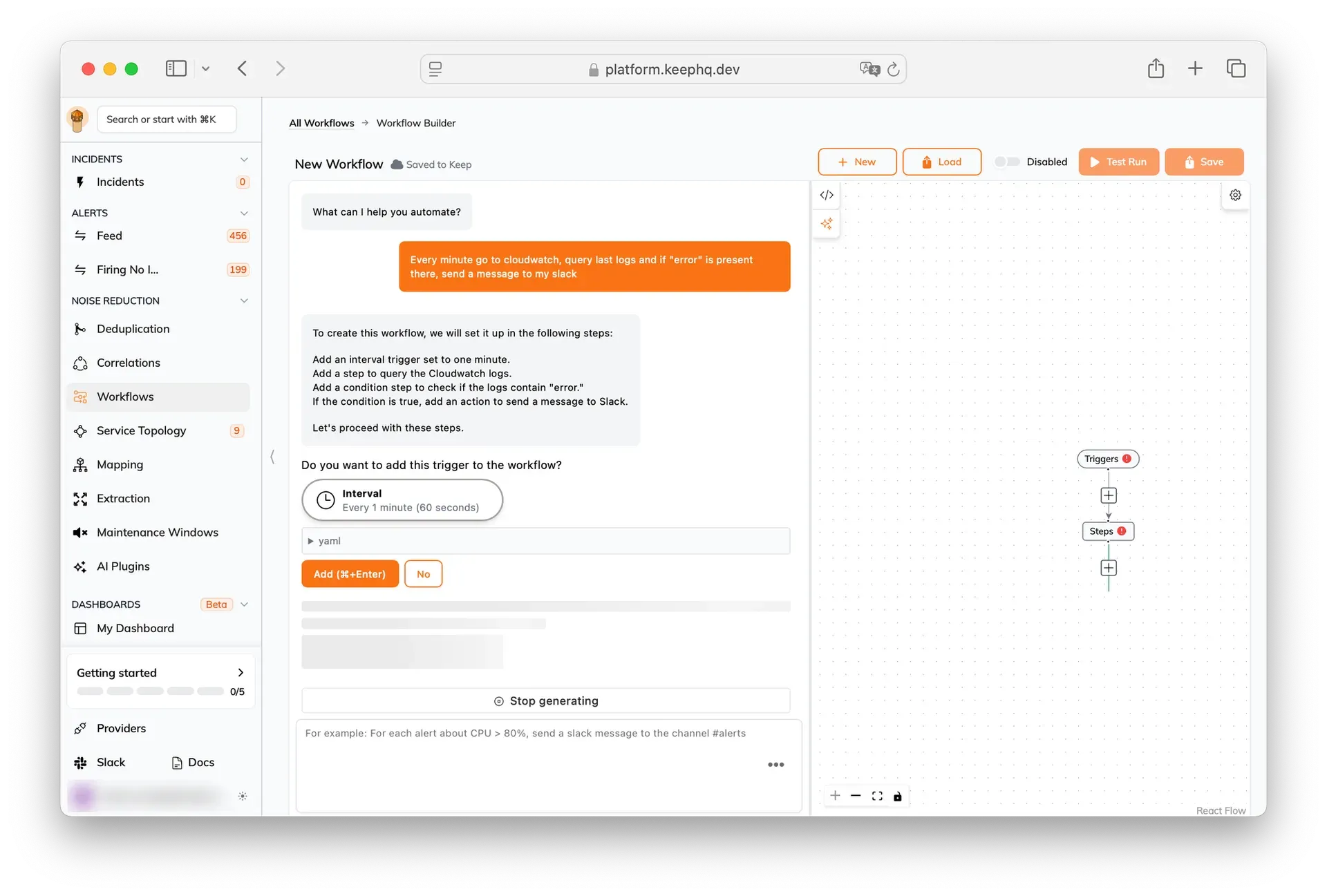
foreachloops, templating with alert fields andenrich_alertblocks that write results such as ticket IDs back to the alert are supported. The repository keeps more than 100 example workflows inexamples/workflows. - Workflow builder UI Workflows can also be built on a visual canvas with a YAML view, test runs and an enable switch. An AI workflow builder assistant, available in Keep Cloud and Enterprise and experimental in the open-source edition, proposes triggers, steps and actions from a natural-language request and applies each change only after the user confirms it.
- Enrichment Mapping rules match alerts to rows of a CSV file or to topology data and copy columns such as owning team or severity override into the alert. Extraction rules apply Python regular expressions with named groups to an alert attribute, optionally gated by a CEL condition, and stop at the first matching rule.
- Maintenance windows Maintenance windows suppress alerts that match a CEL query during a fixed or relative time window, either hiding them from the feed or showing them as suppressed. Resolved and acknowledged alerts always pass through. A recover-status strategy restores an alert's normal flow once the window ends.
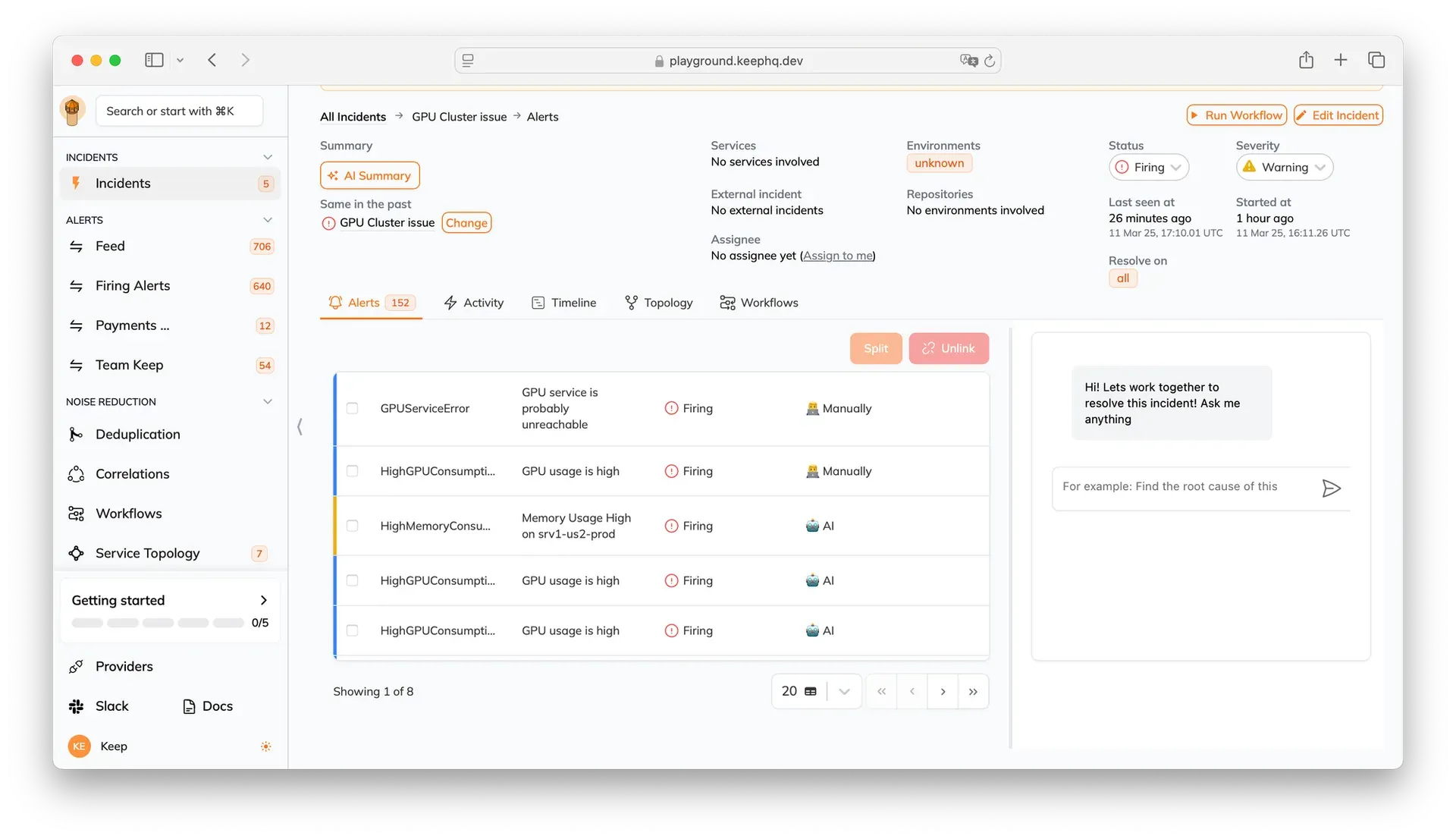
- Incident management Incidents have severity, status, assignee, involved services and environments, start and last-seen times, an optional AI summary and links to similar past incidents. Tabs show the alerts, an activity log, a timeline, the affected topology and workflows that can be run against the incident.
- Alert evaluation engine The alert evaluation engine creates alerts from arbitrary data sources: workflow steps query databases, APIs or metrics systems, and an
ifcondition with an optionalforduration moves alerts through pending, firing and resolved states. The documentation includes VictoriaMetrics examples. - Authentication and access control Authentication options are no authentication, database users, OAuth2 Proxy, Okta, OneLogin and generic OIDC in the open-source edition, plus Auth0, Azure AD and Keycloak under the Enterprise Edition license. Keycloak adds custom roles, group management and LDAP; the other providers use predefined roles.
- Deployment options The Docker Compose setup starts the API on port 8080, the UI on port 3000 and a Soketi WebSocket server, with SQLite in a local state directory and optional Grafana and Prometheus services for Keep's own metrics. Kubernetes installs use the official Helm chart with ingress-nginx or HAProxy Ingress, and further guides cover OpenShift and AWS ECS on Fargate. Secrets can be kept in files, the database, Kubernetes, AWS, GCP or HashiCorp Vault.
- CLI, API and provisioning The Keep CLI, installed from the repository with Python 3.11, lists and enriches alerts, applies and runs workflows, connects providers and manages mapping and extraction rules, and can run in GitHub Actions. The backend has a REST API described by an OpenAPI file in the repository. Provisioning through environment variables and directories loads providers, workflows, dashboards and mapping rules at startup.
Where Keep fits
Consolidating alerts from several monitoring stacks
Operations teams connect sources such as Prometheus, Grafana, Datadog or CloudWatch as providers and let Keep install webhooks so alerts are pushed into one feed. Per-provider fingerprint fields deduplicate repeated notifications, and CEL presets give each team a filtered view, for example only critical alerts from database services.
Opening tickets and notifying teams from critical alerts
The README workflow example triggers on critical Sentry alerts for selected services, posts to a team Slack channel when the service is payments and creates a Jira ticket for another service only if no ticket ID is stored yet. The Jira step writes the ticket ID, type and URL back into the alert with enrich_alert, so later runs and other workflows can see that a ticket exists.
Grouping alert storms into incidents
Correlation rules group alerts by attributes such as host or service within a set time window, optionally as incident candidates that a person approves. With a service topology in place, the topology processor opens one application-level incident when several services of the same application alert. Keep Cloud and Enterprise tenants can add the AI correlation engine on top.
Suppressing alerts during planned work
Before a database upgrade, a maintenance window with a CEL query such as source == "database" and a start and end time keeps expected alerts out of the feed or marks them as suppressed. Resolved and acknowledged alerts still pass through, so incidents can close normally while the window is active.
Using AI steps with self-hosted models
Installations that must keep data on premises can connect Ollama, llama.cpp or vLLM as providers, or route requests through a LiteLLM proxy, and call them from workflow steps to summarize alerts, normalize free-text input or assign severity. For this feature, the documentation states that data leaves Keep only when a workflow explicitly sends it to a connected provider.
Running Keep as code on Kubernetes
Platform teams install the Helm chart, store provider credentials in Kubernetes secrets and provision providers with KEEP_PROVIDERS, workflows from KEEP_WORKFLOWS_DIRECTORY and CSV mapping rules from KEEP_MAPPINGS_DIRECTORY. The CLI command for applying workflows can also run in GitHub Actions to deploy workflow changes from a repository.
Install
curl https://raw.githubusercontent.com/keephq/keep/main/start.sh | shReviews of Keep
Be the first to share your experience with Keep.
Write a review
Loading review form…
Found Keep useful? Upvote it todayYour vote helps other IT teams find it in the daily ranking.