What is Elasticsearch?
Elasticsearch is the distributed search and analytics engine developed by Elastic, the company that also makes Kibana, Logstash and Beats. Its GitHub README describes it as a distributed search and analytics engine, scalable data store and vector database, and names full-text search, vector search, retrieval augmented generation, logs, metrics, application performance monitoring and security logs as use cases. Elasticsearch stores JSON documents, indexes them with Apache Lucene and exposes everything through REST APIs over HTTP, by default on port 9200. The project's public repository dates from February 2010; Elastic N.V. was incorporated in 2012.
The latest GitHub release is Elasticsearch 9.5.6, published November 2, 2026. According to the 9.5.6 release notes, it contains security fixes, upgrades Lucene to 10.5.2 and updates the bundled JDK. The 9.5 line started on August 4, 2026 with batched query-phase execution by default, data stream lifecycle support for the frozen tier and a technical preview of a columnar index mode. Elastic publishes patches for the 9.5, 9.4 and 8.19 lines in parallel, and all Elastic Stack components have to run the same version, as stated in the Elastic Stack overview.
Licensing has changed twice. In January 2021, Elastic moved the Elasticsearch and Kibana source code from Apache 2.0 to a choice of SSPL and the Elastic License, starting with 7.11. The OpenSearch project describes itself in its FAQ as derived from Elasticsearch 7.10.2 and Kibana 7.10.2 under Apache 2.0, with OpenSearch 1.0 generally available in July 2021. On August 29, 2024, Elastic announced AGPL as an additional option, attributing the 2021 change to issues with AWS. The repository's LICENSE.txt puts source code by default under a choice of AGPLv3 only, SSPL v1 and Elastic License 2.0 (ELv2), while code in the x-pack folder is ELv2 only. The licensing FAQ states that the default distribution is released under the Elastic License, covering free and paid features; client libraries stay under Apache 2.0.
Elastic distributes Elasticsearch as tar.gz archives for Linux and macOS, a zip archive for Windows, deb and rpm packages and Docker images from the Elastic registry, each with a bundled OpenJDK, as listed in the installation documentation. Kubernetes clusters are managed with the Elastic Cloud on Kubernetes (ECK) operator, multi-cluster installations with Elastic Cloud Enterprise, and Elastic runs it as a managed service on Elastic Cloud (Hosted deployments and Serverless projects). Kibana provides the user interface, while Elastic Agent, Beats and Logstash collect and transform data before indexing.
Self-managed subscriptions are Free and open Basic ("the forever-free plan"), Enterprise, and Platinum for existing customers only; Gold is discontinued. Self-managed prices are not published and are based on nodes and RAM. On November 20, 2026, Elastic Cloud Hosted started at $99 per month (Standard) and Elasticsearch Serverless at $0.14 per ingest VCU-hour and $0.047 per GB retained per month. Similar search engines on iThub include OpenSearch, Algolia and SeekStorm; Elastic's SIEM built on Elasticsearch is listed as Elastic Security.
Key capabilities
- Distributed document store An Elasticsearch cluster spreads indices across nodes as primary and replica shards, so data stays available when a node fails and search load is shared. Documents are searchable in near real time after indexing. Lucene structures (an inverted index for text, BKD trees for numbers, dates and geo data, and a columnar store for analytics) are part of every tier, as listed in the distributed architecture documentation.
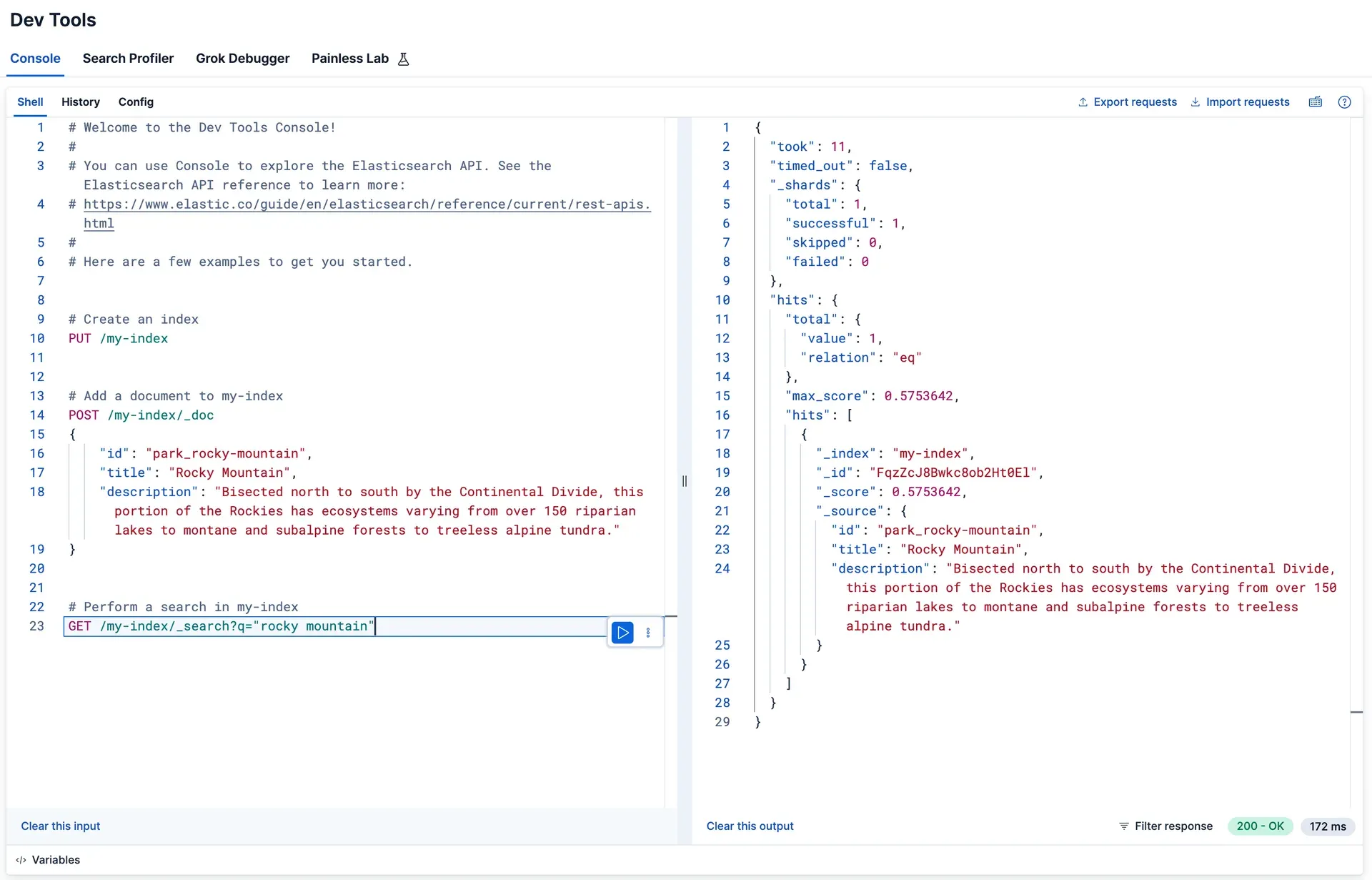
- REST API and Query DSL Indexing, search and administration are exposed as JSON over HTTP. Single documents go to
_doc, batches to_bulkas newline-delimited JSON, and searches to_searchwith the JSON-based Query DSL. The full surface is documented in the Elasticsearch API reference. - Full-text search Text fields are analyzed into terms with language-specific analyzers, and results are ranked by relevance score. Highlighting, type-ahead suggestions, corrections, synonyms that can be updated without reindexing, percolation and a query profiler are included in the free tier. Query rules, Learning to Rank and some reranking retrievers are Enterprise features on the subscription matrix.
- Vector search
dense_vectorfields support approximate kNN search, with BBQ, int8 and int4 quantization to reduce memory use, andsparse_vectorfields store term-weight vectors such as ELSER output. Vector index mode is generally available since 9.5 and GPU-accelerated vector indexing since 9.4, according to the vector search documentation. Vector search itself is in Basic; DiskBBQ and GPU indexing are Enterprise features. - Semantic and hybrid search The
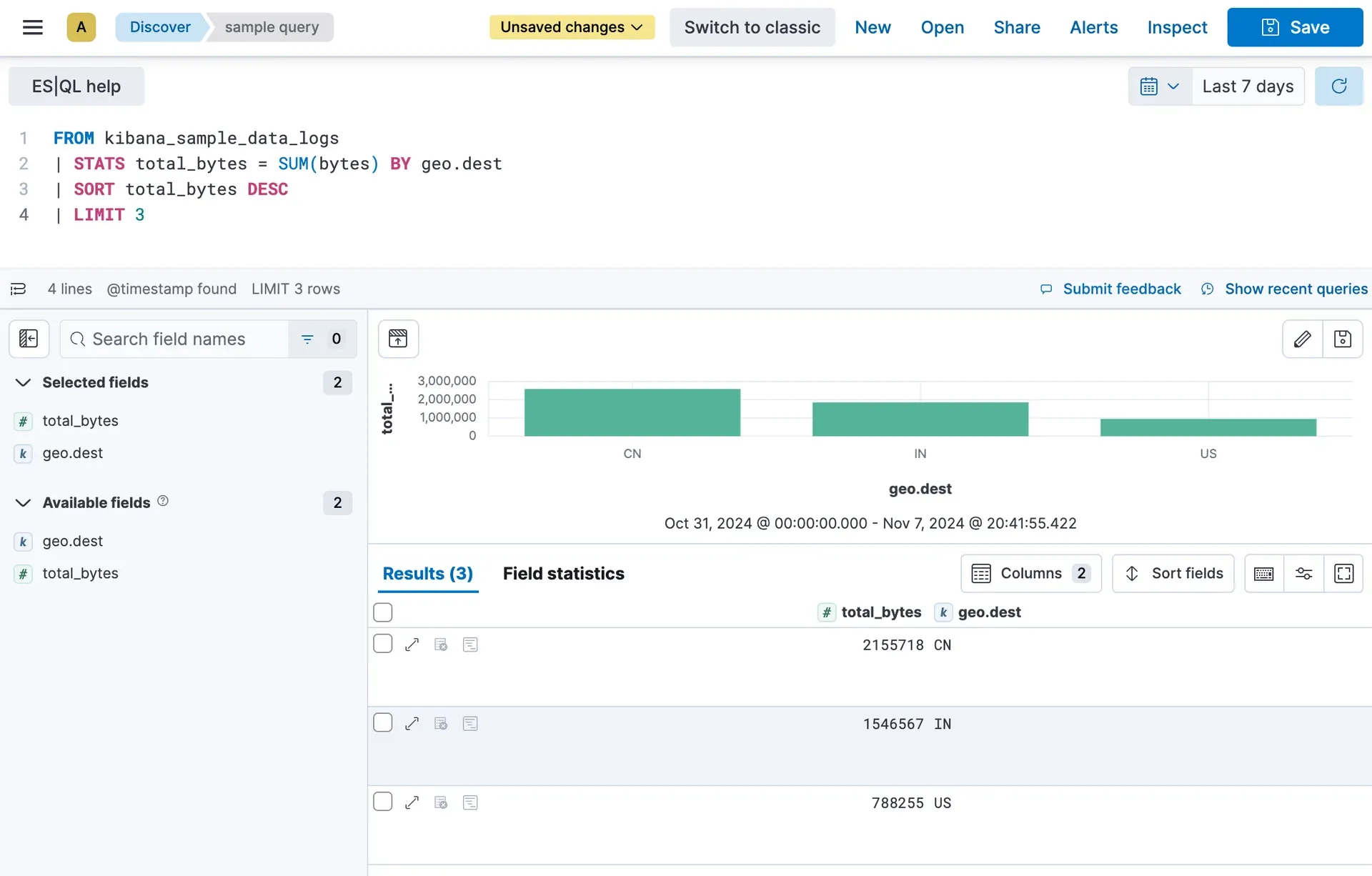
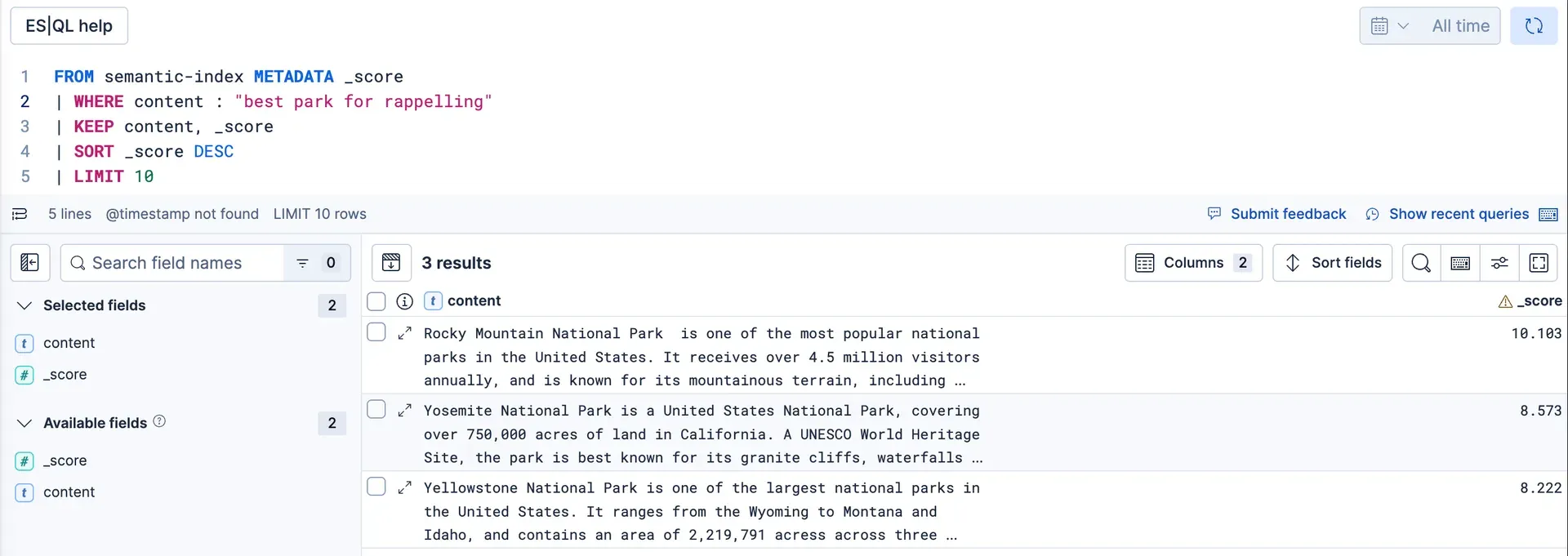
semantic_textfield type handles embedding generation and chunking through an inference endpoint. Built-in models are ELSER (sparse) and E5 (multilingual dense), Jina models are available through the Elastic Inference Service, and the inference API connects third-party providers such as Cohere, OpenAI and Hugging Face. Retrievers combine keyword, kNN and reranking stages in one request; RRF fusion and the Elastic Inference Service require Enterprise, and ELSER and E5 on machine learning nodes require Platinum. - ES|QL The Elasticsearch Query Language is a piped language for filtering, aggregating and transforming data, for example
FROM logs | STATS count = COUNT(*) BY host | SORT count DESC. ES|QL, lookup joins and subqueries are part of the free tier; cross-cluster ES|QL is Enterprise. Version 9.5.0 addedflattenedfield support withFIELD_EXTRACT, a technical preview of thedate_rangetype and experimental data federation over Amazon S3, as described in the 9.5.0 release notes. - Aggregations and other query languages Bucket, metric and pipeline aggregations compute statistics, histograms, percentiles and geo groupings alongside a search. Elasticsearch SQL (with a CLI), Event Query Language (EQL) for event sequences and runtime fields are in Basic; JDBC and ODBC drivers and the Tableau connector are Platinum.
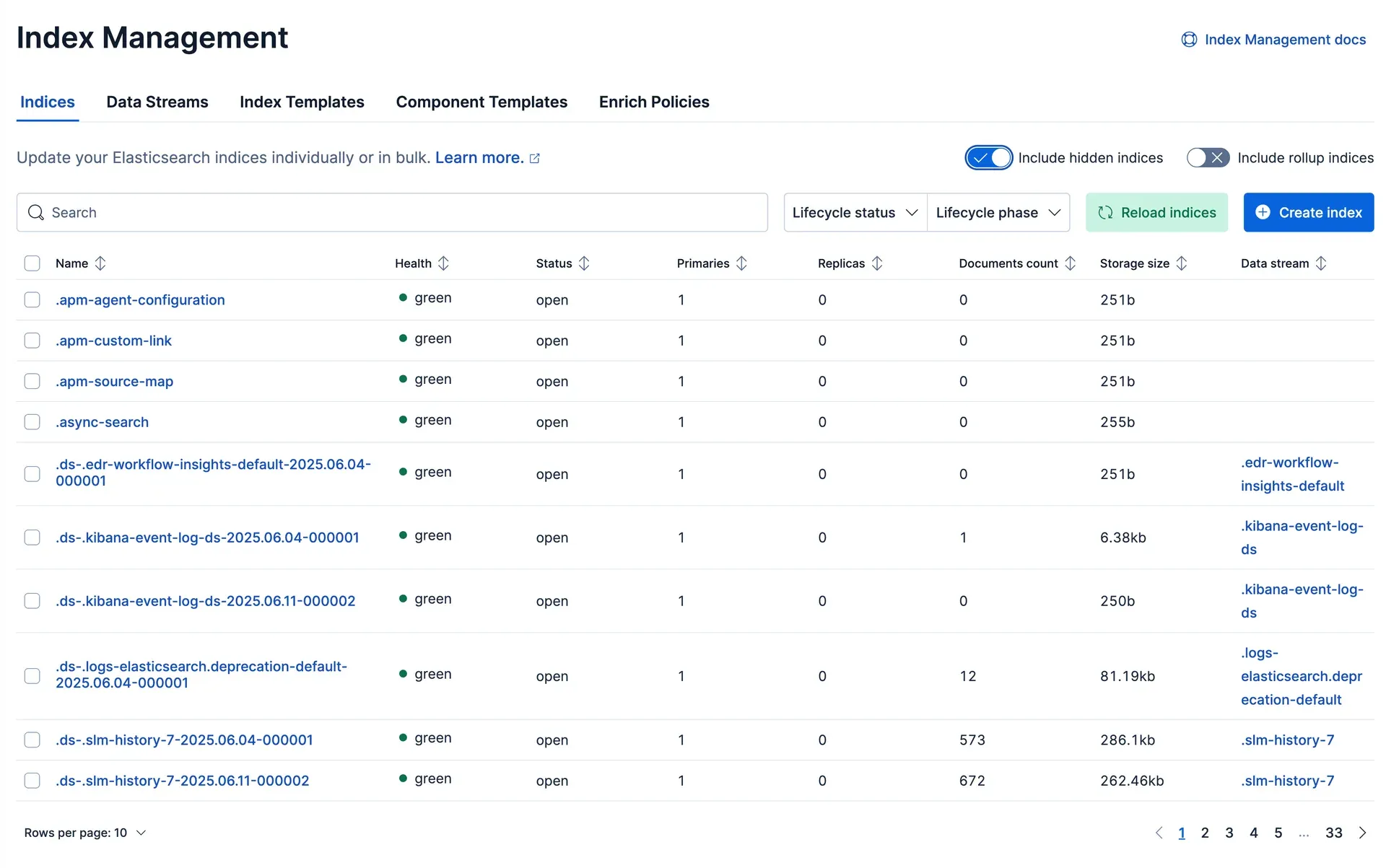
- Data streams and lifecycle management Timestamped data such as logs and metrics is written to data streams backed by rolling indices. Index lifecycle management, data stream lifecycle, data tiers, downsampling and snapshot lifecycle management are free, and since 9.5 data stream lifecycle can move data to the frozen tier with a
frozen_aftersetting. Searchable snapshots, which keep frozen data queryable from object storage, are an Enterprise feature. - Time series and logs storage Time series data streams store metrics with dimension-based routing, and 9.5 made the ES95 doc values codec the default for new time series indices, which the release notes say reduces doc values storage on host metrics by about 30 percent. Logs can use the logsdb index mode; synthetic
_sourceand the pattern text field type for logsdb are Enterprise features. - Security in the free tier TLS for HTTP and transport traffic, role-based access control, API keys, native and file realms and Kibana Spaces are available in Basic. Audit logging, IP filtering and LDAP or Active Directory authentication start at the paid tiers, and single sign-on (SAML, OpenID Connect, Kerberos, JWT), field- and document-level security and FIPS 140 mode are Platinum features, as listed in the security documentation and subscription matrix.
- Snapshots and cross-cluster features The snapshot and restore APIs back up indices to shared file systems or object stores such as Amazon S3, Azure and Google Cloud Storage. Cross-cluster search with the certificate-based model is free; the API-key-based model and cross-cluster ES|QL are Enterprise, and cross-cluster replication is Platinum. All clusters involved must be on the same subscription tier.
- Machine learning Anomaly detection jobs, forecasting, outlier detection, regression and classification run on dedicated machine learning nodes and require Platinum or Enterprise. Third-party trained models can be deployed to machine learning nodes for inference (Platinum), as described in the machine learning documentation.
- Kibana Dev Tools Kibana's Console sends REST requests to Elasticsearch with autocompletion, request history and variables, and the Dev Tools area also contains the Search Profiler, Grok Debugger and Painless Lab. Discover runs ES|QL queries interactively and turns results into charts and dashboards.
- Language clients Elastic maintains official clients for Python, Java, JavaScript and Node.js, .NET, PHP, Go and Ruby, plus an experimental Rust client. The licensing FAQ lists the clients under Apache 2.0.
- Archives and Linux packages
tar.gz(Linux, macOS),zip(Windows),debandrpmpackages are available from the download page and from Elastic's Debian and RPM package repositories. Every distribution bundles OpenJDK, and Elastic recommends the bundled JVM. Officially supported operating systems and JVMs are listed in the support matrix. - Docker images Images are published as
docker.elastic.co/elasticsearch/elasticsearch:9.5.6, with a Wolfi-based variant (elasticsearch-wolfi) that needs Docker 20.10.10 or later. The Docker guide starts a single node with a 1 GB memory limit; on first start the node prints theelasticuser password and a Kibana enrollment token, and the API is reached over HTTPS with a generated CA certificate. - Kubernetes with ECK The Elastic Cloud on Kubernetes operator deploys and upgrades Elasticsearch, Kibana, APM Server, Beats, Elastic Agent, Logstash and Elastic Maps Server. The latest ECK release is 3.5.0 (August 4, 2026), and the current documentation lists support for Kubernetes 1.31 to 1.36, OpenShift 4.16 to 4.22, GKE, AKS and EKS, with installation through YAML manifests or Helm. ECK has Basic and Enterprise tiers; autoscaling and cross-cluster replication require Enterprise.
- Local development with start-local The README's
curl -fsSL https://elastic.co/start-local | shscript creates anelastic-start-localfolder and starts Elasticsearch and Kibana in Docker onlocalhost:9200andlocalhost:5601, with a generated password and API key in a.envfile. HTTPS is disabled, and the start-local project states that the setup is for local testing only. It starts with a one-month trial license of all features that then reverts to Basic.
Where Elasticsearch fits
Site and application search
An application indexes products, articles or support content as JSON documents and queries them through a language client or the REST API, combining full-text matching, filters, highlighting and suggestions in one _search request. Relevance tuning uses analyzers, synonyms and boosting; query rules and Learning to Rank add business rules and trained ranking models on Enterprise. The full-text search guide covers analyzers and scoring.
Semantic search and retrieval for generative AI
A semantic_text field with an ELSER, E5 or third-party inference endpoint stores embeddings next to the original text, and hybrid retrievers merge keyword and vector results. The ES|QL match function and : operator can query semantic fields directly, as in the gallery example. Retrieved passages are commonly passed to a large language model for retrieval augmented generation; the semantic search documentation lists the available workflows.
Log and metrics analytics
Elastic Agent, Beats, Logstash or the OpenTelemetry endpoint write logs and metrics into data streams, and lifecycle policies roll them through hot, warm, cold and frozen tiers. Analysts query them with ES|QL or aggregations in Kibana Discover and dashboards. Time series data streams and logsdb reduce storage for metrics and logs, and searchable snapshots keep older data queryable from object storage on Enterprise.
Data store for security analytics
Security events collected from endpoints, cloud services and network devices are indexed in Elasticsearch and analyzed with EQL sequences, ES|QL and machine learning jobs. Elastic's own SIEM and endpoint product, Elastic Security, is built on this data layer inside Kibana.
Self-managed clusters on Kubernetes or servers
Operators install packages or Docker images on their own servers, or use ECK custom resources to declare Elasticsearch and Kibana clusters on Kubernetes, with the operator handling TLS, rolling upgrades and scaling. Upgrades follow the upgrade documentation, which requires all Elastic Stack components to move to the same version.
Local development and testing
Developers start a disposable Elasticsearch and Kibana pair with the start-local script or a single Docker container, then send requests from Kibana's Console or a language client. The start-local setup disables HTTPS and is limited to localhost, and its trial license reverts to the free Basic tier after one month.
Install
curl -fsSL https://elastic.co/start-local | shReviews of Elasticsearch
Be the first to share your experience with Elasticsearch.
Write a review
Loading review form…
Found Elasticsearch useful? Upvote it todayYour vote helps other IT teams find it in the daily ranking.