
What is Typesense?
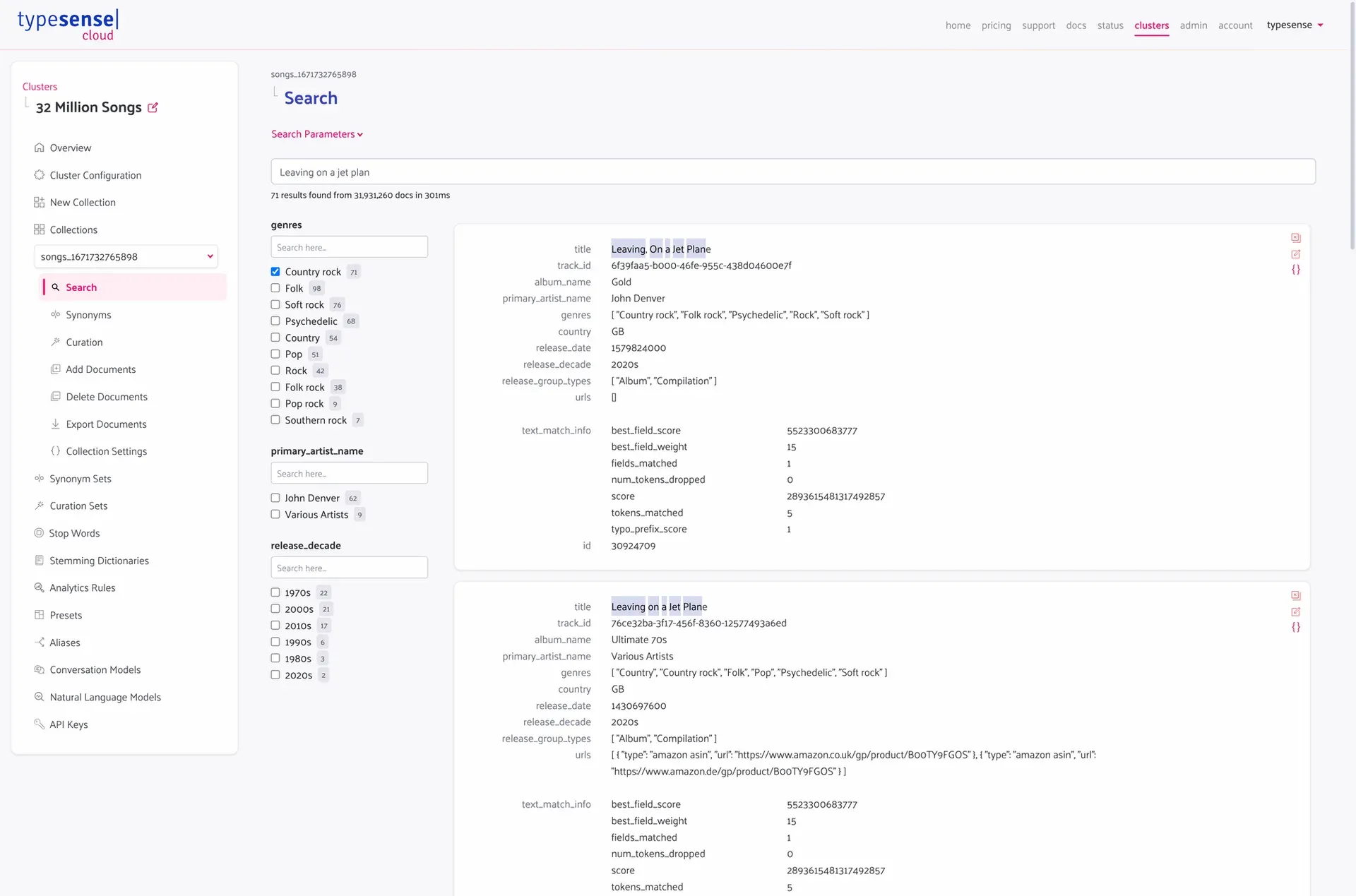
Typesense is an open-source search engine written in C++ for search-as-you-type experiences. It indexes JSON documents in collections and answers queries over a REST API with typo tolerance, faceting, filtering, sorting, geo search, vector and hybrid search, and LLM-based conversational and natural language search. The project describes itself as an open-source alternative to Algolia and an easier-to-use alternative to Elasticsearch. Indexes are held in memory: according to the README, a fresh server uses about 30 MB of RAM, and 1 million Hacker News titles with their points take about 165 MB.
Typesense is developed by Typesense, Inc., based in Houston, Texas, which describes itself on its about page as a lean, customer-funded team. The timeline on that page dates the idea to 2015, the first open-source release to 2018 and the launch of the managed Typesense Cloud service to 2020. The README states that Typesense Cloud serves more than 10 billion searches per month and that the Docker images have been downloaded more than 12 million times. Typesense, Inc. sells the managed Typesense Cloud service and paid support plans.
The server is licensed under GPL-3.0, while the official client libraries use the Apache license. The README explains the choice: modifications to the server only have to be published when the modified server is distributed, and running a modified copy internally does not trigger that obligation. Typesense ships as a single binary without runtime dependencies. The installation guide lists DEB and RPM packages and tarballs for Linux on x86_64 and arm64, native macOS binaries for Intel and Apple Silicon (macOS 13 Ventura or later), a Homebrew tap, official Docker images, Windows through WSL, an optional GPU dependencies package for Nvidia CUDA and a separate build for ARM systems with 16K memory pages. Kubernetes deployment is covered only by community-maintained operators.
The release GitHub marks as latest is v30.2, published April 19, 2026 together with the bug-fix release 29.1. Version 30.0 (January 27, 2026) added result diversification with Maximum Marginal Relevance, turned synonyms and curation rules into top-level synonym sets and curation sets that can be shared across collections (an API change for existing setups), extended JOINs with faceting on reference fields, added grouping, pinned hits and de-duplication to union search, dynamic facet sampling, IPv6 support, and Azure OpenAI and GCP service account support for natural language search and embeddings. Version 30.1 fixed an overflow in the search latency metric, and 30.2 fixed numeric not-equals filters, highlighting, scoped key handling in multi-search and /health responsiveness during bulk inserts. On November 21, 2026 the Typesense Cloud version selector also offered 31.0 release candidates up to 31.0.rc26.
Typesense Cloud runs dedicated clusters with no limits on records or operations, billed per hour by memory, vCPU and options, in 26 selectable regions. The Cloud site states SOC 2 Type 2 and HIPAA compliance, and a Typesense Cloud MCP server lets AI agents create clusters, build collections and index data, with permissions chosen when the agent connects over OAuth. Similar search engines listed on iThub include Algolia, Elasticsearch and OpenSearch.
Key capabilities
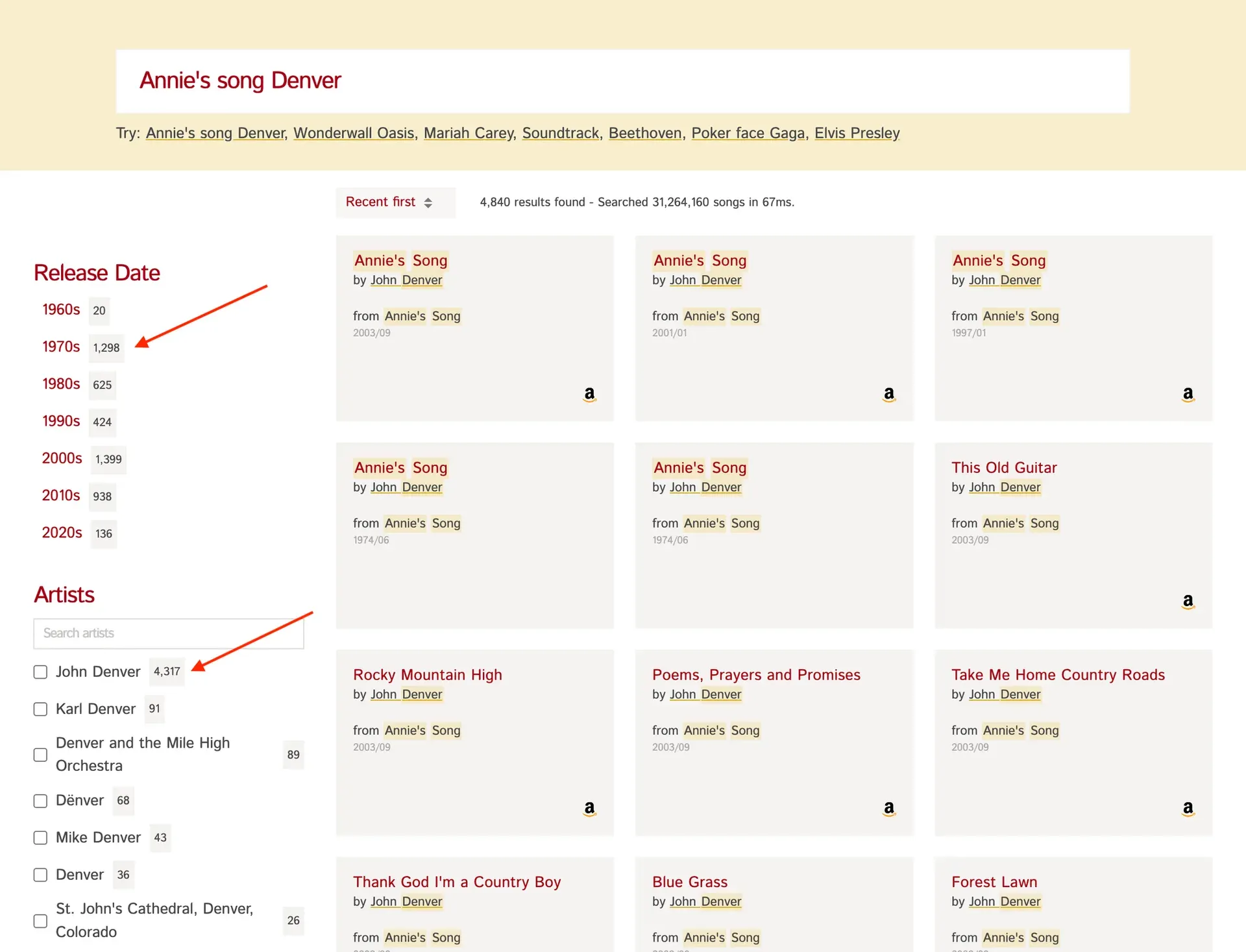
- Typo tolerance and instant search Typo tolerance works out of the box, so a query such as a misspelled song title still finds the intended record. The project targets search latencies below 50 ms. README benchmarks cite 2.2 million recipes indexed in about 900 MB of RAM with an average search time of 11 ms on a 4-vCPU server.
- Query-time relevance settings Fields to search, sort order, facets, grouping and ranking options are set per request through search parameters rather than fixed when an index is created. Results can be sorted dynamically by any sortable field, so one collection serves several sort orders, which the README contrasts with per-sort indices in Algolia.
- Faceting and filtering Facet counts, facet search and filter expressions narrow results by attributes such as genre, price or date. Version 30.0 added dynamic facet sampling via
facet_sample_slopeand faceting on fields of JOINed collections. - Grouping, federated and union search Grouping and distinct return varied results by collapsing similar records. Multi-search sends several queries, to one or more collections, in a single HTTP request, and union search merges them into one ranked list with grouping, pinned hits and de-duplication, as documented in the federated search reference.
- Geo search Documents with latitude and longitude can be filtered by distance from a point or within a bounding area and sorted by proximity. The geo search API is combined with text queries and facets, as in the project's Airbnb listings demo.
- Vector, semantic and hybrid search Embeddings from external models can be indexed for nearest-neighbor search, or Typesense can generate them itself from document fields with built-in models such as S-BERT and E5, or through OpenAI, PaLM and GCP APIs. Hybrid search combines keyword and vector relevance in one query, and the vector search docs suggest a server with a GPU to speed up embedding generation with built-in models.
- Conversational search (built-in RAG) Questions sent to Typesense are answered with a full sentence based on the indexed data, using a conversation model backed by OpenAI, Azure OpenAI, Google, Cloudflare Workers AI or a self-hosted vLLM server, according to the conversational search guide.
- Natural language search An LLM interprets a free-form request and converts it into structured filters, sort orders and query text. The natural language search docs list OpenAI, Azure OpenAI, Cloudflare Workers AI, vLLM, Google Gemini and GCP Vertex AI models.
- Image and voice search The built-in CLIP model (for example
ts/clip-vit-b-p32) supports searching images by text description and finding visually similar images, and 30.0 added a multilingual CLIP model. Voice queries are sent as base64-encoded audio, transcribed with a Whisper model and run as text queries. - JOINs across collections Reference fields connect collections so related documents can be fetched, filtered and sorted at query time in an SQL-like way. Version 30.0 added counts of related documents, sorting and limits on joined fields, schema changes to reference fields and a
cascade_delete: falseoption. - Synonyms, curation and merchandising Synonym sets define equivalent words, and curation sets pin or hide specific records for chosen queries; since 30.0 both are top-level resources shared by several collections. Search results can also be diversified with Maximum Marginal Relevance over the top 250 hits.
- Analytics and query suggestions Analytics rules aggregate popular queries and queries with no hits into separate collections, for example to power autosuggest, and record click, conversion and visit events for document popularity scoring and personalization, as described in the analytics docs.
- Scoped API keys for multi-tenancy API keys can be limited to collections (with regex), actions and expiry. Scoped search keys embed parameters such as
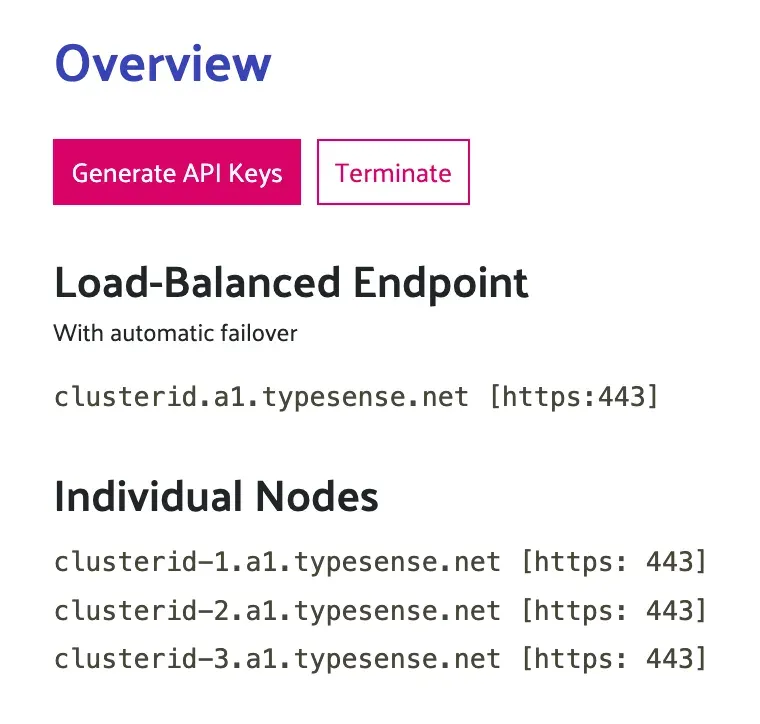
filter_bythat the user cannot override, so one collection can hold several customers' data while each key only sees its own subset, per the API keys reference. - High availability with Raft Several nodes form a cluster that uses the Raft consensus algorithm and replicates the full dataset to every node; reads and writes can go to any node. A quorum requires at least 3 nodes to tolerate one failure, and 5 nodes tolerate two at slightly higher write latency, according to the high availability guide. Typesense Cloud HA clusters run 3 to 7 nodes behind a load-balanced endpoint.
- Client libraries and InstantSearch adapter Official clients exist for JavaScript, PHP, Python and Ruby, and the docs list community-maintained clients for Go, .NET, Java, Rust, Dart, Swift, Perl, Clojure and Elixir. The InstantSearch adapter connects Algolia's InstantSearch UI widgets to Typesense, and framework integrations cover Laravel Scout, Firebase, Gatsby, WordPress, Docusaurus and DocSearch.
- Self-hosted packages and Docker The downloads page and install guide provide the Docker image
typesense/typesense, DEB and RPM packages for amd64 and arm64, Linux and macOS tarballs and a Homebrew tap. DEB and RPM installs listen on port 8108, generate an admin API key in/etc/typesense/typesense-server.iniand keep data under/var/lib/typesense; version 26.0 and later need Ubuntu 20 or a recent Linux kernel. - Typesense Cloud pricing On November 21, 2026 the Cloud pricing calculator showed the smallest cluster, 0.5 GB RAM with 2 vCPUs and 1 hour of burst per day, at $0.03 per hour ($21.60 per month), with the first 720 hours free, plus outbound bandwidth at $0.09 per GB after the first 10 GB. Memory options run from 0.5 GB to 1,024 GB, with optional high availability, a Search Delivery Network across 3 or 5 regions, GPU acceleration and high-performance disks.
- Typesense Cloud features and support The support page lists the visual dashboard, Search Delivery Network, shared team access, role-based access control, single sign-on and auto scaling as Cloud features, and paid support plans with a production support SLA from 30 minutes. Self-hosted users get support through GitHub issues and the public Slack community.
Where Typesense fits
Instant search for sites and online stores
A collection schema declares searchable, facetable and sortable fields, documents are imported in bulk through the API, and the frontend queries Typesense on every keystroke. With the InstantSearch adapter, existing InstantSearch.js, React, Vue or Angular InstantSearch widgets for search boxes, refinement lists, sorting and pagination are pointed at Typesense; the search UI guide walks through the setup, and curation sets pin promoted products for selected queries.
Semantic and hybrid search over product or content data
An embedding field with an auto-embedding model, either a built-in model or an OpenAI or GCP model, lets Typesense create vectors from chosen text fields at indexing and query time. A single query then mixes keyword and vector relevance; the semantic and hybrid search demo listed in the README runs on 300,000 Hacker News comments.
Question answering over indexed documents
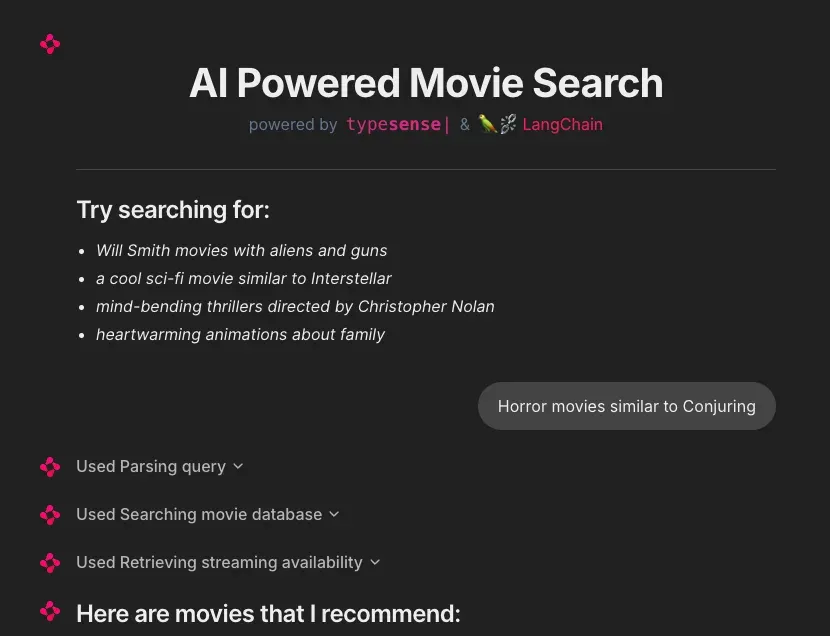
A conversation model connects Typesense to an LLM provider; conversational search queries retrieve matching documents and return a generated answer together with the hits, and follow-up questions reuse a conversation ID. The LangChain guide shows an agent-based movie search built on Typesense as an alternative pattern.
Multi-tenant search in SaaS applications
Records of all customers live in one collection with a field such as an account or user ID. The application backend generates a scoped search key per user with an embedded filter_by condition, so browser-side queries can only return that user's records, and fields such as access lists can be excluded from responses through the same key.
Location-based listings
Documents with a geopoint field are filtered by radius or area around a user's position and sorted by distance, while text search and facets narrow the results further. The Airbnb geosearch demo listed in the README shows this pattern on map-based browsing.
Running a production cluster
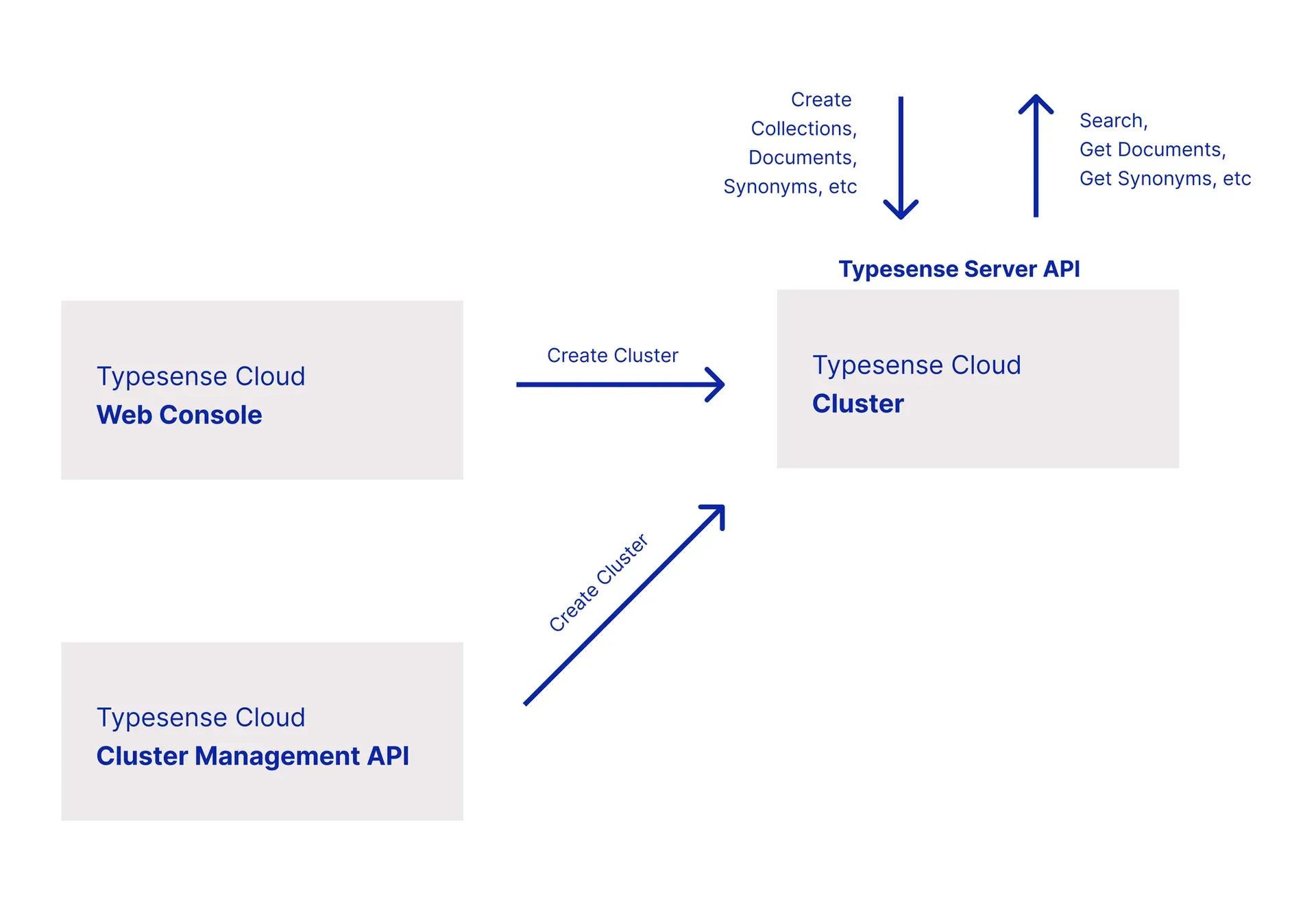
A self-hosted cluster runs 3 or 5 nodes with a shared --nodes file and the same bootstrap API key, behind a load balancer or with clients that list all nodes; the /health endpoint reports readiness and /debug the running version. In Typesense Cloud, high availability and a Search Delivery Network are options at cluster launch, and the Cluster Management API automates cluster creation. Other open-source engines on iThub include SeekStorm.
Install
docker run -p 8108:8108 -v"$(pwd)"/typesense-data:/data typesense/typesense:30.2 --data-dir /data --api-key=$TYPESENSE_API_KEY --enable-corsReviews of Typesense
Be the first to share your experience with Typesense.
Write a review
Loading review form…
Found Typesense useful? Upvote it todayYour vote helps other IT teams find it in the daily ranking.