

What is Elastic Cloud?
Elastic Cloud is the managed service of Elastic N.V., the company behind Elasticsearch and Kibana. Elastic's annual reports state that the company was incorporated in the Netherlands on February 9, 2012 as SearchWorkings Global B.V., later became Elastic N.V. and is listed on the New York Stock Exchange as ESTC. Its registered office is in Amsterdam, and the company describes itself as distributed, without a principal executive office. The service is managed through the console at cloud.elastic.co.
Elastic Cloud has two deployment models, compared on the official pricing page. Elastic Cloud Hosted, formerly called Elasticsearch Service, runs the Elastic Stack as deployments on a chosen cloud provider and region, with control over hardware profiles, cluster size, node count and stack version. Elastic Cloud Serverless runs use-case projects (Elasticsearch, Elasticsearch Vector Database, Observability and Security) where Elastic manages hardware, cluster size, scaling and versions, and projects are continuously updated without a version to choose.
The Hosted regions list contains 21 AWS, 20 Google Cloud and 16 Azure regions; the pricing page also lists Alibaba Cloud and FedRAMP for Hosted. The Serverless regions list contains 34 regions: 10 on AWS, 12 on Azure and 12 on Google Cloud. Elastic Cloud can also be purchased through the AWS, Azure and Google Cloud marketplaces.
Hosted uses resource-based pricing by subscription tier: Standard from $99 per month, Gold from $114, Platinum from $131 and Enterprise from $184, as listed on the Hosted pricing page. Serverless uses usage-based pricing per VCU-hour, per GB ingested or retained and per GB of egress. Both models offer monthly pay as you go or prepaid billing, and Platinum and Enterprise subscriptions carry a 99.95 percent monthly uptime SLA. Hosted offers a 14-day free trial.
Elastic Cloud is a proprietary managed service and cannot be self-hosted; the same software is available separately as self-managed Elasticsearch, Elastic Cloud Enterprise and Elastic Cloud on Kubernetes. Since 2024, Elasticsearch and Kibana source code can be used under AGPLv3 in addition to ELv2 and SSPL, as announced by Elastic. Similar services listed on iThub include OpenSearch and Algolia; the Elastic Security solution has its own profile under Elastic.
Elastic Cloud screenshots
Explore the interface. Open a screenshot to view it at full size.
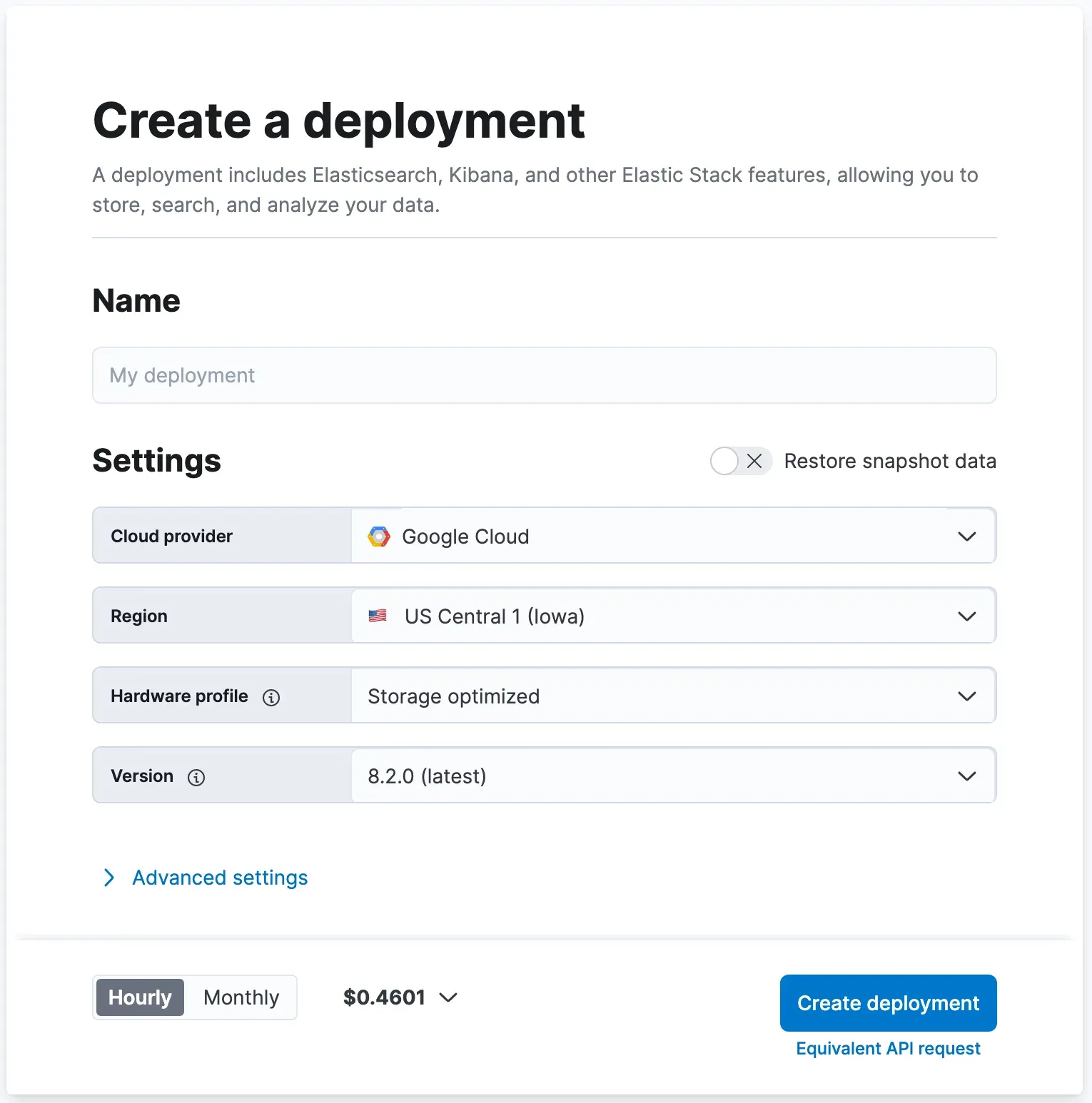
Official Elastic documentation screenshot of the Hosted deployment creation form; the version shown is from an earlier release.
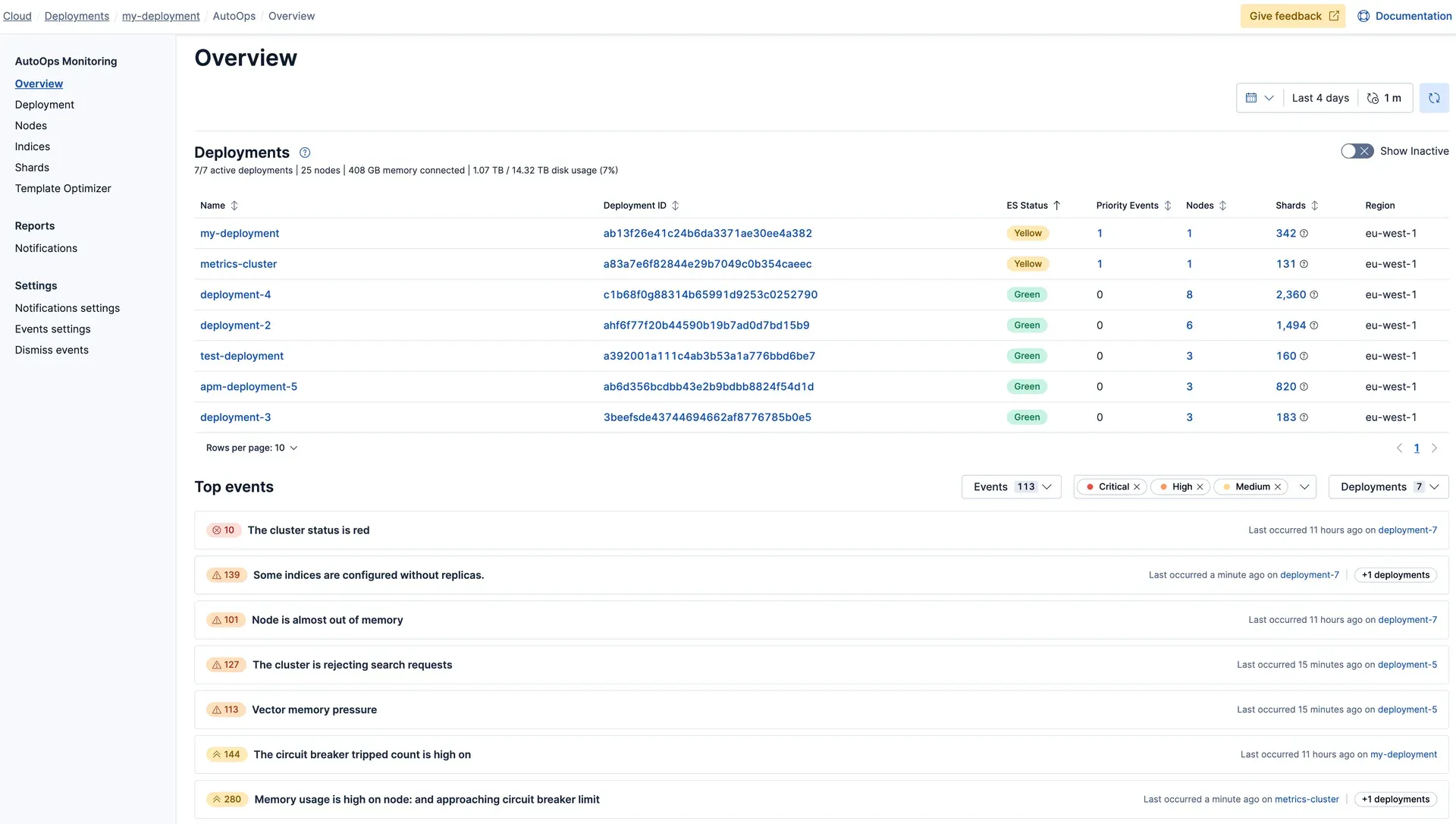
Official Elastic documentation screenshot of the AutoOps overview for Hosted deployments.
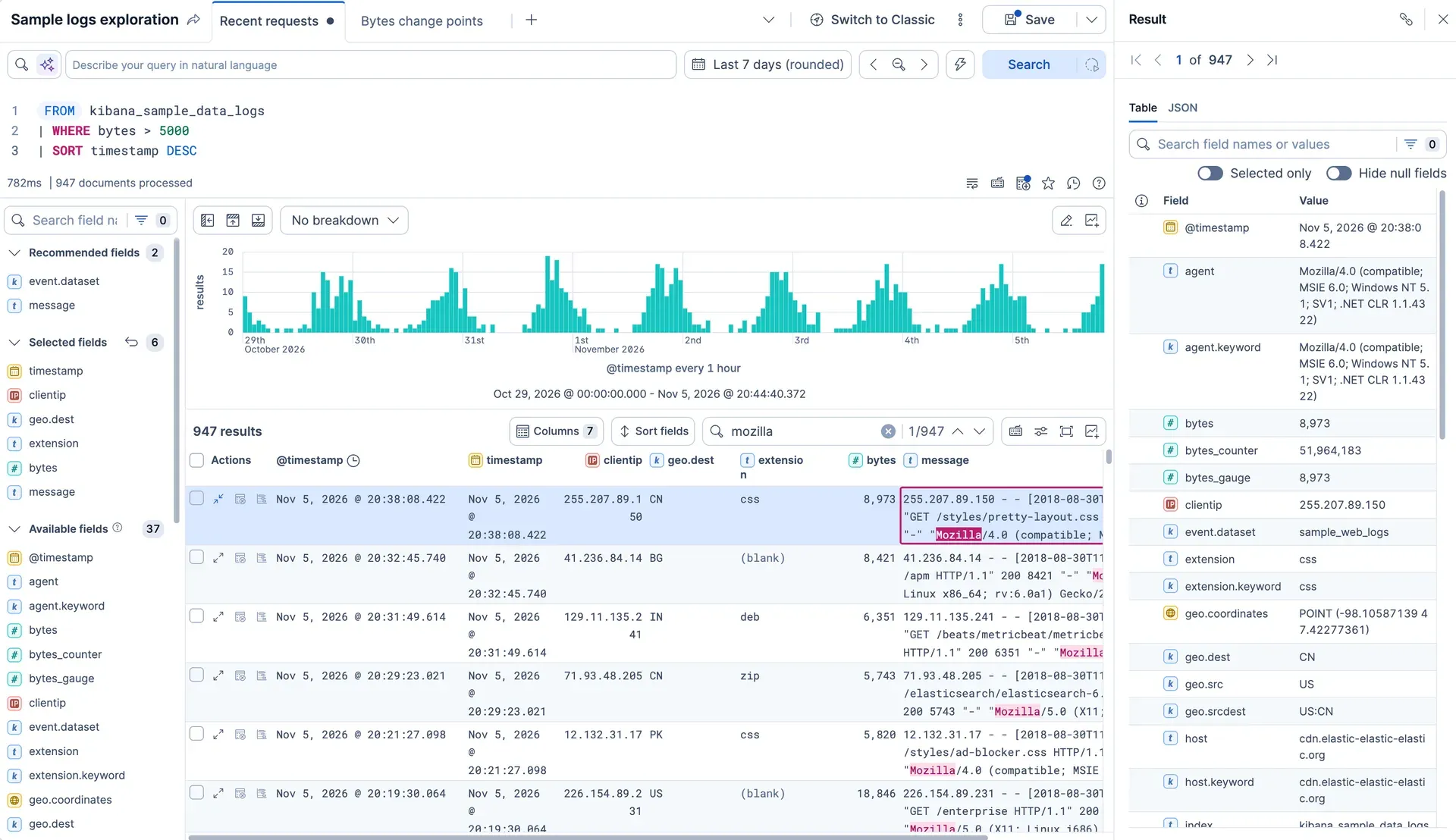
Official Elastic documentation screenshot of Kibana Discover with an ES|QL query on sample data.
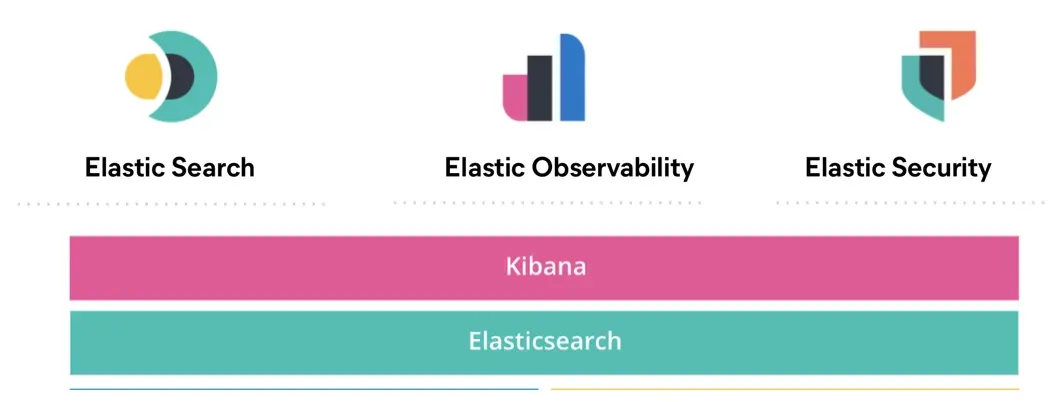
Official Elastic documentation figure of the components in an Elastic Cloud Hosted deployment.
Source: official Elastic Cloud project page.
Key capabilities
- Hosted deployments A Hosted deployment manages an Elasticsearch cluster together with Kibana and other Elastic Stack components such as APM. The cloud provider, region, hardware profile and stack version are chosen when the deployment is created, and clusters can be resized from the console; the Hosted documentation states that highly available clusters are resized without downtime.
- Hardware profiles Hosted offers presets that combine storage, memory and vCPU per component: Storage optimized, Storage optimized (dense), CPU optimized, CPU optimized (ARM, currently on AWS), General purpose and Vector search optimized. Allotments vary slightly by provider and region.
- Serverless projects Serverless projects are purpose-built for one use case: Elasticsearch, Elasticsearch Vector Database (Serverless only), Observability or Security. There are no node counts, hardware profiles or stack versions to manage, and resources scale with ingest and search load. A project's region and type are fixed after creation, and per-project limits such as an index limit apply.
- Serverless limitations Serverless does not support Elasticsearch authentication realms, user-initiated snapshots, custom plugins or username and password authentication for client connections. Elastic handles backups, and emergency restores go through Elastic support. Data from a versioned cluster has to be migrated into a new project rather than converted, according to the Serverless documentation.
- Elasticsearch and vector search Elasticsearch stores structured and unstructured documents, supports semantic and vector search and is queried through REST APIs, language clients and ES|QL, the piped Elasticsearch Query Language. Platinum and higher Hosted tiers include ELSER and E5 models on Elastic machine learning nodes; Enterprise adds GPU inference through the Elastic Inference Service.
- Kibana analysis tools Kibana provides Discover for exploring documents, including with ES|QL, dashboards, field statistics, maps, alerting and a developer console. Reporting and Watcher are included from the Gold tier on Hosted.
- Observability The Observability solution covers log analytics, metrics, APM, infrastructure monitoring, real user monitoring, synthetic monitoring, Universal Profiling and LLM observability. Platinum adds service maps, tail-based sampling, service level objectives, log categorization and AI-assisted parsing with Streams.
- Security The Security solution includes a SIEM detection engine with prebuilt rules, case management, malware prevention and host data collection, cloud security posture management and cloud vulnerability management. Higher tiers add third-party incident response workflows, machine learning anomaly detection jobs and behavioral ransomware protection.
- Ingest and integrations Hundreds of integrations are available through Elastic Agent, connectors and Logstash, with centralized ingest and agent management. Data can also be uploaded as CSV, NDJSON or log files from Kibana.
- Automatic snapshots Hosted registers the found-snapshots repository on every deployment and, by default, snapshots all indices every 30 minutes through the cloud-snapshot-policy SLM policy. Snapshots can also be taken on demand. Deleting a snapshot from found-snapshots removes the data permanently, and only open indices are included, as stated in the snapshot documentation.
- Autoscaling Hosted autoscaling follows predefined policies. Data tiers can grow based on storage needs but are not reduced automatically; machine learning nodes scale up and down, and trained model deployments scale with demand.
- Network and data security HTTPS and inter-node traffic are encrypted, and cluster data is encrypted at rest. Hosted supports IP filters, AWS PrivateLink, Azure Private Link, GCP Private Service Connect, customer-managed encryption keys and keystores for secure settings. Custom SSL certificates are not supported.
- AutoOps AutoOps monitoring is on by default for Hosted. It lists deployments with status, nodes and shards, detects events such as red cluster status, memory pressure or rejected searches, and gives performance recommendations.
- AI and agent features The Enterprise tier includes Elastic Agent Builder powered by the Elastic Managed LLM, dashboard creation through AI chat, Elastic Workflows and an AI Playground for retrieval-augmented generation. On Serverless, the Elastic Managed LLM costs $4.50 per million input tokens and $21 per million output tokens.
- Elastic Cloud API and CLI Deployments can be managed programmatically through the Elastic Cloud API at api.elastic-cloud.com/api/v1 with an Elastic Cloud API key, documented in the Cloud API reference. An Elastic CLI for deployment operations is in preview.
- Hosted subscription tiers Standard starts at $99 per month with web support and a three-business-day target response, Gold at $114 with business-hours support, Platinum at $131 with 24/7 support and the 99.95 percent SLA, and Enterprise at $184 with searchable snapshots in cold and frozen tiers, cross-cluster search and Elastic Cloud SAML SSO.
- Serverless pricing units Elasticsearch Serverless lists ingest from $0.14, search from $0.09 and machine learning from $0.07 per VCU-hour, storage from $0.047 per GB retained per month and egress at $0.05 per GB. Observability Serverless has a Logs Essentials tier from $0.07 per GB ingested and a Complete tier from $0.09 per GB ingested, with separate retention prices and add-ons such as synthetic browser tests at $0.0123 per run.
- Organizations and billing Since July 2026, an Elastic Cloud account can belong to several organizations, and since August 2026 non-admin members can view cost, chart and budget data for their resources, according to the Hosted release notes.
Where Elastic Cloud fits
Running a managed Elasticsearch cluster
A Hosted deployment is created in the console by naming it and choosing a cloud provider, region, hardware profile and Elastic Stack version; the console shows the hourly or monthly price before creation and can generate the equivalent API request. The deployment includes Elasticsearch and Kibana, and the cluster can later be resized, upgraded or restored from snapshots, as described in the deployment creation guide.
Building search and vector search applications
Application search uses Elasticsearch indices queried through REST APIs, language clients or ES|QL. Semantic and vector search use embedding models such as ELSER and E5 on machine learning nodes, or the Elastic Inference Service. On Serverless, the Elasticsearch Vector Database project type is aimed at vector storage and retrieval, and the Search Power setting chooses between on-demand, performant and high-availability behavior.
Centralizing logs, metrics and traces
Elastic Agent and integrations collect logs, metrics and traces into an Observability deployment or project, where Kibana provides log exploration, infrastructure views, APM and synthetic monitoring. On Serverless, Observability is billed per GB ingested and retained, with Logs Essentials for log-centric use and Complete for the full feature set, as listed on the Serverless Observability pricing page.
Operating a SIEM
The Security solution ingests security events through Elastic Agent and integrations, applies the detection engine with prebuilt rules and tracks investigations in cases. Endpoint protection, cloud security posture management and cloud vulnerability management are part of the same solution, with machine learning detections and ransomware protection in higher Hosted tiers or the Serverless Security project.
Monitoring cluster health
AutoOps lists deployments with their status, node and shard counts and region, and groups detected events by severity, such as indices without replicas, nodes running out of memory or tripped circuit breakers. The AutoOps documentation describes the event types and notification settings.
Automating deployment management
The Elastic Cloud API creates, updates and deletes Hosted deployments with an API key, and the console offers an equivalent API request for each deployment created through the UI. Snapshots, autoscaling policies, IP filters and private connectivity are configured per deployment through the console or the API.
Reviews of Elastic Cloud
Be the first to share your experience with Elastic Cloud.
Write a review
Loading review form…
Alternatives to Elastic Cloud
 AlgoliaAlgolia is a hosted search and retrieval platform with search, recommendations and AI agent tools, priced as a free tier plus usage.
 SplunkSplunk offers a data platform for search and analysis, with a separate Enterprise Security product for SecOps.