
What is WeKnora?
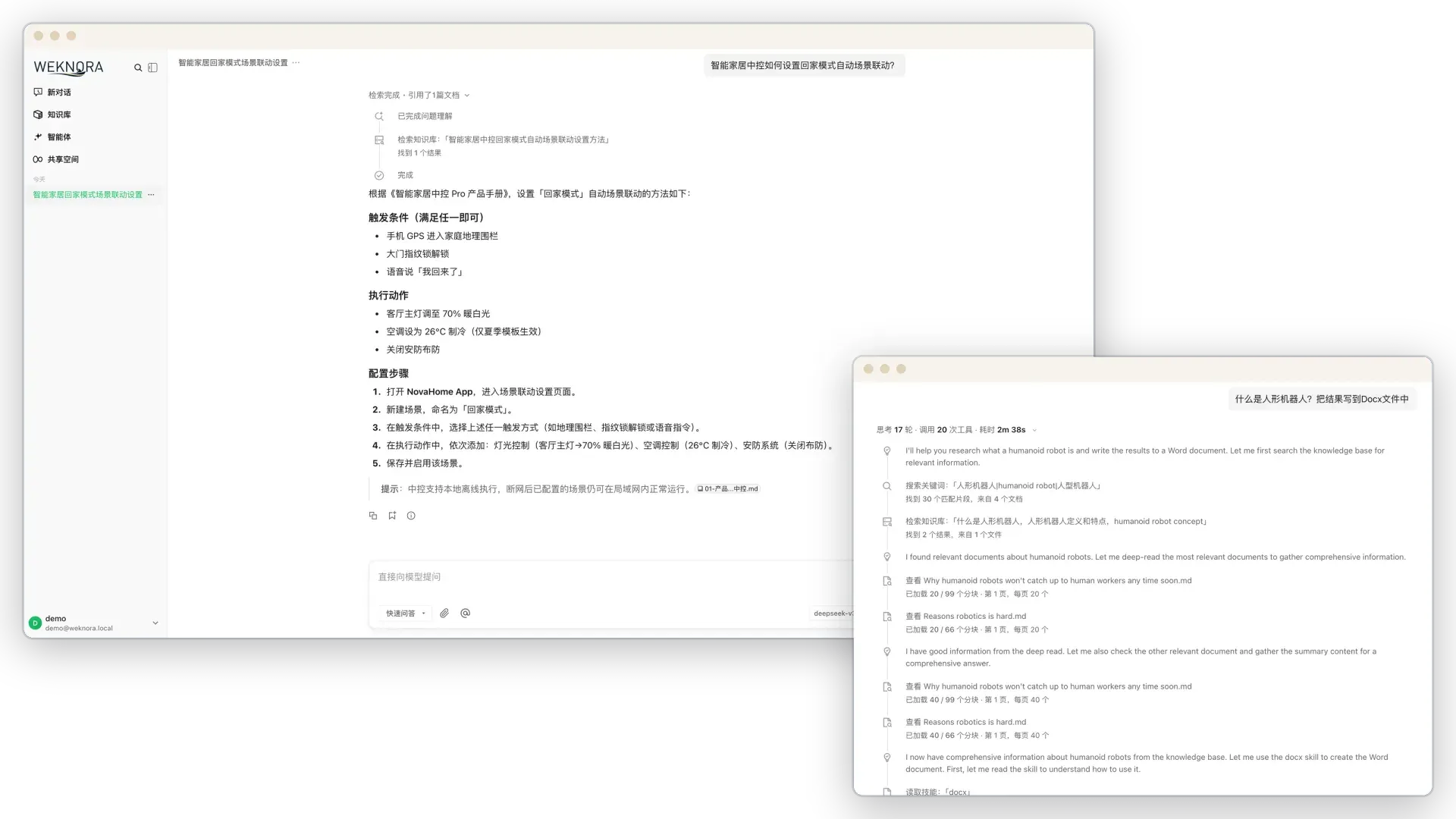
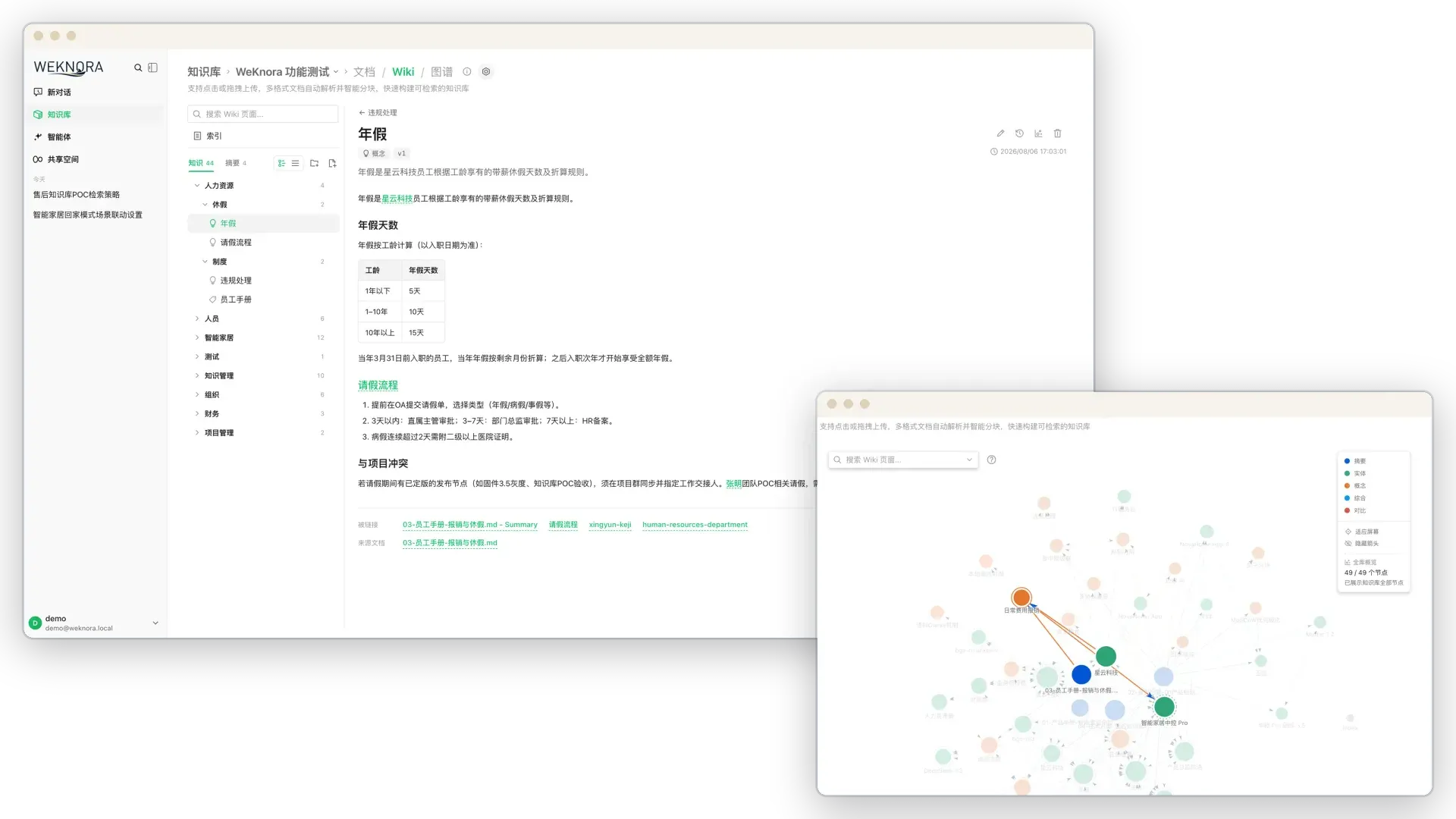
WeKnora is an open-source knowledge framework from Tencent for document understanding, semantic retrieval and LLM reasoning over a team's own material. The project describes three working modes on the same knowledge bases: retrieval-augmented question answering with citations, an agent that runs multi-step tasks with tools and skills, and an automatically generated wiki with a knowledge graph. The official website and the product documentation are published by the project; the documentation is written in Chinese and covers about 360 API endpoints and about 150 environment variables, while the README is available in English, Simplified Chinese, Japanese and Korean.
The system consists of a Go backend, a Vue 3 web front end and a Python document parsing service called docreader. The installation guide lists four deployment forms: the standard Docker Compose stack with ParadeDB (PostgreSQL) and Redis with Asynq, a Helm chart for Kubernetes 1.25 or later, a Lite single binary that uses SQLite (FTS5 and sqlite-vec) with an in-memory queue, and a desktop app built with Wails v2. The project states that no desktop installer is published yet, so the desktop app has to be built from source. Tencent also lists two hosted routes: the WeChat Dialog Open Platform, a hosted Q&A service built on WeKnora, and an application template for Tencent Cloud Lighthouse servers.
The current release is v0.9.0, published on October 29, 2026. According to the v0.9.0 release notes, it adds the WeKnora assistant, which answers questions about releases, features and configuration and can create agents, schedule tasks and manage knowledge as the signed-in user within that user's permissions. It also adds multi-agent collaboration, scheduled automations and three execution permission modes. Upgrading from v0.8.3 runs PostgreSQL migrations 000119 to 000134 or SQLite migrations 000037 to 000051.
Version 0.8.3 (October 14, 2026) added an image gallery, multimodal embedding models and navigation from an answer to the cited passage. Version 0.8.2 (September 24, 2026) added the local browser and a built-in MCP server, and 0.8.0 introduced skill sandboxes and long-term memory. The full history is in the changelog.
WeKnora is released under the MIT License, with third-party components listed separately in the repository LICENSE file. Models, vector databases and object storage are interchangeable, and the project states that it can run locally or on a private cloud so that data stays in the operator's environment. The README notes that WeKnora ships with login authentication and recommends deploying it on an internal network rather than exposing it directly to the public internet. Similar projects on iThub include Dify, PipesHub and AnythingLLM.
Key capabilities
- Docker Compose deployment The standard deployment clones the repository, copies
.env.exampleto.env, then runsdocker compose pullanddocker compose up -d. The web UI is served onhttp://localhost, the backend API on port 8080 and Langfuse on port 3000. Profiles add optional components:neo4jfor the knowledge graph,miniofor object storage,langfusefor tracing, orfullfor all features. The installation guide asks for Docker 20.10 or later, Docker Compose v2, at least 4 CPU cores and 8 GB of RAM, plus a generatedJWT_SECRETand 32-byteSYSTEM_AES_KEY. - Kubernetes, Lite and desktop builds A Helm chart in the
helm/directory targets Kubernetes 1.25 or later and bundles ParadeDB and Redis. The Lite build is a single binary with no external services, a single workspace without registration, only the Simple parser built in, and local-only access by default, as described in Lite vs. standard. The desktop app wraps the Lite runtime in a GUI with a macOS host sandbox and is not yet published as an installer. No prebuilt binaries are attached to the v0.9.0 GitHub release. - RAG question answering with citations Quick Q&A answers from selected knowledge bases and cites the passages it used; since v0.8.3 a citation can open the cited passage in the original document. Retrieval combines keyword (BM25) and vector search with RRF fusion and reranking, and supports parent-child chunking. GraphRAG with Neo4j is optional. The retrieval documentation also covers end-to-end evaluation with recall, BLEU and ROUGE metrics.
- Smart reasoning agent The agent mode runs a ReAct loop over knowledge bases, web search, MCP tools, skills and the local browser, and shows each step in the conversation. A running turn can be given extra requirements, forked from an earlier question or rewound with sandbox checkpoints. Built-in agents cover quick Q&A, smart reasoning, data analysis (SQL over CSV and Excel) and the wiki, and custom agents choose their own model, knowledge scope and tools.
- WeKnora assistant and automations Version 0.9.0 adds an assistant panel next to the logo that reads the bundled documentation and can create agents, manage knowledge bases, FAQ entries, skills and MCP services as the current user. Automations run one-off or Cron-scheduled tasks with a time zone, model and notification options, and keep an execution history. Automations are managed by signed-in users only and do not accept API keys.
- Execution permissions and approvals Sessions and automations run in read-only, confirm-before-change or automatic mode. In automatic mode, deletions and tools marked for mandatory approval still require confirmation, and read-only mode cannot be bypassed through an approval. Pending approvals are stored and survive a page refresh, as described in the v0.9.0 notes.
- Automatic wiki and knowledge graph With Wiki enabled, WeKnora extracts people, products and concepts from knowledge-base documents into interlinked Markdown pages with source citations, organized by directory. A graph view shows how pages relate, pages can be edited in the browser, and every revision can be compared and rolled back. Wiki ingestion uses a task queue that the project says scales to knowledge bases of 40,000 documents.
- Knowledge bases and document parsing Knowledge bases can be document, FAQ or wiki types, with a folder tree, auto-tagging and editable retrieval chunks with revision history. Supported formats include PDF, Word, PowerPoint, Excel, CSV, TXT, Markdown, HTML, EPUB, MHTML, JSON, XMind and images, and audio can be transcribed through an ASR model. Office files are parsed in-process by anydoc; scanned pages use OCR, and images can be described by a vision model.
- Data source sync Connectors keep knowledge bases in sync with Feishu wiki and Drive, Lark, Confluence, GitLab, Tencent IMA, Notion, Yuque, DingTalk Docs, Seafile and RSS. Version 0.9.0 switched Feishu and Lark documents to block parsing and added personal access token support for Confluence Server and Data Center. URL import and whole-folder uploads that keep the directory tree are also available.
- Model providers The model catalog includes 29 built-in vendors, among them OpenAI, Azure OpenAI, Anthropic, DeepSeek, Qwen, Zhipu, Hunyuan, Doubao, Gemini, MiniMax, NVIDIA, SiliconFlow, OpenRouter, LiteLLM and Ollama. Chat, embedding, rerank, vision and speech models are managed separately, and v0.9.0 adds workspace default models. Local inference uses Ollama; the 8 GB RAM baseline excludes model weights, per the model documentation.
- Vector and object storage backends Vector search runs on PostgreSQL with pgvector and ParadeDB, Elasticsearch, OpenSearch, Milvus, Weaviate, Qdrant, Apache Doris or Tencent VectorDB. Files can be stored locally or in Tencent Cloud COS, MinIO, AWS S3, Volcengine TOS, Alibaba Cloud OSS, Kingsoft Cloud KS3 or Huawei Cloud OBS, and a workspace can hold several storage instances.
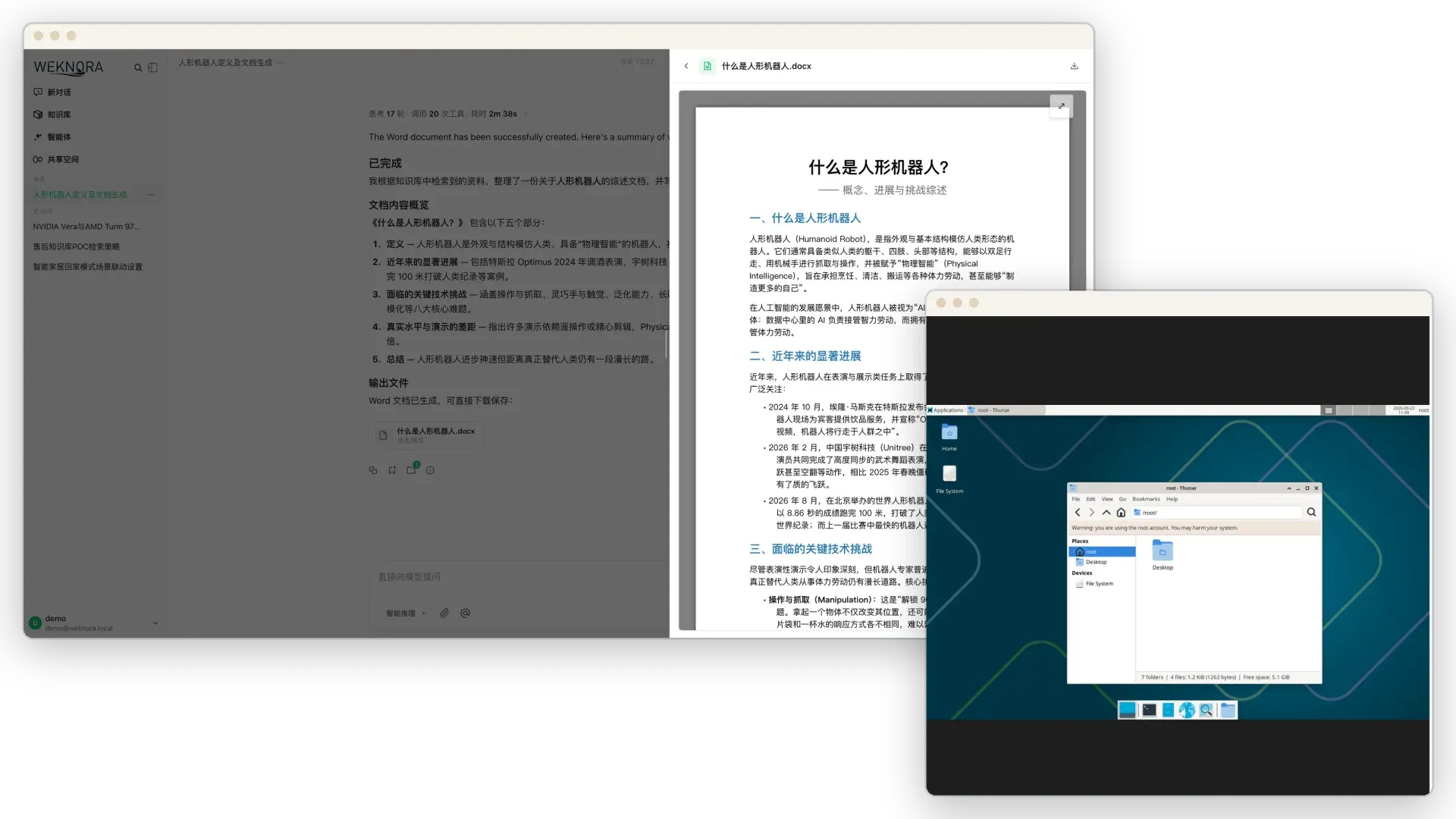
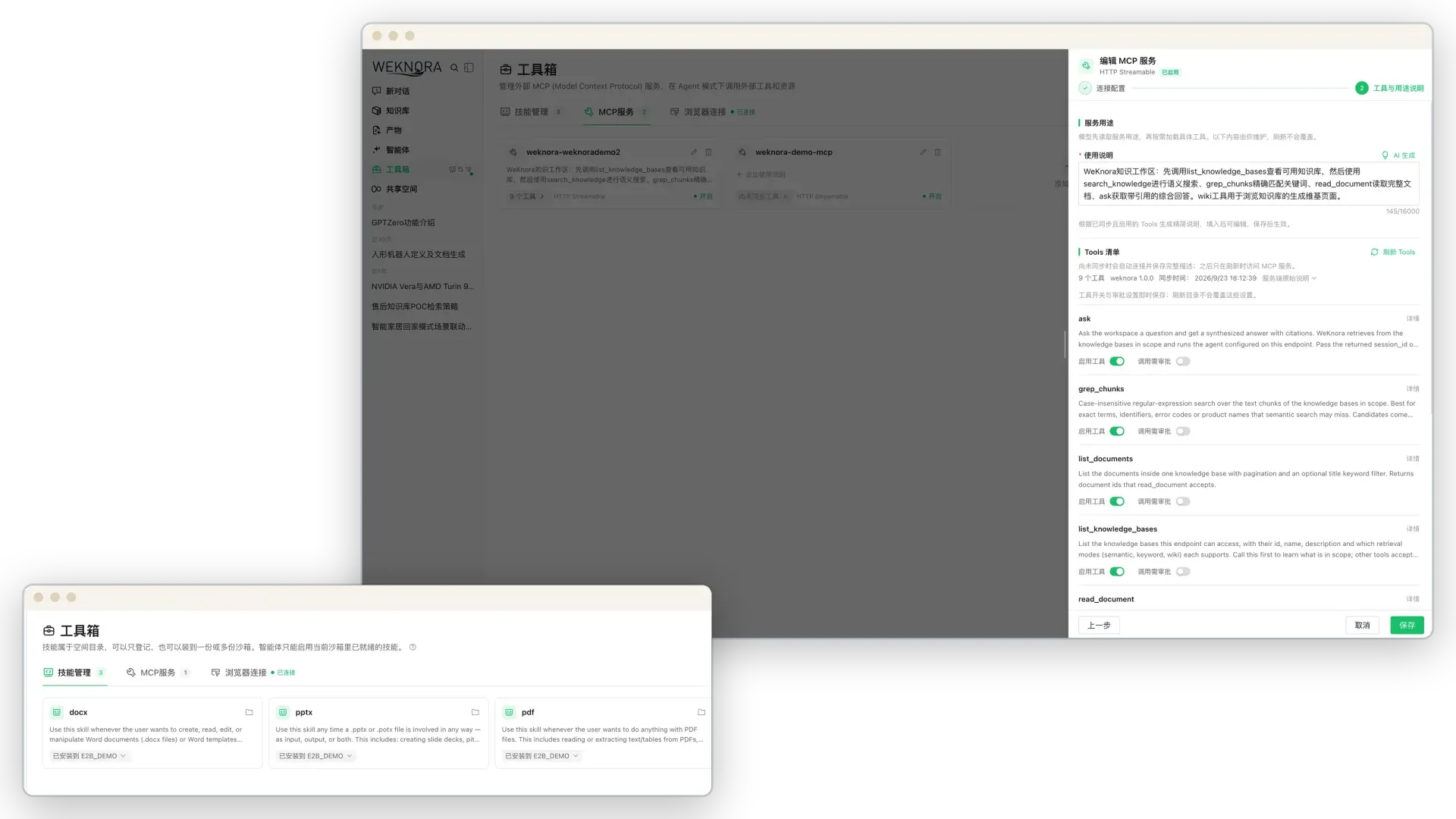
- Skills and sandboxes Skills are installed from ClawHub, SkillHub, Git or ZIP into a workspace catalog and run in session-persistent Docker, E2B or Cube sandboxes with a per-tenant network policy. An interactive terminal and a graphical desktop can be opened beside the chat, and generated files are collected in an artifacts library. The project notes that sandbox commands run as
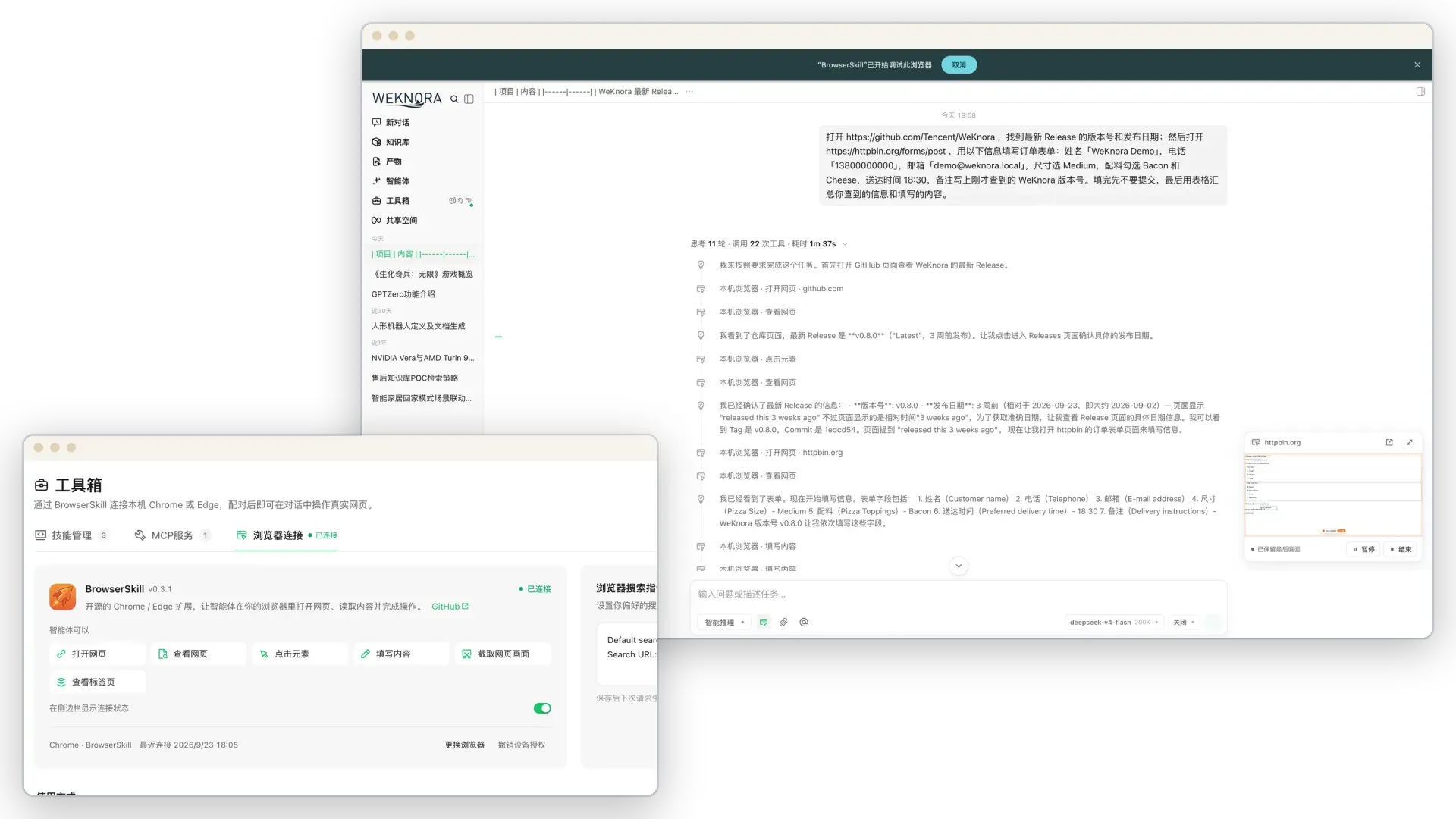
rootsince v0.8.2 and that shared session directories are not operating-system isolation. - Local browser through BrowserSkill With Tencent's open-source BrowserSkill extension, the agent opens pages, reads content, clicks elements and fills in forms in the user's own Chrome or Edge. Tasks can be paused, and logins and CAPTCHAs are handed back to the user, per the local browser guide.
- Built-in MCP server and MCP tools Each workspace can publish knowledge bases as
/mcp/<endpoint_id>endpoints over Streamable HTTP, each with its own token, knowledge-base scope, rate limit and tool groups, for clients such as Cursor and Claude. In the other direction, external MCP services connect over SSE or Streamable HTTP with API key, Bearer or OAuth 2.0 authentication, and individual tools can be enabled or set to require approval. The older Pythonmcp-server/is deprecated. - REST API, CLI and Go SDK The HTTP API uses the
/api/v1prefix with JWT, API key and embed token authentication; workspace and platform API keys use a default-deny route policy, as described in the API overview. TheweknoraCLI emits a JSON envelope by default, serves an MCP tool surface withweknora mcp serveand bundles Agent Skills. A Go SDK covers knowledge bases, documents and sessions with SSE streaming answers. - Channels and clients Q&A can be connected to WeCom, Feishu, Lark, QQBot, Slack, Telegram, DingTalk, Mattermost, WeChat and Yunzhijia. Other clients include a website embed widget, a Chrome extension for saving selected text, images or pages as knowledge, a WeChat Mini Program, a ClawHub skill and the DeepSeek Harness plugin
@wxg-prc-cpg/dsh-weknorawith four read-only tools. - Workspaces, access control and security Workspaces use RBAC with Owner, Admin, Contributor and Viewer roles, per-resource ownership and a per-workspace audit log, and organizations share knowledge bases and agents across workspaces. Sign-in supports OIDC, credentials are encrypted with AES-256-GCM, and outbound requests are SSRF-protected with an optional whitelist-only mode.
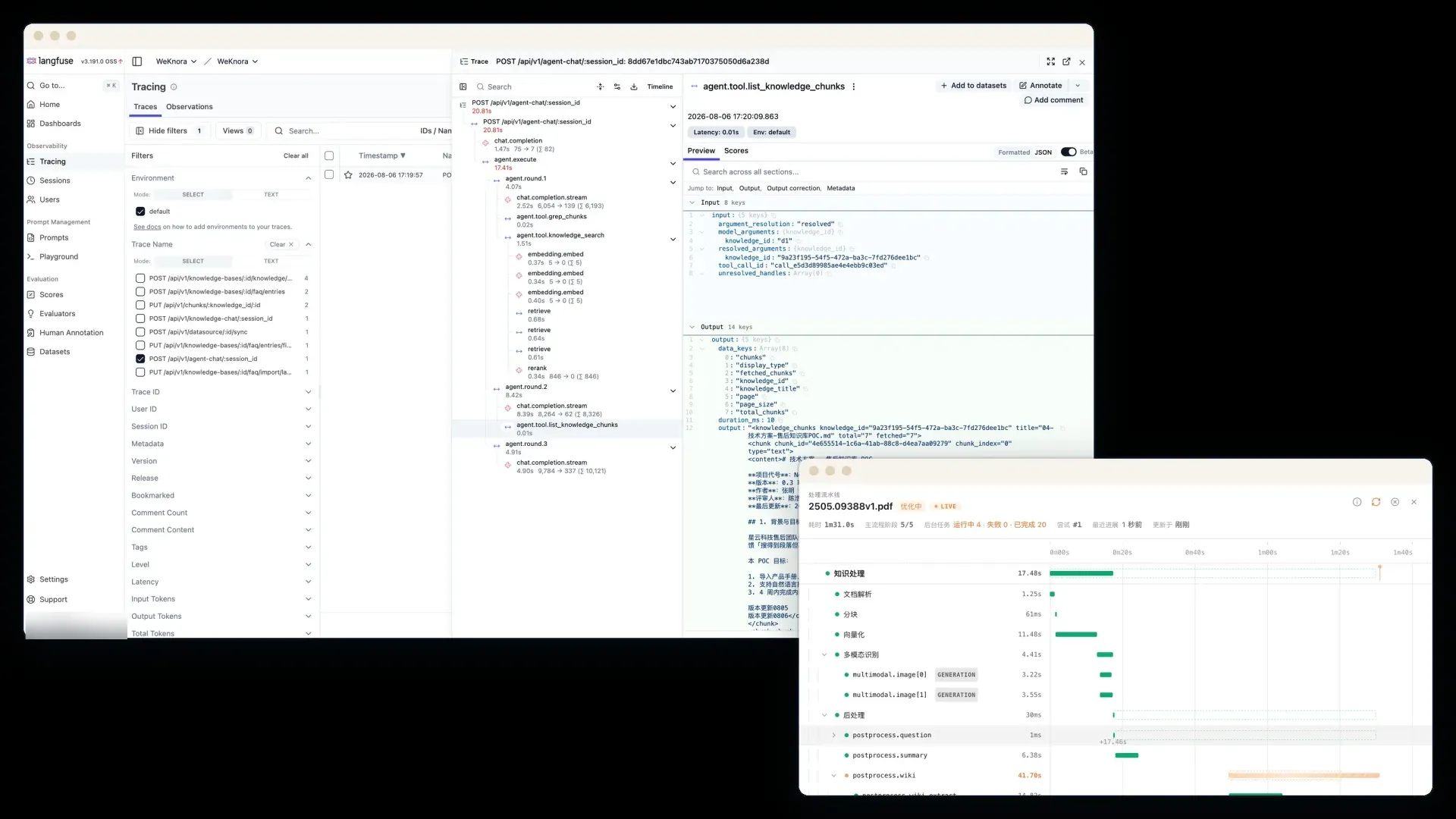
- Observability Langfuse tracing records reasoning, tool calls and token usage for each agent step and for parsing pipelines. A document parsing timeline shows stage-by-stage progress, and a task-queue dashboard lists queued and failed tasks with worker-pool governance, per the observability documentation.
Where WeKnora fits
Answering questions over internal documents
A team uploads files or folders into a document knowledge base, or connects a data source, and WeKnora parses, chunks and indexes the content. Users ask in Quick Q&A mode and receive an answer generated by the selected model with citations that link back to the source passage. Retrieval settings such as candidate counts, thresholds, fusion weights and reranking are configured per knowledge base, as covered in the knowledge base documentation.
Running multi-step research and document tasks
In smart reasoning mode, an agent searches knowledge bases, reads full documents, calls web search and MCP tools, and runs skills inside a sandbox. The project's own example asks the agent to research a topic from the knowledge base and write the result into a Word file using the docx skill; the generated file can be previewed and downloaded from the conversation. Since v0.9.0, independent sub-tasks can be delegated to several agents and their results combined.
Building a maintained wiki from documents
When Wiki is enabled on a knowledge base, WeKnora generates topic pages for people, products and concepts with source citations and page links, and arranges them in a directory and a knowledge graph. Editors change pages in the browser and can compare or roll back revisions. The wiki documentation describes ingestion, page types and graph navigation.
Publishing knowledge to other AI tools and chat channels
Administrators create built-in MCP endpoints so that MCP clients such as Cursor or Claude can search and read a scoped set of knowledge bases with a dedicated token and rate limit. The same knowledge can answer questions inside IM apps such as WeCom, Feishu, Slack or Telegram, on external websites through the embed widget, or from terminals and CI jobs through the weknora CLI with WEKNORA_API_KEY and WEKNORA_HOST.
Scheduling recurring knowledge work
Version 0.9.0 lets users describe a task to the WeKnora assistant, or fill in the automation form, to run it once or on a Cron schedule with a chosen time zone and model. Typical examples named in the release notes are daily news digests, periodic summaries and knowledge-base status checks. Runs pause for approval when needed, notify the creator and keep a full record, as described in the release notes.
Operating a private multi-team deployment
Organizations deploy the standard stack with Docker Compose or Helm, choose their own model providers, vector database and object storage, and separate teams into workspaces with role-based access and audit logs. Langfuse traces, the parsing timeline and the task-queue dashboard show what the system is doing. For single users or offline machines, the Lite binary keeps all data in local SQLite storage without external services.
Install
git clone https://github.com/Tencent/WeKnora.git && cd WeKnora && cp .env.example .env && docker compose pull && docker compose up -dReviews of WeKnora
Be the first to share your experience with WeKnora.
Write a review
Loading review form…
Found WeKnora useful? Upvote it todayYour vote helps other IT teams find it in the daily ranking.