
What is OpenKB?
OpenKB (Open Knowledge Base) is an open-source command-line system from VectifyAI, the company behind PageIndex, that uses large language models to compile raw documents into a structured, interlinked wiki-style knowledge base. The project README describes it as powered by PageIndex, a vectorless, reasoning-based retrieval framework for long documents, and lists the design points as scaling to long documents, reasoning-based retrieval, native multi-modality and no vector database. The PageIndex open-source ecosystem page lists OpenKB as "an LLM knowledge base that compiles documents into an interlinked wiki", next to PageIndex, ChatIndex, ConDB and PageIndex MCP.
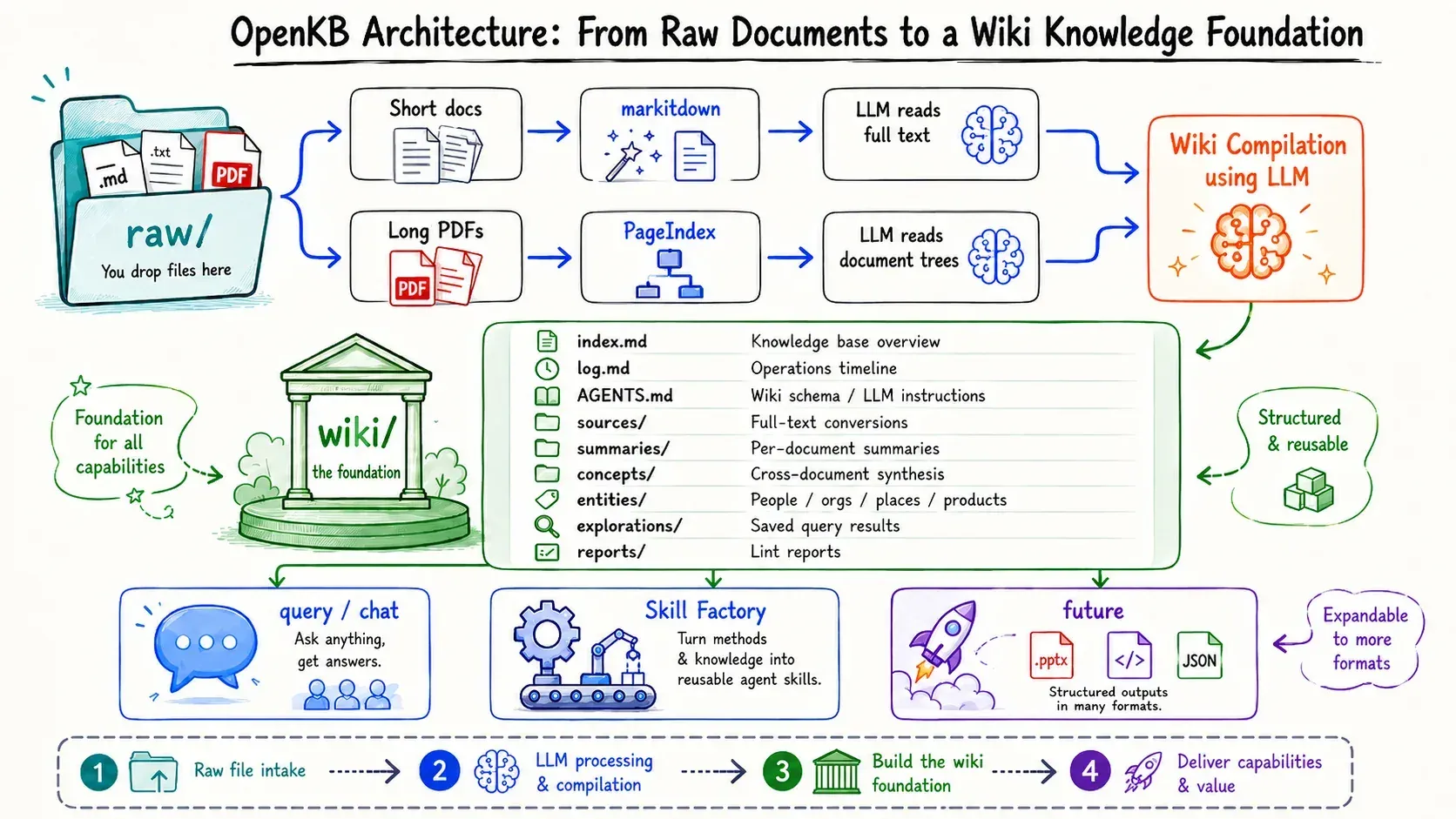
The README states that the idea is based on a concept described by Andrej Karpathy: the LLM writes summaries, concept pages and cross-references and keeps them maintained, so knowledge is compiled once into a persistent wiki and updated as documents are added, instead of being retrieved again from raw chunks on every query. OpenKB is organised in two layers: a wiki foundation that compiles and maintains the knowledge base (init, add, list, status, watch, lint, remove, recompile), and generators that turn the wiki into output (query, chat, visualize, skill and deck).
OpenKB is distributed as the Python package openkb on PyPI and requires Python 3.10 or later; the package metadata lists Python 3.10 to 3.13 and the development status "Alpha". Its stack, as listed in the README, is PageIndex for long-document indexing, Microsoft markitdown for file-to-Markdown conversion, the OpenAI Agents SDK as the agent framework, LiteLLM as the multi-provider LLM gateway, Click for the CLI and watchdog for filesystem monitoring. All runtime dependencies are pinned to exact versions in pyproject.toml. An optional web extra adds a FastAPI REST server and the bundled Knowledge Workbench web UI. Short documents are converted with markitdown and read in full by the LLM; PDFs at or above a page threshold (20 pages by default) are indexed by PageIndex into a hierarchical tree that the LLM reads instead of the full text.
The latest GitHub release is v0.4.5, published on July 20, 2026, a hotfix that pins openai==2.44.0 to avoid a breaking change in the OpenAI SDK. Earlier 2026 releases added the HTML slide-deck generator and first-class entity pages (v0.4.0 and v0.4.1, June 16), an interactive knowledge graph, configurable LLM timeouts, a litellm: config block, import of PageIndex Cloud indices and Google OKF-conformant frontmatter (v0.4.2, June 27), crash-safe mutation recovery (v0.4.3, July 2), and configurable indexing and compile concurrency plus a Bedrock fix (v0.4.4, July 10). A v0.5.0-rc1 tag was created on July 20, 2026, and the most recent commit on the main branch is dated July 22, 2026. The repository was created in April 2026.
OpenKB is licensed under the Apache License 2.0. The project's README roadmap lists items that are not yet implemented: long-document handling for non-PDF formats, nested folder support for large collections, hierarchical concept indexing and a database-backed storage engine; the wiki is currently stored as plain files. OCR for scanned PDFs is offered through the optional, separately keyed PageIndex Cloud service rather than in the local engine. Comparable listings on iThub include PipesHub, AnythingLLM and Khoj.
Key capabilities
- Compiled wiki from raw documents Each
openkb addmakes the LLM write a summary page, read the existing concept and entity pages, create or update concepts with cross-document synthesis, create or update entity pages, and updateindex.mdandlog.md. The README states that one source can touch 10 to 15 wiki pages. Awiki/AGENTS.mdfile defines the wiki structure and conventions and is read from disk at runtime, so edits to it take effect on the next run. - Broad input formats Supported inputs listed in the README include PDF, Word, Markdown, PowerPoint, HTML, Excel, CSV, plain text and URLs.
openkb addaccepts a single file, a whole directory or a URL, and detects the content type of URLs automatically. Non-PDF formats always take the short-document path; extending long-document handling to other formats is on the roadmap. - Long-document path through PageIndex PDFs with at least
pageindex_thresholdpages (default 20) are processed by PageIndex into a hierarchical tree index with summaries, and the LLM reads that tree instead of the full text. PageIndex runs locally by default, with pymupdf text and image extraction. Shorter documents go through markitdown and are read in full. - Optional PageIndex Cloud Setting
PAGEINDEX_API_KEYswitches the long-document path to PageIndex Cloud, which the docs describe as adding OCR for scanned PDFs through hosted VLM models, faster structure generation and scalable indexing, with a local fallback if the cloud call fails.openkb add --from-pageindex-cloud <DOC_ID>imports a document already indexed in the cloud, read-only and idempotent, fetching pages in 1000-page windows (PageIndex Cloud guide). - Multi-modal content The README states that OpenKB retrieves and understands figures, tables and images, not only text. Images in short documents are extracted inline with pymupdf, and images in long documents are extracted by PageIndex; extracted images are stored under
wiki/sources/images. - Entity pages Since v0.4.1,
wiki/entities/holds pages for specific named things, separate from abstract concepts. The default vocabulary has seven types (person, organization, place, product, work, event, other) and can be overridden withentity_typesin the config. Existing knowledge bases can be backfilled withopenkb recompile --all. - Query and chat
openkb queryreturns a grounded answer with citations and can save it towiki/explorations/with--save.openkb chatopens a multi-turn session with persisted sessions (--resume,--list,--delete) and slash commands such as/add,/lint,/skill new,/deck newand/save(commands guide). - Skill Factory
openkb skill new <name> "<intent>"distills a redistributable agent skill (aSKILL.mdplus optionalreferences/) from the wiki for Claude Code, Codex and Gemini CLI. Companion commands validate skills structurally, generate trigger and no-trigger eval prompts withskill eval, and list or roll back saved iterations (Skill Factory guide). - Knowledge graph visualization
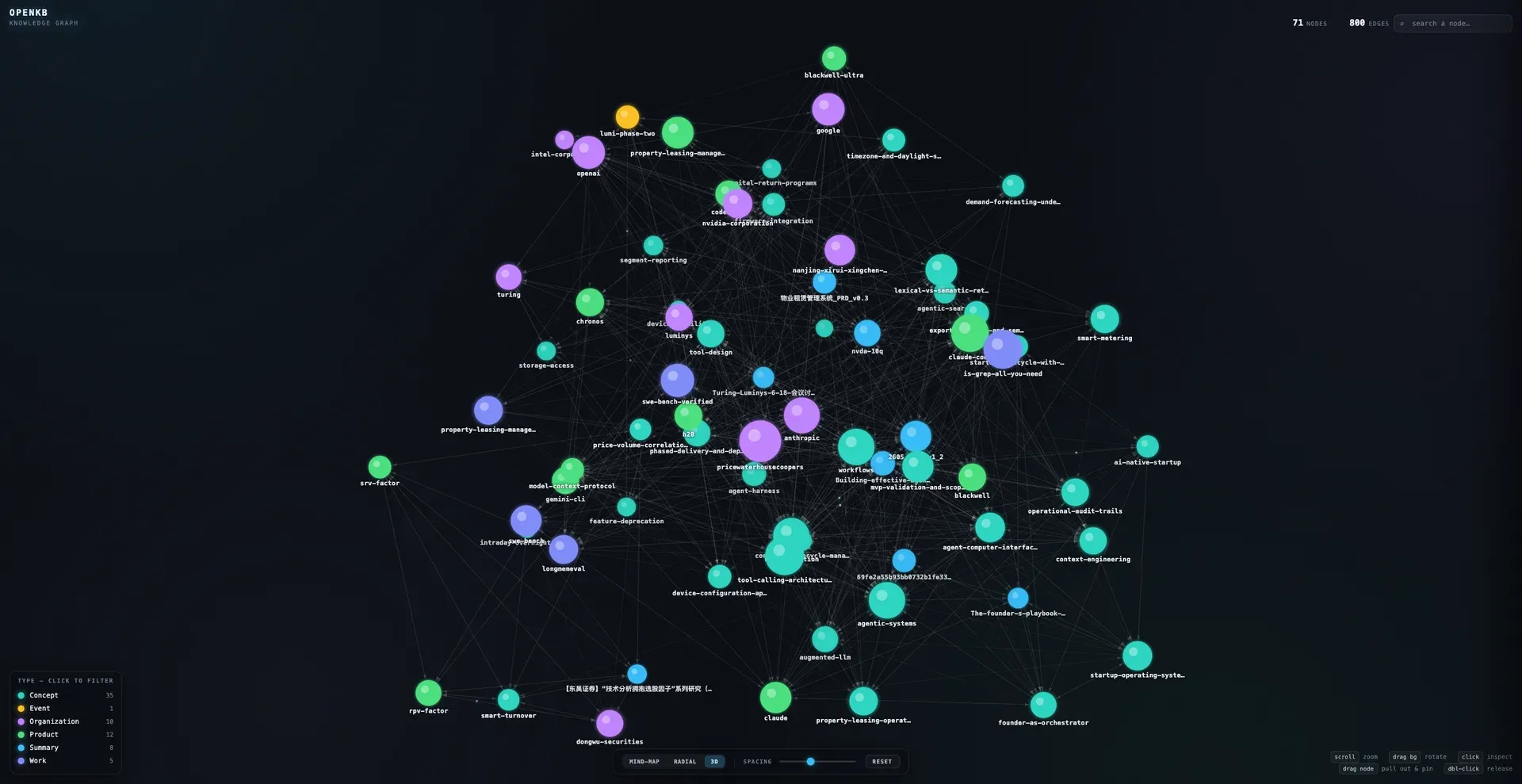
openkb visualizewrites a self-contained HTML page atoutput/visualize/graph.htmlshowing summaries, concepts and entities as nodes and wikilinks as directed edges. The page offers 3D, mind-map and radial modes, search, a type legend filter and a node inspector;--no-openskips opening a browser on headless machines (visualize guide). - HTML slide decks
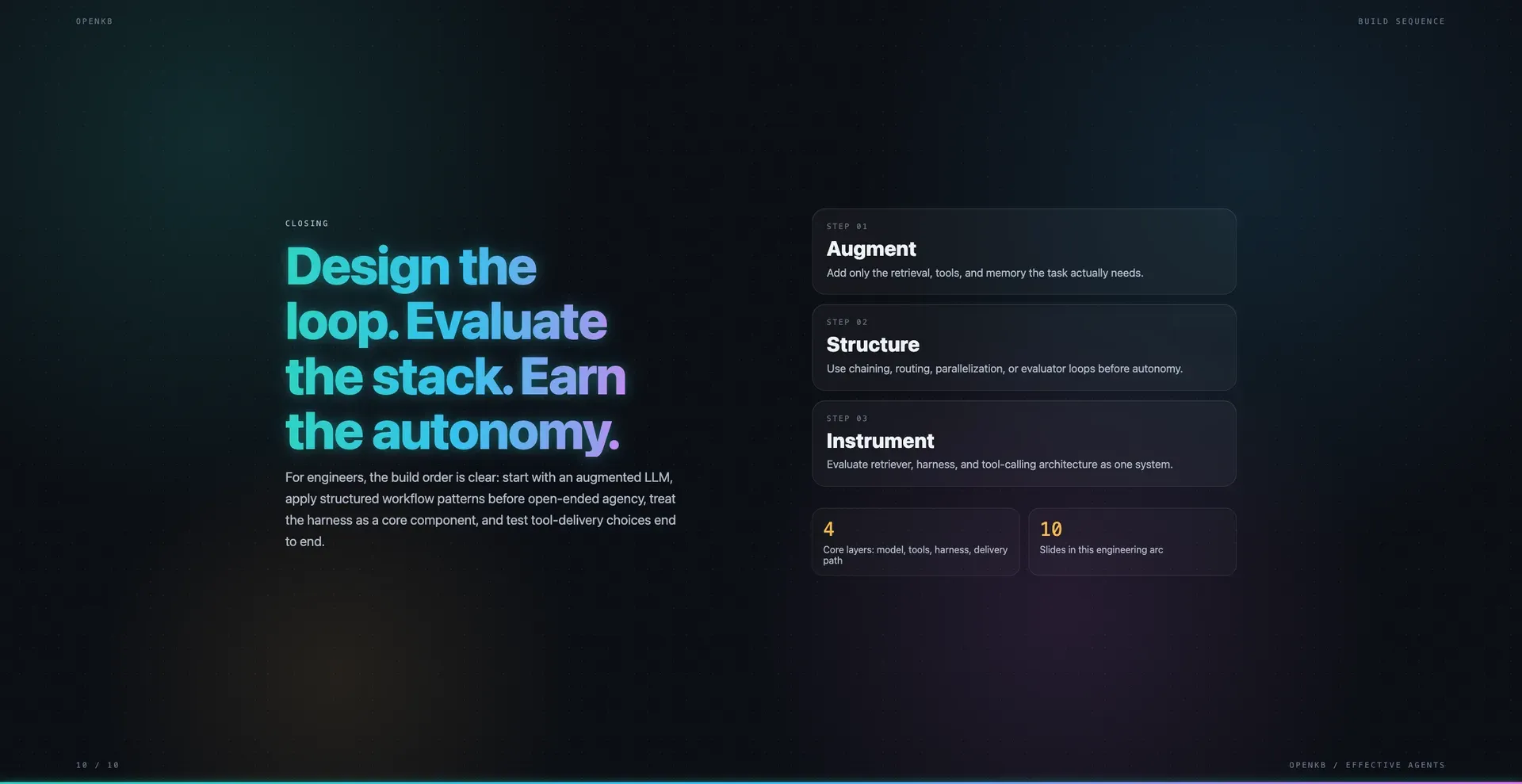
openkb deck new <name> "<intent>"generates a single-file HTML deck with inlined CSS and JavaScript atoutput/decks/<name>/index.html. Two themes ship with the package (openkb-deck-neonby default andopenkb-deck-editorial), third-party deck skills can be added, and--critiqueruns a second-pass HTML critic (slides guide). - Lint, watch and maintenance
openkb lintruns structural and knowledge health checks and writes reports towiki/reports/;--fixrepairs broken wikilinks first.openkb watchmonitorsraw/and compiles new files as they arrive.openkb removedeletes a document and its wiki pages, images, registry entries and PageIndex state, andopenkb recompileregenerates summaries and concept pages, overwriting manual edits. - Multi-provider LLM support Models are set in LiteLLM
provider/modelformat, for exampleanthropic/claude-sonnet-4-6,gemini/gemini-3-flash-previeworollama/llama3.1; OpenAI models can omit the prefix, and the default isgpt-5.4. A singleLLM_API_KEYis mapped to the provider's variable, OAuth providers (chatgpt/*,github_copilot/*) need no key, and Amazon Bedrock uses AWS credentials withparallel_tool_calls: null(configuration guide). - Local runtimes and LiteLLM tuning A
litellm:block in.openkb/config.yamlis forwarded to LiteLLM. The docs show raisingtimeoutand enablingdrop_paramsfor slow local runtimes such as Ollama, LM Studio and llama.cpp, extra headers for GitHub Copilot, and opt-in OpenRouter response caching. Aconcurrencykey caps concurrent LLM calls during ingest. - Knowledge Workbench web UI Installing
openkb[web]and runningopenkb-webserves a bundled single-page app athttp://127.0.0.1:7566/. It has Overview, Documents (drag-and-drop upload with progress), Query, Chat and Maintenance views, plus an Inspector timeline that shows retrieval and reasoning steps. Authentication is off by default; settingOPENKB_API_TOKENrequires a bearer token (Workbench and REST guide). - REST API The FastAPI service exposes endpoints under
/api/v1for listing and creating knowledge bases, adding documents (multipart upload), query, chat and chat sessions, list, status, lint, remove, recompile and file watchers.query,chat,add,removeandrecompilecan stream Server-Sent Events, and an OpenAPI reference is served at/docs. REST-created knowledge bases are stored underOPENKB_KB_ROOT(default~/.config/openkb/kbs). - Obsidian-compatible plain files The wiki is a directory of Markdown files with
[[wikilinks]]; pages follow the Google Open Knowledge Format (OKF) frontmatter specification. The README describes openingwiki/as an Obsidian vault to browse summaries, concepts and explorations in graph view, and using the Obsidian Web Clipper to drop articles intoraw/. - Agent CLI integration OpenKB ships a read-only
SKILL.mdso coding agents can navigate a compiled wiki without an MCP server. Claude Code installs it through the plugin marketplace (/plugin marketplace add VectifyAI/OpenKB), Gemini CLI throughgemini skills install, and Codex CLI through a manual symlink. The skill does not runadd,removeorlint --fixunless asked. - Installation The documented install is
pip install openkb; the latest code can be installed from GitHub with pip, or from a source checkout withpip install -e .. Because OpenKB pins a pre-release of PageIndex (pageindex==0.3.0.dev3), the docs note that some installers needpip install --pre openkboruv tool install openkb --prerelease=allow. Release assets on GitHub are the wheel and source archive with publish attestations.
Where OpenKB fits
Building a research wiki from papers
The quick start creates a directory, runs openkb init to choose the model, API key and wiki language, then adds papers one by one, as a directory or from a URL such as an arXiv PDF. init creates raw/, wiki/ with summaries, concepts, entities and sources, plus AGENTS.md, index.md, log.md and .openkb/config.yaml. Each added paper produces a summary and updates the shared concept and entity pages (commands walkthrough).
Asking questions over long PDFs
Books, reports and other PDFs of 20 pages or more are indexed by PageIndex into a tree, and openkb query or openkb chat answer from the wiki together with PageIndex retrieval. The project's examples use a roughly 22-page paper and a 700-page textbook; with PAGEINDEX_API_KEY set, scanned PDFs can be processed with PageIndex Cloud OCR.
Packaging a knowledge base as an agent skill
The Skill Factory turns a compiled wiki into a portable skill directory for Claude Code, Codex or Gemini CLI. The example in the repository was generated from one paper and includes the SKILL.md, its references and the generated marketplace.json; skill validate --strict returns a non-zero exit on warnings for use in CI, and skill eval reports trigger accuracy and body coverage.
Continuous ingestion with Obsidian
With openkb watch running, files dropped into raw/, for example by the Obsidian Web Clipper, are compiled automatically. The wiki/ folder can be opened as an Obsidian vault to follow wikilinks and use graph view, and openkb lint --fix repairs dangling links.
Running a local knowledge server for a team or frontend
openkb-web serves the REST API and the Knowledge Workbench from one process. The docs state that the server is unauthenticated by default and that OPENKB_API_TOKEN should be set when binding to a non-loopback host; clients identify knowledge bases by name under OPENKB_KB_ROOT and can consume streamed answers over SSE (REST reference).
Using local or subscription models
Because model calls go through LiteLLM, the configuration guide documents setups for Ollama, LM Studio and llama.cpp with longer timeouts, GitHub Copilot and ChatGPT subscriptions through OAuth, OpenRouter, and Amazon Bedrock with AWS credentials. Keys are read from the shell environment, the knowledge base's .env or a global ~/.config/openkb/.env.
Install
pip install openkbReviews of OpenKB
Be the first to share your experience with OpenKB.
Write a review
Loading review form…
Found OpenKB useful? Upvote it todayYour vote helps other IT teams find it in the daily ranking.