
What is Maintenant?
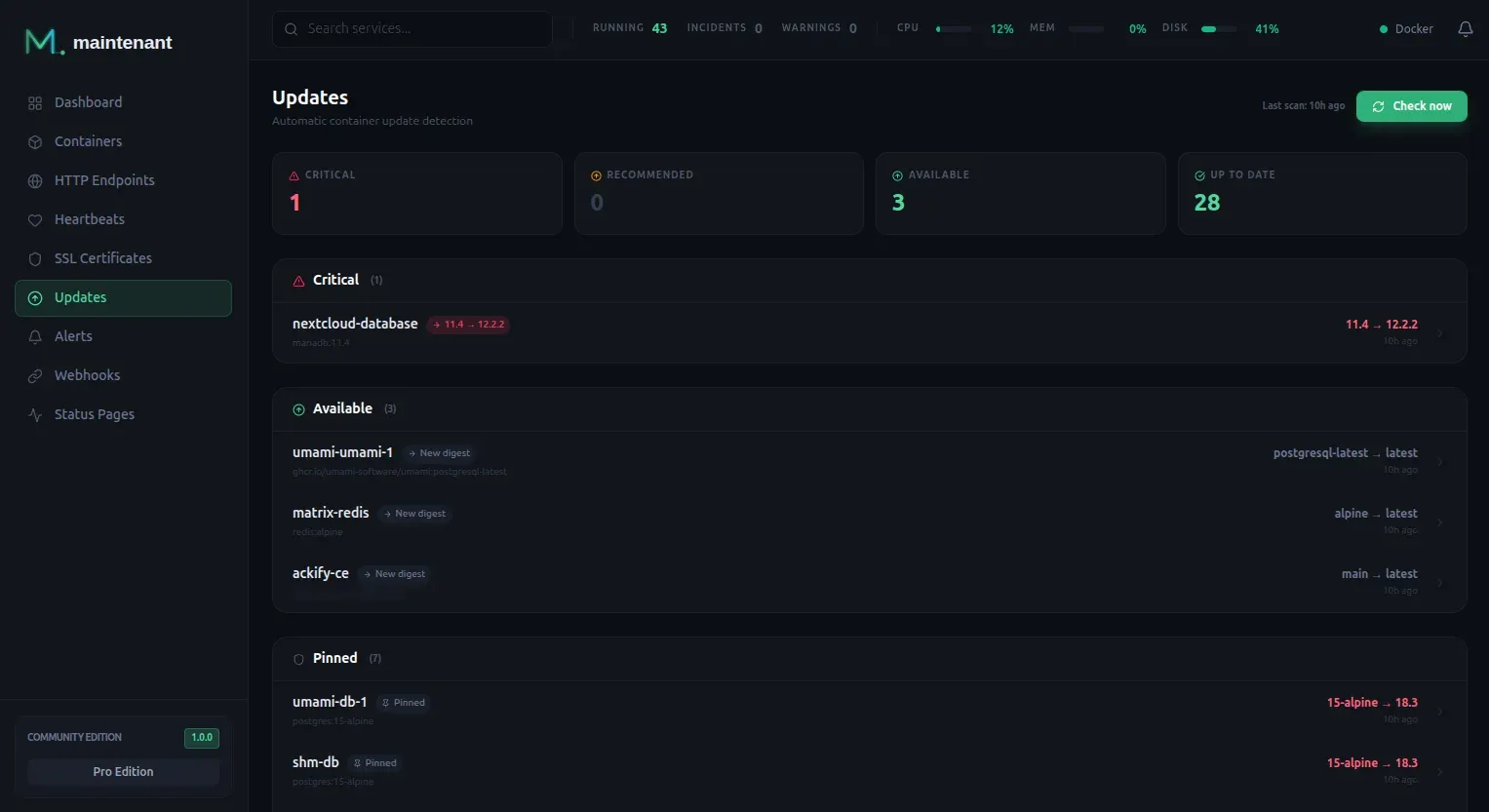
Maintenant is a self-hosted monitoring tool for Docker, Docker Swarm and Kubernetes hosts. It discovers running containers on its own and watches their state, health checks, restart loops, logs and resource use, and the same instance runs HTTP and TCP endpoint checks, TLS certificate monitors, cron job heartbeats, image update detection, a network exposure audit and a public status page. Everything ships as a single Go binary with an embedded Vue 3 interface and SQLite storage, as described in the architecture documentation. The README sets it against a stack of Prometheus, Grafana, Alertmanager, exporters, Loki and Trivy, and states that application metrics queried with PromQL remain a job for Prometheus.
Maintenant is published by kOlapsis in Bordeaux, France. The pricing page states that it is built by one developer without investors and that licence sales fund full-time work on the open-source core; the project is also a winner of the Hyper Open X call for projects, funded by the French government under France 2030. Version 1.0.0 was published on March 5, 2026, and a read-only live demo runs the Pro edition on a real stack.
The core has been licensed under the Apache License 2.0 since version 1.8.0 (September 29, 2026), which moved it from AGPL-3.0. The code unlocked by paid keys, in internal/commercial/ and frontend/src/commercial/, is source-available under the Maintenant Commercial Source License, and production use requires a matching key. All editions run the same binary. Community is free for one host, with up to 10 endpoints, 5 heartbeats and 5 certificates. Personal costs €149 including VAT once, with one year of updates (then €59 including VAT per extra year), and covers one person's own infrastructure with up to 20 remote hosts. Pro costs €29 per month or €290 per year excluding VAT, with a 14-day trial, and adds unlimited hosts, team alerting features, email support and the right to monitor third-party infrastructure. The signed licence answer is cached, so an instance falls back to Community only after 60 days without reaching the licence server.
Distribution covers a container image on GitHub Container Registry (ghcr.io/kolapsis/maintenant) and, since 1.10.1, Docker Hub (kolapsis/maintenant), signed and shipped with SLSA provenance and an SBOM; Kubernetes manifests and a Helm chart in the repository; statically linked Linux binaries for amd64 and arm64 with an install script; and cloud-init files for Hetzner Cloud, DigitalOcean, Scaleway, OVHcloud and Vultr. Container monitoring needs Docker Engine 19.03 or later, while endpoints, certificates and heartbeats work without any container runtime. The website lists Linux, macOS and WSL2 as compatible environments.
The latest release is v1.11.0, published on October 25, 2026. It adds heartbeat editing from the dashboard, a subject label for email channels, acceptance of IP addresses in the Host header, more detailed MCP tool descriptions and a Coolify deployment guide. Version 1.10.0 tightened defaults for public pages, accepted host names, SMTP and MCP token scopes, and 1.9.0 added alert hand-off to AI agents. By design, Maintenant has no login of its own, is meant to sit behind an authenticating reverse proxy and never starts, stops or changes containers. The project website publishes comparisons with Beszel, Netdata, Prometheus with Grafana, Datadog and Uptime Kuma.
Key capabilities
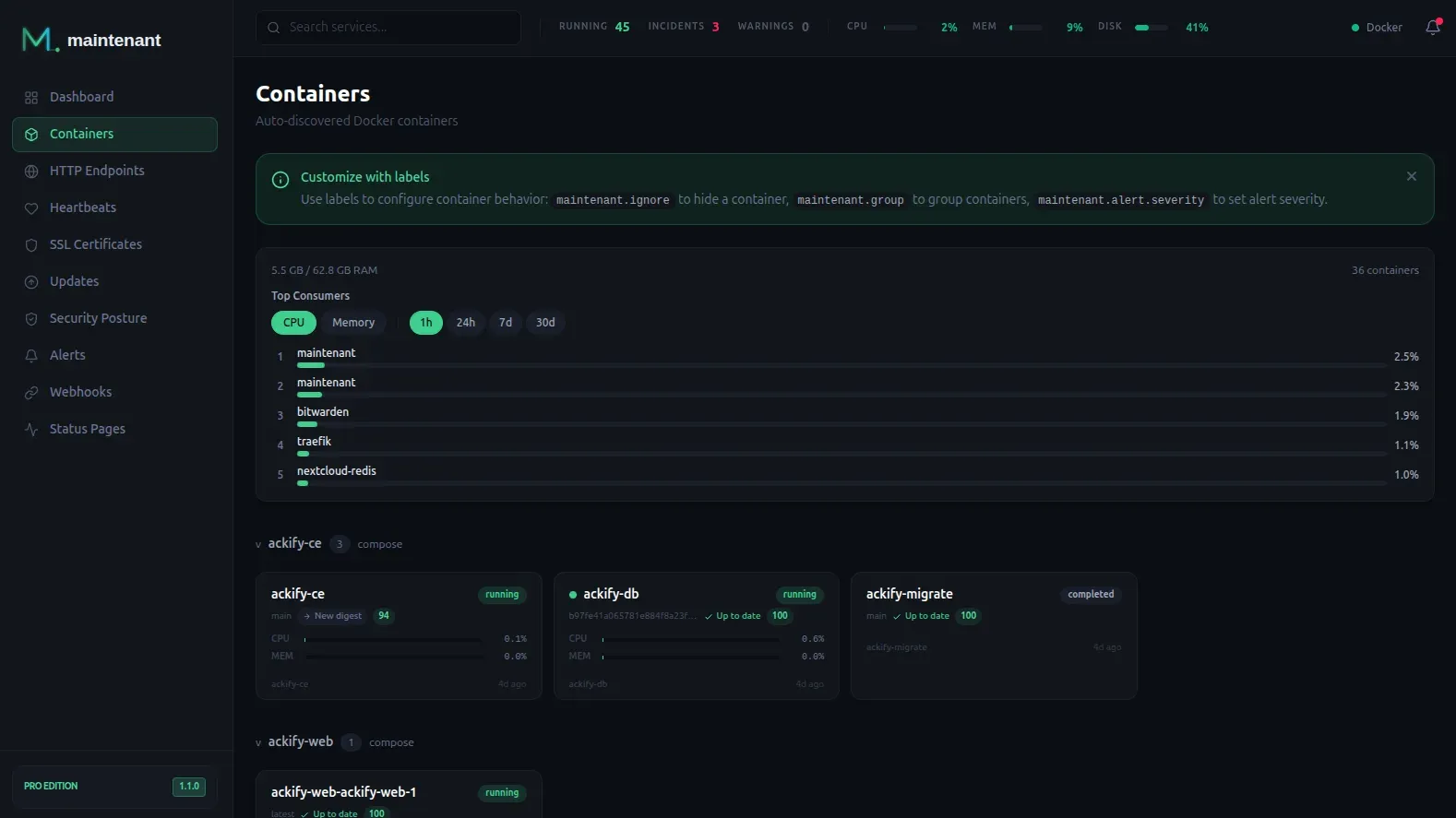
- Container auto-discovery and live logs Containers on Docker, Docker Swarm and Kubernetes are picked up as they start, with state changes, health checks, restart loops and stopped containers tracked without configuration, and logs streamed live with stdout and stderr separated. Compose projects are grouped automatically, and labels such as
maintenant.ignoreandmaintenant.grouphide or group containers. Access is read-only, and discovery has no quota in any edition. - Kubernetes workloads Pods are grouped by their Deployment, StatefulSet, DaemonSet or Job, and each workload gets an aggregated status: healthy, degraded, failed or progressing. System namespaces are excluded by default, and environment variables set a namespace allowlist or blocklist. CPU and memory figures require metrics-server, and PersistentVolumeClaims are not tracked, according to the Kubernetes guide.
- HTTP and TCP endpoint checks Checks are declared with Docker labels such as
maintenant.endpoint.httpandmaintenant.endpoint.interval, derived from Traefik and Caddy labels as an opt-in, or added by hand. Results include response times, uptime history, 90-day sparklines and failure and recovery thresholds. Since 1.10.0, label-declared checks accept onlyGETandHEAD, ignore authorization headers and refuse link-local and multicast addresses. - Heartbeat and cron monitoring Each heartbeat monitor provides a ping URL with a secret, rotatable token that a job calls with
curl. Maintenant records start and finish, duration and exit code, and alerts when a deadline plus grace period is missed. Outbound heartbeats, added in 1.8.0, make an instance ping another instance every 30 seconds to 24 hours, limited to HTTPS targets on public addresses. - TLS certificate monitoring Certificates are detected from HTTPS endpoints, and standalone monitors can be added for any domain. Maintenant validates the full chain and alerts 30, 14, 7, 3 and 1 day before expiry; OCSP stapling checks are part of Personal and Pro (certificate monitoring).
- Resource metrics CPU, memory, network and disk I/O are collected per container and per host, with a top-consumers view and per-container thresholds with debounce. History reaches 7 days on Community, 30 days on Personal and 90 days on Pro.
- Update intelligence Maintenant queries OCI registries for newer versions of fixed tags and, for floating tags such as
latest, compares the running digest with the current one. It shows update and rollback commands for Compose, plain Docker, Swarm and Kubernetes for the operator to run. Scans run every 24 hours by default, with separate entries per host since 1.9.0. - Network exposure and security posture Every edition flags ports bound to
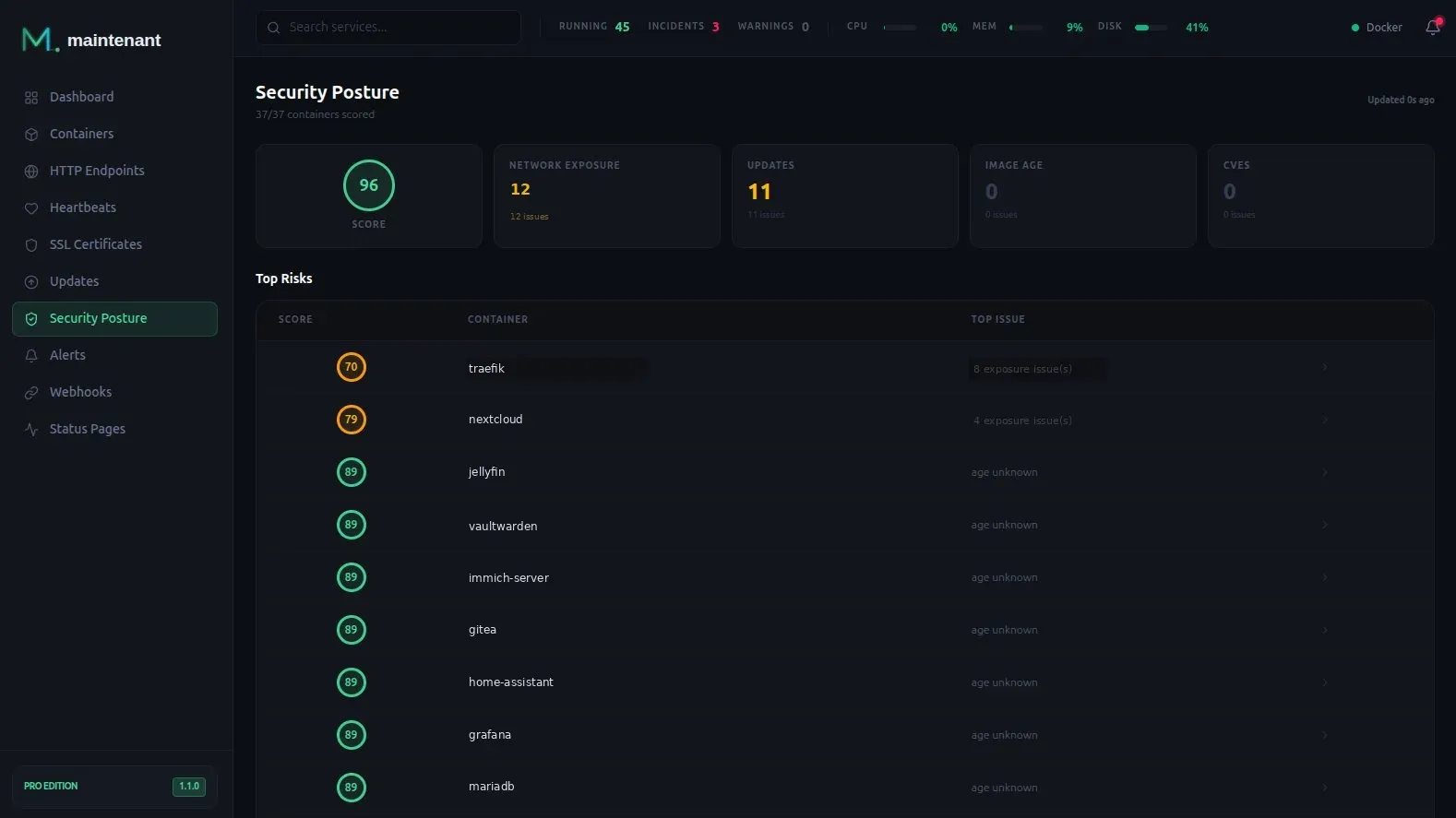
0.0.0.0, exposed database ports, host-network mode, privileged containers and Kubernetes NodePort or LoadBalancer Services. Personal and Pro add CVE enrichment through OCI manifest inspection, a risk score per container, changelog intelligence and a security posture dashboard. - Host OS end-of-support alerts Each host's distribution and version are checked against the support cycles of Debian, Ubuntu, RHEL, Rocky, Alma, Alpine and SLES, with an alert 30 days before free security support ends and another once it has ended. The dates ship with the binary and refresh daily from endoflife.date when the network allows.
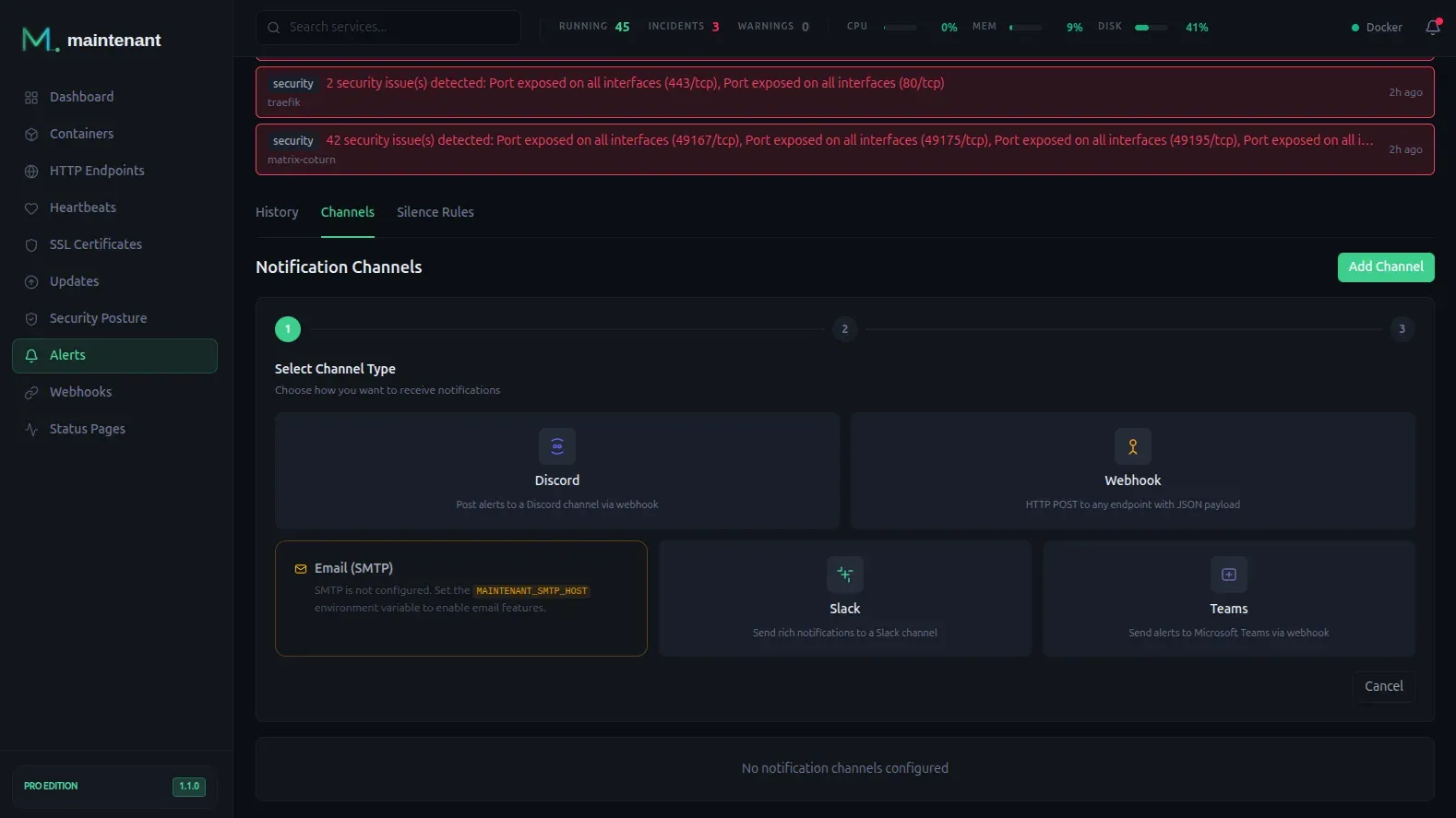
- Alert engine and channels One pipeline covers container problems, endpoint failures, missed heartbeats, certificate issues, resource thresholds, available updates, Swarm and Kubernetes health, offline agents and hosts losing OS support. Channels stay silent until a trigger routes alerts to them by severity, source and scope; alerts can be acknowledged and silenced, and each notification gets three delivery attempts. Discord and webhooks are in Community, email and Telegram in Personal, and Slack, Microsoft Teams, five-level escalation policies and maintenance windows in Pro (alerts documentation).
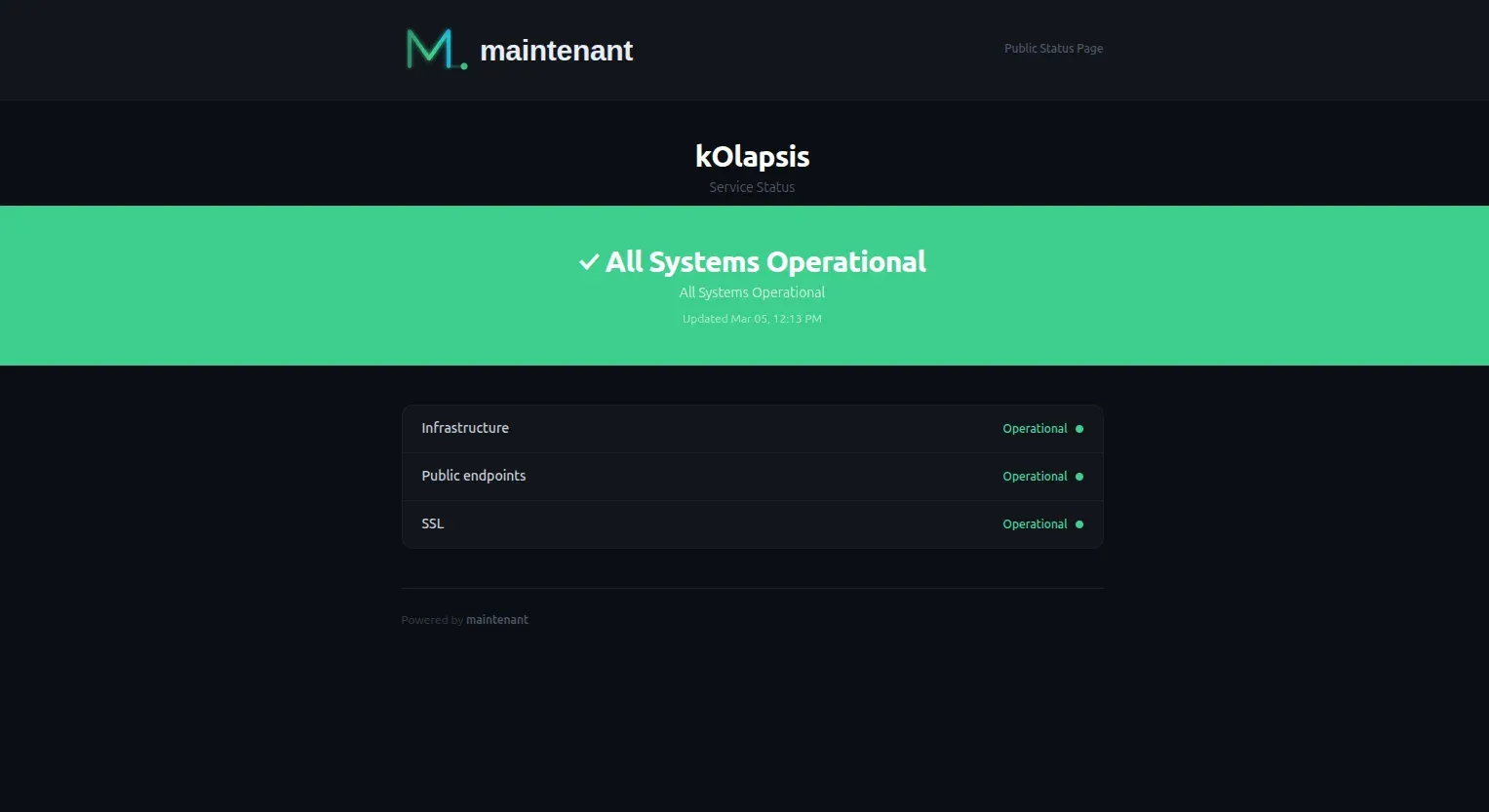
- Public status page The status page aggregates severity across monitors, updates live over Server-Sent Events and can be served on its own subdomain; since 1.10.0 it no longer exposes monitor ids or targets. Community allows 3 components, Personal unlimited components and incident timelines, and Pro adds branding and email subscribers with double opt-in through the operator's SMTP server.
- Multi-host agents The same binary runs in
embedded,serveroragentmode. Agents stream container state, endpoints, certificates and host metrics over a persistent, mutually authenticated gRPC connection, enroll with a one-time token and a locally generated Ed25519 key pair, replay what they saw while disconnected and can be revoked from the interface. Personal allows up to 20 remote hosts and Pro is unlimited (multi-host documentation). - Built-in MCP server A Model Context Protocol server exposes 51 tools covering every monitoring area, alert routing and the status page. 17 of them write, for example to acknowledge alerts or open incidents, and
MAINTENANT_MCP_READ_ONLY=truekeeps only the 34 read-only tools. Local clients connect over stdio with--mcp-stdio, remote clients over Streamable HTTP at/mcpwith OAuth2, PKCE andreadorread writescopes (MCP documentation). - REST API, live updates and PWA A REST API under
/api/v1/and Server-Sent Events streams expose the interface data, and the frontend installs as a progressive web app. The API reference notes that the API has no authentication of its own. - Storage engines SQLite in WAL mode is the default datastore. A server or embedded instance can use PostgreSQL 14 or newer instead, which keeps agent identities and enrolments off the instance's own machine, and
--copy-store-tomigrates an existing installation. Agents always keep their state in SQLite. - Installation options The Docker Compose quick start mounts the Docker socket,
/procand/etc/os-releaseread-only, with a read-only root filesystem andno-new-privileges; the process drops tonobody, and a Docker socket proxy is supported. On Kubernetes, manifests or the Helm chart deploy a single replica with a 10 GiB volume. The native installer verifies SHA256 checksums and the cosign signature, creates a systemd service listening on127.0.0.1:8080and supports pinned versions and air-gapped installs (install documentation). - Accepted hosts and telemetry Host names other than localhost must be declared in
MAINTENANT_BASE_URLorMAINTENANT_ALLOWED_HOSTS; IP addresses are accepted since 1.11.0. Anonymous telemetry sends one hourly snapshot of object counts, edition, version and runtime figures, without host names, IPs, URLs or keys, andMAINTENANT_DISABLE_TELEMETRY=1turns it off.
Where Maintenant fits
Monitoring a single Docker host
The quick start is one Compose service with ghcr.io/kolapsis/maintenant:latest, the read-only Docker socket and a data volume for the SQLite database. After docker compose up -d, the dashboard on port 8080 lists the running containers with health, restart loops, resources and logs. The entrypoint grants the unprivileged user the group of the mounted socket, and a socket owned by group root needs DOCKER_GID=0. Because the UI and API have no authentication, the security guide describes a reverse proxy with Traefik or Caddy and an authentication layer such as Authelia or authentik.
Declaring checks next to the services they watch
Each Compose service can carry its own monitoring labels: maintenant.endpoint.http or maintenant.endpoint.tcp for a check, an interval, a failure threshold and maintenant.alert.severity for routing, picked up when the container starts. The README's full-stack example labels an API health URL, a PostgreSQL port and a Redis port this way, and the Docker labels reference lists the keys for TLS, restart thresholds, update tracking, grouping and exclusion.
Watching backups and scheduled jobs
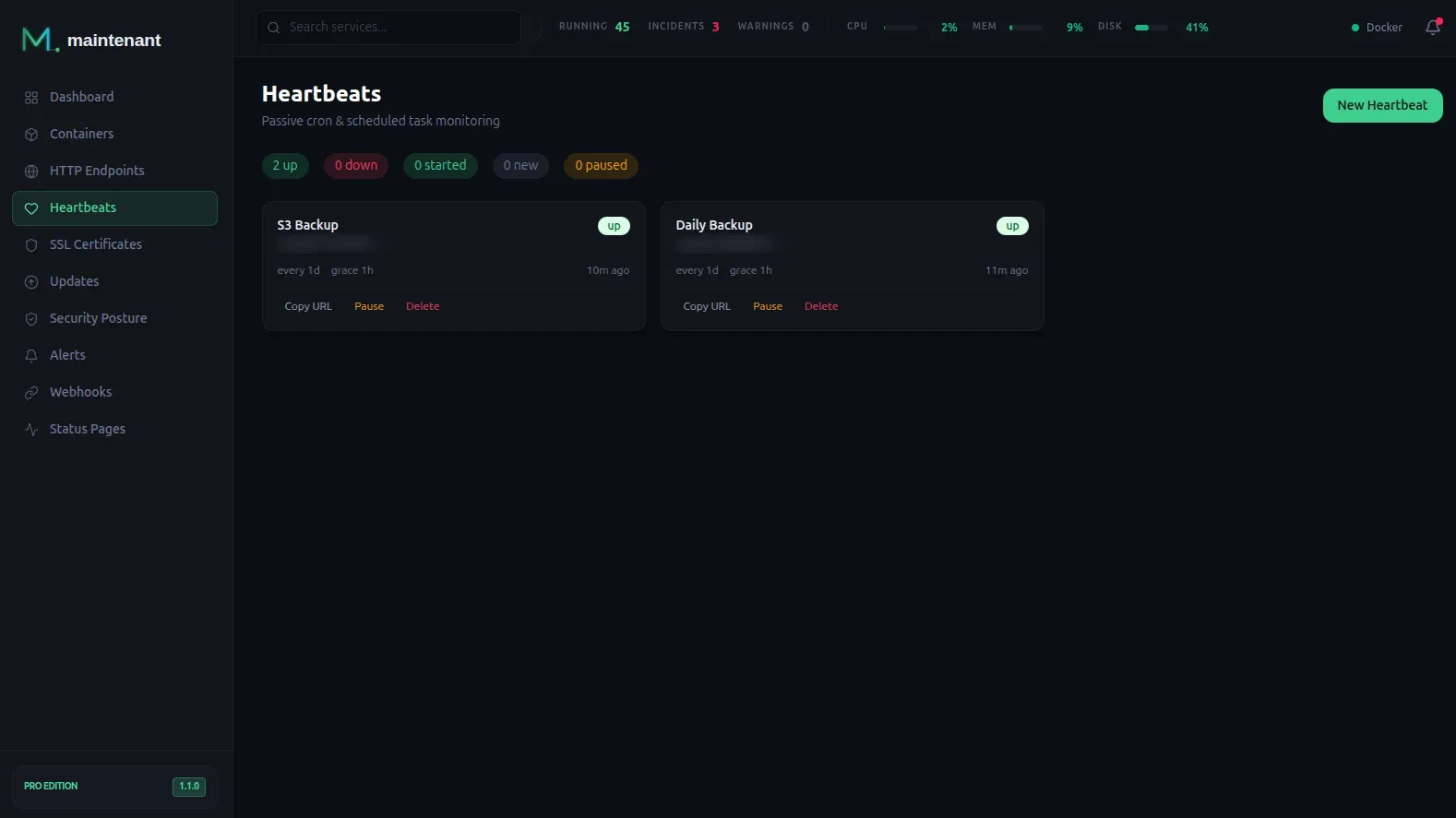
A heartbeat monitor created in the interface or the API returns a ping URL; the job appends a curl call that can pass its exit code, and Maintenant tracks runs, durations and missed deadlines. The project's screenshot shows two backup jobs with a daily interval and a one-hour grace period. Outbound heartbeats let two Maintenant instances ping each other, so an instance that stops raises an alert on the other.
Monitoring several servers from one dashboard
With a Personal or Pro key, the central instance opens a gRPC listener, and the interface generates a docker run command with a one-time enrollment token for each remote host. Agents run read-only and every entity is attributed to its host. The PostgreSQL storage guide describes pointing the server at an existing PostgreSQL database so that a replacement instance can take over the fleet without re-enrolling agents.
Running inside a Kubernetes cluster
The Helm chart is installed from a repository clone with helm install maintenant ./deploy/helm/maintenant -n maintenant --create-namespace, or the raw manifests are applied with kubectl apply -f deploy/kubernetes/. The Kubernetes guide lists storage class values for managed clusters at Hetzner, DigitalOcean, Scaleway, OVHcloud and Vultr. The pod runs as a non-root user with all capabilities dropped, and the cluster role grants only read verbs.
Handing alerts to an AI agent
The AI agents guide describes a loop in which fixed rules detect a problem without any model involved, a webhook pushes alert.fired and alert.resolved events, and an agent investigates through the MCP server. The repository includes a dependency-free Python receiver that starts a headless Claude Code session per alert, limited to read-only MCP tools reached through --mcp-stdio, and writes the diagnosis to a report file. The receiver can call OpenCode instead, and an n8n workflow can pair a Webhook trigger with an AI Agent node whose MCP client points at /mcp.
Install
curl -fsSL https://install.maintenant.dev | sudo bashReviews of Maintenant
Be the first to share your experience with Maintenant.
Write a review
Loading review form…
Found Maintenant useful? Upvote it todayYour vote helps other IT teams find it in the daily ranking.