
What is freehire?
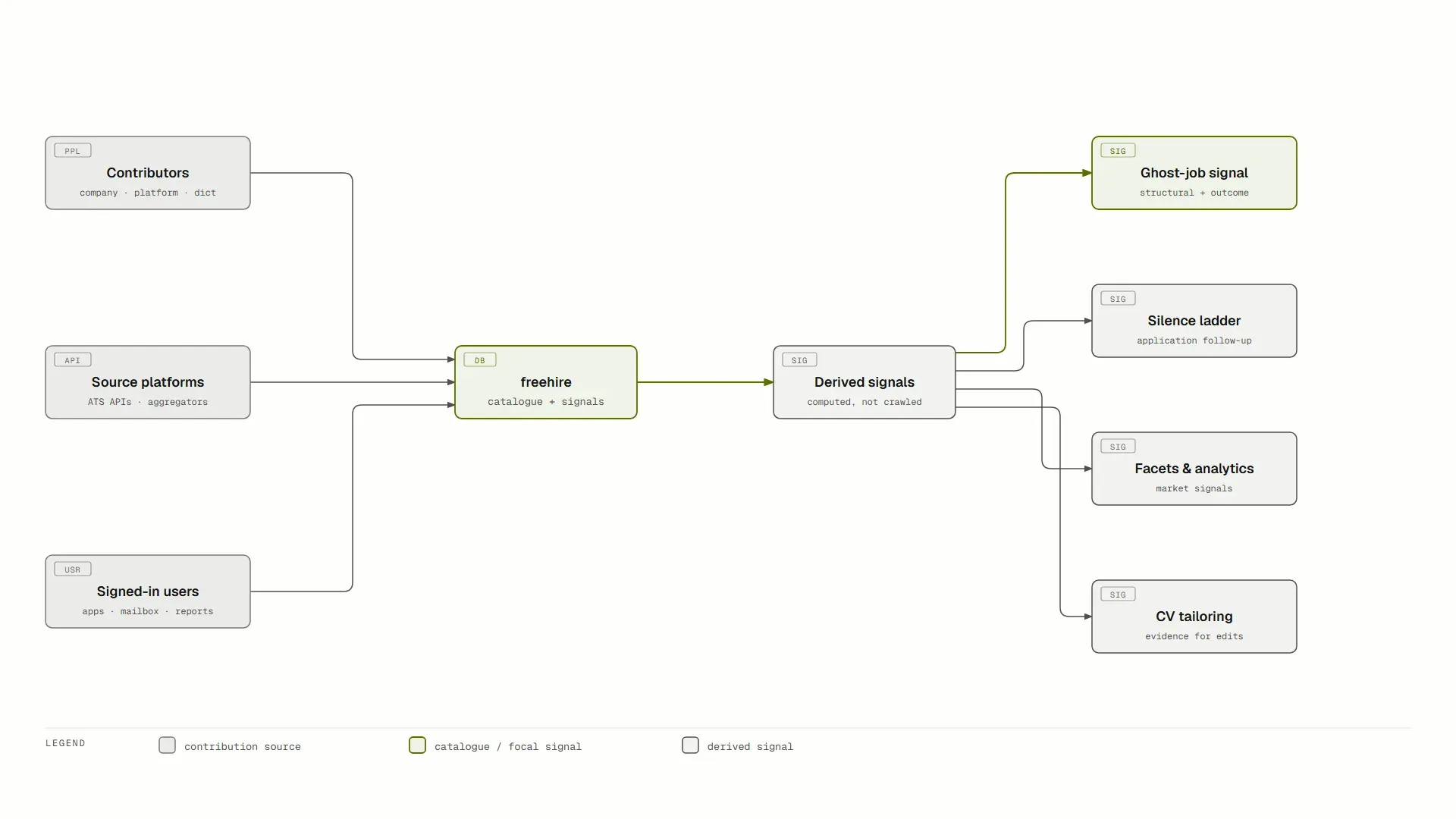
freehire is an open-source job search engine that collects tech job postings directly from company career pages and applicant tracking systems, normalizes them into one schema, removes duplicates and serves the result through faceted search, a public HTTP API, a CLI and an MCP endpoint. The project describes itself as "the open-source search engine for job seekers". The code is published on GitHub as strelov1/freehire under the MIT license, and the same code runs the hosted service at freehire.me. According to the site's privacy policy, the hosted service is operated by ILYA STRELOV TECNOLOGIA DA INFORMACAO LTDA in Florianópolis, Brazil.
The catalogue is built by crawlers called adapters. Each adapter speaks to one source: a multi-tenant ATS such as Workday, Greenhouse, Lever, Ashby or iCIMS, an aggregator or job board such as Adzuna, a list of public Telegram channels, or the careers site of a single company. In a snapshot dated 30 October 2026 the README counts 4,785,488 unique open postings from 701,972 companies across 421 sources, of which 160 ATS platforms, 179 aggregators and job boards and 58 direct company feeds carried postings at the time; the live figures are published on freehire.me/sources and the open metrics page. A posting reposted on several boards is counted once, and a liveness sweep closes postings that return 404 or expire at the source.
On top of the catalogue the repository contains a full job-seeker workspace: saved searches with email, Telegram and push digests, market analytics, a ghost-job signal, a CV builder with PDF templates, a deterministic CV to vacancy match score, LLM-based fit analysis and CV tailoring, an application board, a mail inbox that links recruiter replies to applications, and an in-app assistant with five presets. The feature reference in docs/features.md marks which features need an OpenAI-compatible LLM endpoint; in a self-hosted deployment without one, those features stay disabled.
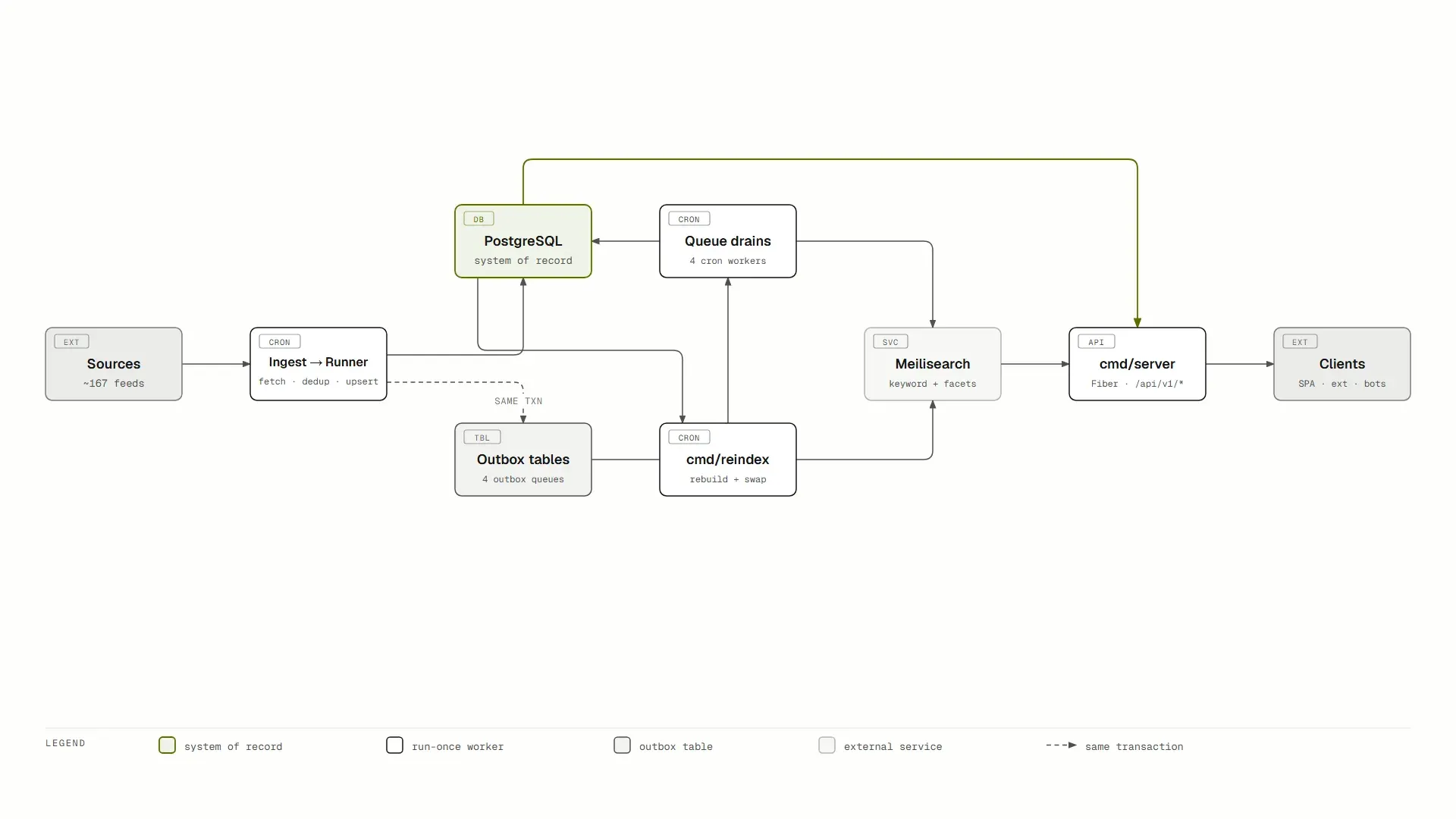
The backend is written in Go with the Fiber v2 HTTP framework. PostgreSQL with pgvector is the system of record, sqlc generates type-safe database access from SQL, Meilisearch serves full-text and faceted search, Redis handles rate limiting and realtime fan-out, and S3-compatible object storage holds CVs, headshots and previews. LLM calls go through langchaingo to any OpenAI-compatible endpoint, with Bifrost as a gateway and Langfuse for tracing. The frontend is a server-rendered SvelteKit 2 application with Svelte 5 and Tailwind 4. The API server only serves requests; crawling, enrichment, embedding, indexing and notifications run as separate run-once workers meant for cron. The architecture document describes the crawl-to-search topology.
Distribution covers several surfaces. The hosted web app is at freehire.me, an iOS app is listed on the App Store, and a side-panel browser extension is available in the Chrome Web Store and on Firefox Add-ons. A separate freehire-cli repository provides the command-line client, and freehire-mcp provides an MCP server. Self-hosting runs the whole stack with Docker Compose. The repository does not publish semantic version releases for the service: its GitHub releases are deployment tags named by date and time (for example deploy-20261112-2320), and separate tags such as extension-v0.1.14 version the browser extension.
The hosted service has a free plan for finding and tracking jobs and a Pro plan at 5 US dollars per month that adds the AI features for applying, as listed on the pricing page. A commercial Jobs API is billed separately. Employers can also publish vacancies directly on freehire and receive applications there. Similar job-search tools in the directory include Dossier, a self-hosted resume and application tracker that lists freehire as one of its job sources, and AI Job Search, a Claude Code workflow for evaluating jobs and tailoring CVs.
Key capabilities
- Postings crawled from the source Each listing is fetched from a company's own ATS board, an aggregator feed, a Telegram channel or a single company's careers site, and links back to the original posting. Every source runs on its own schedule, several times a day for most boards, and a board that keeps failing backs off instead of being retried on every run. A source's kind (ATS platform, aggregator, company site) is a property of the adapter's Go type, so it is classified without a network call.
- Normalization and deduplication Every posting is mapped into one schema and deduplicated on a stable key. Ingest never stores the same posting from the same source twice, and a later pass clusters near-duplicates by role and company across different boards, preferring the employer's own ATS over an aggregator copy. The listing still shows where the role is actually hosted.
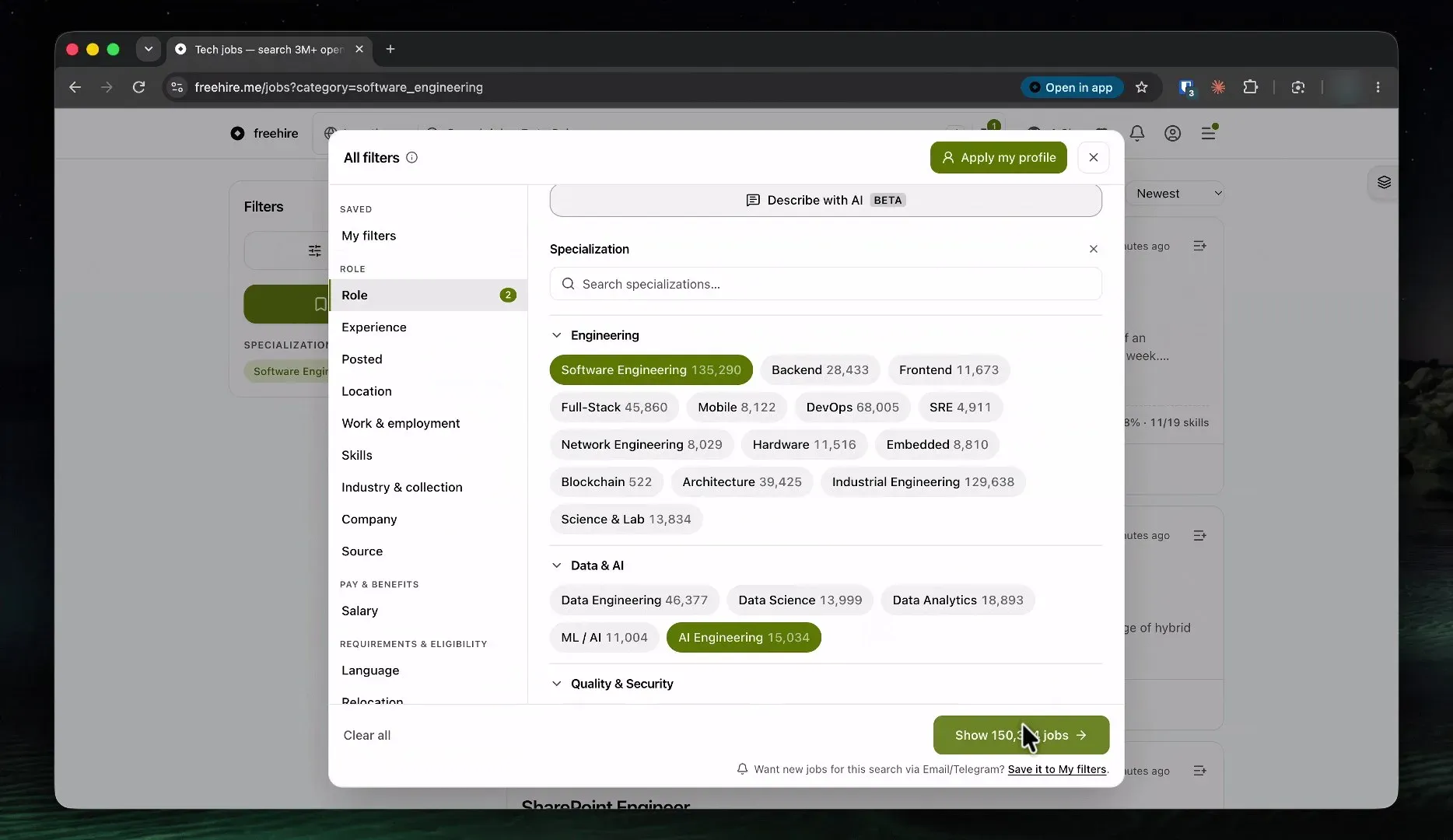
- Faceted search with curated dictionaries Full-text search runs on Meilisearch and can be narrowed by region, work mode, seniority, specialization, skills, salary, company, source and freshness. Facets are derived from closed, curated dictionaries rather than model guesses: an unrecognized value produces no tag. The site documents around twenty filters, and most of them can also be negated.
- LLM enrichment from a queue A separate enrichment worker reads full posting text and fills fields a dictionary cannot tag, such as team size or visa sponsorship. It runs from a queue so a slow model call does not hold up ingest, and every result is validated against a fixed schema; a result that fails validation is dropped. Semantic chunks are embedded into pgvector by a separate embed worker.
- Saved searches, digests and shared boards A search can be saved and subscribed to, and freehire then sends a digest of new matches by email, Telegram or push, instantly or daily. A shared board is a link-addressed, unindexed view of a saved search that can be handed to someone else.
- Market analytics and the ghost-job signal Insights and trends pages aggregate over the whole catalogue: skills gaining postings, pay by role and region, and companies that are hiring, built from periodic rollups. The ghost-job signal flags postings whose observable behaviour (repost patterns, age, movement) suggests they are not being filled, and shows the evidence alongside the flag.
- CV builder with PDF templates Structured CVs are rendered to PDF through Typst templates, each marked for whether it survives an ATS parser and whether it prints a headshot. Editing is revisioned and undoable, contact details can be masked per CV, and opt-in tracer links can record when the links printed in a CV are followed.
- Match score and fit analysis A deterministic score compares a CV with a posting's requirements and only credits what it can verify from the CV. An optional LLM analysis on top argues the fit in three stages and streams the result. The score is free; the analysis needs an LLM endpoint and is metered by a daily allowance.
- CV tailoring backed by an experience bank Tailoring rewrites one CV against one vacancy requirement by requirement. Every edit must be backed by an evidence atom in the experience bank, and only atoms the user asserted may be written into a CV; the check lives in the service code rather than in a prompt. An autopilot mode snapshots the CV before a full pass so the run can be undone. Cover letters are part of the Pro plan.
- Application board and event ledger Viewed, saved and applied jobs land on a board with stages from Preparing through Applied and Interview to Offer. An application is a durable record that survives the deletion of its posting, and an append-only ledger keeps the history of each application. Reminders fire when a saved job is about to age out or an application has been silent too long.
- Mail inbox Users can connect Gmail or use a hosted address; recruiter replies are classified, linked to the application they answer and move its stage forward. According to the privacy policy, Gmail access is read-only, limited to hiring-related mail, and classification first uses a keyword vocabulary on freehire's own servers before falling back to TypeSafe or the LLM provider. Mislinked mail can be relinked by hand.
- In-app assistant A tool-calling agent runs inside the API process and streams over SSE. It has five presets: general chat, browsing the catalogue, filling out the profile, CV tailoring and interview rehearsal against a specific vacancy the user applied to. It has no shell and no minted credential; tools call Go services with the session owner's id. The composer accepts dictation.
- Browser extension The extension puts the job-application agent in the browser side panel for Chrome, Chromium browsers with a side panel and Firefox. It reads the open posting when asked, shows a skill coverage score against the freehire profile, and fills application forms from the profile one field at a time; it never presses Submit. Form filling is part of the Pro plan.
- Public API, CLI and MCP The catalogue is served over a keyless HTTP API at freehire.me/api/v1, documented at freehire.me/docs/api, with JSON responses in a fixed data/meta/error shape. Per-user features authenticate with a session cookie or an API key, and the CV builder, inbox and subscriptions are cookie-only. The CLI installs with a shell script and stores its key in ~/.freehire/creds.json; the MCP endpoint at freehire.me/api/v1/mcp connects Claude, ChatGPT, Grok, Claude Code, Codex, Cursor and Gemini CLI with OAuth sign-in.
- Free and Pro plans on freehire.me The free plan includes every posting and filter, AI search, alerts, the application board, the inbox, ghost-job warnings, MCP and CLI access and anonymous employee referrals. Pro costs 5 US dollars per month, with a yearly option at a 17 percent discount, and adds CV tailoring with cover letters, an unlimited assistant, extension form filling and background auto-apply limited to 3 applications per day. The pricing page offers a refund on request within 14 days.
- Commercial Jobs API plans The read API is free for personal and non-commercial use. An API plan at 29 US dollars per month licenses the data for use in a product, and a Data plan at 99 US dollars per month adds bulk catalogue files, which the pricing page marks as coming soon. API plans are billed separately from Pro and do not include its AI features.
- Self-hosting with Docker Compose Make up builds and starts the API, web frontend, PostgreSQL, Meilisearch, Redis and S3-compatible storage in Docker, and migrations apply on first database initialization. JWT_SECRET is required; OAuth and LLM credentials are optional, and the features they gate stay disabled when unset. Workers such as ingest, enrich, embed, search-drain and reindex are run separately, typically from cron, and no worker hard-deletes jobs.
- Contributing sources Adding a company that runs on a supported ATS is one row in the boards catalog, submitted through the contribute form on the site or with the add-board command. A new ATS platform needs a new adapter in internal/ingest/sources. The README asks contributors to open an issue first with the company name and careers URL.
Where freehire fits
Searching tech jobs across many ATS platforms
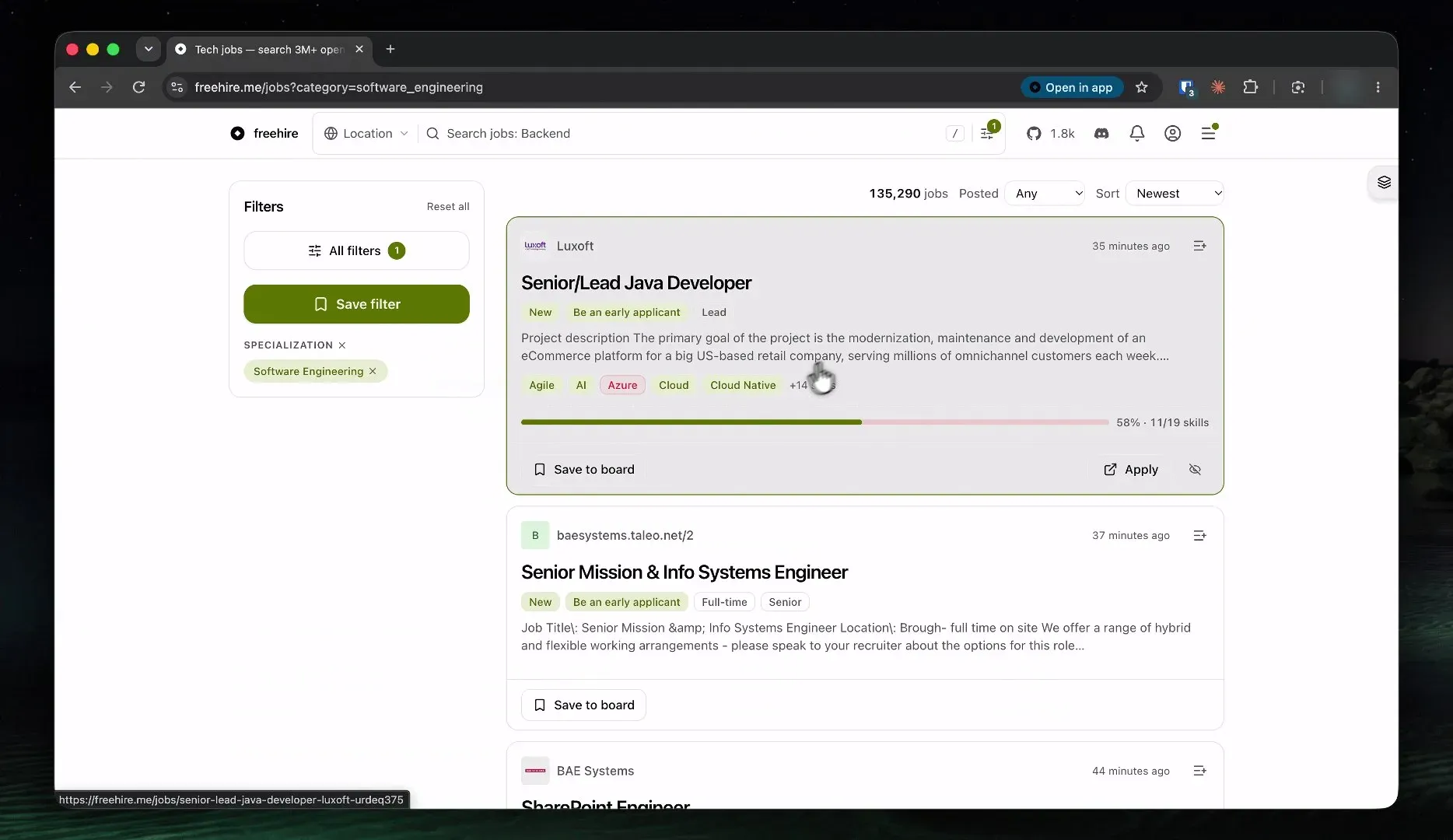
A job seeker opens freehire.me/jobs, types a query and narrows the results by region, work mode, seniority, specialization, skills and salary. Each result links to the employer's own ATS posting, shows the source platform and carries the ghost-job flag where one applies. Searches can be saved under My filters.
Getting alerts for new matching postings
After saving a search, the user subscribes to it and chooses email, Telegram or push, either instantly or as a daily digest. The same channels carry reminders from the application board, such as an application that has been silent for a set time. Notification settings live under the account's saved searches page.
Preparing an application with a tailored CV
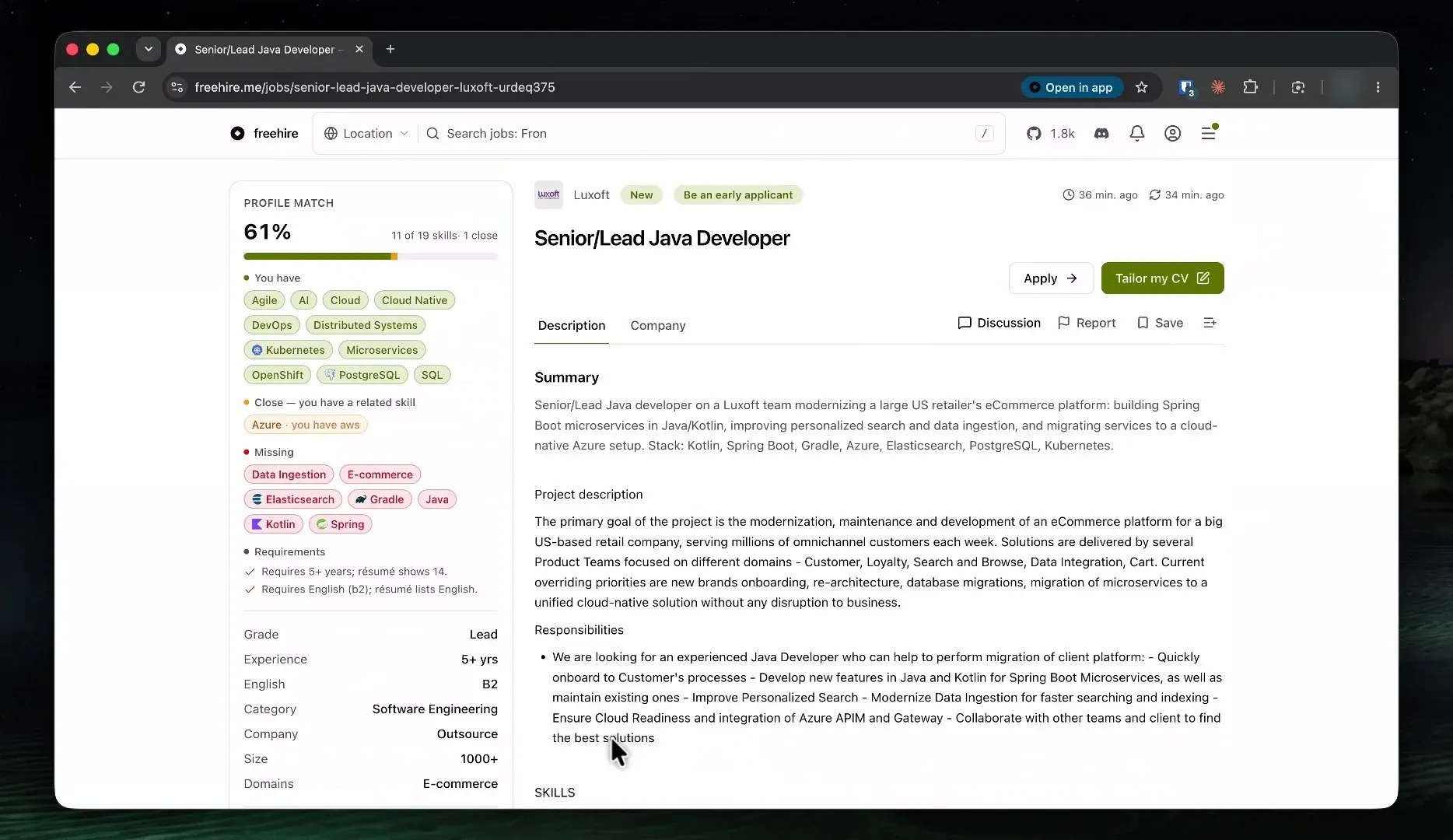
The user builds a structured CV and an experience bank, opens a posting and checks the deterministic match score, which lists covered and missing requirements. The Pro plan then tailors the CV to the vacancy using only asserted evidence and can draft a cover letter; the result renders to PDF through a Typst template. The tailoring flow is diagrammed in the architecture document.
Tracking applications and recruiter replies
Applied jobs move across the board through Preparing, Applied, Interview and Offer. With Gmail or a hosted mailbox connected, recruiter replies are classified and attached to the matching application, and its stage advances automatically; the event ledger keeps the full history. Mislinked messages can be moved by hand.
Searching jobs from an AI assistant or terminal
The MCP page gives the server address and setup steps for Claude, ChatGPT, Grok, Claude Code, Codex, Cursor and Gemini CLI; the assistant signs in to freehire with OAuth and can search, save, track and manage alerts. The CLI covers the same API from a terminal, with a --json flag for machine-readable output.
Running a self-hosted instance or building on the API
A developer clones the repository, copies .env.example to .env, sets JWT_SECRET and runs make up to start the stack, then schedules the ingest, enrichment, embedding and search-drain workers from cron. Products that display postings can instead call the public API documented at freehire.me/docs/api, using an API plan for commercial use under the data licence. The PostgreSQL database behind both is the PostgreSQL server with the pgvector extension.
Reviews of freehire
Be the first to share your experience with freehire.
Write a review
Loading review form…
Found freehire useful? Upvote it todayYour vote helps other IT teams find it in the daily ranking.