What is Crucix?
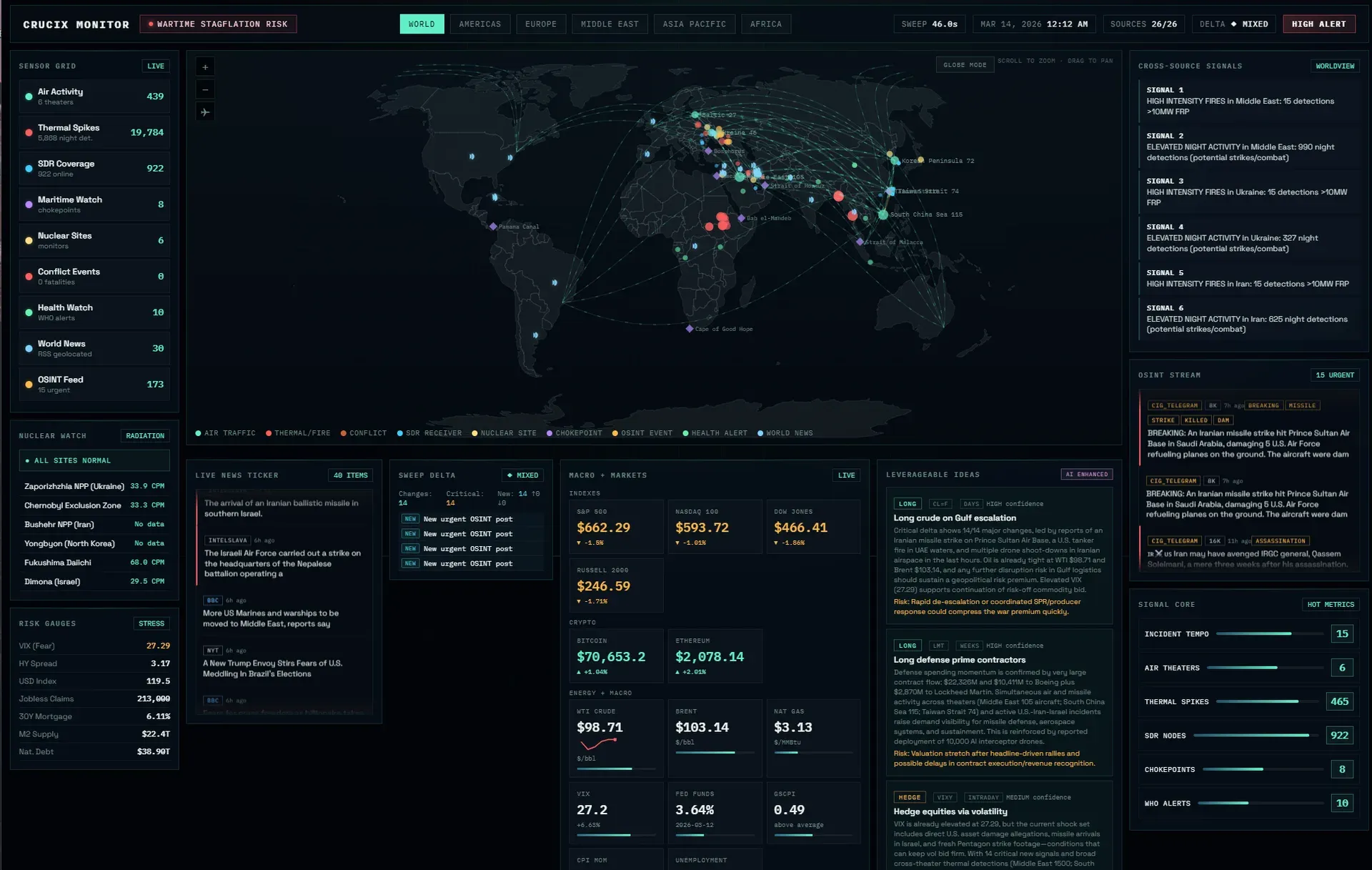
Crucix is an open-source intelligence dashboard maintained in the calesthio/Crucix repository. It collects data from public feeds, including satellite fire detections, flight tracking, radiation readings, satellite launches, economic indicators, market prices, conflict events, sanctions lists and social posts, queries them in parallel every 15 minutes and renders the result on a single-page dashboard with a 3D globe. A public demo runs at crucix.live; the full stack, including alerts and the LLM layer, runs on the user's own machine.
The project is distributed as source code only. The Quick Start clones the repository, runs npm install, copies .env.example to .env and starts the server with npm run dev, after which the dashboard is served at http://localhost:3117. Node.js 22 or newer is required. A Dockerfile and a Compose file build the same server locally and keep sweep data in a mounted ./runs folder. The repository publishes no tagged releases or prebuilt images; package.json on the master branch declares version 2.0.0, and the most recent commit on master is dated May 20, 2026.
The code base is plain ECMAScript modules. Express is the only required runtime dependency, discord.js is optional, and the LLM integrations call provider APIs with the built-in fetch instead of vendor SDKs. Each data source is a standalone module in apis/sources/ that exports a briefing() function and can be run on its own; the orchestrator starts all of them with Promise.allSettled(), so a failing source returns an error without stopping the sweep. The README documents 27 sources, and the orchestrator on master also imports modules for the CISA Known Exploited Vulnerabilities catalog and Cloudflare Radar. Interface strings are available in English and French.
Crucix starts without any API keys: according to the README, 18 or more sources need no authentication, and sources that need a key report a structured error. Free keys for FRED, NASA FIRMS and the US Energy Information Administration unlock the main economic and satellite data, while ACLED, AISStream and ADS-B Exchange (a paid RapidAPI plan) are optional. The optional LLM layer supports Anthropic, OpenAI, Google Gemini, OpenRouter, OpenAI Codex, MiniMax, Mistral and Grok, and .env.example also lists a local Ollama provider. The project describes itself as having no cloud component, no telemetry and no subscription; outbound traffic goes to the data providers and to any chat or LLM service the user configures.
Crucix is licensed under AGPL-3.0. Security reports go to the private e-mail address in the security policy, and the README states that Crucix has not launched any token, coin or other blockchain asset under its name. Similar projects listed on iThub include World Monitor, a hosted and self-hostable global intelligence map, and God's Eye View, a local 3D globe for live flights, ships and satellites.
Key capabilities
- Single-page intelligence dashboard The server delivers one self-contained HTML dashboard with a sensor grid, nuclear watch, risk gauges, a live news ticker, a sweep delta panel, macro and market tiles, cross-source signals and an OSINT stream. The page works with or without the server, because
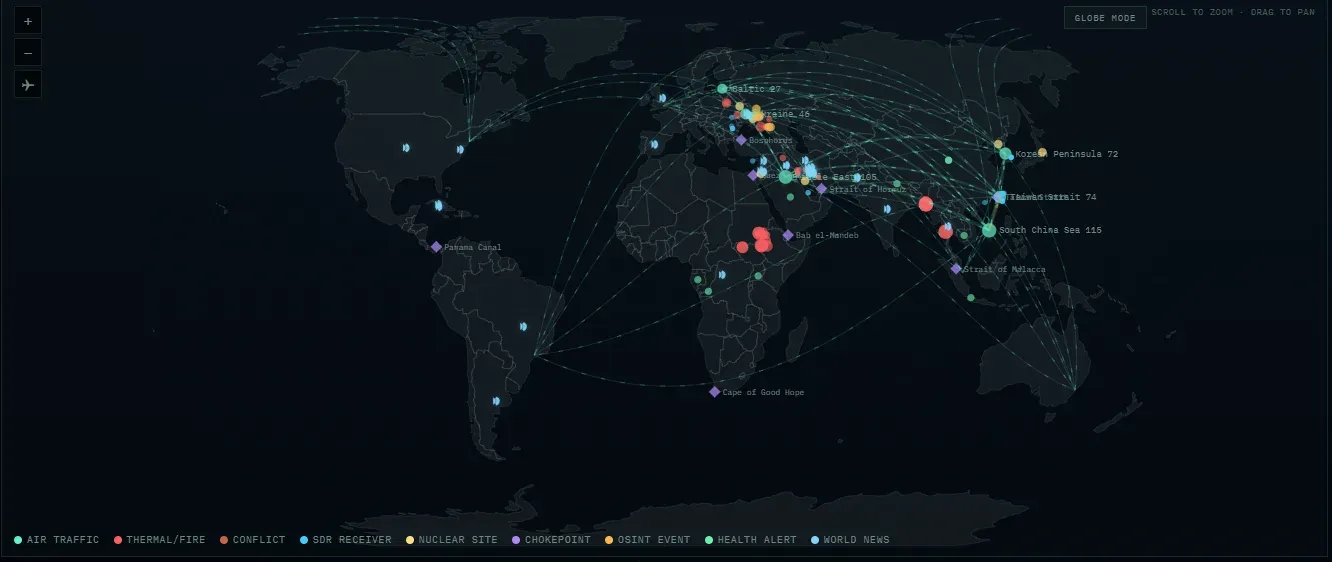
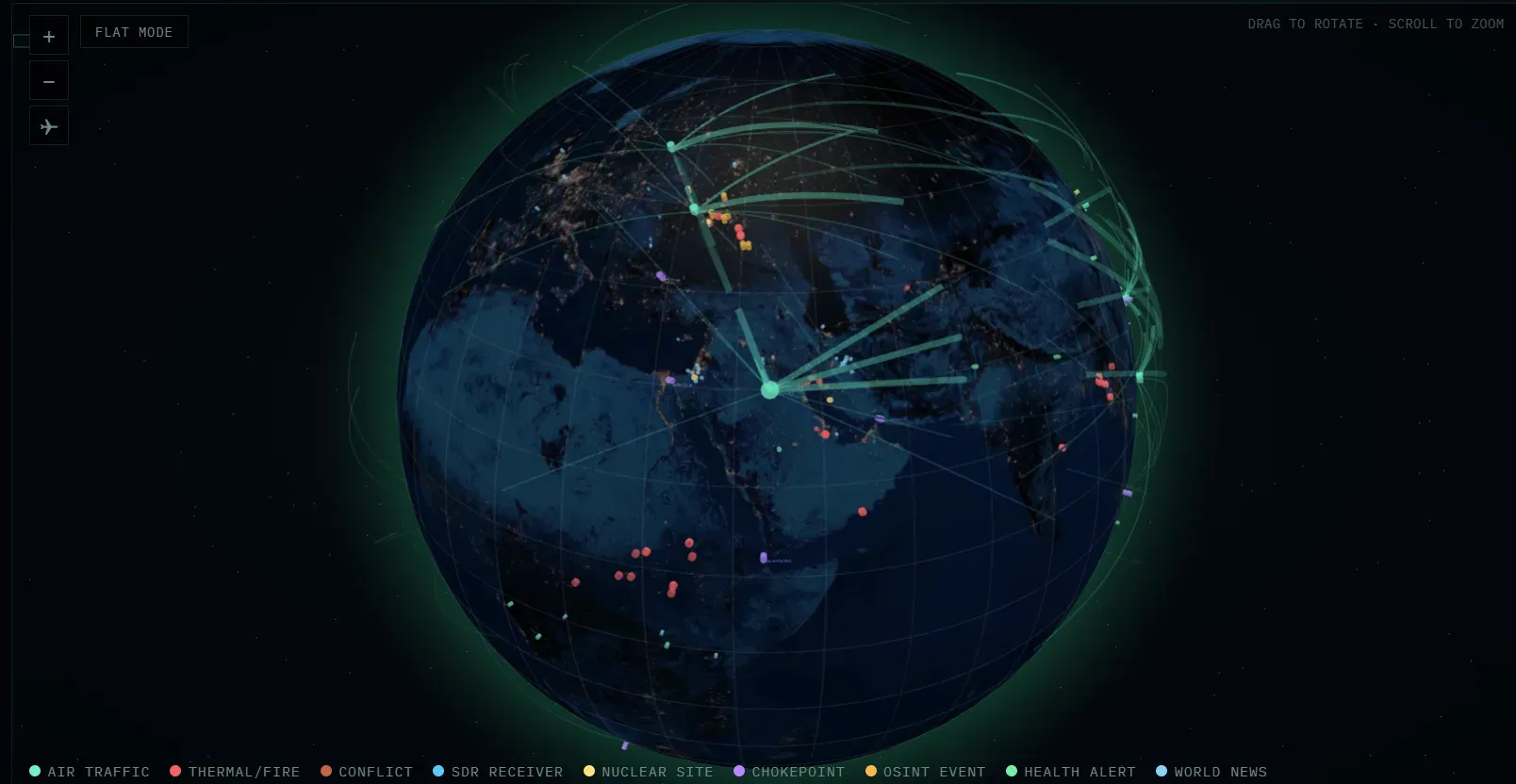
npm run injectcan write the latest data into the static HTML file. - 3D globe and flat map A WebGL globe built on Globe.gl, with atmosphere glow and rotation, can be switched to a flat D3 world map. Both views show nine marker types: fire detections, air traffic, radiation sites, maritime chokepoints, SDR receivers, OSINT events, health alerts, geolocated news and conflict events, plus animated flight corridor arcs. Region filters cover World, Americas, Europe, Middle East, Asia Pacific and Africa.
- Scheduled sweep cycle Every 15 minutes by default (
REFRESH_INTERVAL_MINUTES), the server queries all sources in parallel, synthesizes the results, computes changes, optionally asks the LLM for ideas, evaluates alerts and pushes the update to every open browser over Server-Sent Events. The first sweep after startup takes about 30 to 60 seconds, and the dashboard stays empty until it completes. - Sweep delta engine Each run is compared with the previous one to list new signals, escalations and de-escalations with a severity score and semantic deduplication. Hot memory keeps the last three runs with atomic writes, and older data is archived in daily files under
runs/memory/. Sensitivity thresholds are set incrucix.config.mjsunderdelta.thresholds. - Geopolitical and humanitarian feeds Tier 1 sources are GDELT, OpenSky flight data for six hotspot regions, NASA FIRMS thermal anomalies, AIS vessel data, Safecast radiation readings near six nuclear sites, ACLED conflict events, ReliefWeb, WHO outbreak news, the US OFAC sanctions list, OpenSanctions and ADS-B Exchange. When OpenSky throttles requests, Crucix reports the error and keeps the last non-empty air traffic snapshot instead of retrying around the limit.
- Economic and market data FRED supplies 22 indicators such as the yield curve, CPI, VIX, the fed funds rate and M2. US Treasury, BLS, EIA, the New York Fed supply chain pressure index, USAspending and UN Comtrade add fiscal, labor, energy, spending and trade data. Yahoo Finance provides live prices for indexes, crypto, energy and commodities without an API key.
- Weather, social, radio and space sources NOAA and the National Weather Service supply active US weather alerts, EPA RadNet adds government radiation monitoring, and USPTO patent filings are tracked in seven technology areas. Social data comes from Bluesky, Reddit and 17 public Telegram channels read from their web previews, with more channels configurable through
TELEGRAM_CHANNELS. KiwiSDR covers about 600 shortwave receivers, and CelesTrak provides launches, ISS position and constellation counts. - Two-way Telegram bot With
TELEGRAM_BOT_TOKENandTELEGRAM_CHAT_IDset, Crucix sends alerts and answers/status,/sweep,/brief,/portfolio,/alerts,/mute,/unmuteand/help. The bot only responds to the configured chat ID and polls for messages every 5 seconds by default. - Discord bot and webhook mode A Discord bot built on the optional
discord.jspackage offers slash commands and rich embeds colored by alert tier: red for FLASH, yellow for PRIORITY and blue for ROUTINE. Setting onlyDISCORD_WEBHOOK_URLenables one-way alerts without the extra dependency, and Crucix falls back to webhook mode whendiscord.jsis missing. - Tiered alert evaluation Breaking signals are classified as FLASH, PRIORITY or ROUTINE and deduplicated before they are sent. With an LLM configured, the model classifies signals with cross-domain correlation and confidence scores; without one, a deterministic rule engine uses severity, correlation and signal counts.
- Optional LLM layer
LLM_PROVIDERselects Anthropic, OpenAI, Gemini, OpenRouter, Codex (through a ChatGPT subscription login), MiniMax, Mistral, Grok or a local Ollama model, with a per-provider default model thatLLM_MODELcan override. The model produces five to eight market ideas that cite the sweep data, shown in the Leverageable Ideas panel; without an LLM, the panel shows signal-correlated ideas. LLM errors never stop a sweep. - Performance modes The VISUALS FULL and VISUALS LITE toggle changes rendering only, not data coverage. Lite mode removes background effects, blur and non-essential animations, stops globe rotation, turns the tickers into static lists and, on mobile, switches to the flat map. The choice is stored in browser local storage.
- Local JSON endpoints While the server runs,
GET /api/datareturns the current synthesized data,GET /api/healthreports uptime, source count and LLM status, andGET /eventsstreams updates. The endpoints are listed in the API section of the README. - Command-line scripts
npm run sweepruns one sweep and prints JSON,npm run brief:savesaves a timestamped briefing,npm run injectupdates the static dashboard, and any source can be tested alone with a command such asnode apis/sources/gdelt.mjs. - Docker Compose deployment
docker compose up -dbuilds the image from the repository, publishes port 3117, reads keys from.env, mounts./runsfor persistence and restarts the container unless it is stopped. The image includes a health check endpoint. - Built-in diagnostics
node diag.mjschecks the Node.js version, tests every module import one by one and verifies that port 3117 is free. The README documents fixes for silentnpm run devexits on Windows PowerShell, port conflicts, empty first-start panels and bot setup problems.
Where Crucix fits
Following world events on a self-hosted dashboard
Researchers, journalists and analysts can keep the dashboard open in a browser while the server refreshes it every 15 minutes. The globe or flat map shows where fires, flights, conflict events, health alerts and geolocated news cluster, the region filters narrow the view, and the Sweep Delta panel lists what changed, escalated or eased since the previous run. The Source Integrity information shows which feeds failed and why.
Receiving change alerts on a phone
With a Telegram or Discord bot configured, Crucix sends FLASH, PRIORITY and ROUTINE alerts when a sweep finds a meaningful change. The same chat accepts commands: /brief returns a compact text summary, /sweep starts an immediate cycle, /alerts shows recent alert history and /mute 2h pauses notifications for a set time.
Reading markets next to geopolitical signals
The macro and markets panels place index, crypto, energy and commodity prices next to FRED, Treasury, BLS and EIA indicators and the VIX, high-yield spread and supply chain gauges. Cross-source signals connect satellite, conflict, economic and social data, and with an LLM configured the Leverageable Ideas panel turns them into labeled market ideas with a stated confidence and risk. An optional Alpaca connection adds a portfolio status command to the bots.
Collecting data from scripts
Crucix can be used without the dashboard. npm run sweep prints one sweep as JSON, npm run brief:save writes timestamped files, and the running server exposes the current data at /api/data. Each source module can be run alone, which the project uses for testing individual feeds.
Adding a new data source
The README describes sources as standalone modules: a new file in apis/sources/ exports a briefing() function returning structured data and is added to the orchestrator in apis/briefing.mjs. Because sources run in parallel and errors are isolated, a new module that fails does not block the rest of the sweep.
Trying the public demo first
The public site at crucix.live shows the dashboard without any installation. The README presents it as a preview, with the local installation needed for personal API keys, Telegram and Discord alerts, the LLM layer and the stored sweep history.
Reviews of Crucix
Be the first to share your experience with Crucix.
Write a review
Loading review form…
Found Crucix useful? Upvote it todayYour vote helps other IT teams find it in the daily ranking.