

What is Neon?
Neon is a serverless Postgres service run by Neon at neon.com, together with the open-source storage engine published in the neondatabase/neon repository under the Apache-2.0 license. The README describes Neon as a serverless Postgres database platform that separates storage and compute and replaces the PostgreSQL storage layer by distributing data across a cluster of nodes. Customers use the hosted service through the Neon Console, the Neon CLI, the Neon API and standard Postgres clients such as psql.
Neon is part of Databricks. Databricks announced its agreement to acquire Neon on May 14, 2025 (Databricks press release), and the Neon and Lakebase page states that Neon joined Databricks in 2025. The same page explains that Neon's architecture is the basis of Lakebase Postgres, which runs either on Neon or on the Databricks platform with the same core engine; Neon is aimed at developers, startups and agent platforms, while Databricks offers Lakebase inside its data and AI platform. The Neon about page dates the first commit to March 2021.
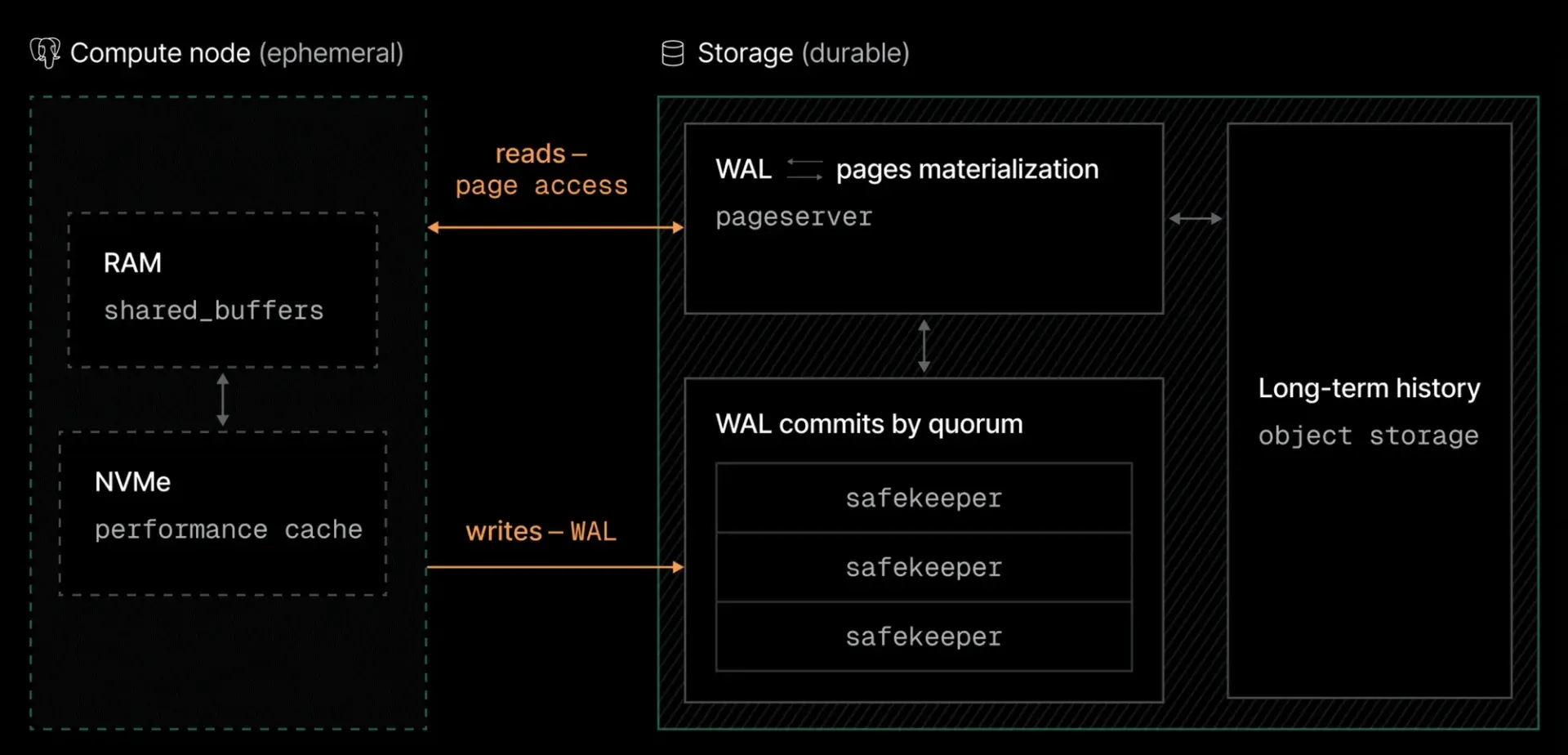
The architecture has two layers. Compute nodes are stateless PostgreSQL instances. The storage engine consists of pageservers, which serve data pages to compute, and safekeepers, a redundant write-ahead log (WAL) service that stores WAL durably until the pageserver has processed it and uploaded it to cloud object storage. The architecture overview documents the read path and the write path. The engine is written mainly in Rust and uses a patched PostgreSQL fork maintained by the project.
The hosted service supports Postgres 14, 15, 16, 17 and 18, selected per project. It runs on AWS in eight regions in the United States, Europe, Asia Pacific and South America; Azure regions are deprecated and no longer accept new projects, according to the regions page. Around the database, Neon now lists managed authentication based on Better Auth, a PostgREST-compatible Data API, Object Storage, Neon Functions, Realtime and an AI Gateway as platform services.
Neon does not publish product version numbers for the hosted service; changes appear in a weekly changelog. The entry of November 13, 2026 lists Postgres minor updates to 18.7, 17.12, 16.16, 15.20 and 14.25, Stripe data sync from the Integrations page and project role checks for Object Storage, Functions and AI Gateway. GitHub releases in the repository are tags for individual components, such as release-proxy-8853 from July 2025, and are not product versions. The README documents building the engine from source on Linux and macOS for local experiments and code changes; the official docs do not describe a supported self-hosted production deployment.
Key capabilities
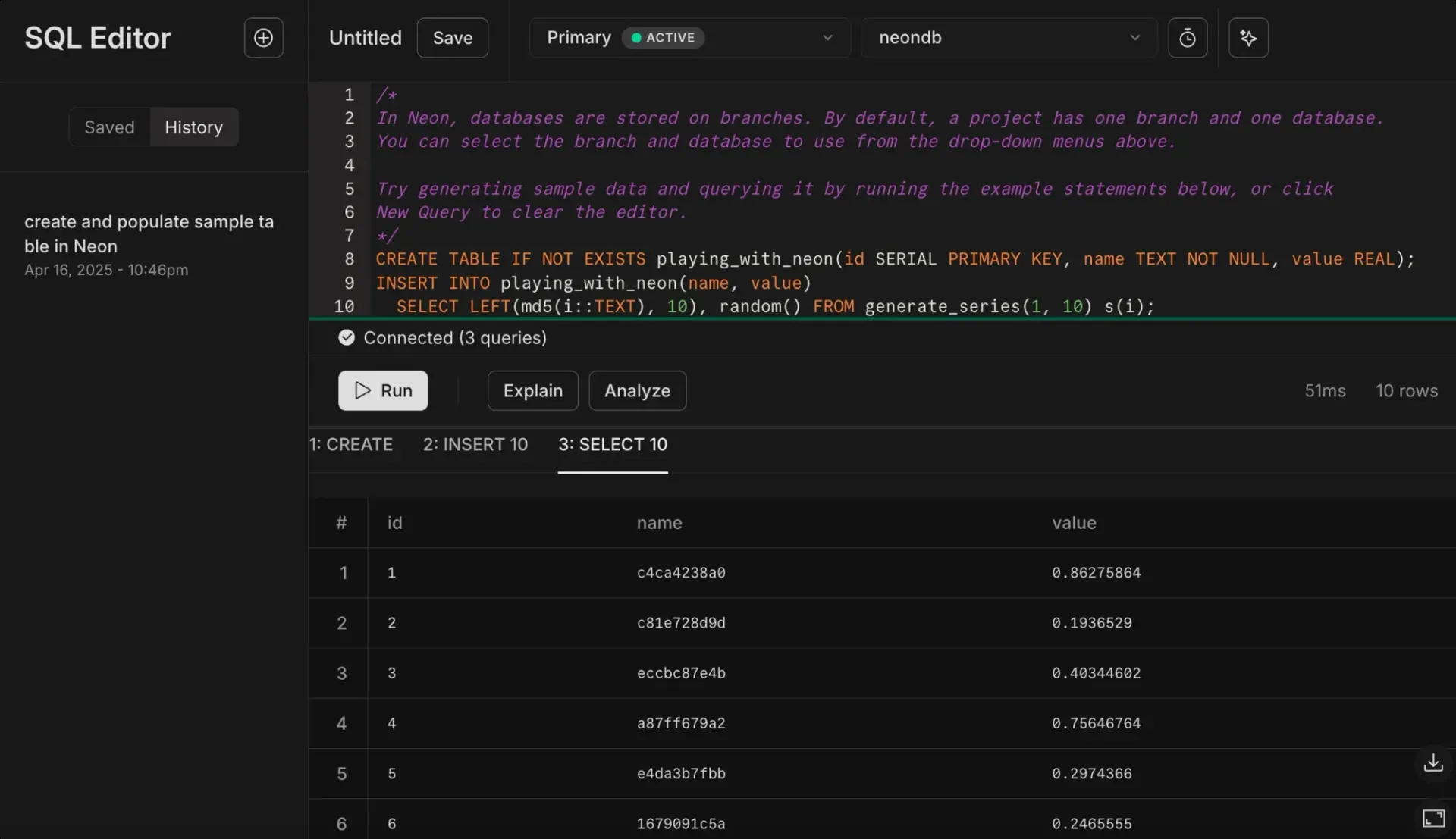
- Serverless Postgres projects A Neon project contains branches, databases, roles and computes. Users connect with any Postgres client using a connection string from the Console, run SQL in the browser SQL Editor or call the API. The superuser role is not available; Neon provides a neon_superuser role instead.
- Postgres 14 to 18 Each project uses one Postgres major version from 14 to 18. The compatibility page lists the limits: no tablespaces, most instance-level parameters fixed, only supported extensions installable, and unlogged or temporary tables lost when a compute restarts or scales to zero. Minor versions are updated by Neon and applied on the next compute restart.
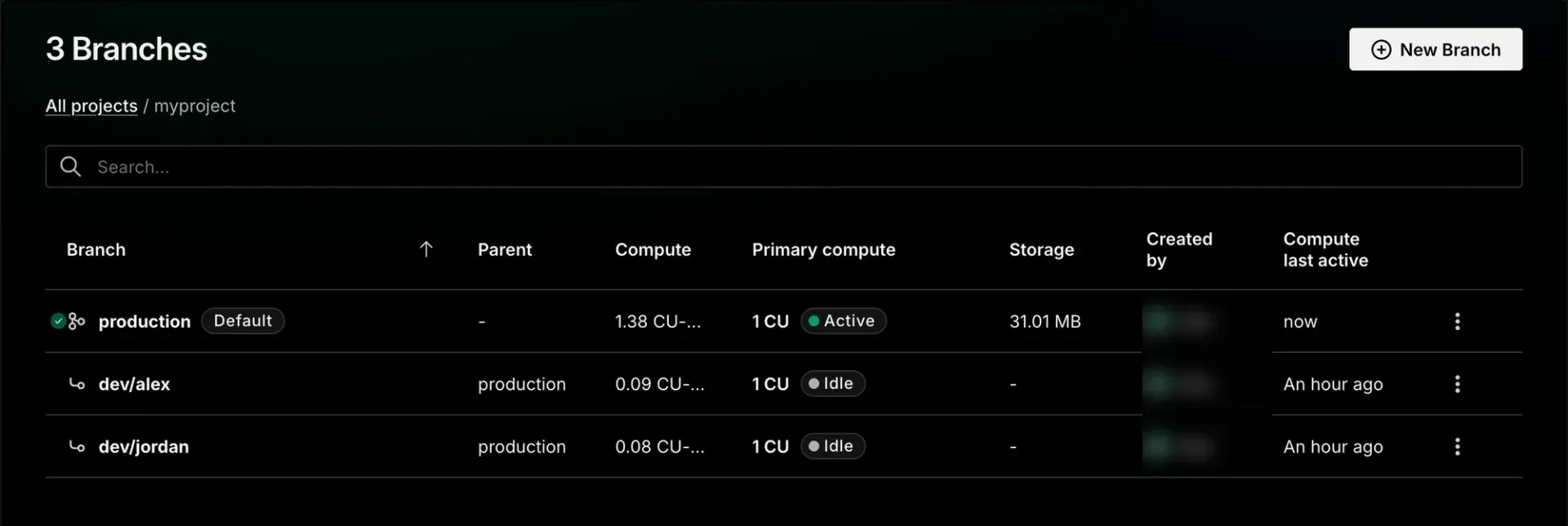
- Copy-on-write branching A branch is a copy-on-write clone of a parent branch, created from its current state or from a past point in time. Writes on a branch are stored as a delta, so creating a branch does not copy the data or add load to the parent. Branches can have an expiration date, and schema-only branches are available for sensitive data.
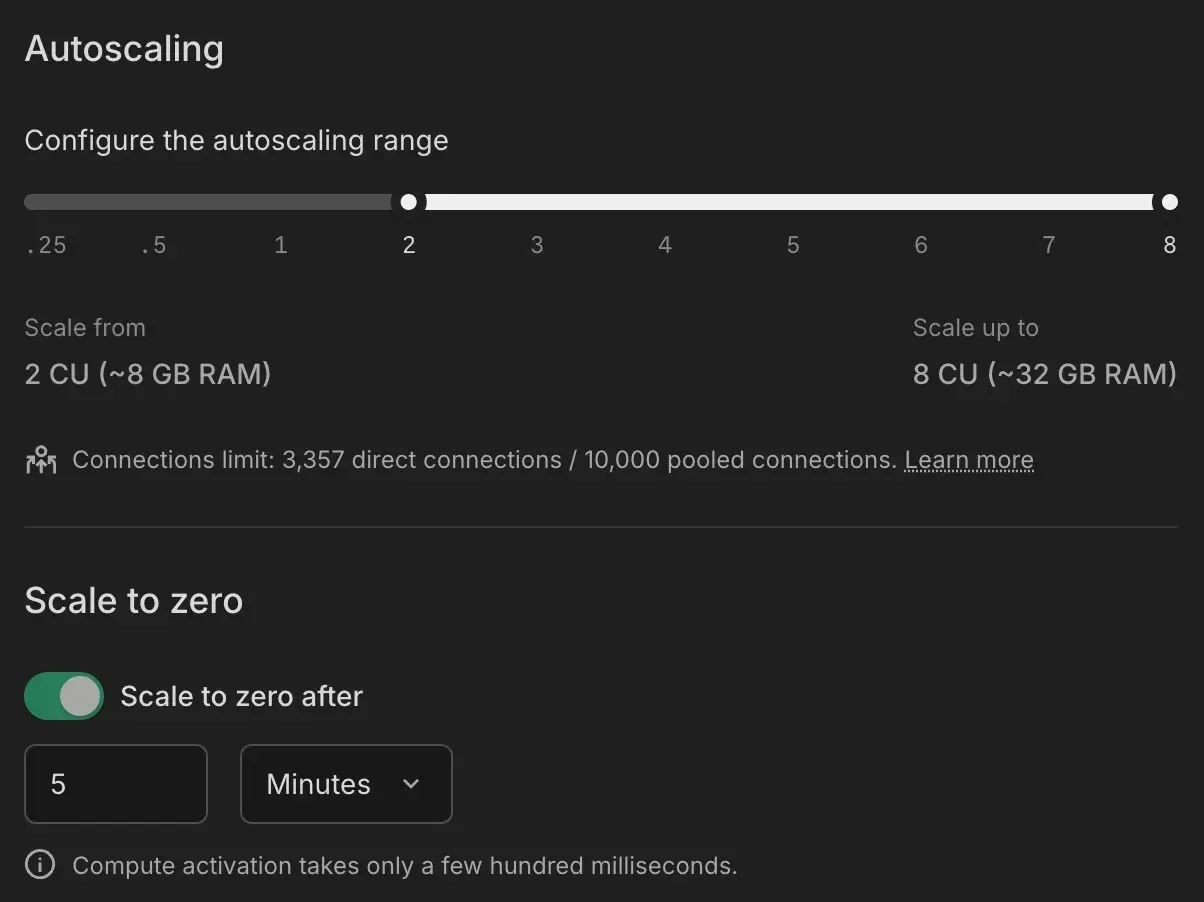
- Autoscaling Computes scale between a minimum and a maximum size in compute units (CU), where 1 CU is about 4 GB of RAM. The autoscaling docs state that the difference between maximum and minimum cannot exceed 8 CU. The Free plan scales up to 2 CU, Launch up to 16 CU, and Scale offers autoscaling up to 16 CU plus fixed sizes up to 56 CU.
- Scale to zero An idle compute is suspended after 5 minutes of inactivity by default and reactivates within a few hundred milliseconds on the next query, according to the scale-to-zero page. On the Free plan the setting cannot be disabled; Launch can disable it, and Scale can set it from 1 minute to always on. Computes larger than 16 CU always stay active.
- Instant restore and Time Travel Instant restore rolls a branch back to any point inside the project's history window. Time Travel queries run against a past state from the SQL Editor without restoring. The history window is up to 6 hours (and 1 GB of changes) on Free, up to 7 days on Launch and up to 30 days on Scale.
- Read replicas Read replicas are read-only computes that read from the same storage as the primary compute, so data is not duplicated. Each replica has its own size and supports autoscaling and scale to zero. The docs allow up to 6 replicas per branch, with Free and Agent plans capped at 3 per project.
- Connection pooling Neon runs PgBouncer in transaction mode with up to 10,000 client connections. The pooled endpoint is selected by adding -pooler to the endpoint ID in the hostname.
- Serverless driver The @neondatabase/serverless npm package queries Neon over HTTP or WebSockets instead of TCP, for Vercel Functions, Cloudflare Workers and the Vercel Edge runtime. Its Pool and Client classes are compatible with node-postgres. Node.js 21 and earlier need a WebSocket implementation such as ws.
- Data API The Data API is an HTTP interface compatible with PostgREST. Requests are authorized through Postgres grants and Row-Level Security, using JWTs from Neon's managed auth or another provider such as Auth0, Clerk or Firebase. The docs state that the Data API is not yet covered by Neon's HIPAA compliance.
- Managed Better Auth Neon's managed authentication is based on Better Auth and keeps users and sessions in the project's own Postgres database. Because the auth data lives in the neon_auth schema, it branches together with the application data.
- Neon CLI The CLI is installed with npm (npm i -g neon@latest, Node.js 20.19.0 or later), Homebrew (brew install neonctl), bun or standalone binaries for macOS, Windows and Linux x64 and ARM64, as described on the install page. The command is neon, with neonctl as an alias.
- Neon API and infrastructure as code The REST Neon API at console.neon.tech/api/v2 uses bearer API keys and covers projects, branches, endpoints, operations, consumption, organizations, snapshots and the newer platform services. Neon also documents a TypeScript management SDK, a Terraform provider and neon.ts configuration as code.
- AI agent tooling Neon documents an MCP server that lets AI assistants manage Neon resources, agent skills for coding agents, and Claimable Neon, which provisions a project before the user signs up. The Agent plan targets platforms that create many databases, with unlimited projects and Launch-rate compute.
- Platform services beyond Postgres The docs list Object Storage, Neon Functions, Realtime, Lakebase Search and an AI Gateway for model access. Other Postgres-based services in this directory include Supabase and Ubicloud, and PostgreSQL has its own listing. According to the branching docs, Object Storage, Functions and AI Gateway configuration also branch with the data.
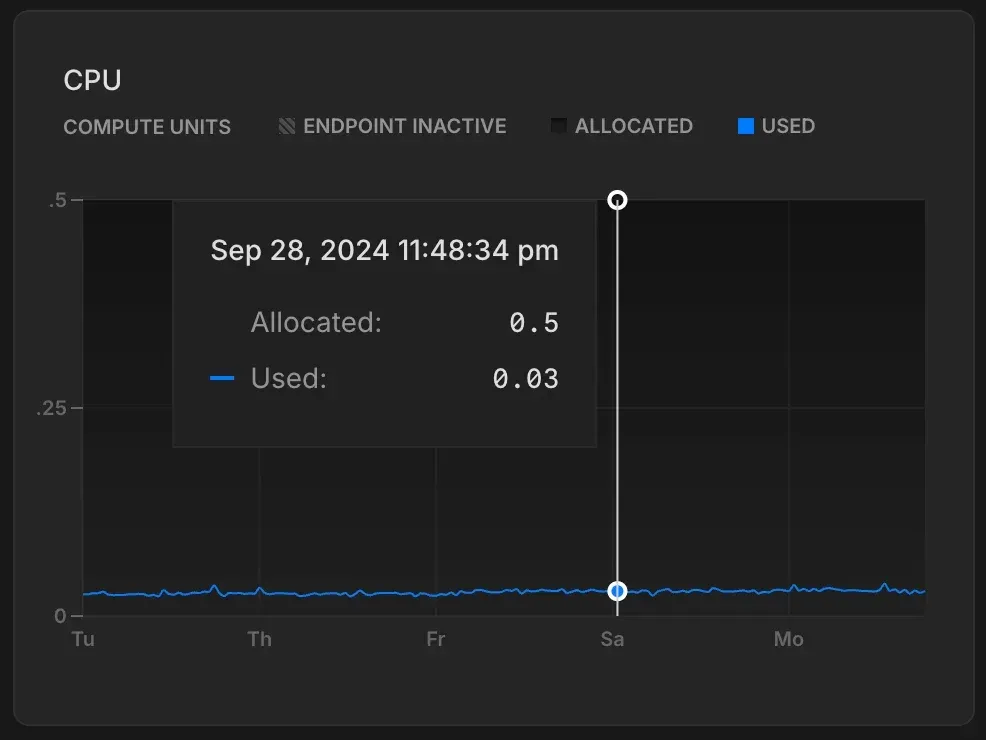
- Monitoring The Console monitoring page charts CPU and RAM allocation and use, connections, pooler connections, database size, deadlocks, rows, cache hit rate and replication delay for each compute. The CPU chart shows allocated and used compute units over time.
- Neon Local for development Neon Local is a Docker image, neondatabase/neon_local, that exposes a local Postgres endpoint and proxies connections to a Neon cloud branch. It can connect to an existing branch or create an ephemeral branch that is deleted when the container stops.
- Building the open-source engine The README lists build dependencies for Ubuntu or Debian, Fedora, Arch and macOS, a Rust toolchain pinned by rust-toolchain.toml and protoc 3.15 or later. cargo neon init and cargo neon start launch a local pageserver, safekeeper and storage broker, then endpoints are created per branch. The repository also documents Docker images and a Docker Compose example with one pageserver, three safekeepers, a broker, a compute and MinIO.
- Plans and compliance The pricing page lists Free at $0 with 100 projects, 100 CU-hours per project, 1 GB storage per project (20 GB total) and 10 branches per project. Launch and Scale are usage-based with no monthly minimum: compute at $0.106 or $0.222 per CU-hour and storage at $0.35 per GB-month. Scale adds SOC 2, ISO, GDPR, HIPAA (extra charge), IP Allow, Private Networking and an uptime SLA.
Where Neon fits
Database per pull request
Neon documents automated branching through the CLI, the API and GitHub Actions, with temporary branches for CI/CD and feature work. The branch starts with the parent's data, gets its own compute and can expire automatically. Migrations and tests run on the copy while the production branch stays unchanged.
Serverless and edge applications
Applications on Vercel Functions, Cloudflare Workers or similar runtimes connect with the serverless driver over HTTP or WebSockets, or through the pooled endpoint with PgBouncer. Computes scale with load and scale to zero when idle, so billing follows compute hours used rather than a provisioned instance size. For local development, Neon Local runs as a Docker container that exposes a local Postgres endpoint and proxies it to a cloud branch, optionally creating an ephemeral branch that is removed when the container stops.
Recovering from a bad change
After an accidental DELETE or a failed migration, instant restore returns a branch to a point inside the history window, or a restore branch is created from the earlier state for comparison. Time Travel queries in the SQL Editor show past data before any restore is performed. The window depends on the plan: 6 hours on Free, up to 7 days on Launch, up to 30 days on Scale.
Databases provisioned by AI agents
Agent platforms create and manage many projects through the API, the MCP server or Claimable Neon. Neon's plans page describes an Agent plan with unlimited projects and credits for the platform's own free tier. Branching and restore give agent-generated changes an isolated copy and a way back.
Read scaling and analytics
Read replicas attach additional read-only computes to the same storage, each sized independently with its own autoscaling range. Reporting or analytics queries run against a replica while the primary compute handles writes, without a second copy of the data. The docs allow up to 6 replicas per branch, and the Free and Agent plans are limited to 3 read replicas per project.
Migrating an existing Postgres database
The migration guides cover moving data from other Postgres providers and databases into Neon. Before moving, the compatibility page lists what differs from self-managed Postgres: no superuser, no tablespaces, fixed instance parameters and a list of supported extensions.
Install
npm i -g neon@latestReviews of Neon
Be the first to share your experience with Neon.
Write a review
Loading review form…
Found Neon useful? Upvote it todayYour vote helps other IT teams find it in the daily ranking.


