What is ClickHouse?
ClickHouse is an open-source, column-oriented SQL database management system for online analytical processing (OLAP). The official introduction describes how each column is stored sequentially so that a query reads only the columns it needs, with a SQL dialect that follows ANSI SQL in many cases and supports GROUP BY, ORDER BY, JOINs, window functions and subqueries. The database server is written in C++ and published on GitHub under the Apache-2.0 license.
The project is developed by ClickHouse, Inc. According to the company's our story page, work on ClickHouse began in 2009, the database was released as open source under the Apache 2 license in 2016, and ClickHouse, Inc. was incorporated in Delaware in 2021 with headquarters in the San Francisco Bay Area. The website footer lists HQ in the Bay Area, CA and Amsterdam, NL. Besides the open-source database, the company runs ClickHouse Cloud, a managed service it describes as built by the creators and maintainers of ClickHouse, and a Bring Your Own Cloud (BYOC) deployment model that runs ClickHouse Cloud inside the customer's own VPC.
Self-managed ClickHouse is distributed as a single binary through the documented quick install script (curl https://clickhouse.com/ | sh), as Debian/Ubuntu and Red Hat packages, as tgz archives and deb/rpm files for amd64 and arm64 attached to each GitHub release, and as the official clickhouse/clickhouse-server Docker image. ClickHouse Cloud is a usage-based service billed in USD on AWS, Google Cloud and Azure, with a $300 trial credit for 30 days.
Release tags follow a year.month numbering. The production FAQ states that stable releases come out roughly monthly and that the three latest stable releases are supported for diagnostics and bug-fix backports, while LTS releases are published twice a year and supported for a year after their initial release. GitHub marks v26.9.30.7-stable, published November 16, 2026, as the latest release; LTS builds of 26.8 and 26.3 were published the same day. The 26.10 changelog, dated October 22, 2026, removes the legacy query analyzer, adds partial Trino syntax such as TRY_CAST, a block nested loop join for non-equality ON conditions, an on-disk query cache and the Cluster and Overlay database engines.
The open-source project also includes ClickHouse Keeper, a ZooKeeper-compatible coordination service, and clickhouse-local for running SQL on files without a server. ClickHouse, Inc. additionally maintains related open-source projects such as ClickStack for observability and chDB, an in-process build of ClickHouse. Managed features such as ClickPipes ingestion, the Cloud SQL console, automated backups and upgrades, and the compliance programs listed in the Cloud overview are part of ClickHouse Cloud, not the open-source server.
Key capabilities
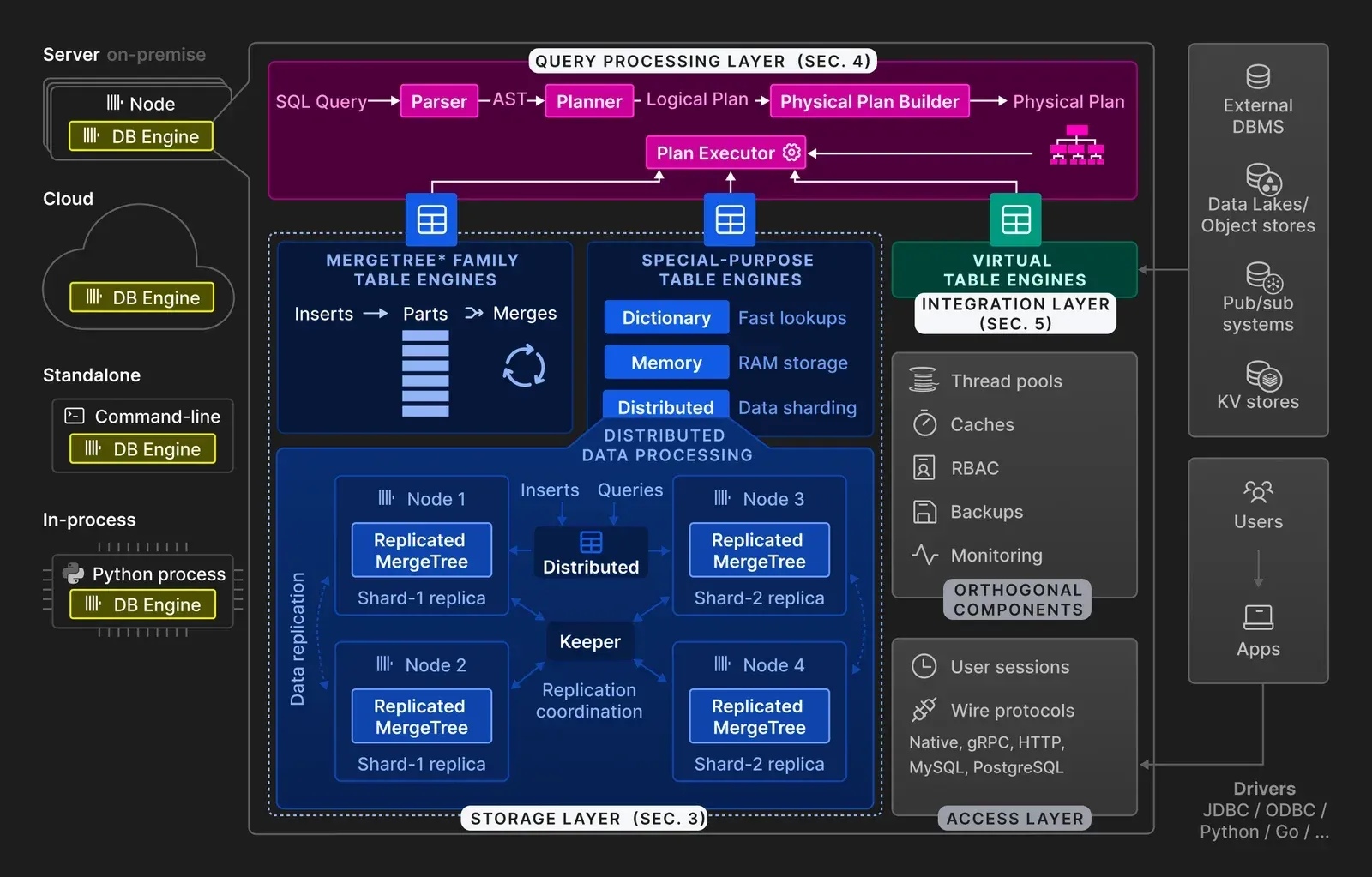
- Column-oriented storage with MergeTree The MergeTree table engine family stores data in immutable parts that background merges combine into larger parts, so inserts stay isolated from running queries. Variants listed in the table engine reference include ReplacingMergeTree, SummingMergeTree, AggregatingMergeTree, CollapsingMergeTree, VersionedCollapsingMergeTree, GraphiteMergeTree and CoalescingMergeTree. Replacing, aggregating and TTL logic runs at merge time instead of query time.
- Sparse primary index, projections and skipping indexes The primary key defines the sort order of a table and lets filters use binary searches instead of full column scans. Projections store alternative internal versions of a table sorted by a different key, and data skipping indexes add statistics such as min/max values or sets of unique values. The architecture explanation describes how these three mechanisms work together.
- Compression codecs Each column can use a generic algorithm such as ZSTD or a specialized codec, for example Gorilla and FPC for floating point values and Delta and GCD for integers. The documentation notes that compression reduces I/O as well as storage. In ClickHouse Cloud, storage is billed on the compressed size of the data.
- Vectorized and parallel query execution Operators pass intermediate rows in batches and can apply SIMD instructions, with the fastest code path for the detected CPU selected at runtime. A query plan is split into lanes, typically one per core, and adding nodes and sharding tables scales queries horizontally. Joins and aggregations choose from more than 30 precompiled hash table variants.
- SQL dialect and access control ClickHouse uses a SQL dialect close to ANSI SQL in many cases, with JOINs, IN, window functions and subqueries. Some aggregate functions are approximate by design. Users and roles are managed in SQL with role-based access control, and release 26.10 adds a
written_rowsquota resource that limits rows written by INSERT. - Replication, sharding and ClickHouse Keeper ReplicatedMergeTree tables use asynchronous multi-master replication, and the Distributed engine spreads data and queries across shards. ClickHouse Keeper is a C++ coordination service with a ZooKeeper-compatible protocol and Raft consensus, used for replication and distributed DDL. It can run inside the server or as a standalone service, packaged separately as
clickhouse-keeper. - Interfaces and drivers The interfaces overview lists an HTTP interface, the native TCP protocol, gRPC and Apache Arrow Flight, with TLS available for HTTP and TCP. A MySQL wire protocol interface is documented on port 9004 for self-managed servers and can be enabled per service in ClickHouse Cloud on port 3306. Official tools include the command-line client and ADBC, JDBC and ODBC drivers plus a C++ client library.
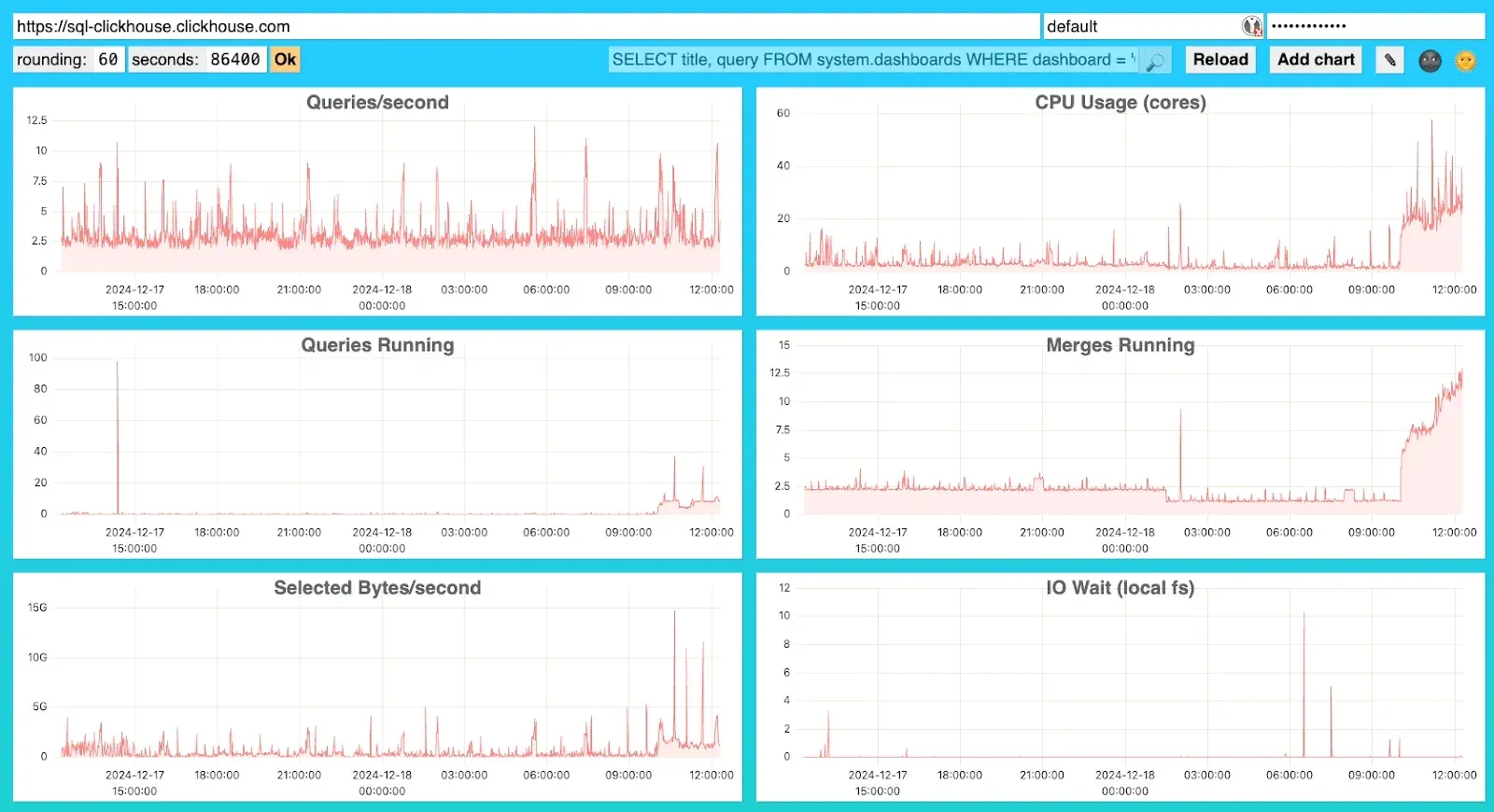
- Built-in web UIs The server exposes a Play UI at
/playfor running queries, an Advanced Dashboard at/dashboardwith charts built from system tables, and a binary symbols viewer at/binary. A ClickStack UI path is also included, which the documentation describes as intended for local debugging rather than production. - More than 70 data formats The formats reference lists over 70 input and output formats, including CSV, TabSeparated, JSONEachRow, Parquet, Arrow, ORC, Avro, Protobuf, Native and RowBinary. The same formats apply to INSERT, SELECT output, table functions and clickhouse-local.
- Integration table engines and data lakes Integration engines read from or write to external systems, including S3, AzureBlobStorage, HDFS, Kafka, RabbitMQ, NATS, PostgreSQL, MySQL, MongoDB, Redis, SQLite, ODBC and JDBC. Open table formats are covered by the Iceberg, DeltaLake, Hudi and Paimon engines, and the S3Queue and AzureQueue engines ingest new files from object storage.
- clickhouse-local clickhouse-local runs SQL on local files, HTTP(S) URLs and S3 objects without installing a database server, for example
./clickhouse local -q "SELECT * FROM 'reviews.tsv'". The documentation positions it for development, testing and file processing; applications are served by the full server. - Quick install script and clickhousectl
curl https://clickhouse.com/ | shdownloads a single ClickHouse binary for the operating system;CLICKHOUSE_ONLY=1skips the extra tooling. On Linux and macOS (x86_64 and ARM64) the script also installs clickhousectl into~/.local/bin, a CLI that manages several local ClickHouse versions, runs servers in the background and manages ClickHouse Cloud. The same binary starts clickhouse-local, the server (./clickhouse server) or the client (./clickhouse client). - Linux packages The Debian/Ubuntu guide adds a signed apt repository and installs
clickhouse-serverandclickhouse-client, withclickhouse-common-staticas the shared binary package andclickhouse-keeperfor dedicated Keeper nodes. The repository offers astableor anltschannel. Red Hat, NixOS and generic Linux installation paths are documented for production servers, and each GitHub release ships deb, rpm and tgz files for amd64 and arm64. - Official Docker image The Docker guide documents the
clickhouse/clickhouse-serverimage, built from the official deb packages, withlatest, branch, full version andheadtags plus optional-alpinevariants. The amd64 image requires the x86-64-v3 microarchitecture level and the arm64 image requires ARMv8.2-A with the Load-Acquire RCpc register; Raspberry Pi 4 is named as unsupported. Thedefaultuser has no network access until a password or user setup is configured. - Stable and LTS release channels Stable releases are published roughly monthly, usually more than ten per year, and the three latest stable releases receive diagnostics and bug-fix backports. LTS releases come twice a year and are supported for a year after release. Patch builds of several lines appear on GitHub in parallel, for example 26.9 stable and the 26.8 and 26.3 LTS lines.
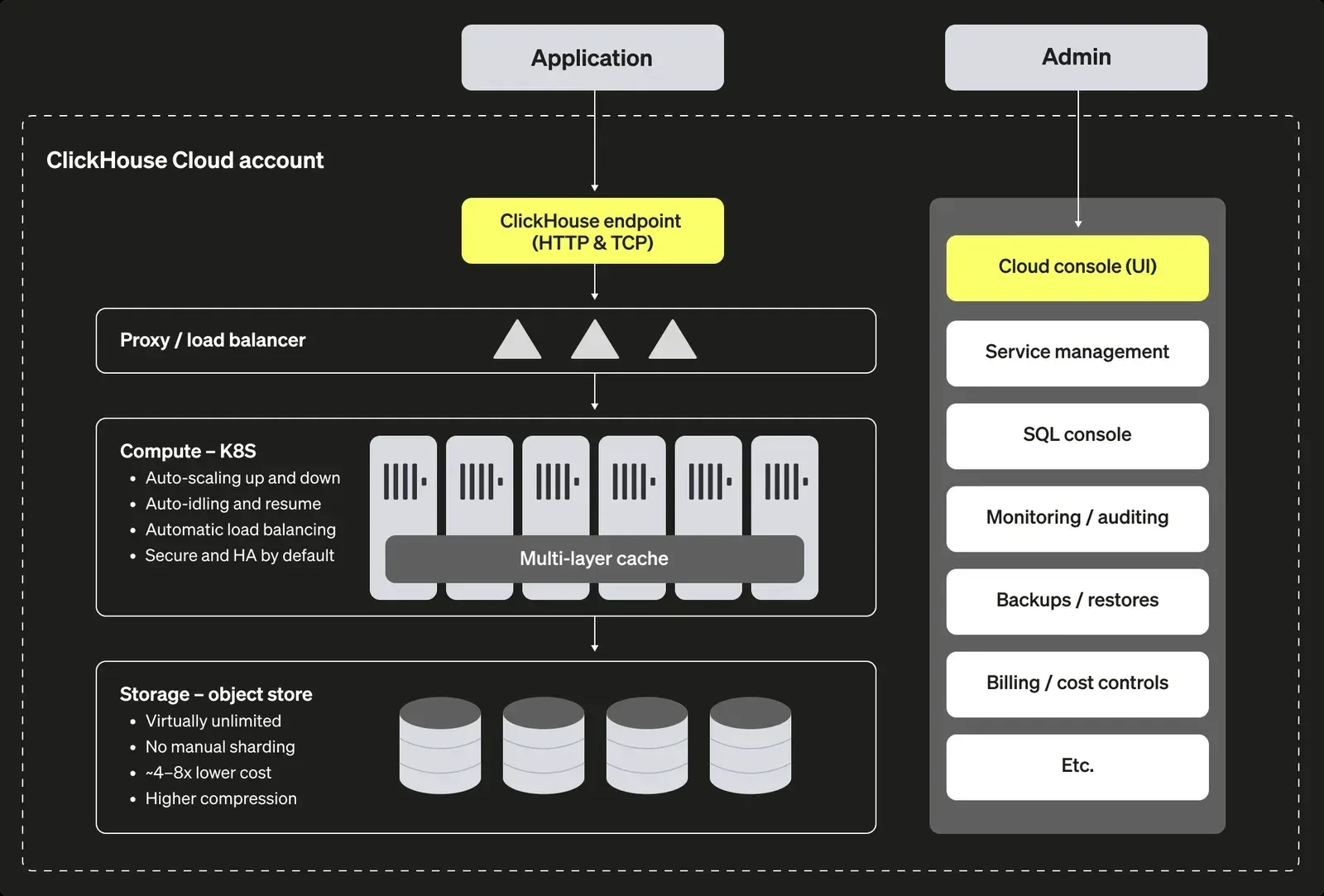
- ClickHouse Cloud service ClickHouse Cloud runs ClickHouse as a managed service on AWS, Google Cloud and Azure, with compute that scales independently of object storage and scales to zero when idle. The Cloud overview lists ClickPipes managed ingestion, a browser SQL console with charts, sharing and AI-assisted SQL, automated backups and upgrades, SSO, RBAC and customer-managed encryption keys. It lists SOC 2, ISO 27001, HIPAA and PCI DSS among its compliance programs.
- ClickHouse Cloud plans and pricing The pricing page lists Basic, Scale and Enterprise plans with usage-based billing in USD and no monthly minimum. For the N. Virginia (us-east-1) region shown by default, storage costs $25.30 per TB per month on every plan, and compute costs $0.2181 (Basic), $0.2985 (Scale) or $0.3903 (Enterprise) per compute unit per hour, where one unit is 8 GiB of RAM and 2 vCPUs. Basic is limited to 1 TB of storage, 8 to 12 GiB of memory and one availability zone; public internet egress starts at $0.1152 per GB, and new organizations receive $300 in credits for 30 days.
Where ClickHouse fits
Real-time analytics on event data
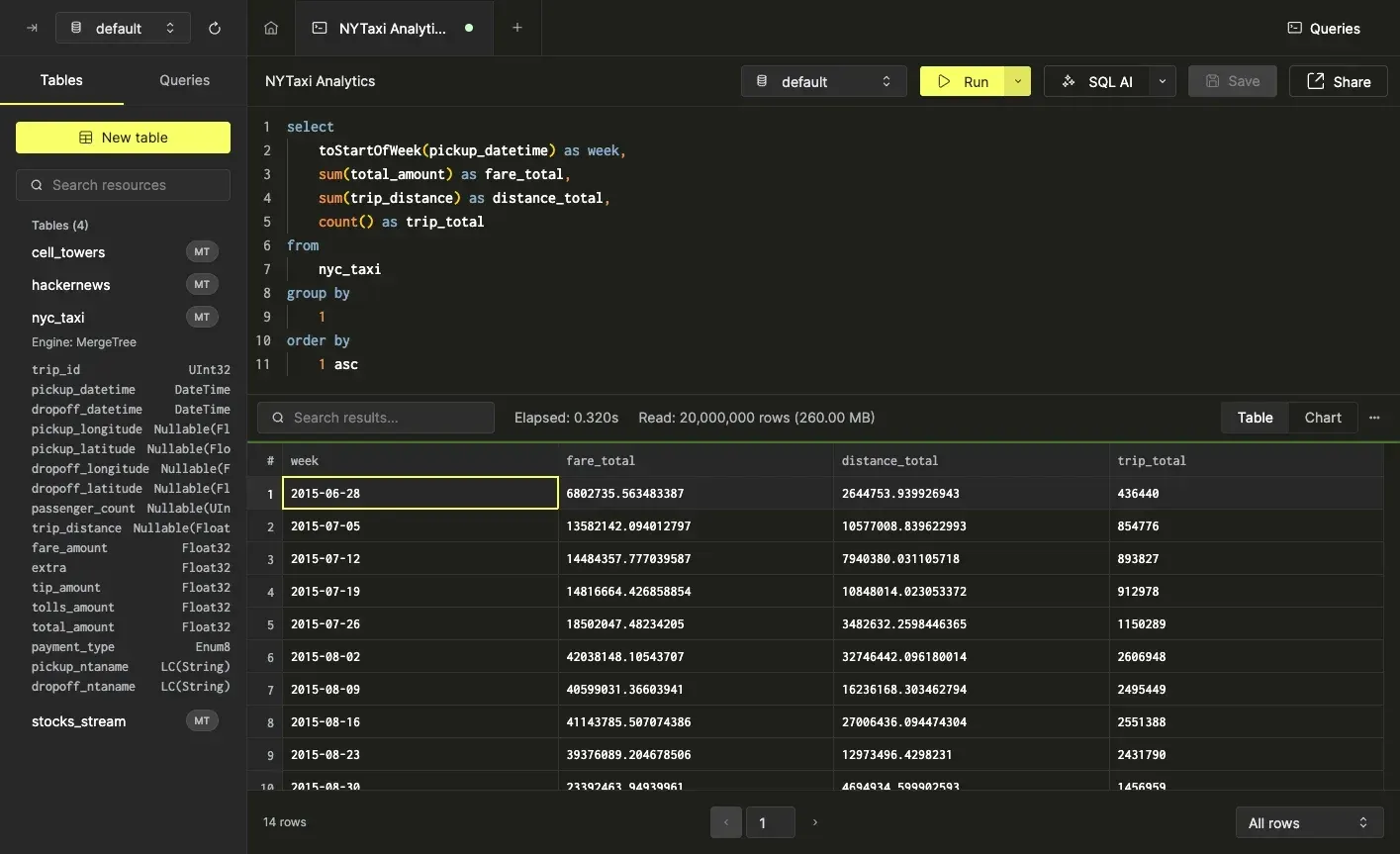
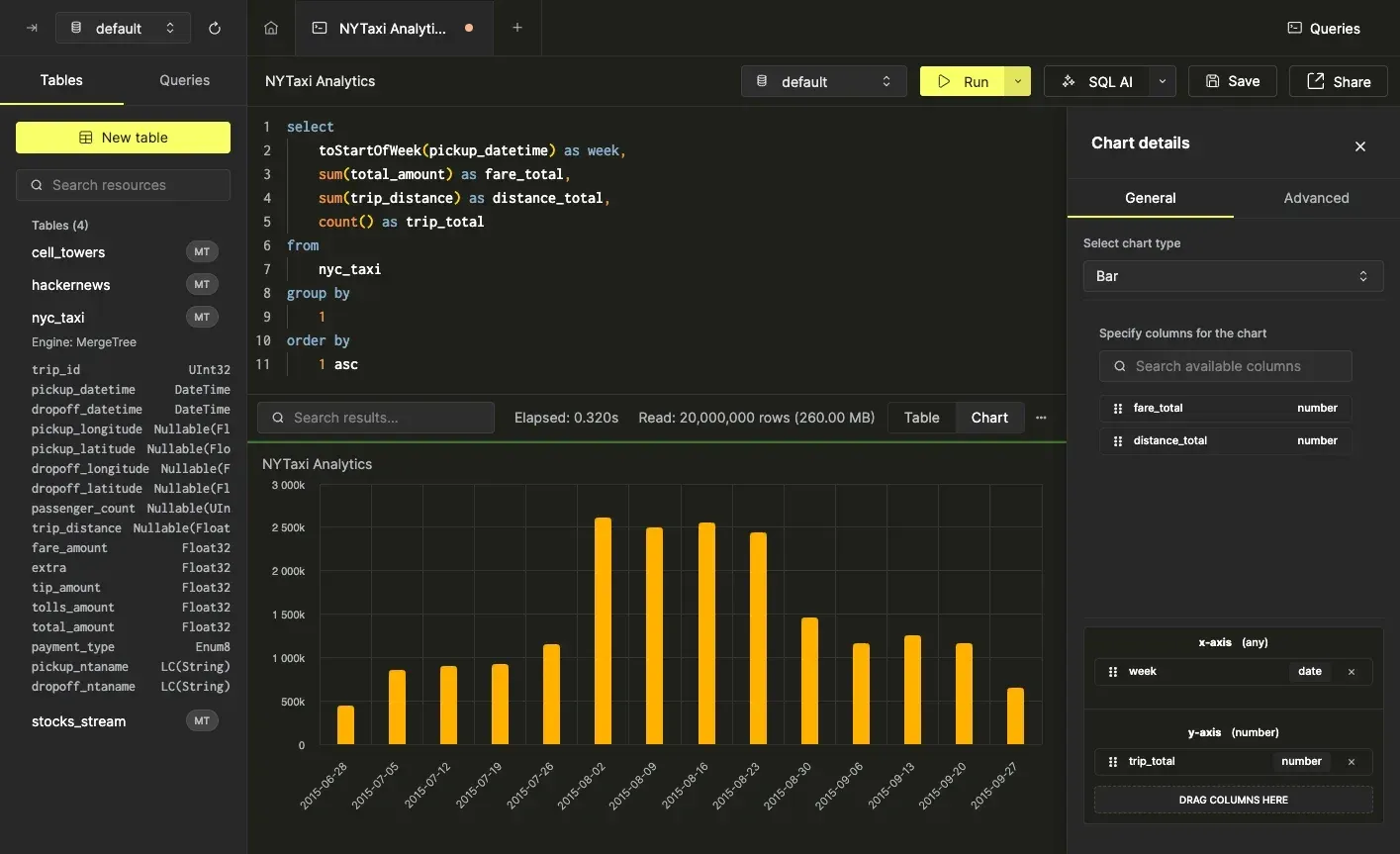
ClickHouse is designed for aggregations over very large tables that keep receiving inserts. Event or log rows are written into a MergeTree table whose primary key matches the most common filters, and background merges keep the number of parts low while queries run. Materialized views and AggregatingMergeTree tables can precompute rollups at insert and merge time. The official gallery examples show this pattern on the NYC taxi dataset in the Cloud SQL console.
Data warehousing and data lakes
ClickHouse lists data warehousing and data lakes among its use cases. Tables can be loaded from Parquet, ORC or Avro files, and the Iceberg, DeltaLake, Hudi and Paimon engines query open table formats in object storage directly. Integration engines for PostgreSQL and MySQL read operational databases, and in ClickHouse Cloud ClickPipes manage continuous ingestion from databases, streaming services and APIs.
Observability with ClickStack
The ClickStack overview describes an open-source observability platform built on ClickHouse for logs, traces, metrics and session replays. It combines the ClickStack UI, ClickHouse for storage and queries, and a preconfigured OpenTelemetry collector with a schema for logs, traces and metrics. It can be self-managed or used with the managed ClickHouse Observability offering. Similar projects listed on iThub include HyperDX and Uptrace, which also store telemetry in ClickHouse.
Querying files without a server
clickhouse-local and the single binary from the quick install script run SQL directly on CSV, TSV, JSON or Parquet files, on HTTP(S) URLs and on S3 objects. Data is streamed into a temporary table and nothing needs to be inserted first. The documentation lists development, testing and file processing as the intended scope. An in-process engine for local analytics is also available in DuckDB, a separate project listed on iThub.
Running a replicated cluster
A self-managed cluster combines ReplicatedMergeTree tables for redundant copies, Distributed tables for sharding and ClickHouse Keeper for replication coordination and distributed DDL. Keeper can be embedded in the server or deployed as dedicated nodes from the clickhouse-keeper package. The tutorial walks through setting up and querying a small cluster, and the built-in Advanced Dashboard charts queries, merges, CPU and I/O from system tables.
Managed deployment in ClickHouse Cloud
ClickHouse Cloud separates compute from object storage, scales services automatically within configured limits and idles them when unused. The Basic plan runs a single replica with up to 1 TB of storage, while Scale adds two or more availability zones, compute-compute separation, private networking and configurable backups, and Enterprise adds SAML SSO, private regions, CMEK and HIPAA and PCI compliance. BYOC places the same service model inside the customer's VPC on a custom quote. Other analytical databases on iThub include Snowflake and SingleStore.
Install
curl https://clickhouse.com/ | shReviews of ClickHouse
Be the first to share your experience with ClickHouse.
Write a review
Loading review form…
Found ClickHouse useful? Upvote it todayYour vote helps other IT teams find it in the daily ranking.