

What is Render?
Render is a hosted cloud application platform operated by Render Inc. Its documentation describes it as a platform for deploying, securing and scaling applications, from small prototypes to architectures with many services. According to the about page, the company is headquartered in San Francisco, California, has team members working remotely around the world and has raised $258M from investors. Render is not distributed as installable server software: services run in Render-operated regions and are managed through the Render Dashboard, a REST API, a command-line client and an MCP server.
Applications are deployed as typed services. The web service type hosts a dynamic application at a public onrender.com subdomain, built from a linked Git repository, a public Git repository URL or a prebuilt Docker image. Other types are static sites served over a global CDN, private services reachable only on the private network, background workers, cron jobs, Render Postgres databases, Render Key Value instances (Valkey 8 for instances created since February 12, 2025) and persistent disks. Newer additions are Render Workflows, an orchestration engine for distributed long-running tasks, and Render Sandboxes, isolated environments for untrusted code that are in public beta.
Builds use native runtimes for Node.js and Bun, Python, Ruby, Go, Rust and Elixir, or a Docker runtime for other languages such as PHP, .NET and JVM languages. Linked repositories can come from GitHub, GitLab, Bitbucket or Cursor Origin (beta). By default, every push to the linked branch triggers a rebuild and a zero-downtime redeploy, unless the service has a persistent disk attached. Service filesystems are ephemeral: local changes are lost on redeploy or restart unless they are written under a persistent disk mount path.
Services and datastores run in one of five regions: Oregon, Ohio and Virginia in the USA, Frankfurt in Germany, and Singapore. The region of an existing service cannot be changed; services in the same region share a private network. Static sites do not have a region because they are served from the CDN.
Billing combines a workspace plan, metered usage such as bandwidth and build pipeline minutes, and per-service compute prorated by the second. The pricing page lists Hobby at $0 per month plus compute, Pro at $25 per month plus compute, Scale at $499 per month plus compute and Enterprise at custom pricing. Free compute plans exist for web services, Postgres and Key Value with documented limits, and static sites are free to deploy. Render lists SOC 2 Type 2 and ISO 27001 compliance and offers HIPAA-enabled workspaces on Scale and Enterprise. Similar hosted platforms in this directory include Vercel, Railway, Fly.io and Netlify.
Render screenshots
Explore the interface. Open a screenshot to view it at full size.
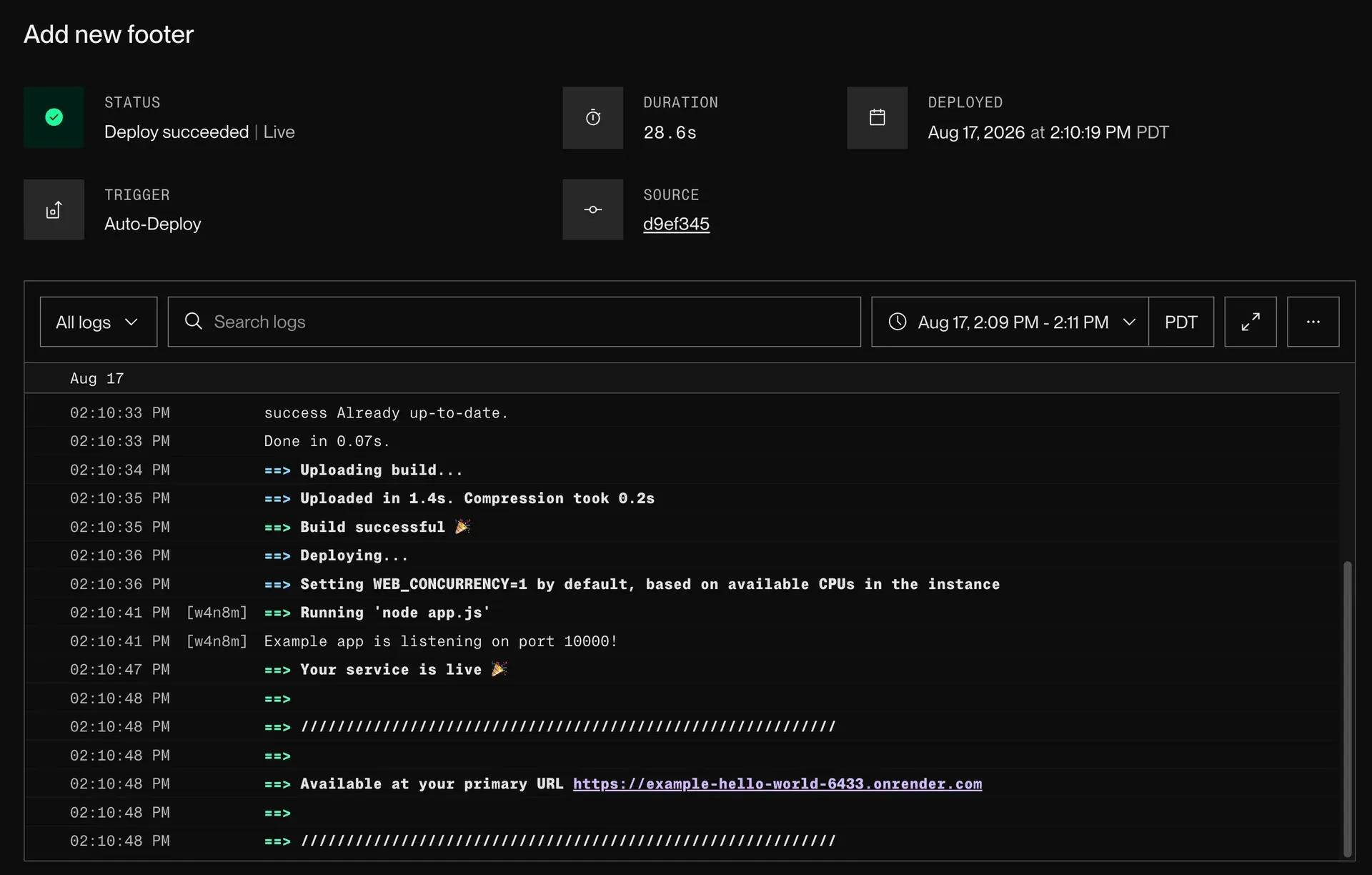
Deploy detail page from the Render documentation: an auto-deploy with its build and start log ending at the service URL.
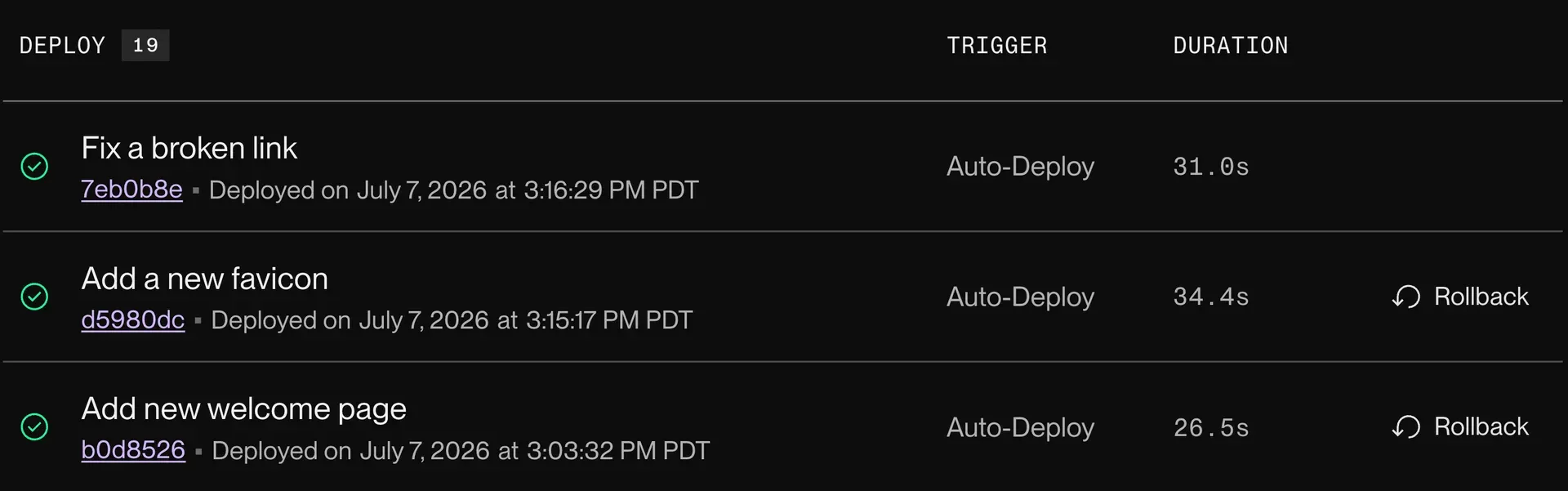
Deploys page from the Render documentation, showing auto-deploys per commit with rollback actions.
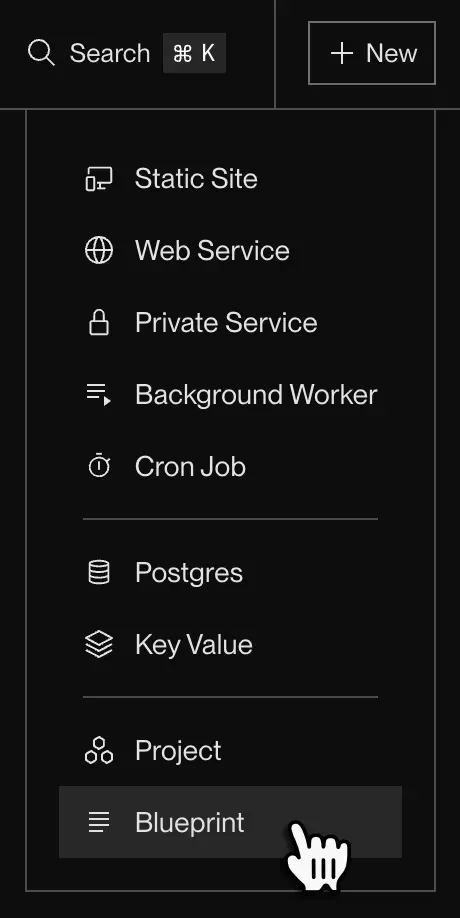
The New menu in the Render Dashboard with the service types and the Blueprint option, from the Blueprints guide.
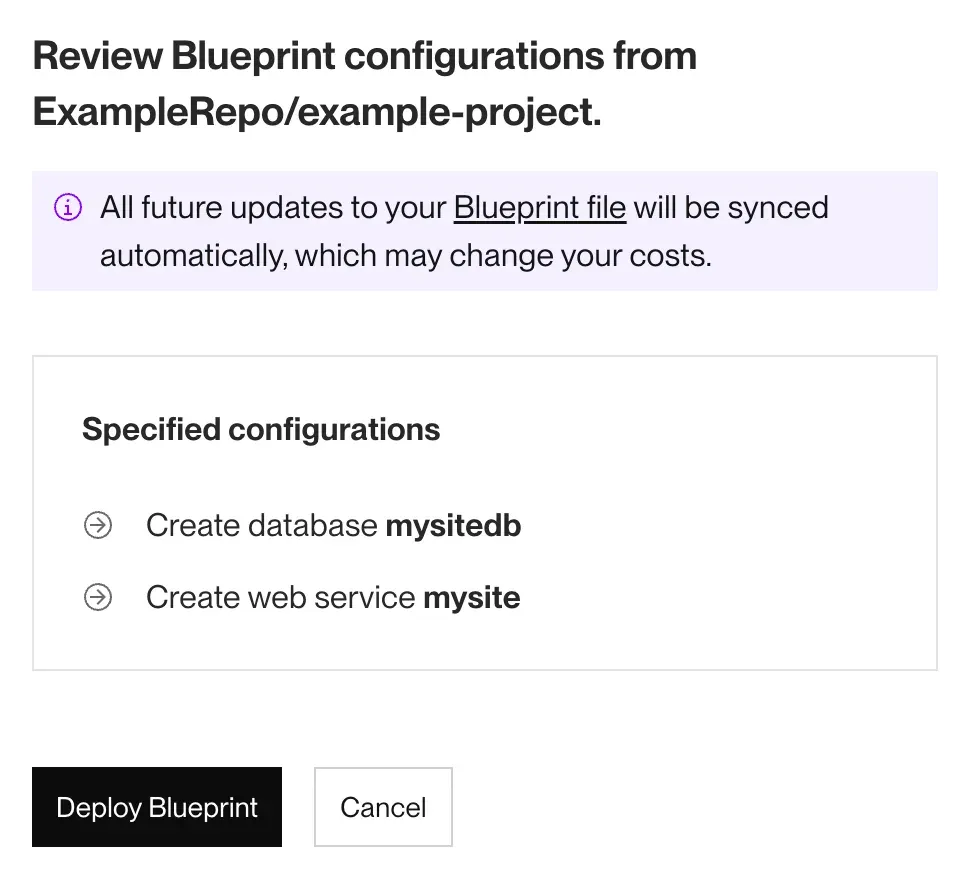
Blueprint review step from the Render documentation, listing the resources defined in render.yaml before deployment.
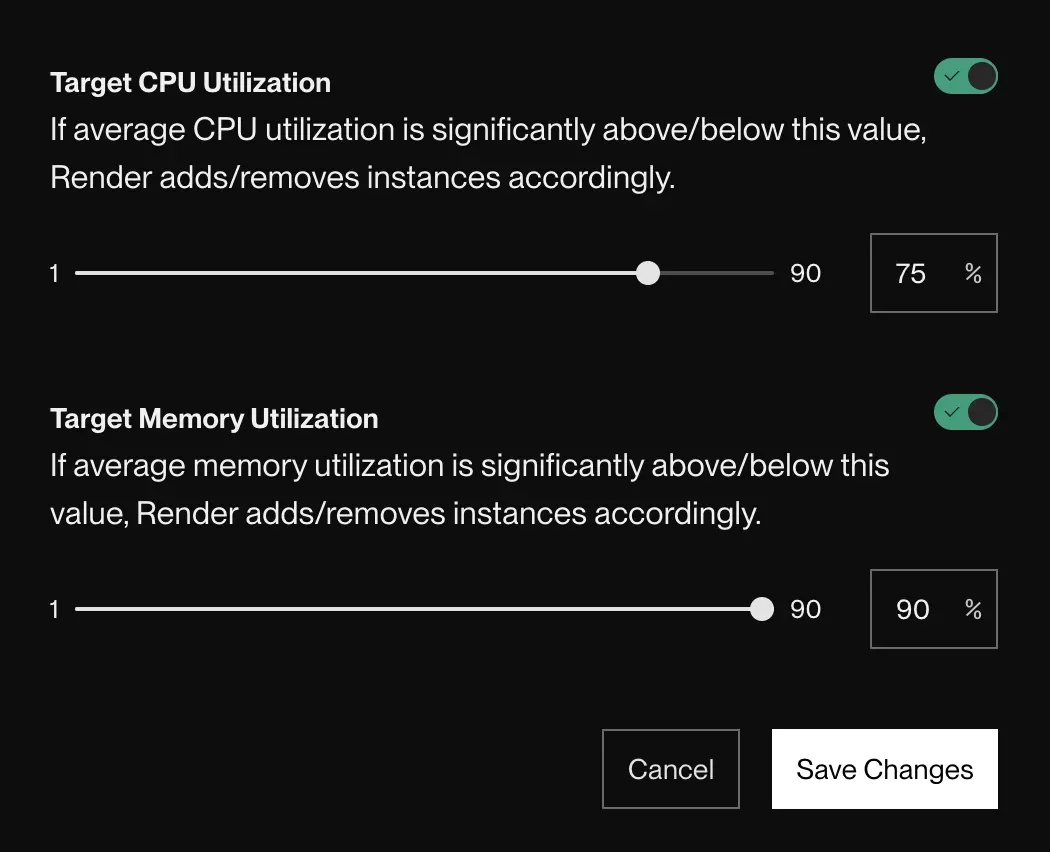
Autoscaling settings from the Render scaling documentation, with CPU and memory utilization targets.
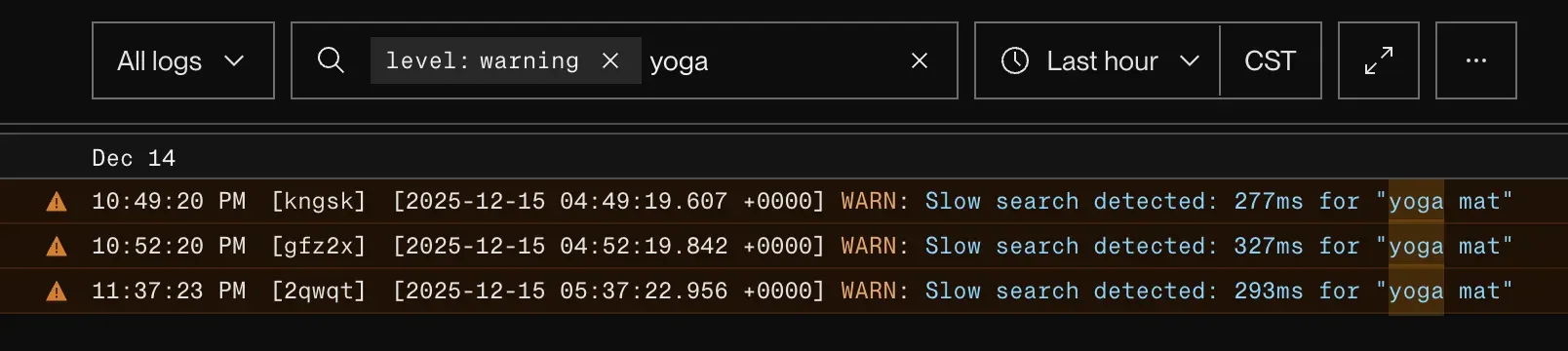
Log explorer from the Render logging documentation, filtered to warning-level lines.
Source: official Render project page.
Key capabilities
- Web services Dynamic applications are deployed from a Git branch, a public repository URL or a Docker image and receive an
onrender.comsubdomain plus optional custom domains, including wildcards. The service must bind to a port on0.0.0.0; the defaultPORTvalue is 10000, and ports 18012, 18013 and 19099 are reserved. Render terminates TLS at its load balancer and redirects HTTP to HTTPS. The web services documentation also lists HTTP/2, WebSockets, edge caching, maintenance mode and Brotli compression. - Static sites Static frontends, blogs and documentation are built from a linked repository and served over a global CDN, with immediate cache invalidation after each successful atomic build. Redirect and rewrite rules and custom response headers are configured in the Dashboard. Static sites are free to deploy but count against the workspace's included bandwidth and pipeline minutes, as described in the static sites documentation.
- Private services and background workers Private services work like web services but receive no public subdomain and accept traffic only from other services on the same private network, on almost any port and protocol. Background workers receive no incoming traffic at all and typically poll a task queue. The background workers page names Celery, Sidekiq, BullMQ, Asynq, Oban and apalis as common queue frameworks.
- Cron jobs Cron jobs run a command or a Docker image on a cron expression evaluated in UTC, from a connected repository or a prebuilt image pulled before each run. Render guarantees at most one active run per cron job; a manually triggered run cancels an active one. Cron jobs cannot use a persistent disk and are billed per minute of runtime, prorated by the second.
- Render Postgres Managed PostgreSQL offers point-in-time recovery, read replicas, high availability, connection pooling, logical replication and extensions such as pgvector and PostGIS. The pricing page lists instances from 256 MB RAM up to 128 CPU and 1024 GB RAM, with expandable storage at $0.30 per GB. The point-in-time recovery window is 3 days on Hobby and 7 days on paid workspace plans.
- Render Key Value Key Value instances are Redis-compatible in-memory stores for caches and job queues. New instances run Valkey 8, while legacy instances created before February 12, 2025 run Redis 6. Paid instances enable disk-backed persistence by default; free instances are in-memory only and lose data on restart, according to the Key Value documentation.
- Persistent disks An SSD can be attached to a paid web service, private service or background worker so that changes under its mount path survive deploys and restarts. Disks are encrypted at rest and snapshotted every 24 hours, with snapshots kept for seven days. A disk is accessible by one instance only, which rules out scaling to multiple instances and disables zero-downtime deploys. Disk size can be increased but not decreased; pricing is $0.25 per GB per month.
- Blueprints (render.yaml) Blueprints are Render's infrastructure-as-code model: a YAML file, by default
render.yamlat the repository root, defines services, databases and environment groups. Pushes to the linked branch that change the file deploy added or modified resources, and automatic sync can be disabled. The Blueprints guide and the Blueprint YAML reference document the format. - Automatic and manual deploys Auto-deploy can run on every commit, only after CI checks pass, or be turned off. Deploys can also be triggered manually, through deploy hooks, the API or the CLI, and a specific commit can be deployed. Build commands time out after 120 minutes, pre-deploy commands after 30 minutes and start commands after 15 minutes; a failed step leaves the previous deploy running, as described in the deploys documentation. Instant rollbacks keep 5 to 30 builds depending on plan.
- Service previews and preview environments Service previews create a temporary instance of a web service or static site per pull request, with its own URL and an
X-Robots-Tag: noindexheader. Preview environments, available on Pro and higher, copy a whole Blueprint (services, datastores and environment groups) for each pull request and are destroyed when the pull request is merged or closed. Copied datastores and disks start without data, and preview compute plans can be set separately, per the preview environments documentation. - Scaling and autoscaling Web services, private services and background workers can run multiple load-balanced instances: up to 100 on paid plans with at most 8 CPU and 32 GB RAM, and up to 5 on larger plans. Manual scaling is available on all workspaces. Autoscaling, on Pro and higher, keeps the instance count between a minimum and maximum based on target CPU and memory utilization, as described in the scaling documentation.
- Private networking and regions Services in the same region communicate over a private network without traversing the public internet; each region has its own separate network. The five regions are Oregon, Ohio, Virginia, Frankfurt and Singapore. Free web services can send but not receive private network traffic, per the private network documentation.
- Free compute plans Free instances exist for web services (0.1 CPU, 512 MB RAM), Postgres and Key Value. Free web services spin down after 15 minutes without inbound traffic and take about one minute to spin up again, and each workspace gets 750 free instance hours per month. Free Postgres databases are limited to 1 GB and expire 30 days after creation, with a 14-day grace period before deletion. The full list of limits is on the free plan page.
- Workspace plans Hobby ($0 plus compute) allows up to 25 services, one seat, 5 GB of included bandwidth and 500 pipeline minutes. Pro ($25 plus compute) adds unlimited seats and services, 25 GB of bandwidth, full-stack previews, horizontal autoscaling and audit logs. Scale ($499 plus compute) adds multiple workspaces, 1 TB of bandwidth, SAML SSO, SCIM and HIPAA-enabled workspaces; Enterprise adds contractual uptime SLAs and dedicated support. Details are on the pricing page.
- Compute pricing Paid service instances start at $7 per month for 0.5 CPU and 512 MB RAM and go up to 12 CPU and 96 GB RAM at $1,500 per month. Key Value instances range from $10 per month (256 MB) to $750 per month (50 GB). Additional bandwidth is $0.15 per GB, and extra pipeline minutes cost $5 per 1,000. HIPAA-enabled workspaces carry a 20% compute premium.
- REST API The public REST API covers service types, Postgres and Key Value, Workflows, deploys, environment groups, Blueprints, metrics and logs, projects, custom domains, one-off jobs and audit logs. Requests authenticate with API keys created in account settings; scoped API keys are in early access. The API reference publishes an OpenAPI specification.
- Render CLI and MCP server The Render CLI creates and updates services, triggers deploys, restarts and one-off jobs, opens psql sessions, streams logs and validates
render.yamlfiles, with a non-interactive mode for CI. It installs with Homebrew (brew install render), WinGet (winget install render.cli) or a curl script. A hosted MCP server atmcp.render.com/mcplets AI apps such as Claude Code, Codex and Cursor create services, query databases and read metrics and logs. - Logs, metrics and monitoring Each service has a log explorer with text and level filters, per-deploy logs, health checks, service metrics and notifications. Log retention is 7 days on Hobby, 14 days on Pro and 30 days on Scale and Enterprise. Log streams are available on all plans, while HTTP request logs and an OpenTelemetry metrics stream are listed for paid workspace plans.
- Security and compliance The compliance page lists SOC 2 Type 2 and ISO 27001, GDPR compliance and HIPAA-enabled workspaces for US health data on Scale and Enterprise. All workspaces can download a SOC 3 report and the GDPR DPA from the Document Center; the SOC 2 report and ISO certificate require Pro or higher and an NDA. The security page lists certification under the EU-US Data Privacy Framework, a HackerOne disclosure program and subprocessors including AWS, Google Cloud and Cloudflare.
Where Render fits
Deploying a web application from Git
A developer connects a GitHub, GitLab or Bitbucket account, selects a repository and branch, chooses a region and runtime, and sets build and start commands such as npm install and npm start. Render builds and deploys the service, shows progress on the Deploys page and redeploys on later pushes to the branch. Render provides quickstart templates for Express, Django, Rails, Gin, Rocket, Phoenix and Laravel.
Running an application with a database and a queue
A typical multi-service layout combines a web service, a Render Postgres database, a Key Value instance used as a job queue and a background worker that consumes it. Services in the same region connect over the private network, and connection strings can be passed as environment variables or environment groups. Render's documentation includes quickstarts for Celery and for Rails with Sidekiq.
Defining infrastructure as code with Blueprints
A team describes its services, databases and environment groups in render.yaml, commits the file and creates a Blueprint from New > Blueprint in the Dashboard. Render lists the resources it will create, provisions them and keeps them in sync with later changes to the file. The Render CLI can validate the file before it is pushed, and a resource is meant to be managed by at most one Blueprint, per the Blueprints guide.
Reviewing pull requests in preview environments
With previews.generation set to manual or automatic in a Blueprint, each pull request receives a copy of the services, datastores and environment groups, with deployment status shown in the pull request. Preview copies can use smaller compute plans, start without production data and can be seeded during initialization. Render announces support for stacked pull requests on November 18, 2026, in the preview environments documentation.
Scheduling recurring jobs
Recurring tasks such as reports or cleanup scripts run as cron jobs with a cron expression in UTC and a command that exits when finished. Each run appears on the Runs page with its logs, a run can be triggered manually from the Dashboard, and failure notifications are listed on the pricing page. Docker-based cron jobs use the image's ENTRYPOINT or CMD unless a Docker command is set, according to the cron jobs documentation.
Hosting a static frontend or documentation site
Frameworks such as Next.js (static export), Vue.js, Hugo, Docusaurus, Svelte, Jekyll and Gatsby are deployed as static sites from a repository. Each push rebuilds the site, a successful build is deployed atomically and the CDN cache is invalidated immediately. Custom domains are included (2 on Hobby, 15 on Pro, 25 on Scale) with TLS certificates issued through Let's Encrypt and Google Trust Services, as stated in the static sites documentation.
Install
brew install renderReviews of Render
Be the first to share your experience with Render.
Write a review
Loading review form…
Alternatives to Render
 VercelVercel deploys frontend and full-stack apps such as Next.js from Git, with preview URLs, functions, a CDN and Hobby, Pro and Enterprise plans.
 RailwayRailway is a hosted cloud platform that builds and runs services from GitHub repos, Docker images or the CLI, with databases, volumes, private networking, preview environments and metrics. Plans start with a free trial; Hobby has a $5 monthly minimum.
 Fly.ioFly.io runs applications on Fly Machines, fast-launching VMs you control through a REST API or flyctl, with pay-as-you-go pricing from $2.19 a month.