

What is Fivetran?
Fivetran is a managed data movement platform. Its about page states that the company was founded out of Y Combinator in 2012, is headquartered in Oakland, California, and has offices in Denver, Toronto, Dublin, London, Amsterdam, Munich, Novi Sad, Bengaluru and Sydney. The same page lists the acquisitions of Teleport Data and HVR in 2021.
The service extracts data from sources such as SaaS applications, databases, files and event streams and loads it into a destination. Each connector creates and manages its own schema in the destination, and Fivetran maintains the canonical schema while customers write their own SQL transformations and models, as described in the core concepts documentation. A connection first runs a historical sync of all selected tables and then switches to incremental syncs that load only added or modified data.
Fivetran runs in two deployment models. In SaaS Deployment, data processing happens entirely within the Fivetran cloud. In Hybrid Deployment, data is processed inside the customer's own network while the Fivetran cloud orchestrates and configures the data movement. Hybrid deployment is listed as an Enterprise plan option.
Beyond ingestion, the platform includes Transformations (a Fivetran-hosted dbt integration plus Quickstart data models), Activations for reverse ETL from a warehouse into business tools, a Python Connector SDK for custom sources, and a REST API. Pricing is usage-based on monthly active rows (MAR), with a Free plan up to 500,000 MAR for connections, as listed on the pricing page.
Fivetran is a closed-source commercial service operated through a web dashboard. Similar listings on iThub: Airbyte, an open-source data movement platform, and Estuary for CDC and streaming pipelines; Census is now Fivetran Activations.
Key capabilities
- Managed connectors The Standard plan lists more than 700 fully managed connectors for SaaS applications, databases, files and events. Enterprise adds enterprise database connectors. Some connectors receive pushed data while others poll the source, and each one creates and manages its own schema in the destination.
- Historical and incremental syncs A historical sync, the initial sync, is required before a connection can be used. Incremental syncs then load only added or modified data, tracked with cursors. Syncs are checkpointed, so a failed sync restarts from the last checkpoint.
- Sync frequency The sync documentation lists fixed intervals of 1, 5, 15 and 30 minutes and 1, 2, 3, 6 (default), 8, 12 and 24 hours. The 1-minute frequency and cron schedules (beta) require Enterprise or Business Critical and are not available for every connector. Manual syncs are available through the REST API.
- Re-syncs and rollback syncs A re-sync reruns the historical sync to fix data integrity errors and overwrites existing rows. Some connectors run a daily rollback sync over a larger window of past data, which increases MAR.
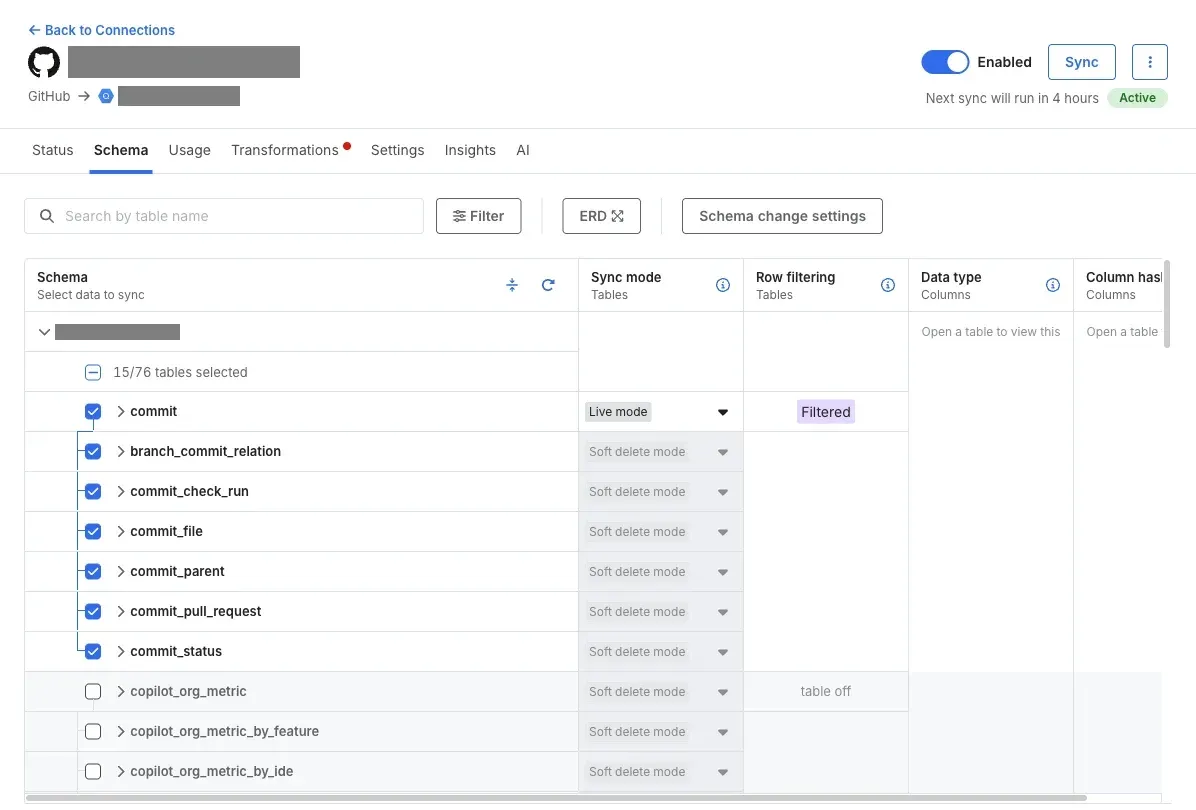
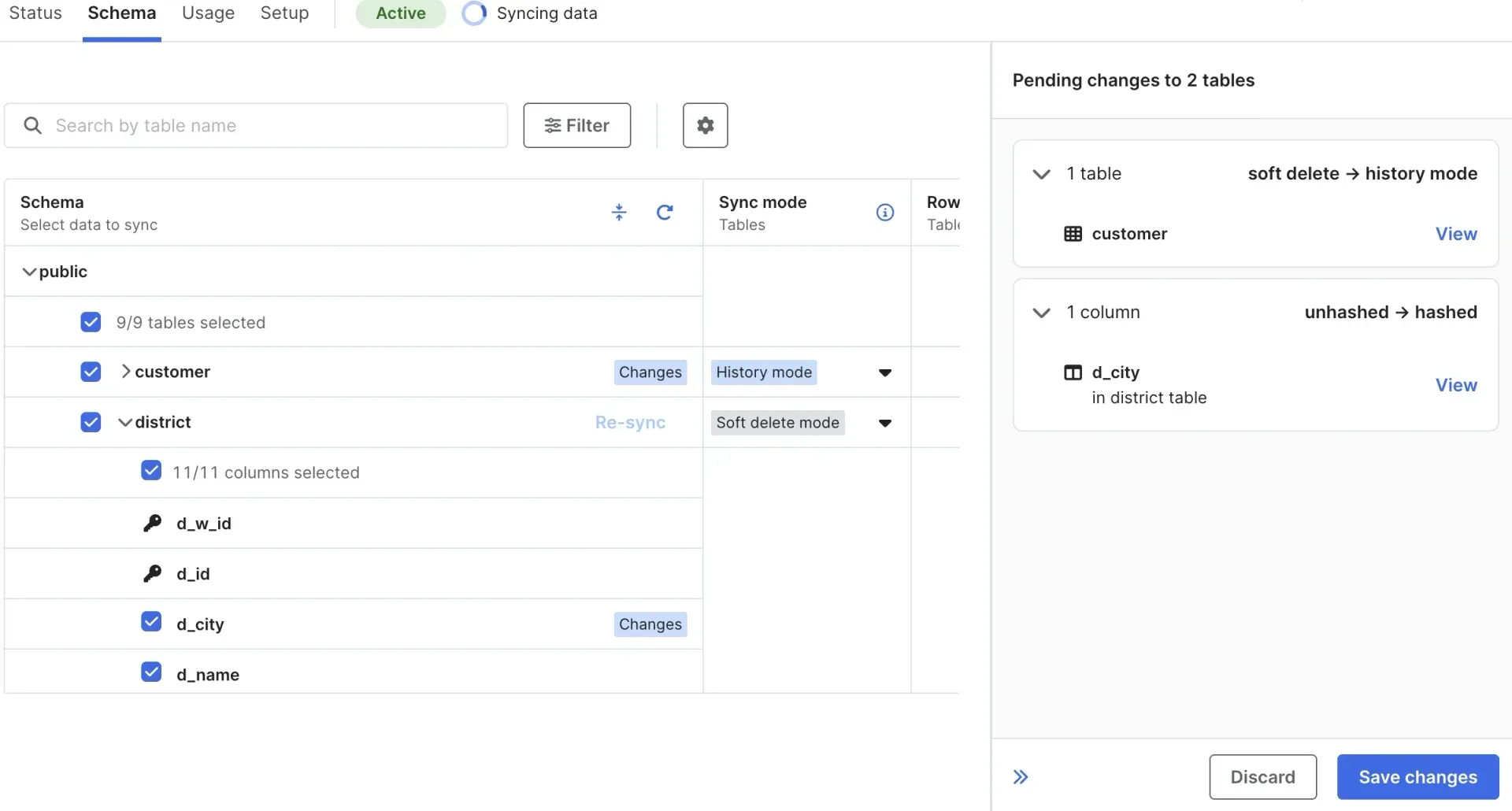
- Schema management The Schema tab lets users select schemas, tables and columns to sync, choose a sync mode per table (soft delete, history mode or live mode), block or hash columns, and review pending schema changes before saving them.
- Type handling Fivetran uses one standard data type list across destinations. When a source column changes type, it is promoted to the most specific type that holds both old and new values; JSON becomes STRING where a destination lacks a JSON type.
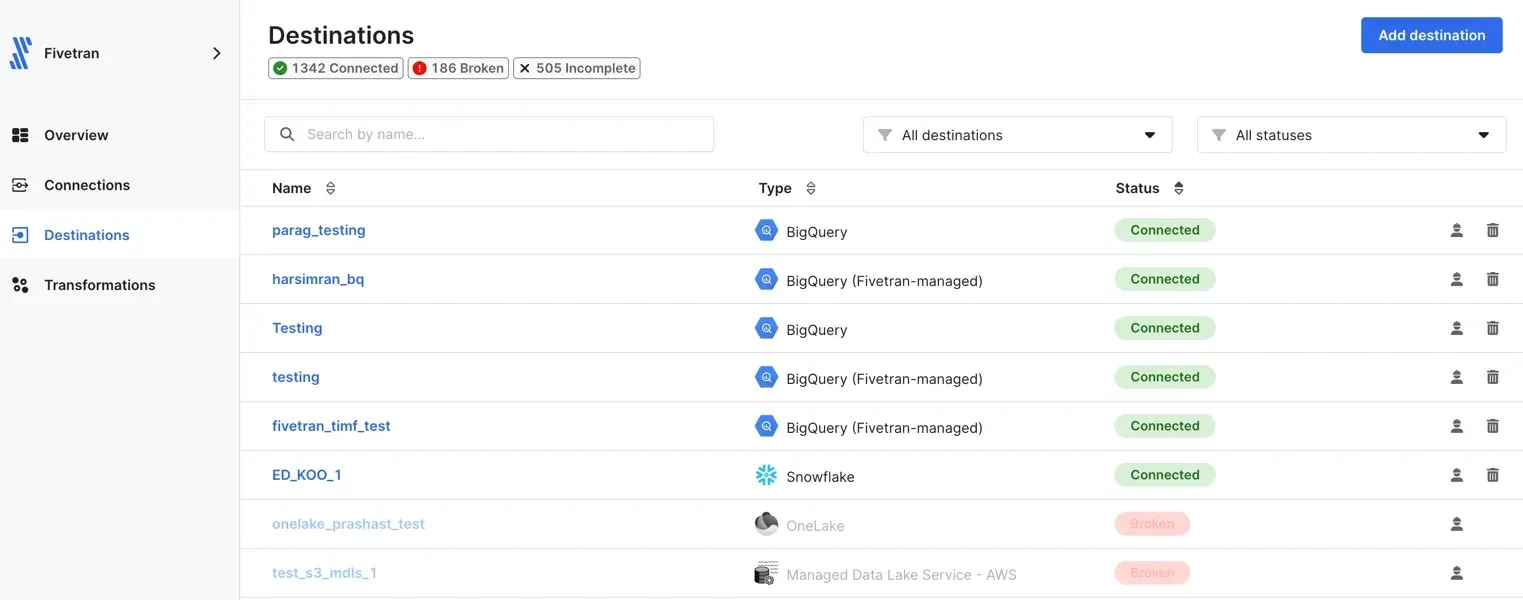
- Destinations The destinations list includes Snowflake, BigQuery, Databricks, Redshift, Azure Synapse, ClickHouse Cloud, MotherDuck, Teradata Vantage, PostgreSQL, SQL Server, MySQL and Oracle (beta), Apache Kafka, Milvus and the Managed Data Lake Service. Several destinations are partner-built or in beta or preview.
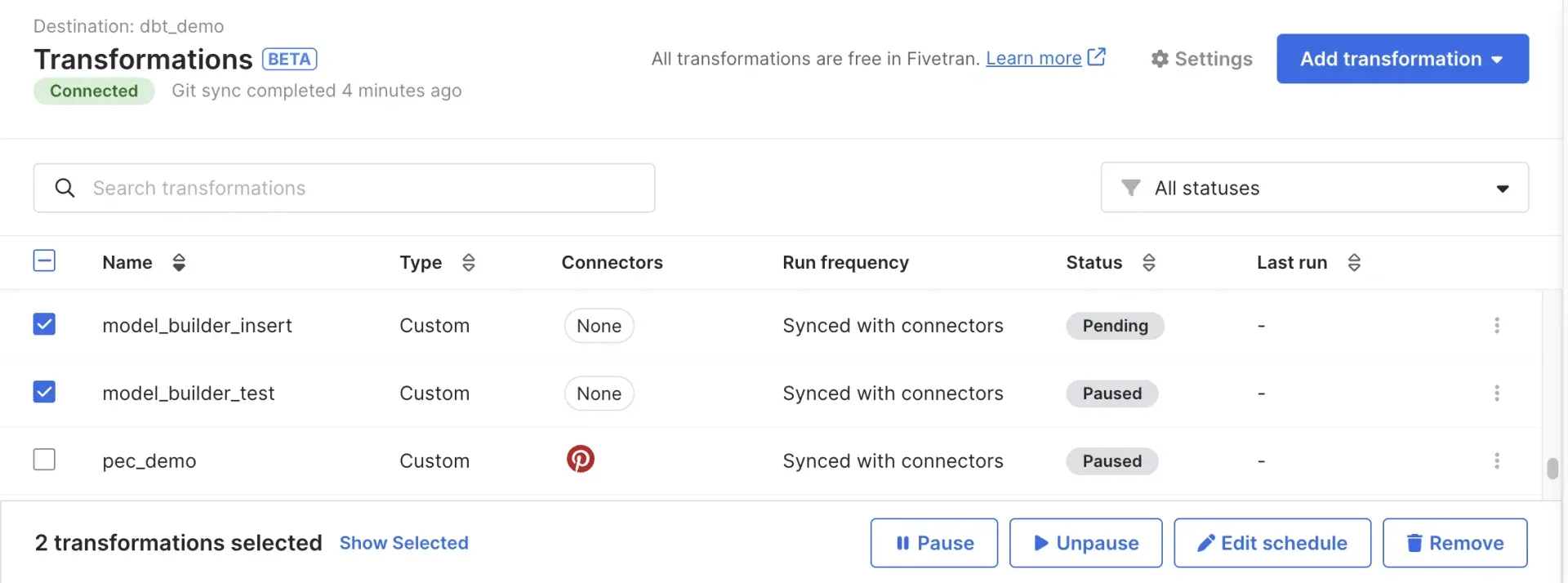
- Transformations Transformations cover Quickstart data models added in the dashboard, Fivetran data models imported into a dbt project and the hosted dbt integration, plus orchestration of dbt Cloud and Coalesce. Integrated scheduling runs a transformation as soon as relevant destination data is updated.
- Activations (reverse ETL) Fivetran Activations moves data from a warehouse or other source of truth into business tools with configurable mappings, triggers and schedules. It includes Audience Hub for building segments without SQL. The pricing page lists more than 200 managed activation destinations on Standard.
- Connector SDK The Connector SDK builds custom connectors in Python, published on PyPI as fivetran-connector-sdk, and deploys them with the fivetran deploy command; Fivetran runs them on the sync schedule and manages the compute. Webhooks, History Mode and table-level re-syncs from the dashboard are not supported for SDK connectors.
- REST API The REST API provides programmatic access for automation and is included from the Standard plan; manual sync scheduling is available only through the API.
- Hybrid Deployment With Hybrid Deployment, data is processed in the customer's own network while Fivetran orchestrates the pipelines from its cloud. It is listed under the Enterprise plan; cron scheduling is not supported for hybrid connections.
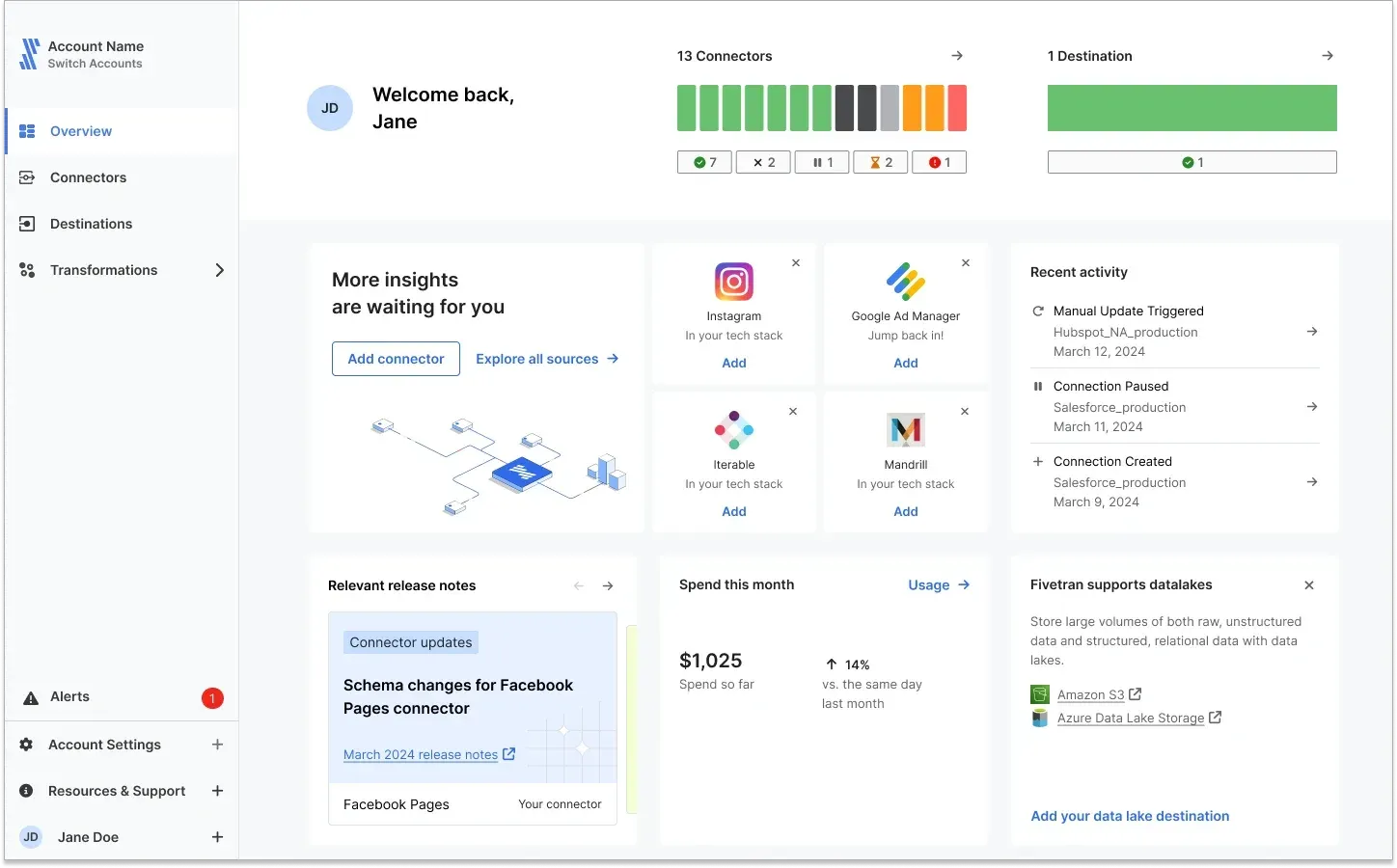
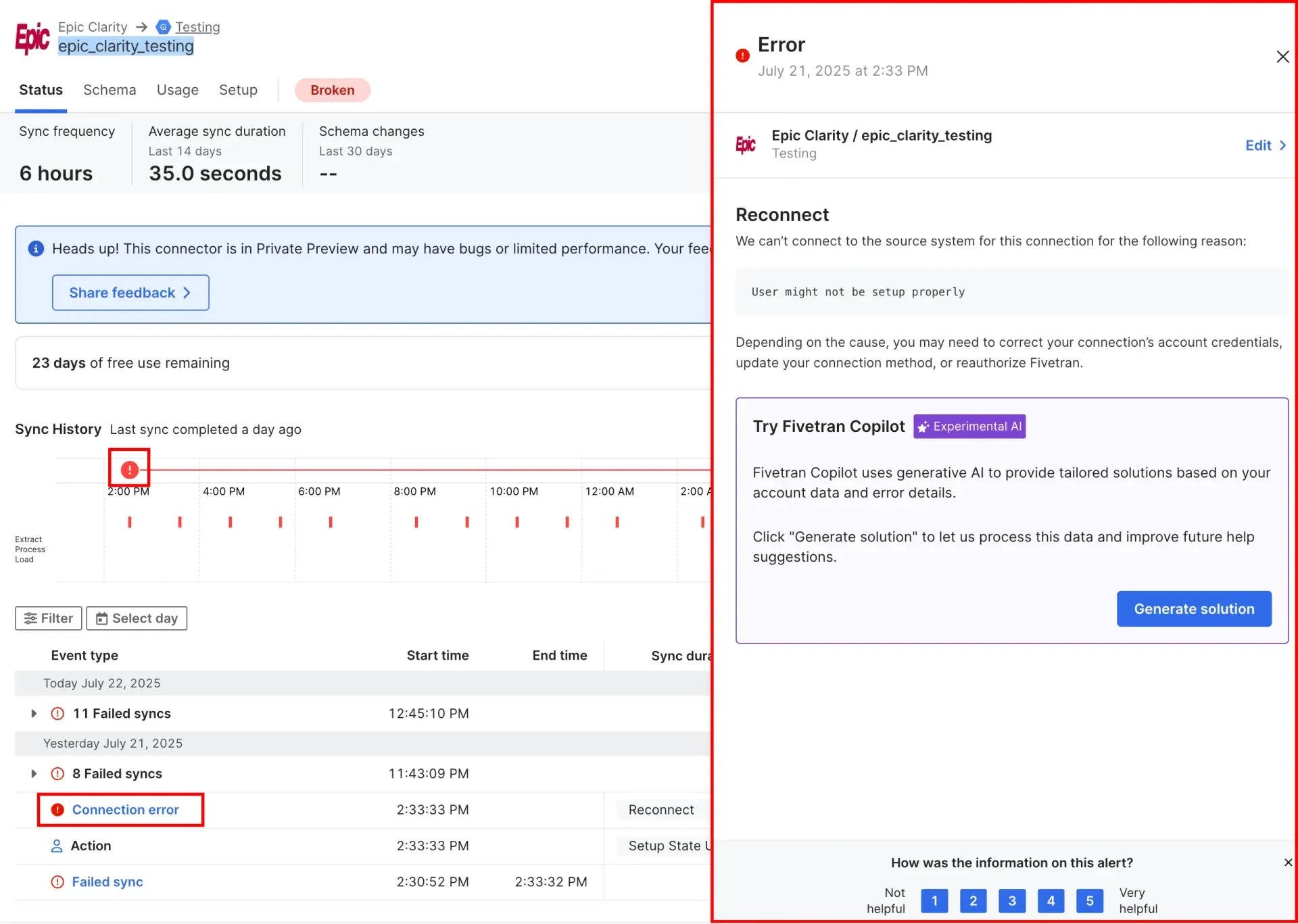
- Monitoring and alerts The dashboard shows connection status, sync history with start and end times, usage and alerts. Failed syncs are retried on a schedule tied to the sync frequency; after 14 days of failures, Fivetran pauses the connection automatically.
- Security and access control Standard includes role-based access control and SSH tunnels. Enterprise adds custom roles, VPN tunnels on annual contracts, SCIM provisioning and a choice of GCP, AWS or Azure. Business Critical adds customer-managed encryption keys, PCI DSS Level 1 certification and private networking.
- Usage-based pricing Connections are billed on monthly active rows: inserts, updates and deletes count, while unchanged rows in re-syncs and initial loads do not. Standard connections with 1 to 1M MAR carry a $5 base charge. Transformations are billed per successful model run, with the first 5,000 runs per month free.
Where Fivetran fits
Centralizing SaaS data in a warehouse
A team adds connections for sources such as Salesforce, HubSpot, Google Ads or Stripe and points them at a destination like Snowflake, BigQuery or Databricks. After the historical sync, incremental syncs keep the destination tables current at the chosen frequency, from every 24 hours down to 15 minutes on Standard.
Replicating operational databases
Database connectors replicate tables from systems such as Oracle, Db2 or MongoDB into an analytics destination. The Schema tab controls which tables and columns are synced and how deletes and history are recorded, and enterprise database connectors are part of the Enterprise plan.
Modeling data after load
Raw data lands in the destination unchanged, and transformations run there afterwards. Teams add Quickstart data models from the dashboard or connect a dbt project; integrated scheduling triggers models after the relevant syncs complete.
Pushing modeled data back to business tools
With Activations, segments and tables built in the warehouse are synced to tools such as Salesforce or HubSpot. Mappings, triggers and schedules are configured per sync, and Audience Hub builds segments for marketing without SQL.
Building a connector for an unsupported source
When no managed connector exists, developers write a Python connector with the Connector SDK, test it locally with fivetran debug and deploy it with fivetran deploy. Fivetran then runs it like any other connection and bills it on MAR.
Handling failed syncs
When a sync fails, the connection Status tab shows the error and sync history. Fivetran retries automatically: within the first 24 hours at intervals based on the sync frequency, then at the set frequency, then once daily after 72 hours, and it pauses the connection after 14 days of failures.
Keeping regulated data inside the company network
Organizations that must keep data local use Hybrid Deployment, where processing runs in their own environment and only orchestration is handled by the Fivetran cloud. Business Critical adds customer-managed keys and private networking for stricter requirements.
Reviews of Fivetran
Be the first to share your experience with Fivetran.
Write a review
Loading review form…
Found Fivetran useful? Upvote it todayYour vote helps other IT teams find it in the daily ranking.


