

What is Temporal?
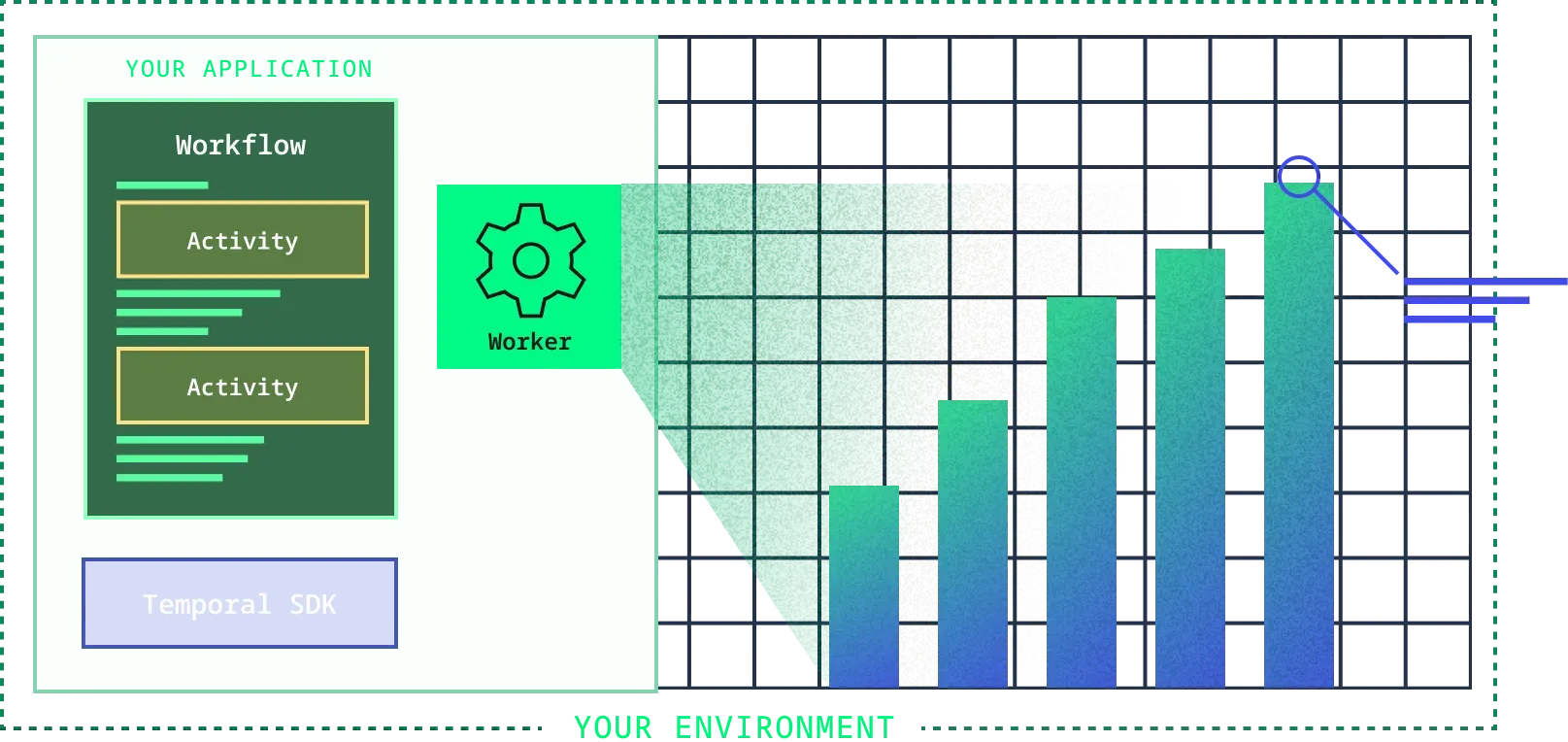
Temporal is a durable execution platform. Its server executes units of application logic called Workflows, records every step in an append-only event history and, after a crash or deploy, recreates Workflow state by replaying that history, while failed operations are retried automatically. Application code is written as Workflow definitions and Activity definitions with one of the Temporal SDKs and runs in Worker processes in the user's own environment. The temporalio/temporal repository contains the server source code.
The project originated as a fork of Uber's Cadence and is developed by Temporal Technologies, a company founded by the creators of Cadence. Its about page names Samar Abbas (CEO) and Maxim Fateev (CTO) as co-founders, who co-created Cadence at Uber in 2015 after earlier work on Amazon Simple Workflow Service and the Azure Durable Task Framework. The same page states that Temporal is released under the MIT license and lists more than 2,900 customers and more than 22,000 community members.
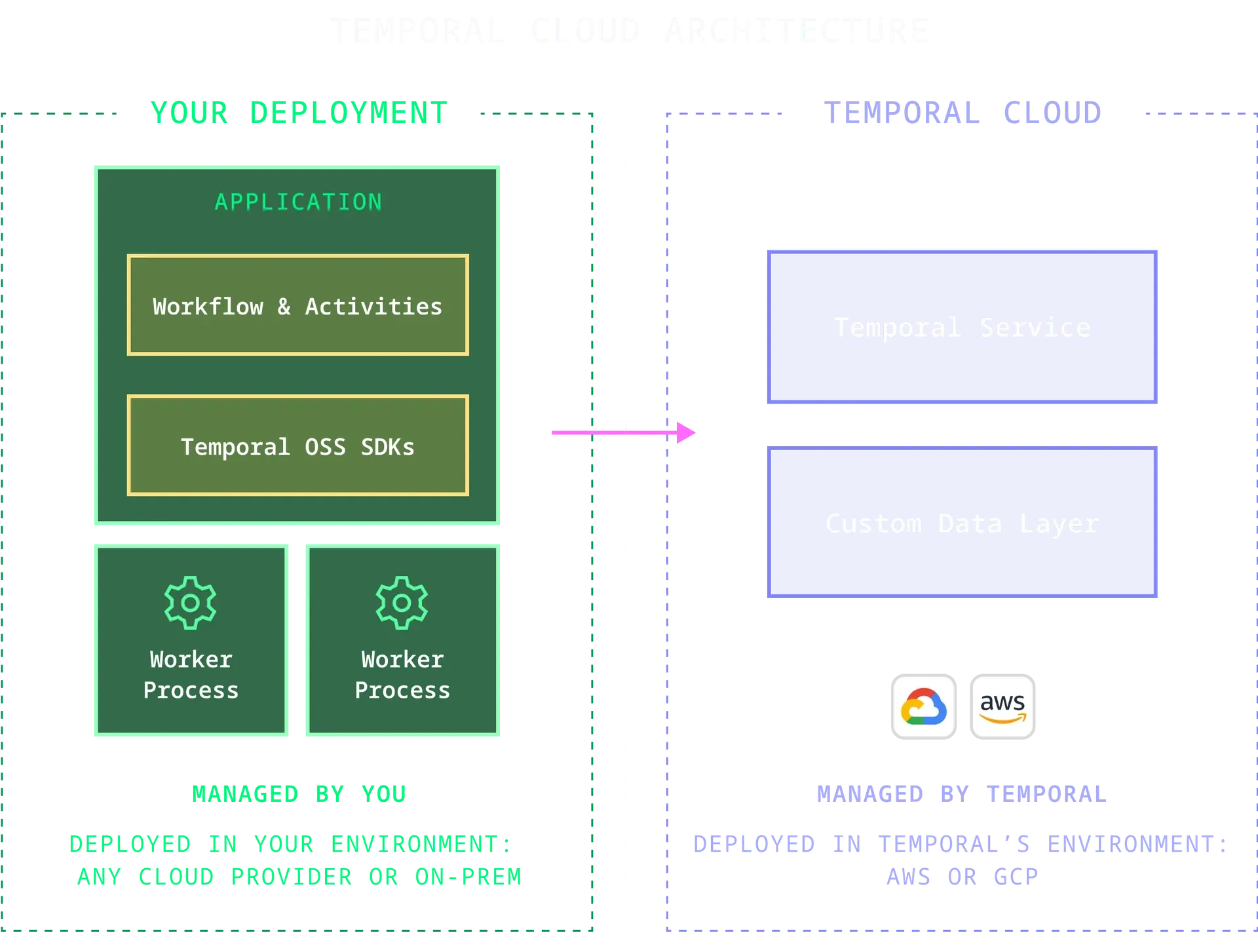
The server is available as release binaries for Linux, macOS and Windows (amd64 and arm64), as the temporalio/server Docker image and as source. For local development the Temporal CLI, installed for example with brew install temporal, starts a complete single-binary development service with the Web UI on port 8233 through temporal server start-dev. Production self-hosting is covered in the self-hosted guide (Docker, Kubernetes or manual deployment), and Temporal Technologies operates the managed Temporal Cloud on AWS or Google Cloud, where Workers stay in the customer's environment.
The latest release is v1.32.2 from November 2, 2026, a patch with security fixes, matching and backlog fixes and one potentially breaking change: ValidateWorkerDeploymentVersionComputeConfig now requires write access to the namespace. The v1.32.0 minor release from September 2026 made Standalone Activities generally available with delayed starts, operator APIs and batch operations, added Standalone Nexus Operations as a pre-release, made the unified Visibility query converter the default, enabled Activity eager execution by default and is the last release with the deprecated Worker Versioning APIs, which are planned for removal in v1.33.
Internally, the server consists of the Frontend, History, Matching and Internal Workers services, described in the repository's architecture documentation. It is written in Go. Persistence is supported on Cassandra, PostgreSQL and MySQL, with SQLite intended for development and testing, and the Visibility store that lists and searches Workflow Executions runs on Elasticsearch, OpenSearch, MySQL, PostgreSQL or SQLite. The server, SDKs and CLI are open source under the MIT License; Temporal Cloud is a commercial service.
Key capabilities
- Durable Workflows Workflow state is captured at every step and survives process crashes and deploys without custom checkpointing code. Workflow code has to be deterministic and free of side effects, while Activity code performs the actual work and is retried according to its retry policy, as the architecture documentation explains.
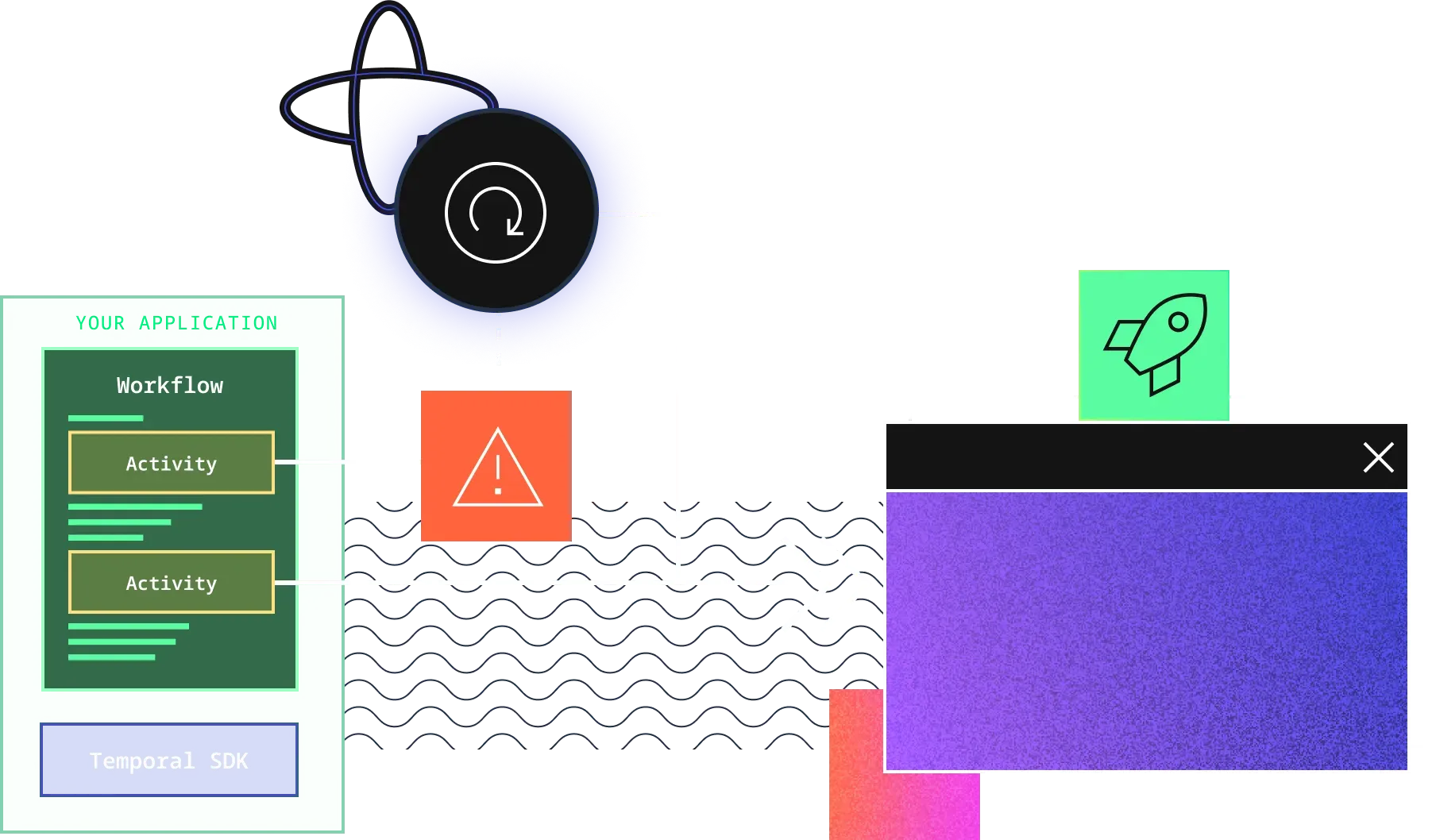
- Failure handling Activities get automatic retries with backoff, four timeout classes and heartbeating, and Workflows can implement saga-style compensation. Failures of Worker processes or server processes do not lose Workflow progress, because state is rebuilt from the event history.
- Long-running and scheduled processes Durable Timers can sleep for months, Schedules run Workflows on a cron-like plan with backfill, and Continue-As-New is available for Workflows that run indefinitely, as listed on the pricing page.
- Interaction with running Workflows Signals, Queries and Updates read and change Workflow state while it is running, and the pricing page also lists Workflow Streams. The Web UI shows pending Activities, stack traces and query results per execution.
- Composition with Child Workflows and Nexus Child Workflows isolate failures inside larger processes, and Temporal Nexus connects services across teams and namespaces through Nexus Endpoints. Since server v1.32.0, Standalone Nexus Operations can be started directly from a client as a pre-release feature, with minimum SDK versions such as Go SDK v1.46.0 and Python SDK 1.30.0.
- Standalone Activities Activities can be run without a parent Workflow. In v1.32.0 this became generally available, with delayed starts, operator APIs to pause, resume, reset or update an Activity and batch cancel, terminate or delete operations, each enabled through namespace-scoped dynamic configuration.
- SDKs in eight languages Temporal lists SDKs for Go, Java, Python, TypeScript, .NET, PHP, Ruby and Rust, plus time-skipping test environments. Sample repositories exist for Go and Java with HelloWorld-type scenarios, and the developer guide covers each language.
- Temporal CLI and development server The
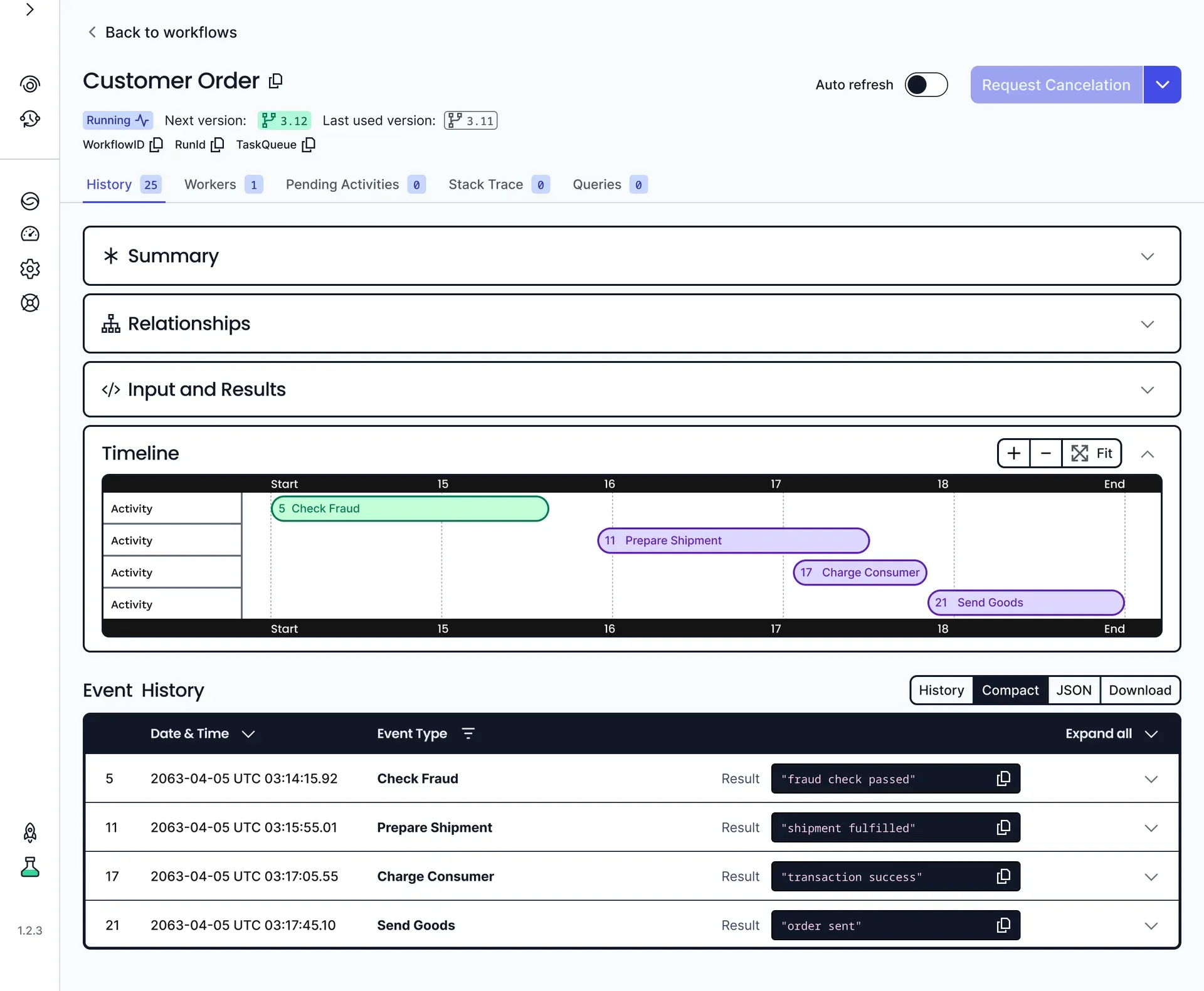
temporalcommand line tool starts a local development service, lists namespaces and Workflows (temporal operator namespace list,temporal workflow list) and, with its cloud extension, manages Temporal Cloud resources. Installation options are listed in the CLI setup guide. - Web UI The Temporal Web UI lists Workflow Executions and shows per-run history, a timeline of Activities, workers, pending Activities, stack traces, queries, relationships and inputs and results, with JSON view and download of the event history.
- Worker Versioning and safe deploys Worker Deployment APIs pin Workflows to a Worker version or let them auto-upgrade, and Replay tests validate new code against recorded histories. Release v1.32.0 added one-time Versioning Overrides and explicit overrides for Child Workflows.
- Task Queue priority and fairness Task Queues support native priority and fair distribution of work, marked as preview on the Temporal pricing page. The poller autoscaling features in v1.32.0 can be enabled per namespace from the server side.
- Visibility and search Workflow Executions are listed and filtered with search attributes through Visibility queries. Supported Visibility stores are Elasticsearch 7 and 8, OpenSearch 2 or later, MySQL 8.0.17 or later, PostgreSQL 12 or later and SQLite 3.31.0 or later, per the Visibility documentation; Cassandra Visibility was removed in v1.24.
- Persistence databases The persistence store supports Cassandra 3.11, 4.0 and 5.0.4 or later, PostgreSQL 13.18, 14.15, 15.10 and 16.6, and MySQL 5.7 and 8.0 (8.0.19 or later). SQLite 3.x persistence is supported only for development and testing, as stated in the persistence documentation.
- Self-hosted operations The self-hosted guide covers namespaces, TLS and mTLS, authentication and authorization, monitoring with service and SDK metrics, archival of closed histories to blob storage, multi-cluster replication for failover and data encryption with Payload Codecs and a Codec Server. The server can also be embedded in-process as a Go library for local development and testing.
- Durable AI agents Temporal lists integrations with the OpenAI Agents SDK and Google ADK that run LLM and tool calls as durable Activities, so agent steps get the same retries and history as other Workflows.
- Temporal Cloud pricing Pay-As-You-Go has no base monthly fee and starts at $50 per million Actions, with $150 in free credits for 90 days, active storage at $0.042 per GB-hour and retained storage at $0.00105 per GB-hour. Volume discounts go down to $25 per million Actions, developer support is 10% of usage, and the SLA is 99.9%, or 99.99% with high availability, per the pricing page.
- Cloud support add-ons Business support starts at $500 per month (the greater of $500 or 10% of usage) with a 2-hour P0 response during business hours and includes 2.5 million Actions. Enterprise and Mission Critical are sold through sales with a 30-minute P0 response around the clock (15 minutes on Mission Critical), include 10 million Actions and add SCIM. Temporal Cloud includes Private Link, SOC 2 and HIPAA, user roles, audit logging, SAML SSO, API keys and service accounts.
Where Temporal fits
Order and payment processing
A business process such as an order is written as one Workflow that calls Activities for fraud checks, shipment preparation, charging and delivery, as in the Customer Order example shown in the Web UI. If a Worker or downstream service fails midway, the Workflow resumes from its last recorded step instead of starting over or leaving a half-finished order.
Long-running business processes
Processes that run for long periods wait on durable Timers for days or months and react to Signals and Updates from other systems or people. Schedules replace cron jobs, with backfill for missed runs, and Continue-As-New is available for processes without a fixed end.
Microservice orchestration
Calls across several services are coordinated in a Workflow with retries, timeouts and compensating actions, and Child Workflows or Temporal Nexus split the work between teams and namespaces. The event history in the Web UI and the CLI shows where each execution currently stands.
Durable AI agents and data pipelines
LLM calls, tool calls and data-processing steps run as Activities so that rate limits, timeouts and provider errors are retried without losing earlier results. Temporal names the OpenAI Agents SDK and Google ADK as integrations for this pattern.
Local development and testing
Developers run temporal server start-dev for a local service with the Web UI on localhost:8233, run the Go or Java samples against it and use the SDK test environments with time skipping. The Temporal 101 course introduces the programming model.
Running Temporal in production
Teams either self-host the MIT-licensed server on Docker or Kubernetes with Cassandra, PostgreSQL or MySQL and a Visibility store, upgrading sequentially through server and schema versions, or connect their Workers to Temporal Cloud and pay per Action and storage. Related orchestration tools listed on iThub include Argo and Dagster.
Install
brew install temporalReviews of Temporal
Be the first to share your experience with Temporal.
Write a review
Loading review form…
Found Temporal useful? Upvote it todayYour vote helps other IT teams find it in the daily ranking.


