

What is Flarum?
Flarum is open-source forum software for running discussion communities on a website. It is owned and governed by the Flarum Foundation (Stichting Flarum), a Dutch non-profit registered with the Dutch Chamber of Commerce and established in August 2019. According to the foundation, Toby Zerner open-sourced the project in December 2014, the first stable release, 1.0, arrived in May 2021 after seven years of beta development, and development today is carried out by a volunteer team. Flarum is released under the MIT License, and the foundation states it is the sole legal owner of the software, name and trademarks.
The code is split across two repositories. flarum/flarum is the skeleton application that a new forum is created from with Composer, and flarum/framework is the monorepo that holds the core package (flarum/core) and the first-party extensions. The backend is written in PHP and built on Laravel components, while the forum and admin interfaces are single-page applications written with the Mithril JavaScript framework. The browser talks to the backend through a JSON:API REST interface that external scripts can use as well.
Flarum 2.0.0 was declared stable on October 9, 2026, in the official release announcement, which counts 17 pre-releases (eight betas, a beta.8.1 and eight release candidates) since development of 2.0 started in May 2023. The 2.0 line requires PHP 8.3 or newer, moves to Laravel 13 and Mithril 2.2, rebuilds the JSON:API layer and search drivers, splits the JavaScript bundle into smaller chunks, and adds support for PostgreSQL, SQLite and MariaDB next to MySQL. Core patch releases followed in the framework repository: v2.0.2, published on October 18, 2026, adds a withDefaultIncludes query parameter, limits repeated failed logins from one address and contains a series of performance and interface fixes.
New in 2.0 are several bundled extensions. Messages adds private conversations, Realtime pushes new discussions, replies and notifications live over a websocket service, Audit records moderation and administration actions, and Deck shows activity in side-by-side live columns. Realtime and Audit were previously paid third-party extensions: the announcement states that Realtime was donated to the Flarum Foundation and that the foundation bought Audit and published it as flarum/audit under the MIT License. The 1.8.x line receives security fixes and critical bug fixes only, most recently 1.8.22 on November 20, 2026.
Flarum is self-hosted software. The project does not sell hosting or paid plans, and is funded through donations and supporters, with NLnet's NGI Zero grant programme named on the homepage. The installation guide points to Free Flarum, a free community service that it describes as not affiliated with the Flarum team, as a way to create a forum without running a server. Translations and support in other languages come from verified communities that the foundation authorises to use the Flarum name.
Key capabilities
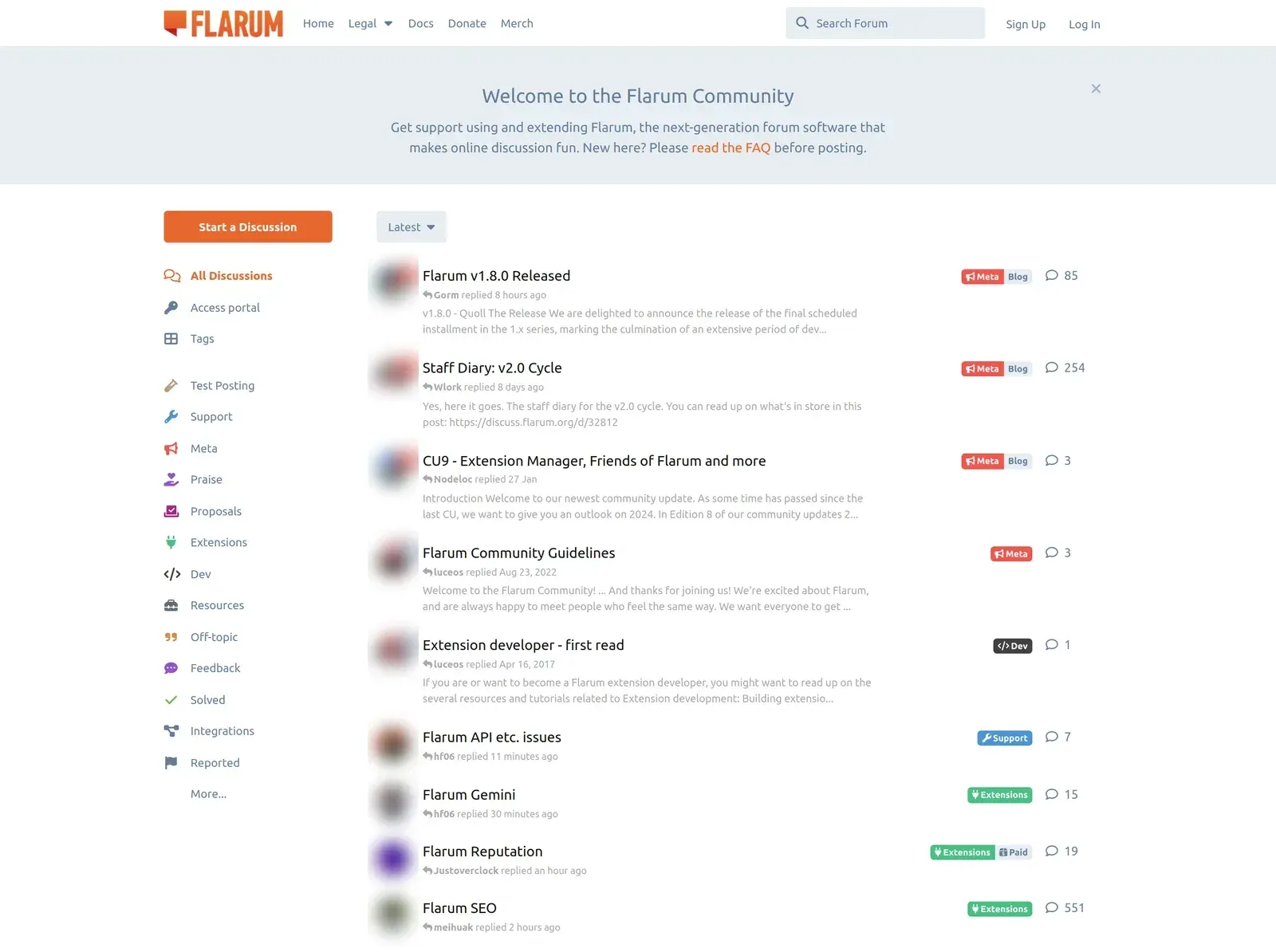
- Discussion list and tags The forum index lists discussions with titles, excerpts, reply counts and tag labels, sorted by latest activity or other criteria. The bundled Tags extension sorts discussions into primary tags, which work like categories with one level of child tags, and secondary tags for labels such as Solved, each with its own permissions. Sticky and Lock extensions pin discussions to the top or close them to replies.
- Composer and formatting Posts are written in a composer that stays open while the reader keeps browsing. Markdown and BBCode extensions are bundled, Emoji converts shortcodes, and Mentions lets users reference other users and quote individual posts. The bundled Embed extension, disabled by default, shows a Flarum discussion inside another website, for example as the comment section under a blog post.
- Private messages The Messages extension, introduced with 2.0, adds private conversations between members. According to the 2.0 announcement, new messages arrive live, unread counts are tracked, and only one email is sent per conversation until it is read, with throttling against spam.
- Realtime updates With Realtime enabled, new discussions appear in the list, replies show up in the open thread and notifications arrive without a page refresh, including for guests and with permissions respected. It runs its own websocket service on the server and needs a long-running process and a queue worker, with Redis recommended, which the project notes rules out most shared hosting. The
flarum/pusherextension remains as an alternative. - Deck A page at
/deckshows live columns for all discussions, unread items, notifications, a single discussion, a member, a group, a tag, followed discussions, private messages or any search filter such astag:support is:unread. Columns can be dragged, resized and arranged in up to two rows. Administrators set the maximum number of columns per member, eight by default, and without Realtime the columns check for new activity every 60 seconds. - Groups, permissions and moderation Permissions are assigned to groups in the admin panel and can be scoped per tag. The default install includes Approval for post moderation queues, Flags for reporting posts, Suspend for time-limited bans and Likes for reactions. Version 2.0.2 adds a limit on repeated failed logins from one address.
- Audit log The Audit extension records logins, renames, group and permission changes, settings changes, deleted posts, locked and stickied discussions, approvals, flags, suspensions, extension changes, GDPR erasures and exports, filterable by actor, action, user, discussion or IP. Existing kilowhat Audit logs are taken over in place, and an Audit extender lets other extensions log their own actions.
- GDPR tools A bundled GDPR extension handles account data exports and erasure requests with email confirmation. The 2.0 release fixed several erasure email edge cases found during the release candidate phase, and notification emails now carry unsubscribe links.
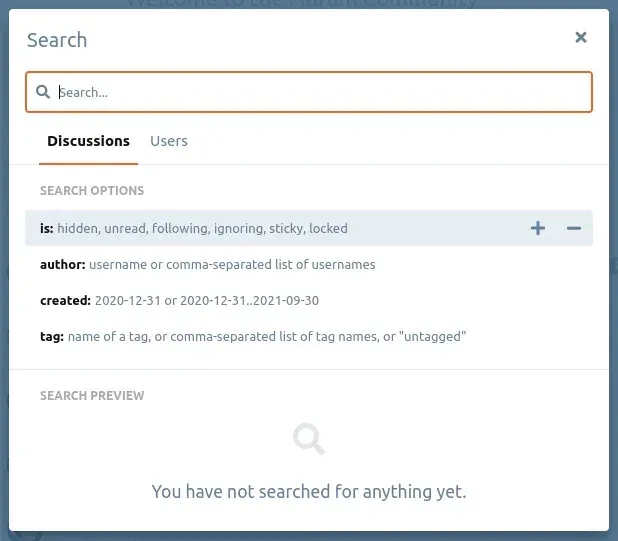
- Search Discussion and post search use gambits such as
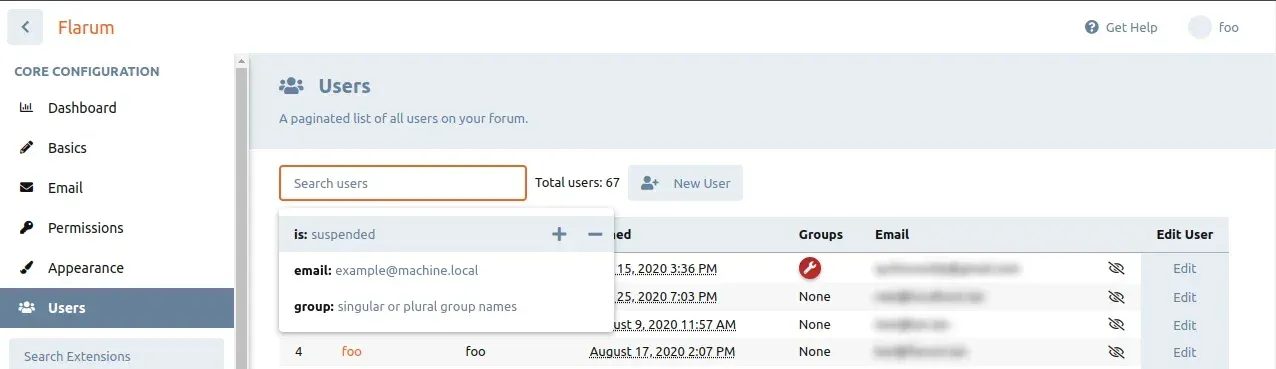
author:,tag:,created:andis:unreadwith autocomplete in the search field. In 2.0 users can be found by any part of their name, a CJK mode handles Chinese, Japanese and Korean word boundaries, and search drivers allow the built-in search to be replaced, for example with Elasticsearch through an extension. - Admin dashboard Administrators configure basics, email, permissions, appearance and users in a separate admin interface. Flarum 2.0 adds admin search for settings, collapsible extension categories, an extension health widget, a weekly check for abandoned packages, dashboard announcements, reset-to-default on settings and advanced maintenance modes.
- Extension bisect and queue dashboard When an extension breaks a forum, extension bisect disables and re-enables extensions in halves to find the cause. A queue dashboard shows background jobs, lets administrators manage failed jobs and pause or resume queues before maintenance.
- Extension ecosystem Extensions are Composer packages installed with
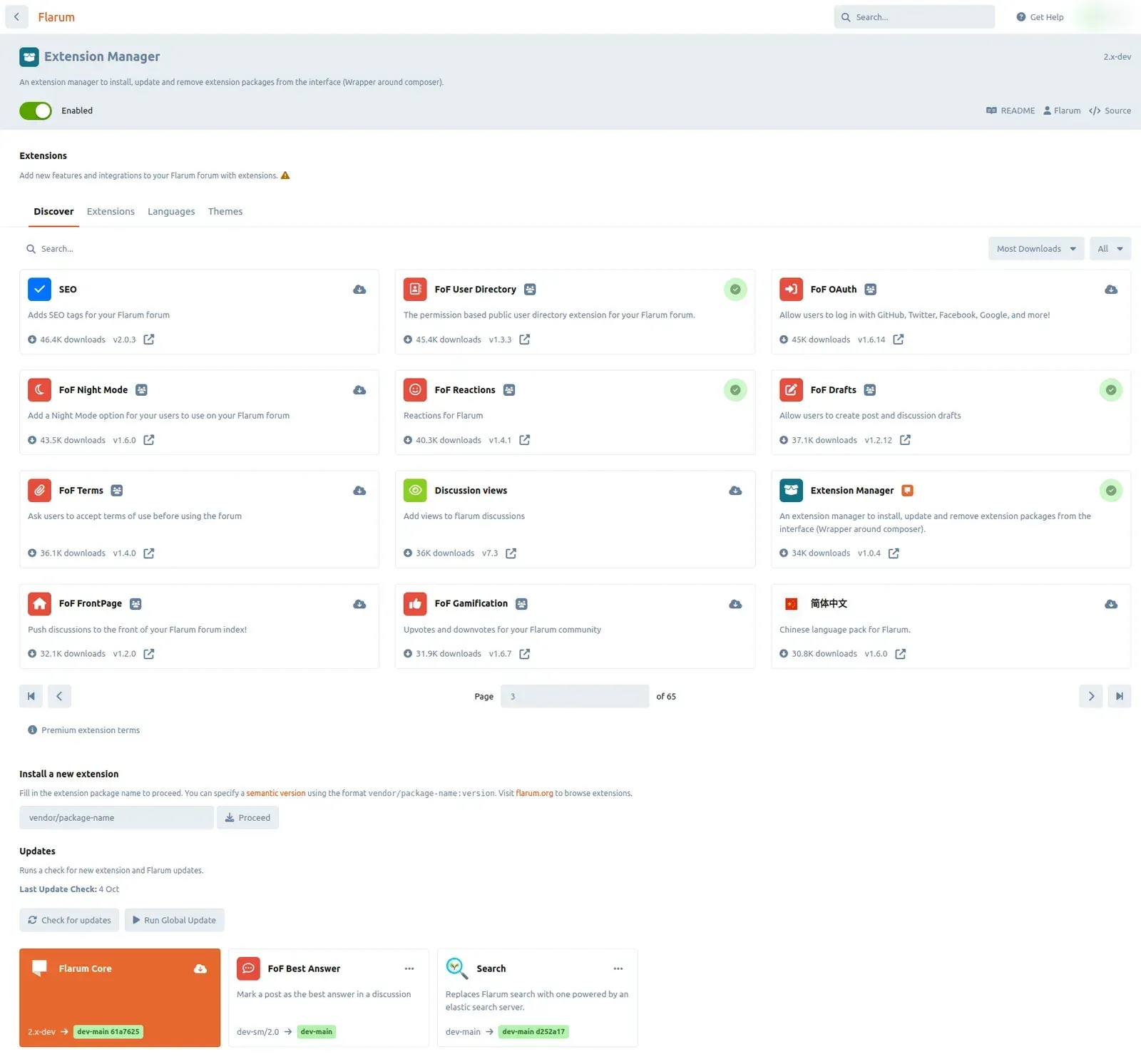
composer require vendor/package:*or through the optional Extension Manager, which adds a Discover tab connected to flarum.org/extensions. The foundation counted its 2000th published extension in March 2023. The documentation warns that the Extension Manager can install any Composer package, and describes premium extensions from Extiverse served through a Composer repository at flarum.org/composer with a bearer token. - Database support Flarum 2.x supports MySQL 5.7+ or 8.0.30+, MariaDB 10.3+, SQLite 3.35.0+ and PostgreSQL 10.0+, each through its PDO extension. The installation guide recommends MySQL 8.4 LTS, MariaDB 11.8 LTS or PostgreSQL 15, 16 or 17, and the installer checks the database version before setup.
- Server requirements Flarum needs Apache with
mod_rewriteor Nginx (a Caddy configuration is also documented), PHP 8.3 or newer with the curl, dom, fileinfo, gd, json, mbstring, openssl, tokenizer, zip and session extensions, and SSH access for maintenance commands. The web server user needs write access to the install directory,storageandassets. - Installation with Composer or archive The command-line install is
composer create-project flarum/flarum:^2.0.0 .in an empty directory with the webroot pointed atpublic, and the setup then finishes in the browser. Without SSH access, TAR.GZ and ZIP archives from the flarum/installation-packages repository are available for PHP 8.3, 8.4 and 8.5, with or without apublicdirectory. - REST API The REST API follows the JSON:API specification under
/api, for exampleGET /api/discussionsorPOST /api/users. Clients authenticate with access tokens fromPOST /api/tokenor with API keys stored in theapi_keystable, which currently have no management UI. - Notifications and email In-browser and email notifications are built in. Flarum 2.0 sends formatted HTML emails with an unsubscribe link in every notification email, supports a separate email logo, and adds a Postmark mail driver next to the existing drivers.
- Theming and dark mode The Appearance page sets theme colours, dark mode and a coloured header, logo and favicon, custom header and footer HTML and custom LESS or CSS. Version 2.0 adds dark-mode logos, an optional theme switcher in the header, WebP avatars and logos, and Font Awesome 7 icons.
Where Flarum fits
Support forum for a product or open-source project
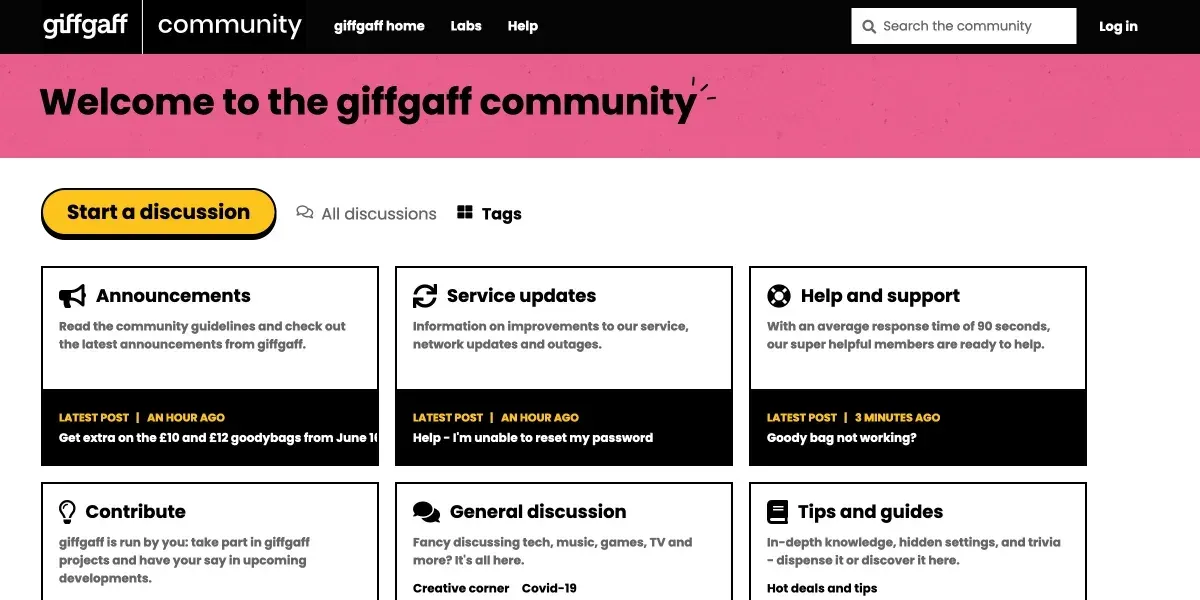
The official community at discuss.flarum.org runs Flarum 2.0 itself, and the flarum.org homepage shows communities such as giffgaff, Swisscom, SBB, Kagi and mailcow that run on Flarum. Tags separate support, feedback and announcements, Flags and Approval handle moderation, and Mentions and Likes help surface answers.
Starting a new forum on a PHP server
A new forum is created with composer create-project flarum/flarum:^2.0.0 . on a server with PHP 8.3+, a supported database and URL rewriting, followed by the browser-based setup. The installation guide lists the PHP extensions, database versions and folder permissions to check, and provides .htaccess and .nginx.conf files.
Upgrading an existing 1.8 forum to 2.0
The announcement describes the path: set flarum/core to ^2.0 and every extension to * in composer.json, run composer update --prefer-dist --no-plugins --no-dev -a --with-all-dependencies, then php flarum migrate and php flarum cache:clear --force. The project states the upgrade should be run from the command line, not through the Extension Manager or the browser update page, and points to the FoF Upgrade Advisor to check extension compatibility and PHP and database versions first. The update guide has the full walkthrough.
Live community with private messaging
With Realtime and Messages enabled, replies, new discussions and private messages then appear live, and a typing indicator shows when someone is writing. This requires a server that can run the websocket service and a queue worker. Deck builds on the same data to give moderators flagged posts and support tags on one screen.
Extending Flarum for a custom community
Developers build extensions as Composer packages with PHP extenders and a JavaScript frontend. Flarum 2.0 adds extension points such as a DeckColumns extender, a Statistics extender, custom avatar drivers and slug drivers, and testing tools that fail on N+1 queries. The 2.0 extension upgrade guide lists breaking changes for extensions ported from 1.x.
Integrating a forum with other systems
External applications read and write discussions, posts and users through the JSON:API REST interface, using an API key or a user access token. Another open-source forum listed on iThub is Discourse, which its developer also offers as a hosted service. For federated microblogging rather than threaded forums, see Mastodon.
Install
composer create-project flarum/flarum:^2.0.0 .Reviews of Flarum
Be the first to share your experience with Flarum.
Write a review
Loading review form…
Found Flarum useful? Upvote it todayYour vote helps other IT teams find it in the daily ranking.


