

What is OpenUI?
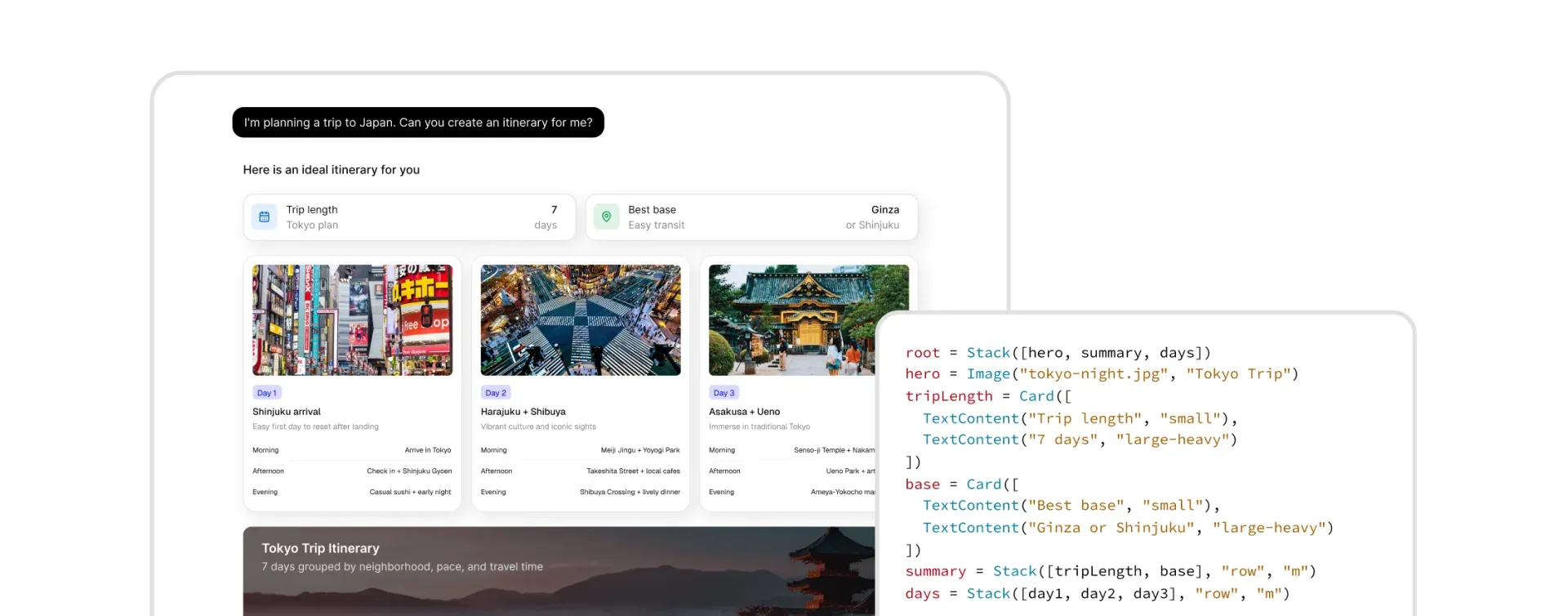
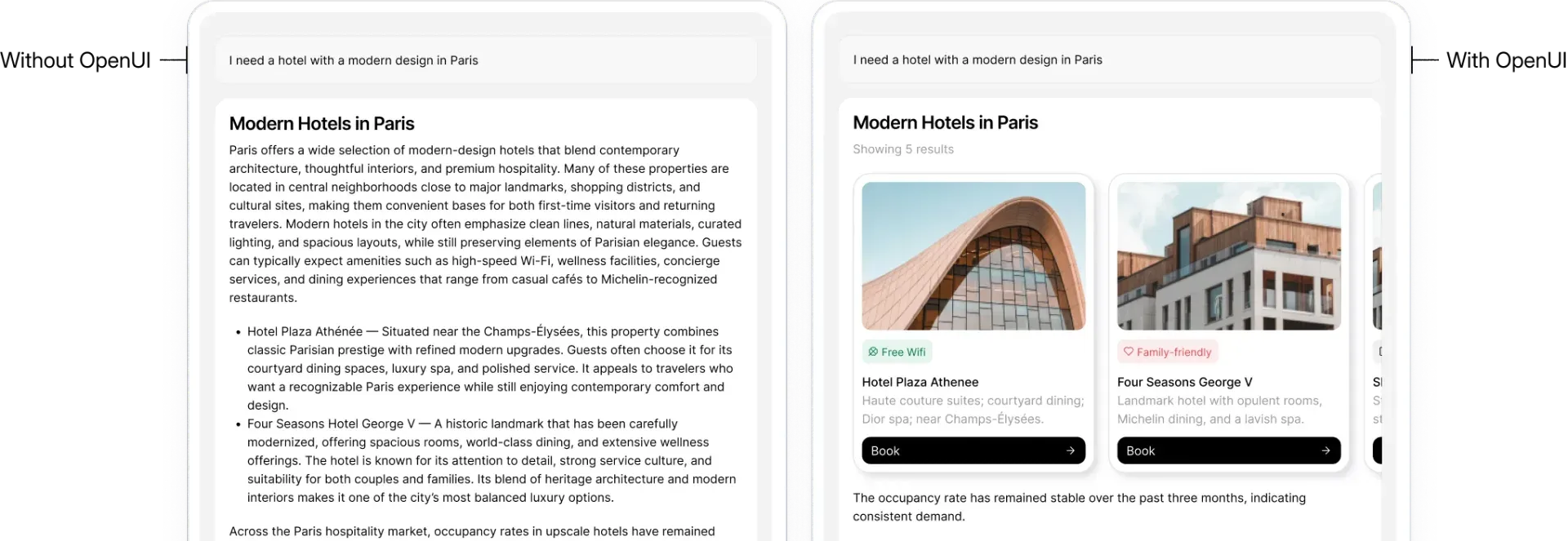
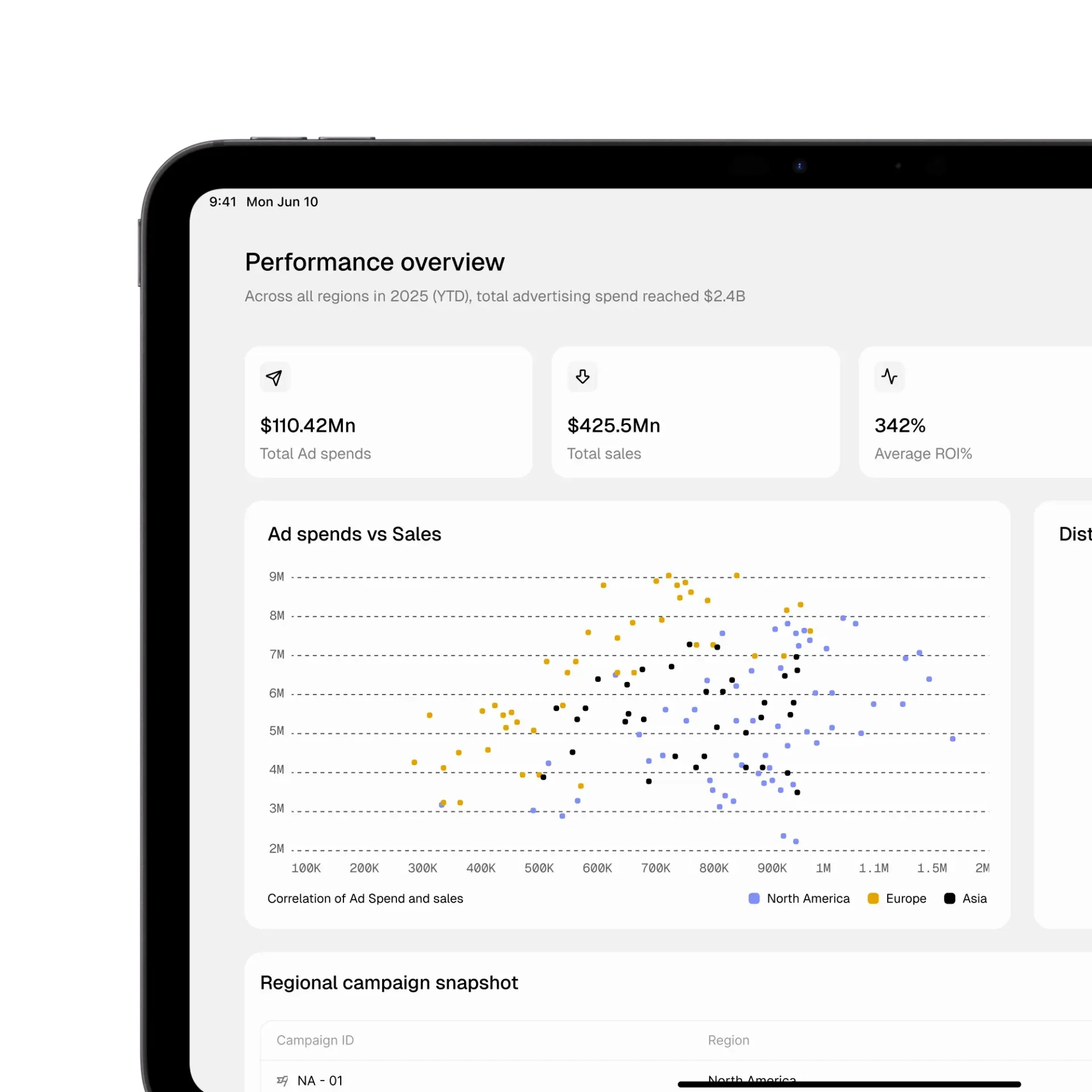
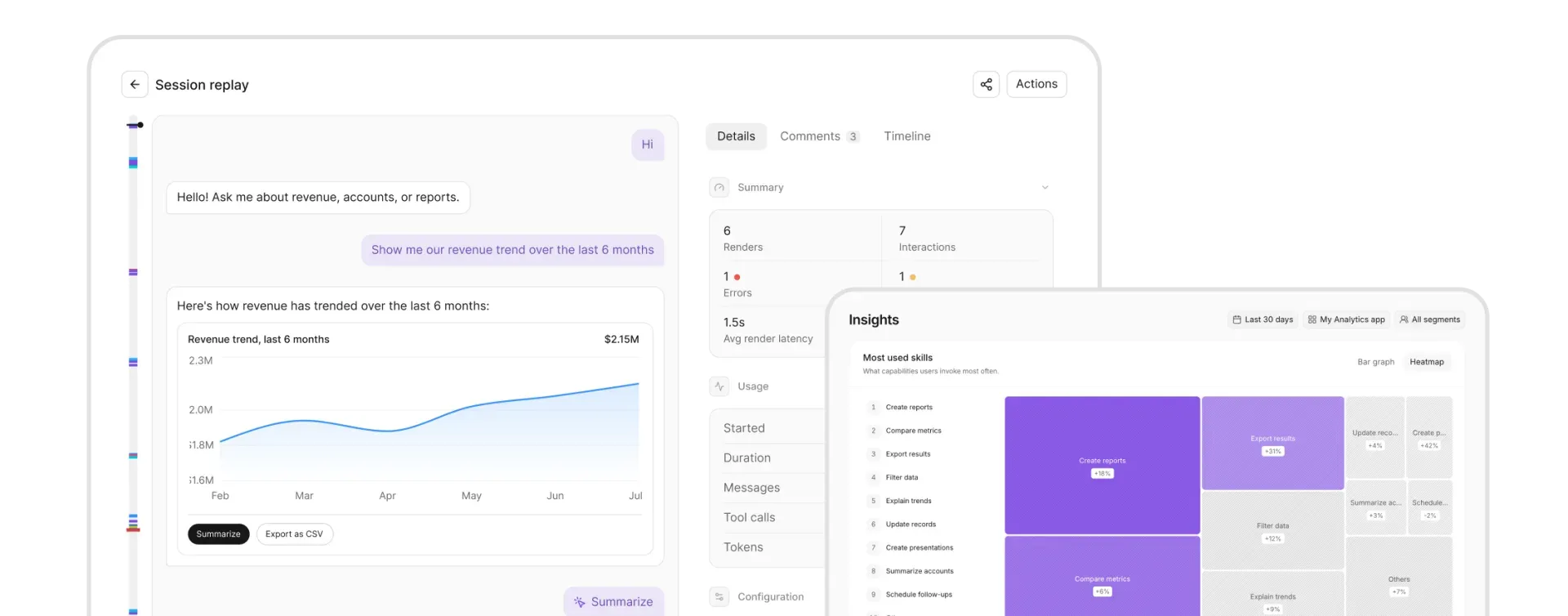
OpenUI is an open source Generative UI framework developed by Thesys Inc. and published in the thesysdev/openui repository. Thesys describes it as "the open standard for Generative UI". The README defines it as a full-stack, framework-agnostic framework built around a compact, streaming-first language called OpenUI Lang. Instead of returning only Markdown text, a model answers in OpenUI Lang, and the application renders that output with components from a library the developer defines, such as charts, forms, tables and multi-tab layouts.
The OpenUI Lang overview describes four parts: a component library defined with Zod schemas and framework components, a prompt generator that turns the library into model instructions, a streaming parser that turns OpenUI Lang into a typed element tree and validates component usage, and a renderer that maps that tree to the application's components. The documentation states that the language and renderer do not depend on a model provider, chat library or hosted service. The README reports that OpenUI Lang uses up to 67% fewer tokens than equivalent JSON, measured with tiktoken across seven UI scenarios against Vercel json-render and Thesys C1 JSON output; the methodology is published in the repository's benchmarks/ folder.
The project is a TypeScript monorepo distributed as npm packages under the @openuidev scope. Packages are versioned and released separately, so the repository has no single version number. The latest GitHub release at the time of writing is @openuidev/react-ui@0.18.8, published on November 12, 2026, a patch that updates its dependency on @openuidev/react-headless 0.18.8. The same day saw @openuidev/lang-core and @openuidev/react-lang 1.1.1, @openuidev/server 0.4.2 and @openuidev/dashboard-library 1.0.0. According to the react-lang changelog, 1.1.1 changes how Renderer reports errors when no onError handler is set, and 1.1.0 lets a query that reads another query's result wait for it and rerun when it changes. React UI 0.18.7 keeps showing a dashboard's last results while it reloads. OpenUI Lang 1.0 added custom functions, custom actions, library.extend and a message format; the What's New page notes that the Vue, Svelte and Angular runtimes stay on 0.4 and that these 1.0 language features need the React renderer for now.
The open source code is released under the MIT License, with the copyright held by Thesys Inc. Alongside it, Thesys runs managed services documented on openui.com: OpenUI Gateway, an OpenAI-compatible API for models across providers that validates and corrects OpenUI Lang while it streams, the Autofix API, Reliability Monitoring, Observability and Dashboards. Gateway requests authenticate with an API key from the Thesys Console. The pricing page lists OpenUI itself as free and open source with no usage limits from OpenUI, while Gateway has Free, Build, Grow and Scale plans.
The README carries a notice that OpenUI has no official cryptocurrency, token or coin. Documentation lives at openui.com/docs, with a Playground, cookbooks, an integrations catalog and a Discord server. Similar listings on iThub include OpenBot by CopilotKit and LangChain, whose agents OpenUI can render through its LangChain package.
Key capabilities
- OpenUI Lang A line-oriented language in which each statement has the form
identifier = Expression, with component calls, strings, numbers, booleans, null, arrays, objects and references. Arguments are positional and follow the Zod key order of the component schema, optional arguments can be omitted from the end, and forward references are allowed. The entry point is the statement namedroot. The syntax reference lists the default library signatures such asStack,Card,Form,TableandBarChart. - Component libraries defined in code Developers create a library with
createLibraryfrom@openuidev/react-lang, listing the components the model may use and the root component. Props and structure are typed with Zod schemas. OpenUI Lang 1.0 addedlibrary.extend, which derives a new library from an existing one by adding, overriding or removing components and by adding functions and actions. - System prompt generation The prompt generator turns a library into component signatures, language rules, examples and streaming instructions for the model.
generateSystemPromptin@openuidev/lang-coreworks from a JSON specification exported withnpx @openuidev/cli@latest generate ... --spec, so the server does not need the React components. The specification has to be regenerated whenever the library changes. - Streaming parser and Renderer The parser validates component usage and handles partial output while tokens arrive. The React
<Renderer />takes the accumulated response text, the library and anisStreamingflag, and draws each component as its line arrives. AnonActioncallback receives user interactions; since react-lang 1.1.1 a Renderer withoutonErrorlogs all errors as oneconsole.error. - Functions, actions, queries and state
@X(...)expressions are either functions, which compute a value, or actions, which run on click. Built-ins include@Count,@Sum,@ToAssistant,@OpenUrl,@Runand@Reset. Libraries can add their own withdefineFunctionanddefineAction; arguments are checked like props and a failed function call evaluates tonull. The documentation also covers reactive state, queries and mutations. - @openuidev/react-ui chat interface The package that carries the latest GitHub release provides
AgentInterface, a full-page chat with a thread-history sidebar, composer and per-thread artifact workspace. It ships two built-in libraries:openuiChatLibrarywith aCardroot and chat blocks such asFollowUpBlock, andopenuiLibrarywith aStackroot and layouts such asTabs,Carousel,AccordionandModal. Styles come as a default stylesheet or a variant wrapped in@layer openui, with a documented order for Tailwind v4 (API reference). - Headless React state
@openuidev/react-headlessprovides headless chat state, streaming adapters and message format converters for teams that bring their own React chat UI. It is released in lockstep with react-ui; version 0.18.8 was published on November 12, 2026. - Vue, Svelte and Angular runtimes
@openuidev/vue-lang(Vue 3),@openuidev/svelte-lang(Svelte 5) and@openuidev/angular-langdefine model-renderable components and render streamed OpenUI Lang in those frameworks. They are at version 0.4.2 and pair with@openuidev/lang-core^0.4. The documentation states that custom functions, custom actions and actions without a wrapper currently need the React renderer. - Framework-agnostic core
@openuidev/lang-corecontains the parser, prompt generation, runtime evaluation and type layer with no React, Angular, Vue or Svelte dependency, which the README lists for backend and Edge prompt generation. It is at version 1.1.1. - LangChain and LangGraph over AG-UI
@openuidev/langchainconverts LangGraph protocol-v2 message and tool events into AG-UI events and relays them to an OpenUI frontend over Server-Sent Events. Its server helpers use Web-standardRequest,Response,fetchandReadableStream. The package reference requires an agent-protocol-v2 server and names@langchain/langgraph-cli1.4.x as the tested local baseline. - Agent framework integrations The integrations page lists LangChain and LangGraph, Vercel AI SDK, Mastra (connected over AG-UI), AG-UI itself (OpenUI points at an AG-UI SSE endpoint), Google ADK (run events mapped to AG-UI), Pi Coding Agent, Grok Build and Vercel Eve. Reference implementations live in the repository's
examples/agent-frameworksfolder. - Chat frontends and design systems OpenUI Lang can be rendered inside an existing CopilotKit chat through its
assistantMessage.markdownRendererslot, and@openuidev/assistant-uiprovides tool UI renderers for assistant-ui. The integrations page also lists an Open WebUI plugin, React Native and Lynx runtimes, and libraries that wrap shadcn/ui, Material UI, Handsontable and React Email components. - Email and A2UI packages
@openuidev/react-emailcontains React Email component definitions and prompt options for model-generated emails with HTML export.@openuidev/a2uiis a framework-agnostic client for the A2UI v1.0 protocol with OpenUI Lang component payloads and an optional React renderer. - Browser bundle
@openuidev/browser-bundleships the renderer, UI library, React and styles as a script and stylesheet for CDN, iframe and no-build embeds. - CLI and scaffolding
npx @openuidev/cli@latest createasks which agent framework to use, creates the project, installs dependencies and can start the development server; Node.js 20 or later is required. The CLI also generates system prompts or JSON schema from a library, creates a Gateway API key withgenerate-api-keyand sends feedback withfeedback(Getting Started). - OpenUI Gateway A hosted endpoint at
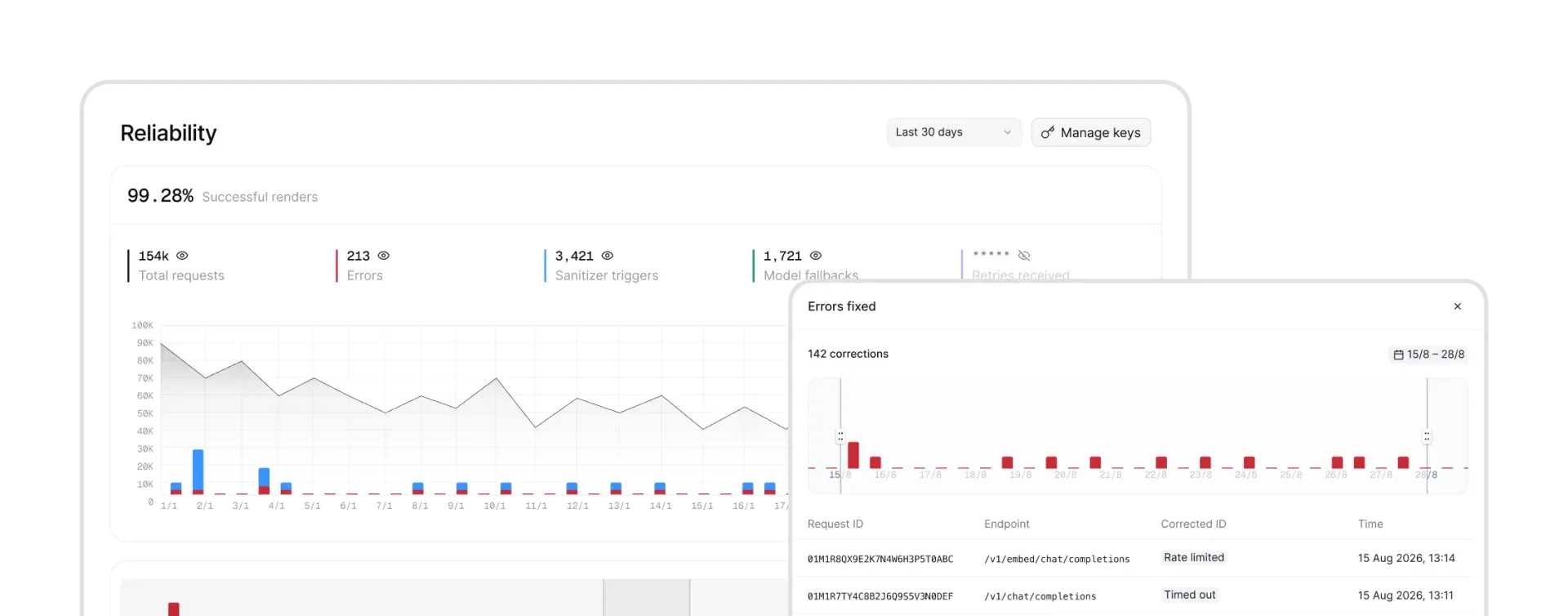
api.thesys.dev/v1/embedwith OpenAI-compatible Chat Completions and Responses APIs and{provider}/{model}identifiers. It validates generated UI during the stream, fixes malformed syntax, invalid component usage and schema violations, and retries with other providers if one fails. The Gateway documentation states no markup on model tokens, and BYOK for OpenAI, Anthropic and Google keys is available on every plan. - Autofix, Reliability Monitoring and Observability Autofix repairs completed OpenUI Lang with one API call for teams that keep their own inference; a call that runs a fix costs a flat $0.02 and a valid generation is free. Reliability Monitoring shows how often generated interfaces fail and which errors recur.
@openuidev/observability-cloudships OpenUI events to the Thesys console, and the pricing page lists Observability (session replay, AI-assisted triage) as free during early access. - Dashboards The Dashboards APIs let an agent generate a live dashboard once, after which the user can reopen, filter and refresh it without another model call; each opening calls the data tools again. React UI renders OpenUI Cloud dashboards through
LiveArtifactRendererand related hooks, and@openuidev/dashboard-libraryreached 1.0.0 on November 12, 2026. - Coding agent support An Agent Skill maintained in the
thesysdev/skillsrepository is installed withnpx skills add thesysdev/skills --skill openuiand covers component design, syntax, system prompts, the Renderer and debugging malformed output. The documentation is also available through Context7's MCP server and asllms.txtandllms-full.txt.
Where OpenUI fits
Adding generated UI to an existing agent
The Getting Started guide describes four steps: create a component library, export its specification with the CLI, call a model with a system prompt generated from that specification, and pass the streamed text to <Renderer /> with isStreaming set until the server stream closes. The model call can go through OpenUI Gateway or directly to a provider, with Autofix available for repairing invalid output.
Building a complete chat application
The create command of the CLI scaffolds an app with streaming, built-in UI and OpenUI Lang support. For a full React chat surface, AgentInterface from @openuidev/react-ui combines threads, streaming messages, tool activity and generated components, using openuiChatLibrary or a library derived from it with library.extend.
Rendering in an existing chat frontend
Applications that already use CopilotKit, assistant-ui or a custom chat UI keep their chat, agent and runtime and add the OpenUI renderer to the assistant message. For CopilotKit the documented change is a single slot, assistantMessage.markdownRenderer; for assistant-ui the @openuidev/assistant-ui package provides tool UI renderers and instruction wiring.
Streaming from LangGraph, Mastra or other AG-UI sources
LangChain and LangGraph agents use openUIStreamTransformer() from @openuidev/langchain to emit AG-UI events on a custom:openui channel, which a Web-standard server route relays to the frontend over Server-Sent Events. The integrations page lists Mastra as connected over AG-UI and Google ADK through a server route that maps run events to AG-UI.
Live dashboards inside a product
The Dashboards documentation describes in-product analytics, operations and support views, finance and planning reports, and developer metrics as use cases. An agent builds the dashboard once from a prompt, and later openings call the data tools again to load current numbers without a new model call.
Running generation in production
The production guide lists failure types such as unknown components, invalid properties, unresolved references, truncated responses and provider outages. Gateway corrects output during streaming and falls back to other providers, Autofix repairs output after generation, and Reliability Monitoring records the failures and the generation behind each one.
Install
npx @openuidev/cli@latest create --name genui-chat-appReviews of OpenUI
Be the first to share your experience with OpenUI.
Write a review
Loading review form…
Found OpenUI useful? Upvote it todayYour vote helps other IT teams find it in the daily ranking.


