
What is Council of High Intelligence?
Council of High Intelligence is an MIT-licensed agent skill that runs a structured, multi-round deliberation on a single question. A coordinator prompt seats a panel of analytical personas, collects their first positions independently, has them cross-examine each other, records a final stance from each member and then writes a verdict. The repository describes the goal as multi-perspective deliberation for hard decisions, and the verdict format keeps unresolved questions, dissent, kill criteria and one concrete next step instead of reducing the discussion to a single answer.
The project is maintained under the GitHub account 0xNyk, which also publishes an OSS profile page for it on nyk.dev. It ships as prompt files and shell scripts rather than as a compiled application: a canonical coordinator protocol in SKILL.md, host mirrors for Codex, Gemini CLI and OpenCode, 18 persona contracts under agents/, provider routing templates under configs/ and helper scripts for provider detection, agent conversion and validation. The main repository language is Shell, with a few Python helper scripts.
Two install paths are documented. Claude Code users add the repository as a plugin marketplace and install the council plugin, which resolves agents, scripts and configs from the plugin root. For Codex, Gemini CLI and OpenCode, a local clone runs install.sh with a host flag, and the script copies the skill, the persona files and the detection script into each host's configuration directory. The command is /council on every supported host. The security policy states that there is no curl-to-bash install path and no network call at install time.
The current release is v1.2.0, published on July 4, 2026, with a release tarball attached. According to the changelog, it added Claude Code plugin marketplace support, confidence-weighted stance voting with a deterministic two-thirds threshold, a distinct reasoning method per persona, per-project .council.yaml overrides and Cursor CLI as a sixth provider path. Version 1.1.0 (May 2026) added the Codex coordinator, NVIDIA NIM support, anonymized cross-examination and a named Chairman role for synthesis. Version 1.0.0 shipped on March 30, 2026. Unreleased work on the main branch adds a roster validation script that runs in CI.
The council does not include a model or an inference service. Each seat is answered by the active host's own subagents or by an external provider the user already has: the codex, gemini, ollama or cursor-agent executables, or NVIDIA NIM through an API key. The README describes the personas as analytical instruments and not as impersonation claims. Similar Claude Code add-ons listed on iThub include Superpowers and AutoMode; more are in the AI skills and plugins category.
Key capabilities
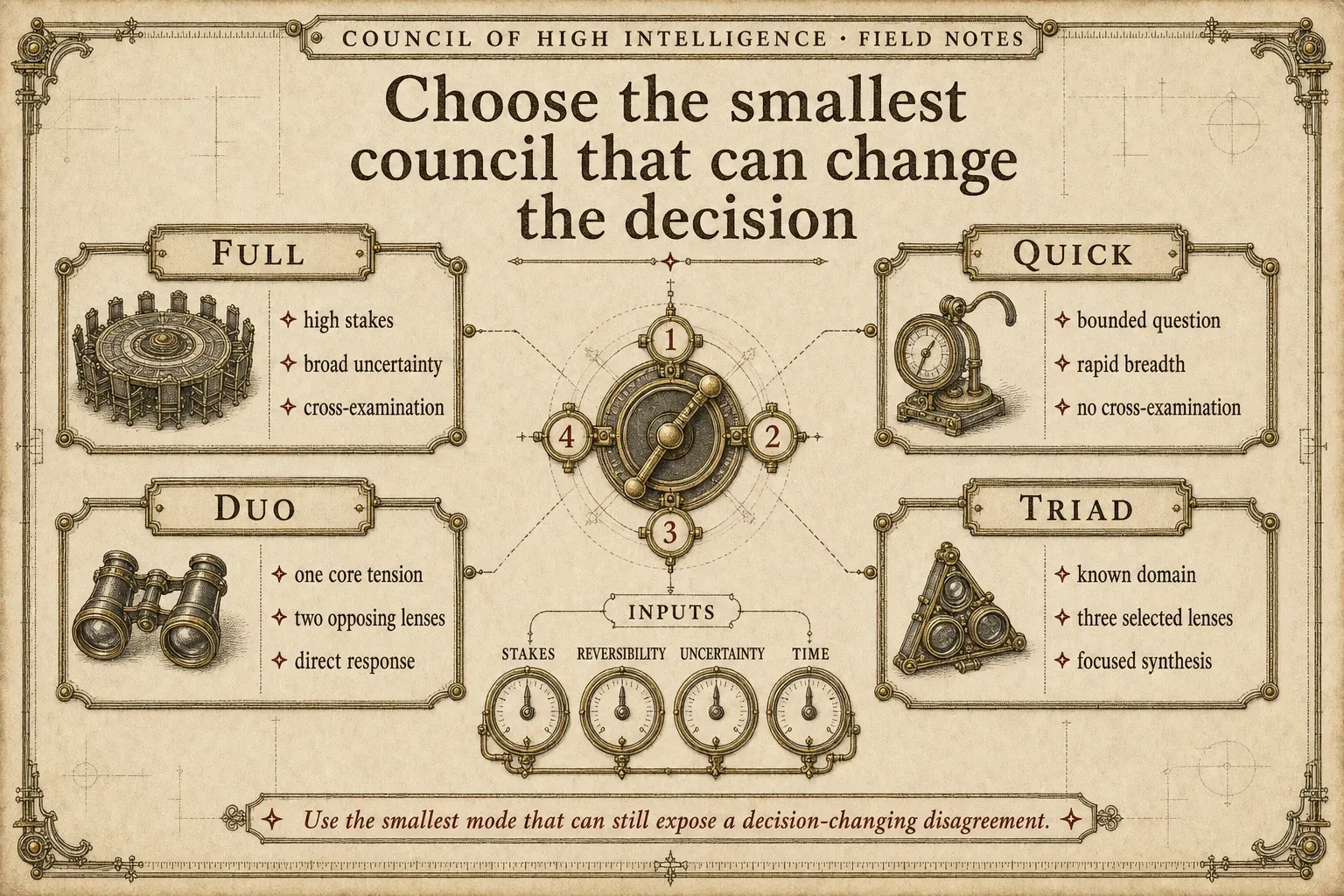
- Three deliberation modes Full mode runs independent analysis, anonymized cross-examination, a final stance round and Chairman synthesis. Quick mode (
--quick) uses two rounds, a 200-word analysis followed by a 75-word position, without cross-examination. Duo mode (--duo) seats two members from a polarity pair for opening positions, a direct response and final statements. The SKILL.md flag table lists the exact behaviour of each mode. - 18 persona contracts The roster covers lenses such as categories and structure (Aristotle), assumption testing (Socrates), terrain and adversarial strategy (Sun Tzu), formal systems (Ada Lovelace), empirical debugging (Richard Feynman), tail risk (Nassim Taleb), cognitive bias (Daniel Kahneman) and feedback loops (Donella Meadows). Each file in
agents/defines a grounding protocol, an analytical method, known blind spots and a structured output contract. The README states that the members are analytical instruments, not impersonation claims. - Named triads and panel profiles
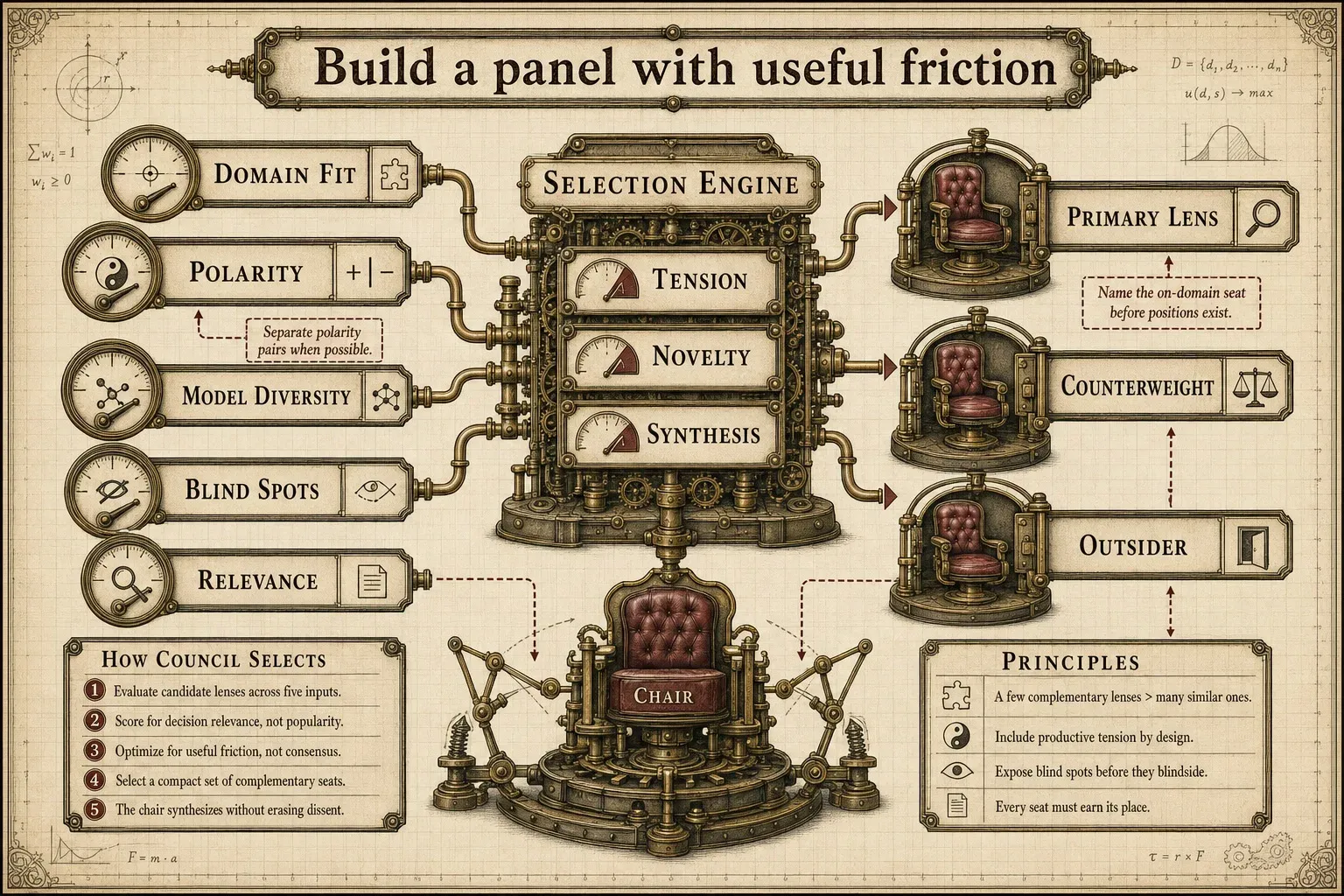
--triadselects a predefined three-member panel for a domain keyword such asarchitecture,strategy,debugging,risk,shipping,ai-safety,decision,economicsorbias. Profiles change the pool:classicuses all 18 members,exploration-orthogonala 12-member pool with its own triads, andexecution-leana 5-member pool for fast decision loops. When no panel is given, the coordinator matches the question to a triad and states its choice before starting. - Manual panels and polarity pairs
--memberstakes a comma-separated list of 2 to 11 members. Duo mode uses a table of polarity pairs keyed by domain words, for example Aristotle against Lao Tzu for structure questions or Taleb against Karpathy for risk and uncertainty, with Socrates against Feynman as the default pair. The coordinator keeps polarity pairs on different model families when several providers are available. - Blind first round and anonymized cross-examination In Round 1 every member sees only the problem statement. In Round 2 the earlier outputs are relabelled as Member A, B, C and so on, so members judge arguments without knowing the source, and an anti-conformity directive requires a member to name the specific flaw before changing position. The changelog cites the research papers behind each of these rules.
- Enforcement scan between rounds After cross-examination, the coordinator checks for a dissent quota (at least two non-overlapping objections), novelty, premature agreement and unsupported confidence, and sends targeted follow-up prompts when a check fails. The number of enforcement calls and the conditions that triggered them are recorded in the session metadata. The full protocol has a fixed round budget and anti-recursion guards.
- Weighted stance voting Since v1.2.0, each member ends with a machine-readable
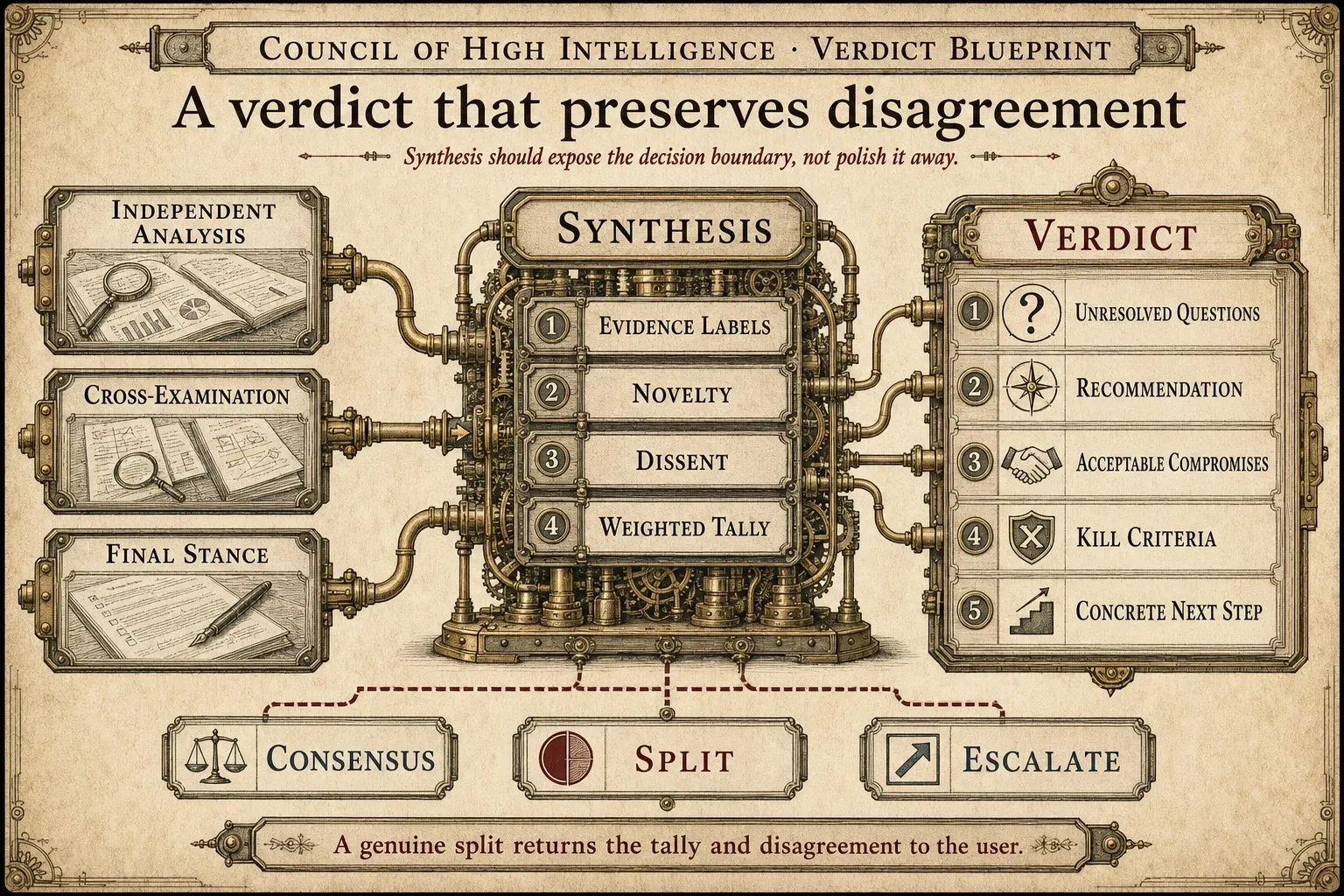
STANCE | CONFIDENCE | DEALBREAKERline. Vote weight is the base weight (1.0, or 1.5 for the on-domain seat chosen before any positions exist) multiplied by a confidence factor of 1.0, 0.75 or 0.5. An option reaches consensus only at two thirds of the total base weight; otherwise the split is returned to the user, as described in the v1.2.0 release notes. - Structured verdict templates The full verdict lists the problem, panel, Chairman, provider routing, acceptable compromises, kill criteria, one concrete next step, unresolved questions, a vote tally, insights by member, points of disagreement, a minority report and an epistemic diversity scorecard. Quick and duo modes use shorter templates. Every verdict ends with a
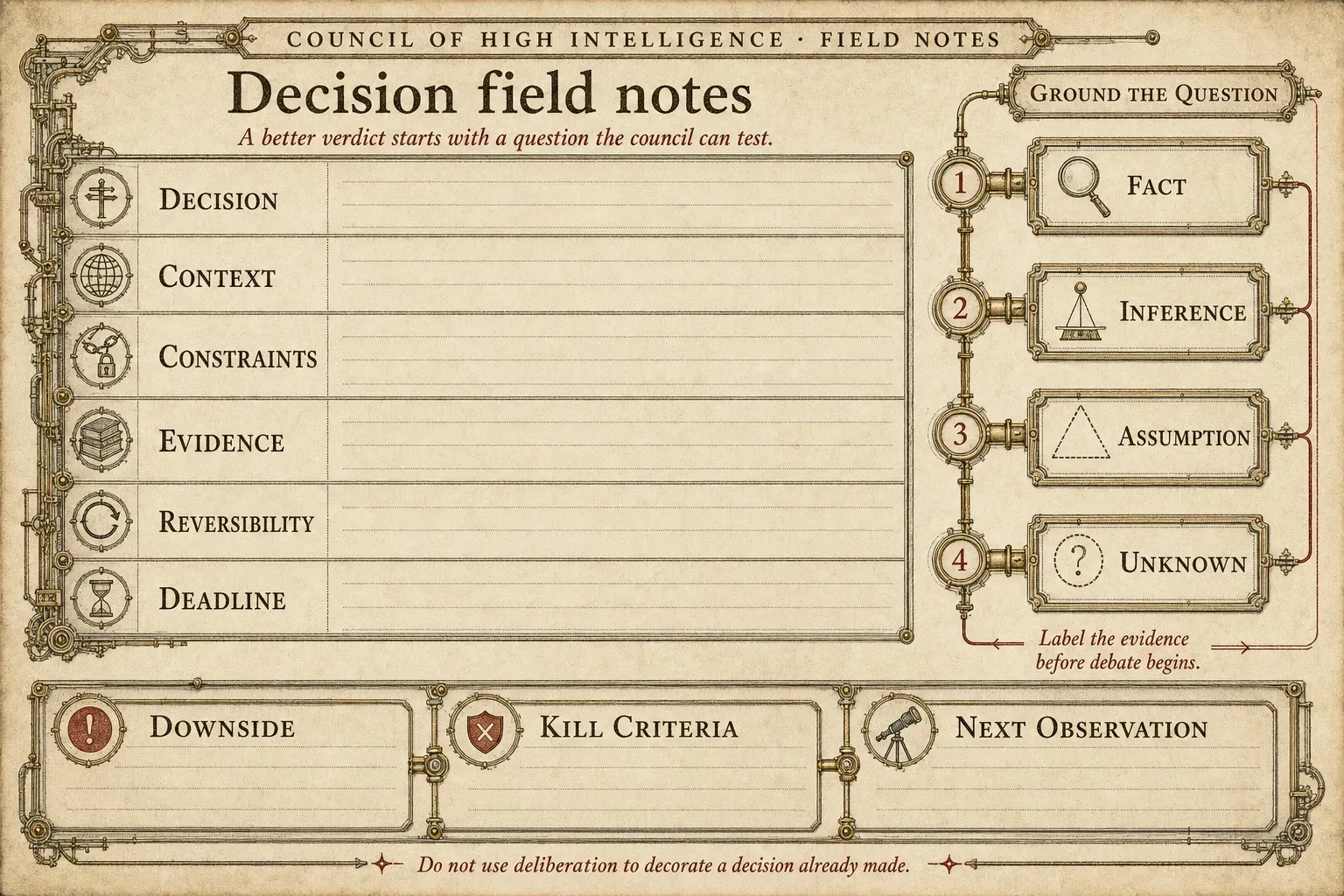
schema_version: 1metadata block recording mode, panel size, rounds run, provider count and fallbacks. - Evidence labels Claims in the deliberation carry one of four labels: FACT for directly supported statements, INFERENCE for conclusions drawn from evidence, ASSUMPTION for unverified premises the argument depends on, and UNKNOWN for missing information that could change the decision. The README pairs this with field notes that separate the decision, constraints, evidence, reversibility and deadline before personas are added.
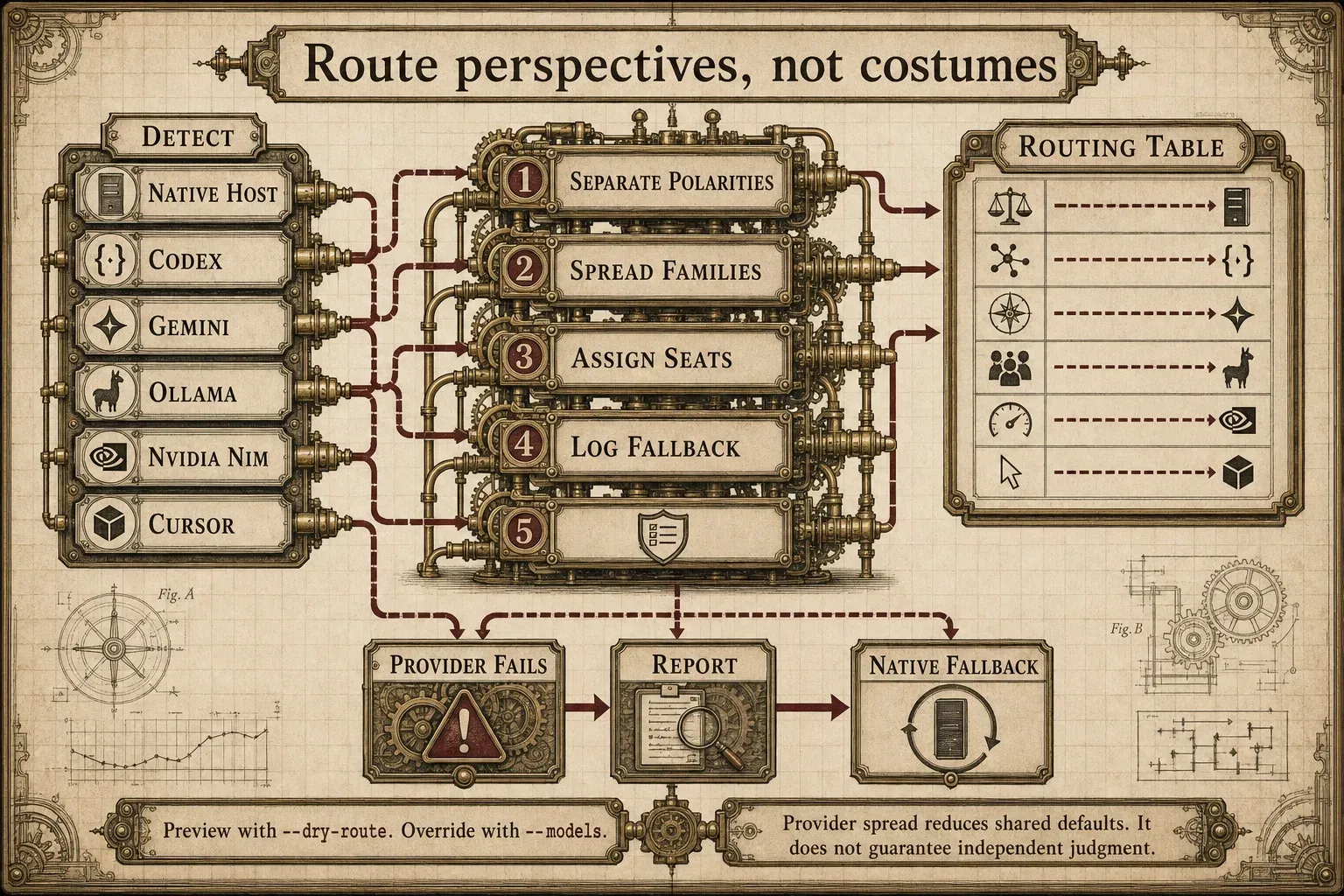
- Multi-provider routing
scripts/detect-providers.shlooks for native host subagents, thecodex,gemini,ollamaandcursor-agentexecutables, and anNVIDIA_API_KEYfor NVIDIA NIM. The coordinator spreads seats across the detected providers.--dry-routeprints the routing table without convening the council,--no-auto-routekeeps the host defaults, and--modelsloads an explicit seat map based on provider-model-slots.example.yaml. A failing provider is reported before its seat falls back to the native host. - Chairman role Synthesis is written by a named Chairman model that cannot also sit on the panel. By default the coordinator picks the highest-tier provider not used by a member;
--chairmanaccepts a provider tag such asanthropic,openai,google,ollama,nvidia_nimorcursor_cli, or a model alias. - Project-level defaults A
.council.yamlfile in the working directory can pinprofile,triad,members,chairman,modelsandno_auto_routefor one project. Command-line flags always take precedence over the file, and the file takes precedence over the built-in defaults inconfigs/auto-route-defaults.yaml. - Claude Code plugin install The repository contains
.claude-plugin/plugin.jsonandmarketplace.json. In Claude Code,/plugin marketplace add 0xNyk/council-of-high-intelligencefollowed by/plugin install council@council-of-high-intelligenceinstalls the skill, and the persona agents become available as namespaced subagents. - Installer for Codex, Gemini CLI and OpenCode
install.shinstalls into Claude Code by default and accepts--codex,--geminiand--opencode(in addition to Claude Code) or the matching-onlyflags. Custom target folders are set with--claude-dir,--codex-dir,--gemini-dirand--opencode-dir,--copy-configsadds the routing templates, and--dry-runprints every write. For Gemini CLI it writes agemini-extension.json, and for OpenCode it converts the personas into native subagents with a Python 3 script. - Validation scripts and CI
scripts/council-simulation-checklist.shchecks persona structure, protocol parity between the four host files, routing configuration, verdict fields and installer behaviour, and runs in GitHub Actions together with ShellCheck and markdownlint. The unreleasedvalidate-roster.pyadds 166 structural checks that the roster in SKILL.md matches the agent frontmatter. A demo session pack covers full, quick and duo runs. - Security model and license The security policy treats the project as a supply-chain risk surface: prompt files, shell scripts and provider credentials. API keys are read from environment variables at run time and passed to curl through process substitution, prompts are written through quoted heredocs instead of being inlined into shell arguments, and only the latest release receives security fixes. The code is released under the MIT license.
Where Council of High Intelligence fits
Architecture and technology choices
The README shows examples such as /council --triad architecture for monorepo or polyrepo questions and /council --duo --members torvalds,ada for judging whether an abstraction is worth keeping. The architecture triad combines classification, formalization and a simplicity test, and the resulting verdict lists acceptable compromises and kill criteria next to the recommendation.
Product, launch and shipping decisions
The shipping, product and founder triads and the execution-lean profile target release and roadmap questions, for example /council --quick --triad shipping Should we release today?. Quick mode keeps the breadth of several lenses while skipping the cross-examination round, and the verdict ends with a single concrete next step.
Strategy, risk and irreversible choices
For pricing, market entry, acquisition or open-sourcing questions, the README shows full councils and the strategy, risk, uncertainty and economics triads. When the weighted tally stays below the two-thirds threshold, the split and the minority report are returned to the user instead of a forced consensus. The verdict template shows the full output structure.
AI product and AI safety questions
The ai, ai-product and ai-safety triads, the ai-frontier exploration triad and the Karpathy against Sutskever duo pair cover questions about model capabilities, which features belong in a product and alignment risk. Routing seats to different model families through Codex, Gemini CLI, Ollama, NVIDIA NIM or Cursor reduces the chance that one model family argues both sides; the provider routing figure states that this does not guarantee independent judgment.
Checking for bias and reframing the question
The bias and decision triads seat lenses for cognitive bias, inversion and assumption testing, and the reframing and blind-spots triads in the exploration profile look for false problems and unknown unknowns. Evidence labels mark which statements are facts, inferences, assumptions or unknowns.
Recording and reviewing outcomes
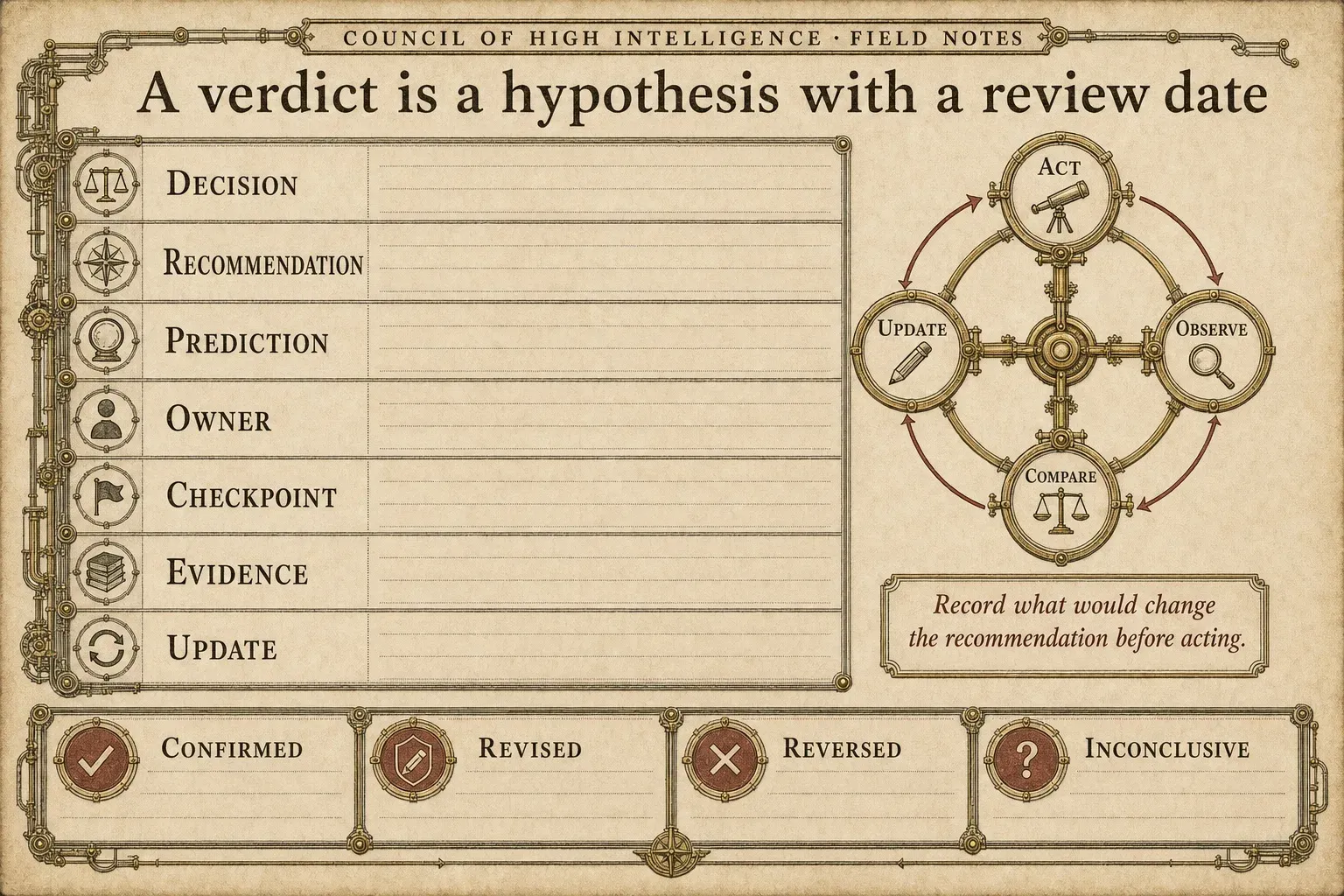
The README describes an outcome ledger: before acting, the user records the prediction, owner, review date and the evidence that would change the recommendation, then marks the result at the checkpoint as confirmed, revised, reversed or inconclusive. The session metadata block at the end of each verdict supplies the mode, panel size and providers used for that record.
Install
git clone https://github.com/0xNyk/council-of-high-intelligence.git && cd council-of-high-intelligence && ./install.shReviews of Council of High Intelligence
Be the first to share your experience with Council of High Intelligence.
Write a review
Loading review form…
Found Council of High Intelligence useful? Upvote it todayYour vote helps other IT teams find it in the daily ranking.