
What is GEO-SEO Claude?
GEO-SEO Claude (repository geo-seo-claude) is an open-source skill bundle for Claude Code that audits websites for generative engine optimization (GEO), meaning visibility in answers from ChatGPT, Claude, Perplexity, Gemini and Google AI Overviews, alongside traditional SEO checks. It is published on GitHub by Zubair Trabzada. Commands run inside a Claude Code session as /geo sub-commands, for example /geo audit <url>, and write their results as Markdown files, with an optional PDF report. The FAQ states that the bundle runs within the user's own Claude Code session and subscription, with no separate API key, usage meter or subscription for the skill itself.
The repository contains a main orchestrator skill (geo/SKILL.md), thirteen sub-skills in skills/ plus an update skill, five subagent definitions in agents/, Python utility scripts for page fetching, citability scoring, brand mention scanning and llms.txt generation, six JSON-LD schema templates, an HTML and CSS report template and a white-label branding helper. A full audit fetches the homepage, detects the business type and crawls the sitemap, then runs five subagents in parallel (AI visibility, platform analysis, technical SEO, content quality and schema markup) and combines their results into a composite GEO Score from 0 to 100. The weights and signals are documented in scoring-methodology.md.
Installation is by shell script. install.sh (macOS and Linux) and install-win.sh (Windows, run from Git Bash rather than PowerShell or Command Prompt) check for Git, Python 3.10 or newer and the Claude Code CLI, copy the skills to ~/.claude/skills/ and the agents to ~/.claude/agents/, and install the Python dependencies from requirements.txt (Beautiful Soup, requests, lxml, Playwright, Pillow, urllib3, validators, Flask and rich). According to the README they go into a dedicated virtual environment at ~/.claude/skills/geo/.venv/, using uv when it is present. Playwright's Chromium download is optional and only needed for screenshots. uninstall.sh removes the installed files but not the prospect data folder.
The project publishes no GitHub releases, so the reference version here is the default-branch commit 989cae0 of October 5, 2026. The commits before it, merged on October 2, 2026, changed the Python version check in the installer to keep probing candidates and look for Python 3.14 and 3.15, fixed the Windows virtual-environment path, and added detection of Cloudflare-managed robots.txt files. The commands reference lists its own discrepancies: /geo page appears in the main skill's table without a skill file, and /geo quick is defined only through the orchestrator and other skills.
The code is MIT-licensed. Out of scope, according to the FAQ, are keyword research, rank tracking and full-site crawling of the kind done by dedicated SEO crawlers; the /geo technical command covers technical foundations only. Similar entries on iThub include the Claude Code plugin Claude SEO and the agent workflow collection NotFair Plugin.
Key capabilities
- Full audit with parallel subagents
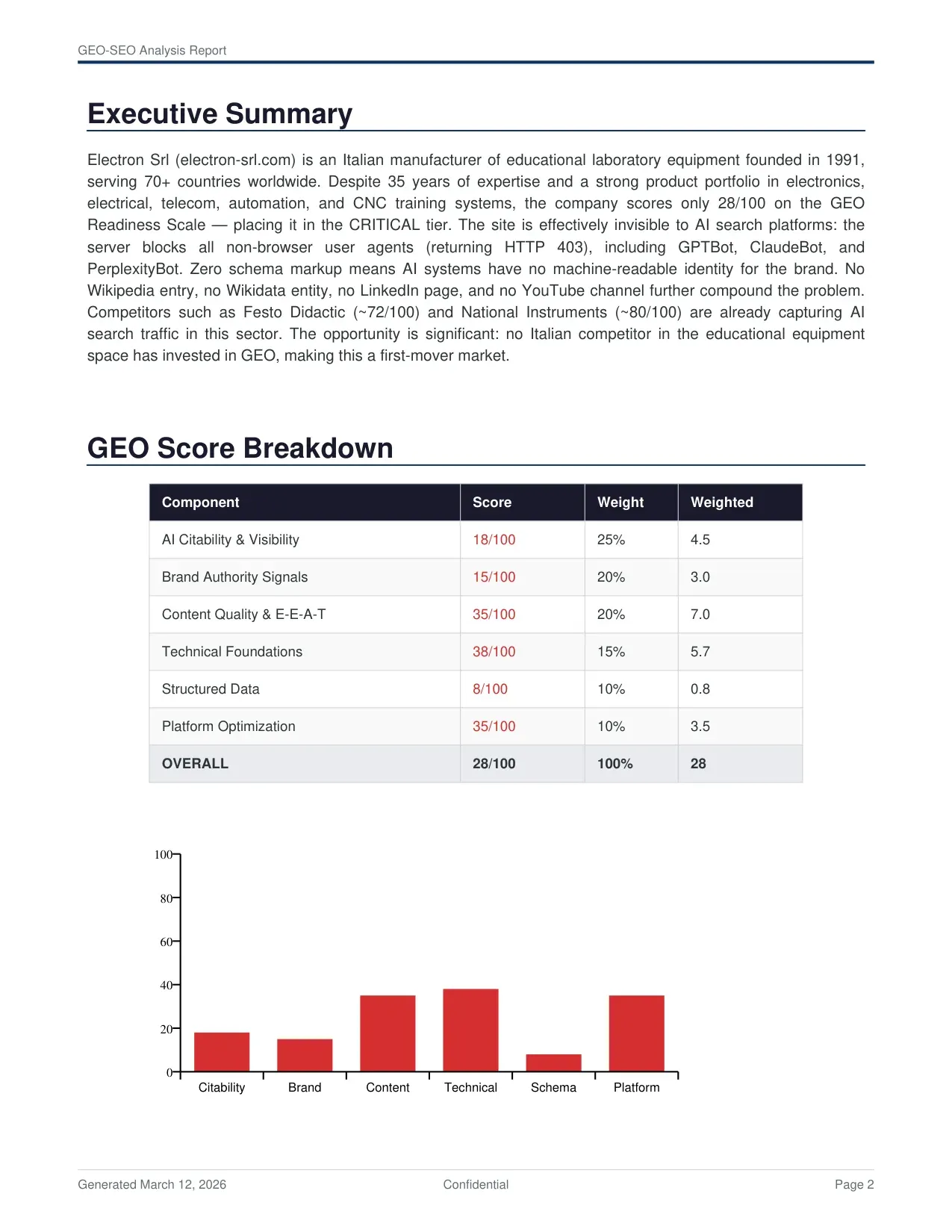
/geo audit <url>runs discovery (homepage fetch, business-type detection, sitemap crawl), then dispatches the five subagentsgeo-ai-visibility,geo-platform-analysis,geo-technical,geo-contentandgeo-schemaat the same time. The orchestrator aggregates their sub-scores into the composite GEO Score and writesGEO-AUDIT-REPORT.mdwith a prioritized action plan. - Composite GEO Score The score is a weighted average of six categories: AI Citability and Visibility 25%, Brand Authority Signals 20%, Content Quality and E-E-A-T 20%, Technical Foundations 15%, Structured Data 10% and Platform Optimization 10%. Each subagent returns a 0 to 100 sub-score; the formula is in the
geo-auditskill. The client report command uses a different five-category weighting, documented in the commands reference. - Quick snapshot
/geo quick <url>produces a 60-second visibility snapshot inline in the session and writes no output file. The prospect and compare skills call it to record a score for a domain. - Citability scoring
/geo citability <url>scores a page's content blocks for AI citation readiness usingscripts/citability_scorer.py. The README describes the target as self-contained, fact-rich passages that answer a question directly, and gives 134 to 167 words as the passage length it treats as optimal. - AI crawler access
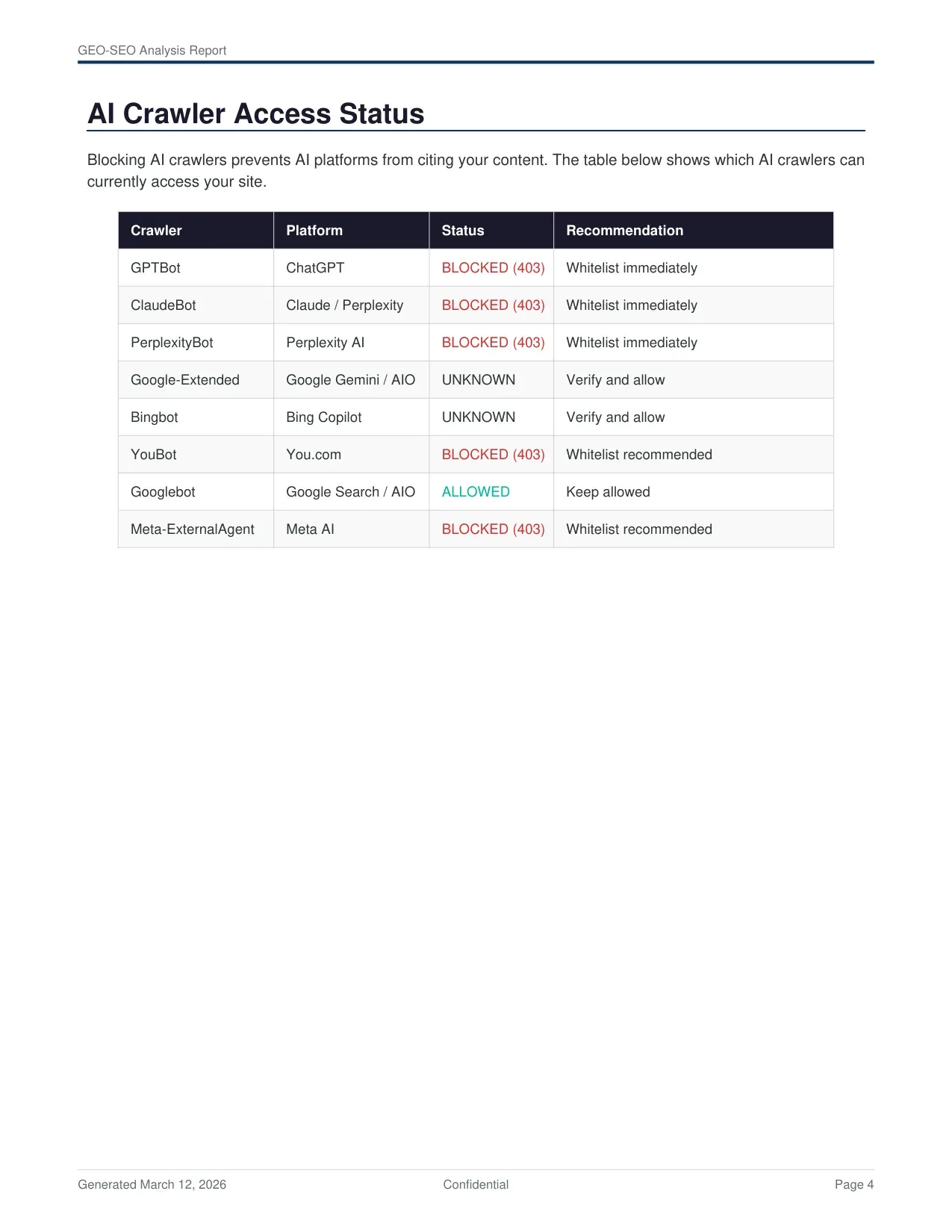
/geo crawlers <url>readsrobots.txtand meta tags for 14 or more AI crawlers, including GPTBot, ClaudeBot and PerplexityBot, and reports which are allowed or blocked with allow or block suggestions. Detection of Cloudflare-managedrobots.txtfiles was merged on October 2, 2026. - llms.txt analysis and generation
/geo llmstxt <url>validates an existingllms.txtfile or generates one from the site's structure withscripts/llmstxt_generator.py. - Brand mention scanning
/geo brands <url>looks for a brand's presence on platforms the project associates with AI citations, including YouTube, Reddit, Wikipedia and LinkedIn among more than ten sources, usingscripts/brand_scanner.py. The results feed the Brand Authority category of the score. - Platform-specific readiness
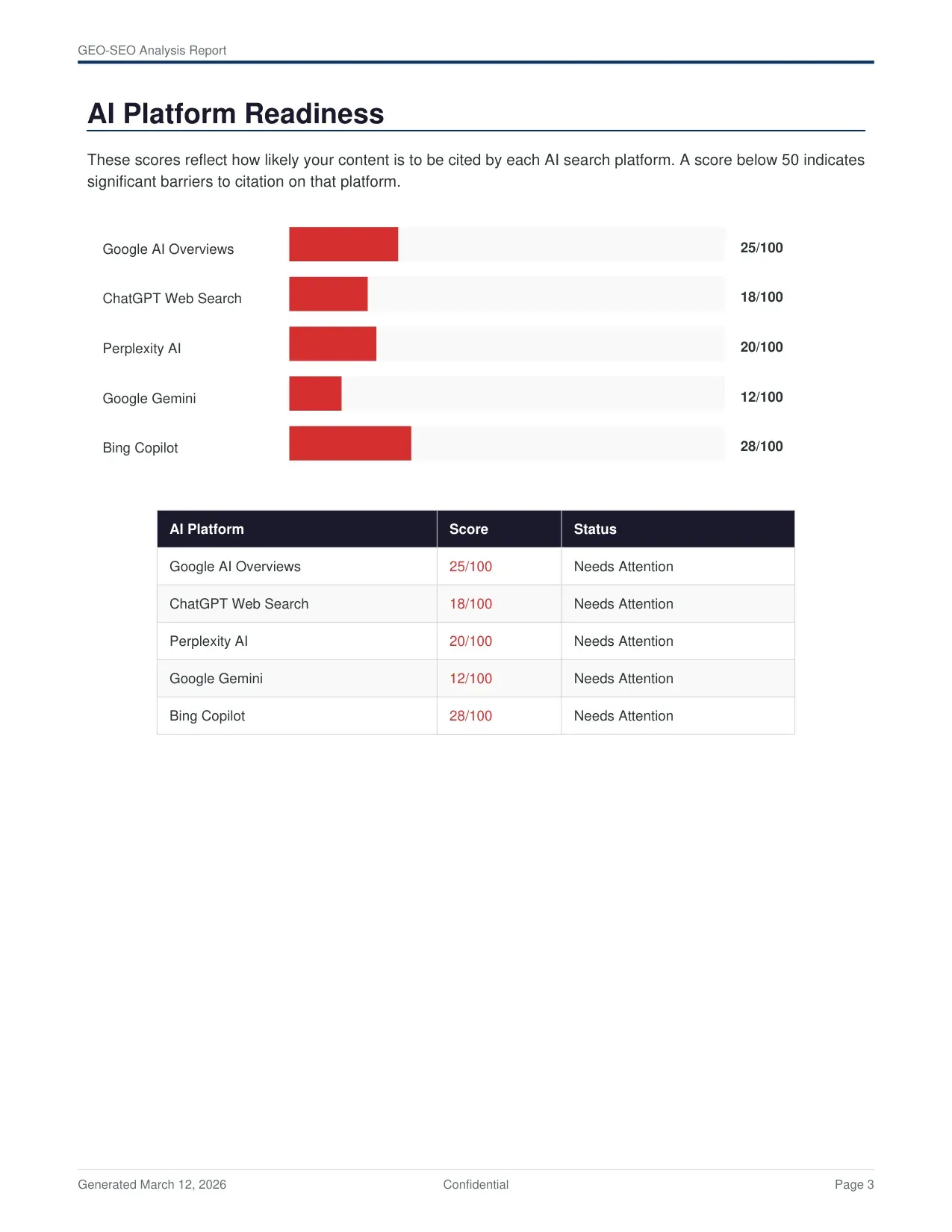
/geo platforms <url>returns separate readiness scores for Google AI Overviews, ChatGPT, Perplexity, Gemini and Bing Copilot, with suggestions per platform. In a full audit this is thegeo-platform-analysissubagent. - Schema markup
/geo schema <url>detects, validates and generates Schema.org structured data. Six JSON-LD templates ship inschema/: Organization withsameAs, LocalBusiness, Article with author, SoftwareApplication, Product with offers, and WebSite with SearchAction. - Technical SEO and content checks
/geo technical <url>covers Core Web Vitals, server-side rendering, security and mobile checks with GEO-specific additions./geo content <url>assesses E-E-A-T, readability and freshness. - Client report in Markdown
/geo report <url>reads existingGEO-*.mdaudit files from the working directory, runs missing audits, and writesGEO-CLIENT-REPORT.md. The commands reference lists twelve sections, from an executive summary and per-platform visibility dashboard to crawler access, citability of top and bottom pages, an action plan in three horizons and a glossary, written for business owners rather than developers. - PDF report
/geo report-pdfturns the audit into a PDF. The skill file (version 2.0.0) uses pandoc with the bundled HTML template and CSS to buildGEO-REPORT.html, then Google Chrome in headless mode to printGEO-REPORT.pdf, with a cover page and score badge, color-coded score tables and severity-tagged findings; its prerequisites namebrew install pandocand the macOS Chrome path. The README and commands reference still describe an older ReportLab script,generate_pdf_report.py, which is not in the current repository tree. - Prospect pipeline
/geo prospectmanages prospects in~/.geo-prospects/prospects.jsonwith the sub-commandsnew,list,show,audit,note,status,won,lostandpipeline, and five stages from lead to won or lost.scripts/crm_dashboard.pyshows the same data as a terminal dashboard built with rich. - Proposals and monthly comparisons
/geo proposal <domain>fills a twelve-section service proposal from the latest audit, picks one of three tiers from the GEO score and saves it under~/.geo-prospects/proposals/; the tier prices are part of the template and can be overridden./geo compare <domain>compares the oldest and newest audits for a domain and reports score deltas, crawler changes and completed action items. - White-label branding
white-label/brand_config.pyloads an optionalbrand.jsonwith agency name, contact details and colors and merges it over defaults, so report generators can use those values instead of hard-coded ones. The white-label README describes the keys. - Installation on macOS, Linux and Windows MacOS and Linux use
curl -fsSL .../install.sh | bashor a clone followed by./install.sh. Windows needs Git for Windows and runsinstall-win.shfrom Git Bash; WSL is not required. Requirements are Python 3.10 or newer (pluspython3-venvon Debian and Ubuntu), the Claude Code CLI and Git; Playwright is optional./geo updatepulls the latest files from the upstream repository and replaces the installed skills, agents, scripts and templates. - Local data storage Audit and report files are written to the current working directory. The prospect, proposal and compare skills store data in
~/.geo-prospects/, which the uninstaller leaves in place. Page fetching runs from the user's machine, and analysis runs in the user's Claude Code session.
Where GEO-SEO Claude fits
Auditing a site for AI search visibility
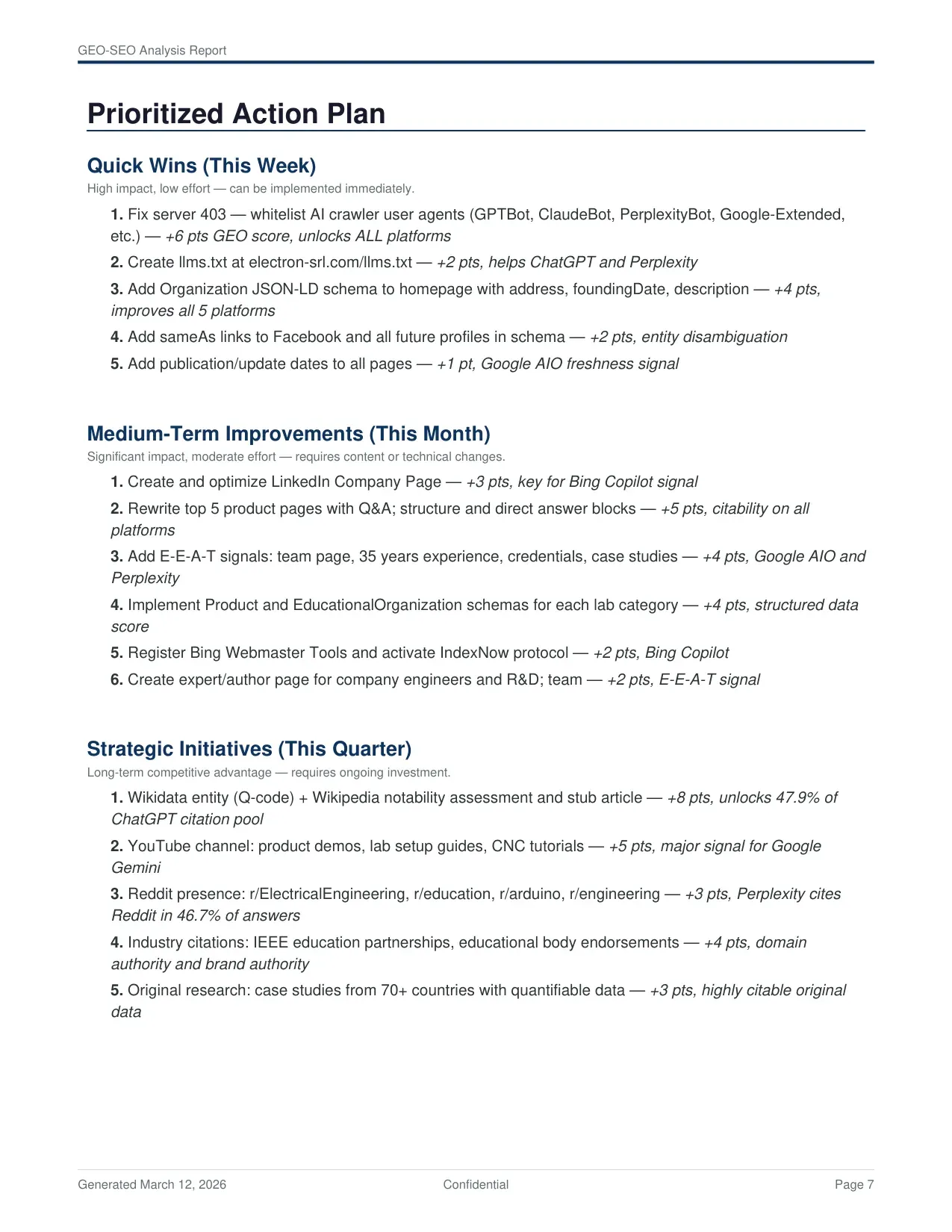
Running /geo audit https://example.com in Claude Code performs discovery, the five parallel analyses and the score synthesis, and writes GEO-AUDIT-REPORT.md. The report lists the composite score, the six category scores and a prioritized action plan with quick wins. The getting-started guide walks through installation and a first audit.
Checking whether AI crawlers can read a site
/geo crawlers reports, crawler by crawler, whether robots.txt or meta tags allow or block bots such as GPTBot, ClaudeBot, PerplexityBot and Google-Extended. In the repository's example report for an equipment manufacturer, the crawler table shows most AI crawlers receiving HTTP 403 responses, which the report lists as a critical finding.
Generating structured data and llms.txt
/geo schema detects existing JSON-LD and generates new markup from the six bundled templates, for example Organization with sameAs links or Product with offers. /geo llmstxt validates an existing llms.txt or drafts one from the site structure. Both outputs are files to review and deploy on the site; the skill does not publish them.
Producing a client deliverable
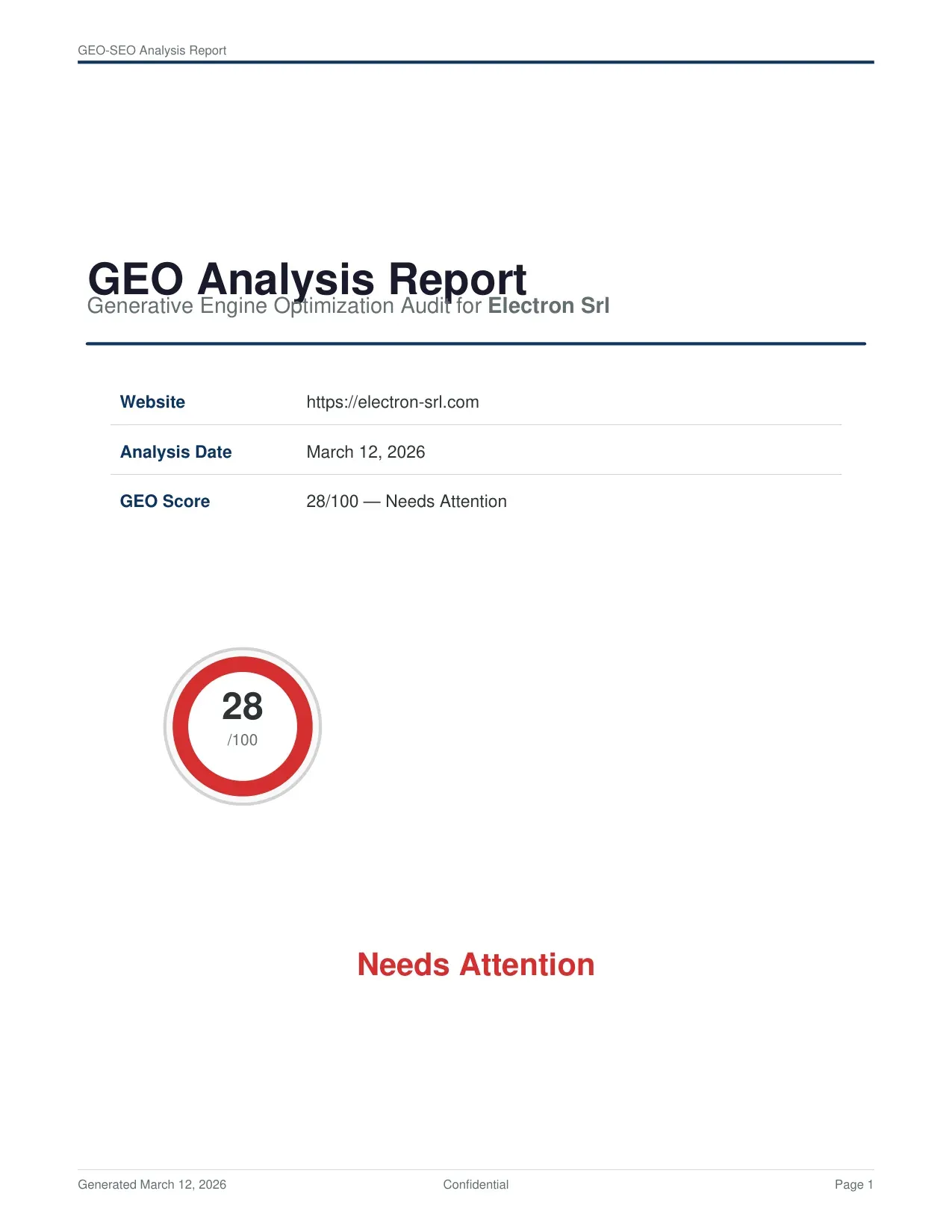
After the audits, /geo report writes a Markdown client report and /geo report-pdf converts it to a PDF with pandoc and headless Chrome. The examples folder contains a sample PDF report dated March 12, 2026, together with the matching audit JSON, a quick-audit Markdown file and a proposal. The report template and CSS in templates/ can be edited, and the white-label helper supplies agency name and colors.
Tracking prospects and monthly progress
The prospect pipeline records domains, statuses, scores and notes in ~/.geo-prospects/. /geo prospect audit stores a quick score for a prospect, /geo proposal drafts a proposal from that audit, and after later audits /geo compare produces a monthly delta report with per-category and per-platform score changes.
Comparing readiness across AI platforms
/geo platforms returns separate scores for Google AI Overviews, ChatGPT web search, Perplexity, Gemini and Bing Copilot. The example report shows these as a bar chart and a table with a status per platform. Related listings on iThub include OpenSEO and Canonry, which track AI answer citations as hosted or self-hosted platforms.
Install
curl -fsSL https://raw.githubusercontent.com/zubair-trabzada/geo-seo-claude/main/install.sh | bashReviews of GEO-SEO Claude
Be the first to share your experience with GEO-SEO Claude.
Write a review
Loading review form…
Found GEO-SEO Claude useful? Upvote it todayYour vote helps other IT teams find it in the daily ranking.