What is fast-anything?
fast-anything is an MIT-licensed command-line tool published in the EL4CTEO/fast-anything repository on GitHub by the developer account EL4CTEO, and distributed on npm as @el4cteo/fast-anything. Its stated idea is to leave an application in its own language and rewrite only the few functions where most of the runtime goes. It profiles the app, ranks functions by time share and portability, records real calls to the chosen function, hands a one-function Rust crate and a TASK.md brief to a coding agent, replays the recorded calls against the compiled port and only then swaps it in. Each swap is reversible per function or for a single run.
The project is at an early stage. The repository was created on November 21, 2026, and versions 0.1.0 to 0.4.0 were all released on that day. Version 0.1.0 covered Python through PyO3, Node.js and TypeScript through napi-rs, and Ruby through a C entry point that exchanges JSON. Version 0.2.0 added Java and Go, 0.3.0 added PHP, and the latest release, v0.4.0, added C and C++ apps built with gcc or clang and Java apps built with Maven or Gradle. The npm package is also at 0.4.0.
The tool itself is written in Rust and ships as prebuilt binaries for Windows x64, macOS (Apple silicon and Intel) and Linux (x64 and arm64), both as GitHub release archives and as platform packages pulled in by the npm wrapper. Ports are compiled on the user's machine, so a Rust toolchain installed with rustup is required. The README also gives cargo install fast-anything as an alternative, but on November 21, 2026 crates.io returned no crate under that name. All state lives in a .fast folder in the project: port crates, recorded calls, backups of temporary edits and one shared Cargo target directory that can be deleted at any time.
The same binary works three ways with coding agents. fast-anything go --agent claude or --agent codex runs the whole loop and calls the agent CLI itself; any other command that reads a prompt on stdin also works, and without --agent the TASK.md file can be handed to any assistant. The repository is also a Claude Code plugin marketplace with a /fast-anything:fast command, it contains an agent skill that describes the loop, and fast-anything mcp starts an MCP server with eight tools. Other Claude Code plugins and skills on iThub are listed under AI Skills & Plugins; Codex CLI is one of the two agents with a built-in preset.
A related project with a broader scope is rust-anything, which describes itself as rewriting a whole app in Rust one piece at a time, checked against recordings of the original, until the app is pure Rust. The fast-anything README does not mention rust-anything, and the repository is not a GitHub fork of it. fast-anything keeps the original application and its runtime, moves only selected hot functions behind an opt-in switch, and has no step that turns the app into a standalone Rust program.
Key capabilities
- One-command loop
fast-anything go --agent claudefollowed by-- python app.pyprofiles the app, picks the top function, records calls, lets the agent write the port, verifies it, enables it and times the app before and after. The command after--is the normal way the app is started, for examplenode app.ts,ruby app.rb,java App.java,mvn exec:java,gradle run,go run .,php app.phporclang -O2 main.c. The agent gets three attempts per function by default. - Profiling per language
scanruns the app once under a profiler and lists functions with their time share and call count. According to the source and changelog, Python uses cProfile, Node.js uses a V8 CPU profile (--cpu-prof), Ruby uses a TracePoint call and return tracer, Java uses Flight Recorder, Go uses pprof, and PHP, C and C++ get a one-line timer inserted into each function for one run. Temporary source edits are backed up in.fast/backupand restored even after an interrupted run. - Hotspot ranking Functions are scored by time share multiplied by how portable they are. Anything under 2% of the run is not proposed, and functions that do I/O, use randomness or global state are marked as not portable with the reason. When an outer function and the helper it calls take about the same time, the outer one is preferred so the app crosses into Rust once instead of once per inner call; the README reports 116x for the outer Python port against 35x for porting only the inner
levenshtein. - What can be ported Top-level, deterministic functions that take plain data such as numbers, strings, lists, dictionaries and typed arrays. In Java and PHP that means static methods (and PHP functions), in Go plain functions, and in C and C++ free functions and static methods. C ports take numbers, strings and pointer plus length arrays; C++ ports also take
std::string, vectors, arrays, maps and pairs. Functions in the entry script qualify when its main code sits under a main guard. - Call recording
port [id]re-runs the app and records up to 500 real calls to the chosen function with their arguments and results. It then creates.fast/ports/<id>/with a stub Rust crate and aTASK.mdthat includes sample calls and the semantic rules the port must keep. - Agent hand-off The
claudepreset runs Claude Code in print mode with edits accepted and tools limited to reading and editing files pluscargo check,build,testandfmt. Thecodexpreset runscodex exec --full-auto. Any other value of--agentis run as a command with the prompt on stdin, and without the flag the user can giveTASK.mdto any tool. - Behavior check
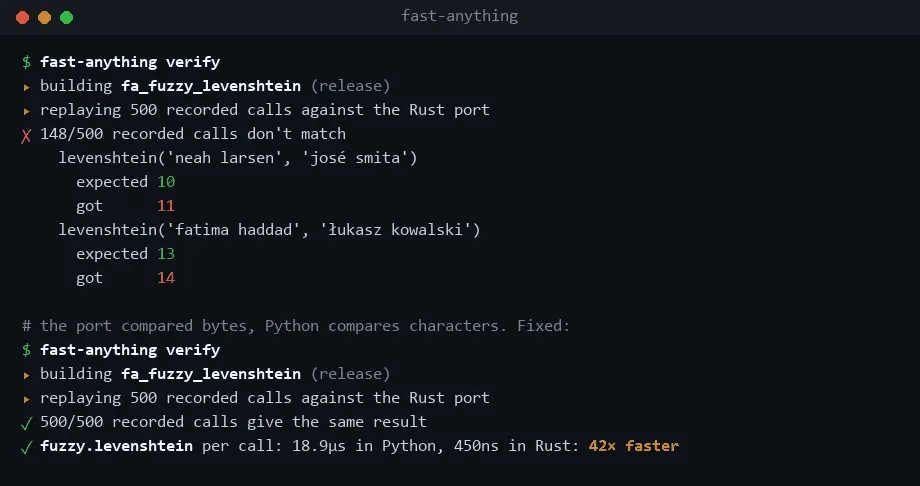
verifybuilds the port in release mode and replays every recorded call. It also derives extra cases by shrinking recorded inputs (empty, tiny and random slices) and lets the original function answer them. A port passes only when every case matches: same values, floats within 1e-9, and errors where the original raises errors. The README shows a port that compared bytes instead of characters failing 148 of 500 recorded calls. - Reversible swap
enableappends one marked block to the original module that loads the Rust port, anddisableremoves it byte for byte. SettingFAST_ANYTHING_DISABLE=1runs the original code for a single run. The original function body is not edited. - Benchmark and report
benchtimes the whole app with and without the ports in interleaved runs, so machine drift affects both sides, and for Go it times a prebuilt binary so compile time is not counted.reportwrites a Markdown summary and an SVG card intended for a pull request. - Python binding Python 3.10 or later, with ports built as PyO3 extension modules.
- Node.js and TypeScript binding Node.js 22 or later, with ports built through napi-rs.
- C bridge for other languages For Ruby 3.3+, Java 22+, Go 1.22+, PHP 8.1+, C and C++, the port is a plain Rust library with one C entry point that takes and returns JSON. Ruby calls it through its built-in Fiddle, Java through the FFM API, Go through the Windows loader or dlopen, PHP through the FFI extension (
extension=ffi), and C and C++ through LoadLibrary or dlopen. No headers or binding generators are needed, and ports for these languages are verified in a child process so a crashing port cannot stop the tool. - Claude Code plugin
/plugin marketplace add EL4CTEO/fast-anything, then/plugin install fast-anything@fast-anything, adds the/fast-anything:fastcommand, which takes the command that runs the app and asks for end-to-end and per-call speedups in the final answer. The plugin also registers the MCP server. - MCP server Built into the binary and started with
fast-anything mcp, for example viaclaude mcp add fast-anythingwithfast-anything mcpas the server command. It exposes eight tools:fast_scan,fast_port,fast_verify,fast_enable,fast_disable,fast_bench,fast_reportandfast_status. The README names Claude Code, Codex and Cursor as clients. - Agent skill
skills/fast-anything/SKILL.mddescribes the scan, port, verify, enable loop for any agent, including rules such as never editing the recordings, never enabling a port that has not passed verify, and explaining why a function marked as not portable cannot move yet. - Toolchain check
doctorchecks the Rust toolchain, the language runtimes and the agent CLIs before a run. - Installation
npm i -g @el4cteo/fast-anything(Node.js 18 or later for the wrapper) installs the prebuilt binary for Windows x64, macOS arm64 or x64, or Linux x64 or arm64. The same binaries are attached to each GitHub release. A Rust toolchain from rustup is needed to compile ports. - Example apps The
examples/folder holds the apps behind the README results: fuzzy duplicate finders in Python, TypeScript, Ruby, Java (plain, Maven and Gradle), Go, PHP and C++, and a C Mandelbrot renderer, each with a reference Rust port. - License MIT, for the CLI, the plugin, the skill and the examples.
Where fast-anything fits
Find where a script spends its time
fast-anything scan followed by -- python app.py runs the app once under the language's profiler and prints a ranked table with time share, call count and a verdict per function: port it, covered by a portable caller, or not portable with a reason such as I/O or living in the entry script. The skill tells the agent to profile a representative workload rather than the test suite and to skip anything under 2% of the run.
Port one hot function with Claude Code or Codex
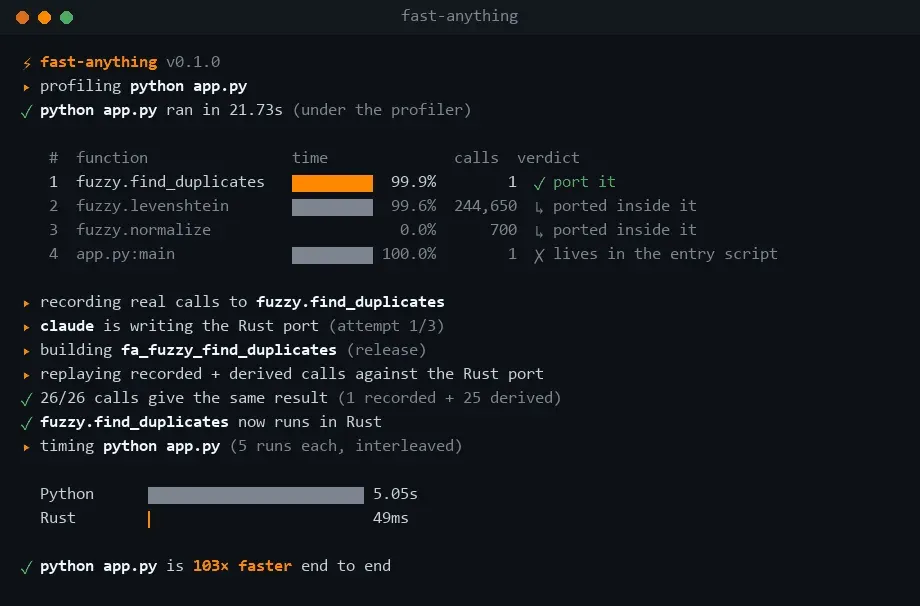
fast-anything go --agent claude followed by -- node app.ts, or --agent codex runs profiling, recording, the agent session, verification, enabling and benchmarking in one command. In the README demo a Python fuzzy duplicate finder goes from 5.05 seconds to 49 milliseconds after its outer find_duplicates function is ported and 26 recorded plus derived calls match.
Work step by step with any assistant
Without --agent, port leaves a crate and a TASK.md with sample calls and semantic rules (Unicode code points, integer ranges, float operation order, error cases). The port is written in src/lib.rs (or src/port.rs for the C-bridge languages), then verify, enable, bench and report follow. The same steps are available as MCP tools for agents connected through fast-anything mcp.
Catch a port that looks right but differs
verify lists failing calls with the expected and actual result. The README example is a Levenshtein port that counted bytes instead of characters and returned different distances for names with accented letters; after the fix all 500 recorded calls matched and the function ran 42x faster per call (18.9 microseconds in Python, 450 nanoseconds in Rust).
Speed up apps outside Python and Node.js
Ruby, Java (single-file, Maven or Gradle), Go, PHP, C and C++ apps use the C bridge, so no binding generator is needed. The project's results table, measured on an i5-10500 under Windows 11 and a GitHub Actions Linux runner for C and C++, lists 14x for Ruby, 21x for Go, 55x for PHP, 3x end to end for Java (11x on the function, with the rest in JVM startup), 3.4x for C and 2.7x for C++. These are the project's own figures for its example apps.
Document and undo a speedup
bench times the app with and without ports over interleaved runs and report writes Markdown plus an SVG card for a pull request. disable <id> removes the swap block byte for byte, and FAST_ANYTHING_DISABLE=1 runs the original code for one run without changing files.
Install
npm i -g @el4cteo/fast-anythingReviews of fast-anything
Be the first to share your experience with fast-anything.
Write a review
Loading review form…
Found fast-anything useful? Upvote it todayYour vote helps other IT teams find it in the daily ranking.