
What is Elephant-Goldfish Model?
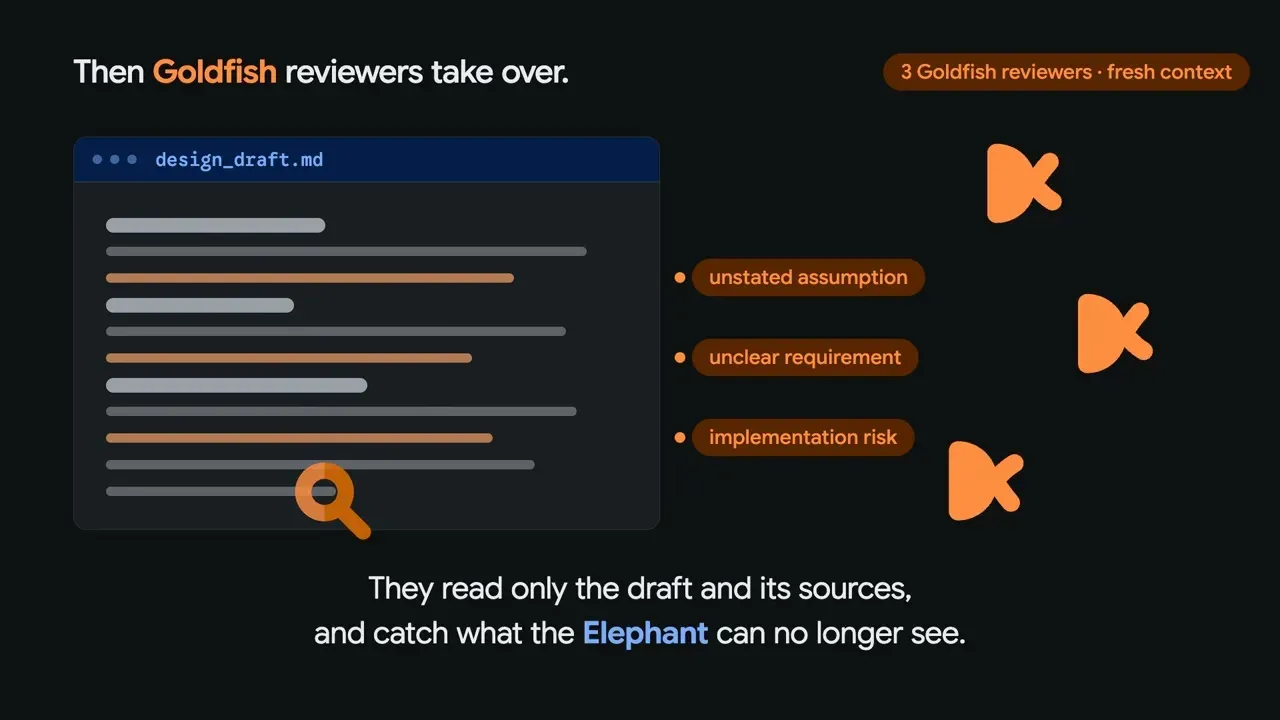
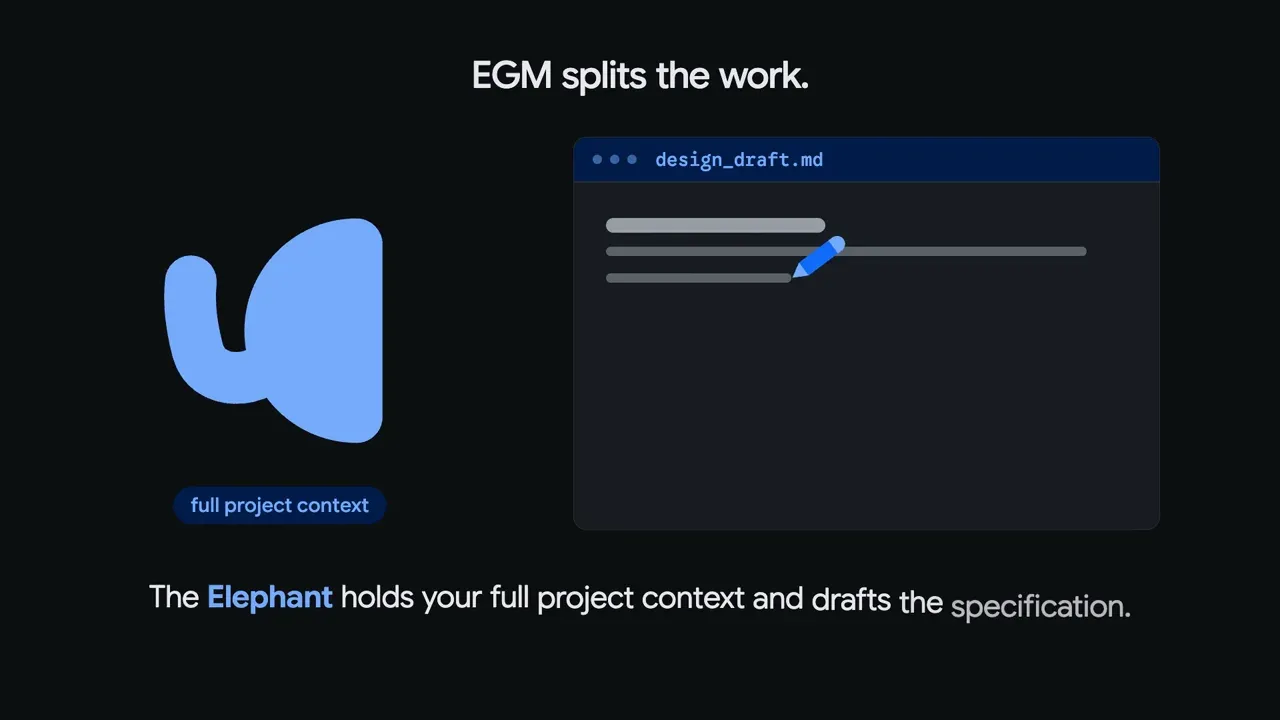
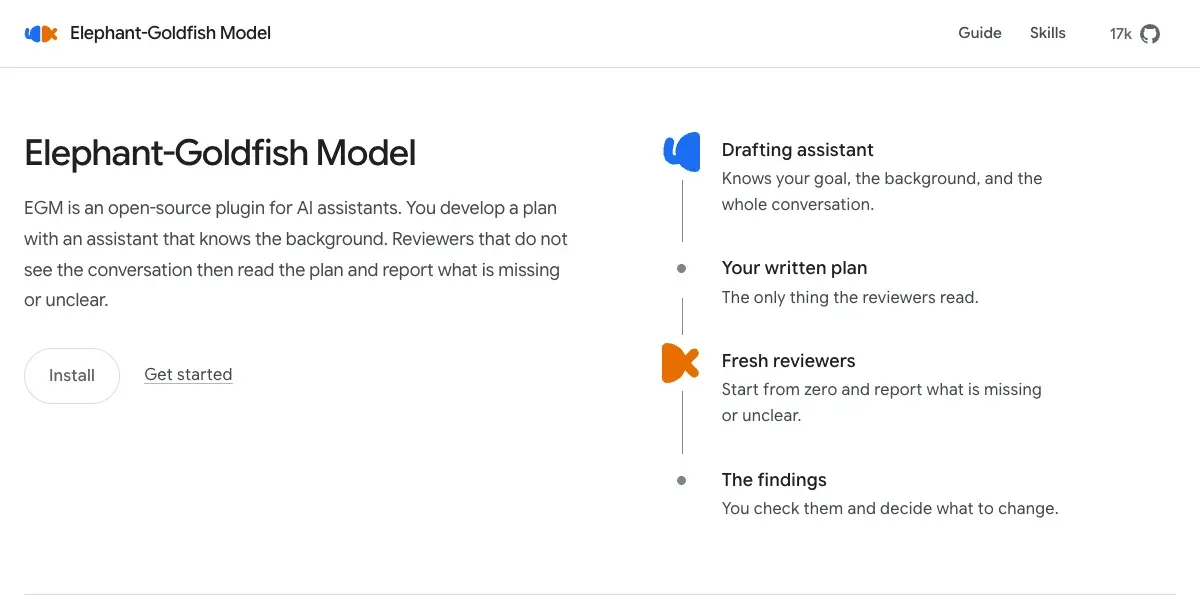
Elephant-Goldfish Model, or EGM, is an open-source plugin for AI coding assistants that splits design work between two kinds of agent. The README describes the Elephant as the main session that holds project context, requirements and earlier decisions and drafts the specification. Goldfish reviewers are subagents started in fresh contexts: they read only the document and its referenced source material, without the earlier conversation, and report unstated assumptions, unclear requirements and implementation risks. The person using the plugin resolves the trade-offs and approves the design before implementation. The project site at egm.dev summarizes it as "Design with an elephant. Review with a goldfish."
The repository is published under the Google GitHub organization, the plugin manifests name Google as author, and source files carry a Google LLC copyright. The README states that EGM is not an officially supported Google product. According to the getting started guide, EGM is an implementation of spec-driven development based on Dave Rensin's article Elephants, Goldfish, and the New Golden Age of Software Engineering, packaged after practitioners noticed repeated patterns in the manual prompt sequence.
EGM is distributed as one set of Markdown skills, reviewer personas and document standards, with a separate manifest for each host. The harness guide lists install paths for Antigravity CLI, the Antigravity App and Antigravity for IDEs, Claude Code, Claude Cowork, Codex CLI, the ChatGPT and Codex desktop apps, ChatGPT workspace import, omp and Muse. Antigravity CLI, Claude Code and Codex pass the project's automated installation and end-to-end workflow fixtures; Claude Cowork and ChatGPT Work have working installation paths with open cloud verification gaps. Windsurf (now Devin Desktop) routing is experimental, and standalone Antigravity IDE is not supported because it does not expose the fresh-context subagent tool that Goldfish reviews require.
The latest release is EGM v0.1.1, published November 6, 2026. It ships two runtime archives, egm-claude-0.1.1.zip and egm-openai-0.1.1.zip, with a SHA256SUMS file and GitHub Actions attestations. According to the release notes, it clarifies the plugin listing copy, adds three OpenAI starter prompts, adds the TRIZ inventive catalyst reviewer, improves review context handling and severity preservation, and adds experimental Cursor, OpenCode V1 and GitHub Copilot adapters. The notes state that native end-to-end verification of those exact ZIP files remains open in issue #60. The release policy uses patch bumps for compatible fixes while EGM is pre-1.0 and reserves 1.0 for a stable contract on skill names, parameters, output paths and report formats.
EGM is licensed under Apache 2.0. Per its data handling notice, the runtime package operates no hosted service, database, analytics client or telemetry endpoint and needs no separate EGM account; prompts and files are processed by the selected host under that host's own terms. The repository's Python tooling covers release packaging and pytest unit tests, and the documentation site is built with Astro. The README states that a review does not replace tests or human judgment, and that the built-in draft and design-review workflow targets software specifications, while bootstrap and drift reporting apply to software codebases.
Key capabilities
- Install in Claude Code Add the repository as a marketplace with
claude plugin marketplace add google/elephant-goldfish-model, then runclaude plugin install egm@egm. Claude reviewer adapters setomitClaudeMd: trueso reviewers do not receive the project CLAUDE.md. The README asks users to start a new session after installation. Claude Cowork installs from claude.ai/plugins or the Cowork plugin panel using the same marketplace. - Install in Codex and ChatGPT Codex CLI uses
codex plugin marketplace add google/elephant-goldfish-modelfollowed bycodex plugin add egm@egm. The ChatGPT and Codex desktop apps install the published EGM plugin listing, which is desktop-only. ChatGPT workspace admins can import the marketplace from the repository path.agents/plugins. Codex has no named personas, so a general-purpose subagent reads the persona file first. - Install in Antigravity Antigravity CLI installs with
agy plugin install https://github.com/google/elephant-goldfish-model. The Antigravity App and Antigravity for IDEs (the Visual Studio Code extension) use/pluginor a manual copy of the runtime bundle into~/.gemini/config/plugins/egm/. The harness guide notes that the command form for skills in the App and IDE extension has not been verified. - Other hosts and experimental adapters Omp and Muse have documented install commands; omp invokes skills as
/skill:egm-<command>. Release v0.1.1 adds experimental Cursor, OpenCode V1 and GitHub Copilot adapters with separate installation guidance, and Windsurf routing is experimental. The project asks for the whole plugin to be installed, because skill-only installers that copyskills/alone break the references toagents/andresources/document_standards/. - Brainstorm skill
/egm-brainstormstarts an ideation session in which the agent asks clarifying questions about requirements and trade-offs. A group of fresh Goldfish reviewers then challenges the proposal, and the agreed direction is saved asconcepts_brief.md. The README notes that brainstorming requires a session that can create fresh subagents. - Draft skill
/egm-draftturns a concept brief or existing notes intodesign_draft.md, a design document written section by section. The agent pauses after each section for feedback in chat. Approved specifications are meant to be committed underdocs/designs/so teammates and agents read the same files. - Five-stage design review
/egm-reviewruns the Goldfish review protocol on a design document in five phases: initial zoom out review, comprehension review, design critique, intermediate zoom out review and implementation readiness. Reviewers check the design, its clarity, its fit with the code and its implementation plan. If the host cannot create fresh subagent contexts, the skill stops instead of reviewing in the same context. - Resolve skill
/egm-resolveruns in the Elephant session that wrote the document and processes the Goldfish findings. Each finding is classified as CONTEST (inaccurate, with evidence the reviewer could read), ESCALATE (inaccurate, but the evidence is outside the reviewer's files), PROPOSE FIX or DECLINE for nits. Fixes are applied through multiple-choice confirmation gates. - Configurable review loop
/egm-review-loopruns a chosen group of reviewers against a chosen standard for any document, including READMEs, feature specifications and implementation plans. Inputs are the target file, a semantic target such as a section or the full file, the reviewer list, a reviewer-to-standard mapping and a reading list for the reviewers. URLs in the reading list are saved as local files first because some reviewers cannot open URLs. - Bootstrap documentation
/egm-bootstrapcreates or updates README files across a repository subtree: leaf-level component READMEs with file contracts ("Peanuts") and parent-level blueprints that roll up child interfaces ("Hay"). It is limited to documentation, does not write functional code and does not commit. If it finds more than 15 subdirectories, it asks for approval before running on the full tree. - Drift report
/egm-drift-reportcompares each design document or README in a folder with the current source code. It looks for missing features, incomplete models, hardcoded shortcuts and architectural divergence, reports only the differences, and appends them to a datedDRIFT_REPORT.mdfile. The user decides whether to update the document or the code. - Reviewer personas Persona prompts in
agents/cover zoom out, comprehension, design critic, implementation readiness, structural, style, codebase details and the TRIZ-based inventive catalyst, plus a synthesizer and a bootstrap orchestrator. Hosts that loadagents/*.mdregister them as named subagents such asegm-zoom-out. The architecture document describes how skills and reviewers fit together. - Document standards Reviewers measure documents against standards stored in
resources/document_standards/: a feature specification standard, a Heilmeier standard, an implementation readiness standard, a re-implementation standard and a zoom-out standard. The review loop maps each reviewer to one of these standards or to a custom path. - Configurable artifact directory Skills write briefs, drafts and reports to the working directory or the host's artifact directory. In Claude Code, Claude Cowork, Codex and ChatGPT, a line such as
EGM artifact directory: .dev/docsin the prompt or inCLAUDE.mdorAGENTS.mdredirects them. A path from an instructions file that resolves outside the working directory requires confirmation each session. - Local data handling The privacy notice states that EGM declares no MCP server, installs no permission-approval hook and sends no telemetry. The host assistant reads the files supplied for a task and processes them under its own account settings. Outputs stay in the workspace until deleted; EGM applies no retention period of its own.
- Verifiable releases Each release publishes a Claude runtime ZIP, an OpenAI runtime ZIP,
SHA256SUMSand an in-toto provenance bundle. The release guide documents checking the ZIPs withsha256sum -candgh attestation verifyagainst the release workflow. The project notes that attestations do not establish host support or prove that the code is safe. - Documented isolation limits The testing record and harness guide separate parent-turn isolation from host-instruction exclusion. Issue #237 reports that Codex CLI 0.166.0 and Antigravity CLI supplied project
AGENTS.mdorGEMINI.mdfiles to reviewers; the project lists these as host-instruction leaks, not evidence that parent conversation turns leaked.
Where Elephant-Goldfish Model fits
Reviewing an existing design document against the code
The README's quickest workflow needs no new specification: running /egm:egm-review docs/designs/webhooks.md in Claude Code or Antigravity CLI, or selecting the EGM review skill in the Codex skill picker, points fresh reviewers at an existing design document or a PR plan saved as Markdown. The reviewers check the design, its clarity, its fit with the live code and its implementation plan, and the report is written to a file. The user chooses which findings to address.
Designing a new feature from an idea
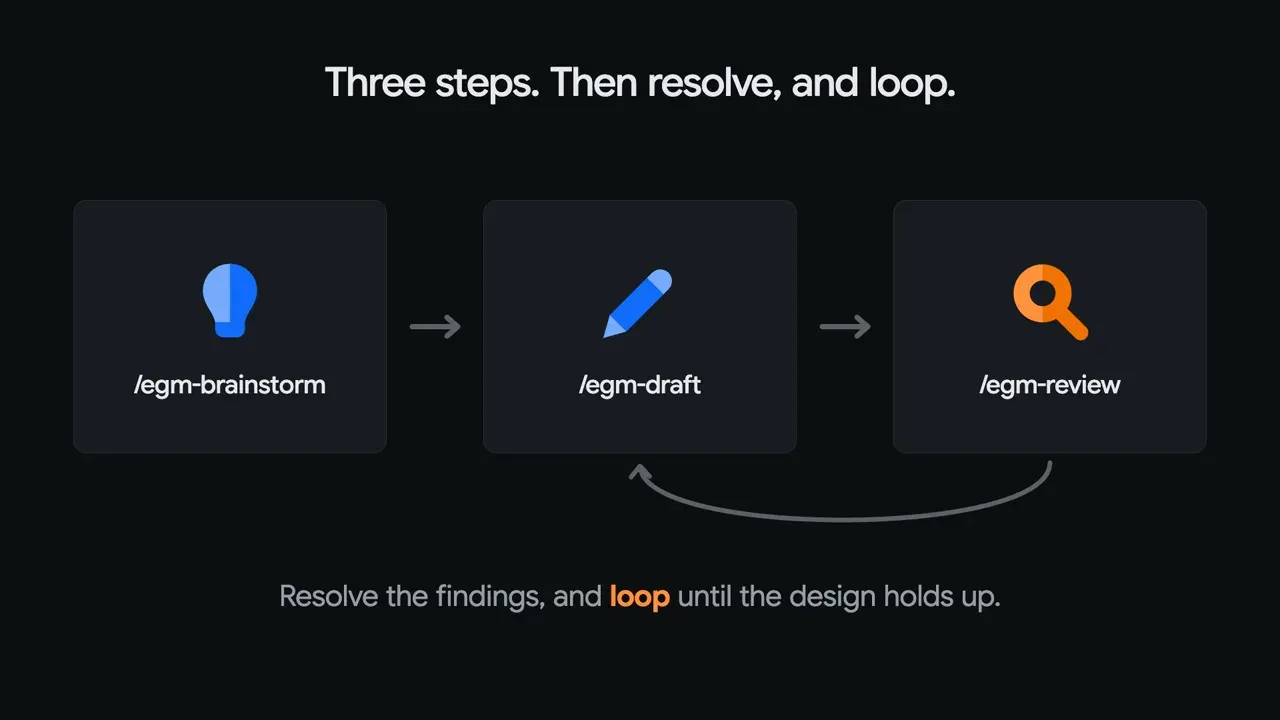
The core loop described in the getting started guide is brainstorm, draft, review. The README example adds webhook delivery to a project: /egm-brainstorm discusses failure handling and duplicate events and produces concepts_brief.md, /egm-draft turns it into design_draft.md section by section, and /egm-review runs the Goldfish review. After the user approves the design, the coding agent is asked to implement it. The project states that skills can be used out of order and that a simple bug fix does not need the design-first process.
Working through review findings
After a review, /egm-resolve runs in the same session that wrote the document so it can recall earlier reasoning. It sorts findings into contested, escalated, fixed and declined items, applies textual repairs through confirmation gates and presents re-sync checkpoints. The project video describes the cycle as resolving the findings and looping until the design holds up.
Documenting an existing codebase
/egm-bootstrap generates or corrects README contracts across a directory tree, recording interfaces, invariants and side effects for both developers and AI assistants. Parent READMEs index the contracts of their children. An alternate filename such as EGM.md can be used when existing human-maintained READMEs must not be modified, and changes are left uncommitted for the user to review.
Detecting drift between documents and source
Running /egm:egm-drift-report docs/designs/ makes the agent read each document in the folder, locate the corresponding source files and compare the design with the current code. The report lists only divergences, or "No drift detected" when a document matches. Where a document lacks explicit file paths, the skill prompts the user to add links so later checks are cheaper.
Reviewing documents that are not software specifications
For other documents, /egm-review-loop accepts a custom set of reviewers and standards. The egm.dev site lists class projects, design briefs and delivery plans among possible inputs and shows an example in which reviewers without the conversation flag who staffs a desk, which opening hours apply and what an unexplained "Friday rule" means. Similar projects on iThub include Superpowers and Plannotator.
Install
claude plugin marketplace add google/elephant-goldfish-model && claude plugin install egm@egmReviews of Elephant-Goldfish Model
Be the first to share your experience with Elephant-Goldfish Model.
Write a review
Loading review form…
Found Elephant-Goldfish Model useful? Upvote it todayYour vote helps other IT teams find it in the daily ranking.