
What is Music Skill?
Music Skill (repository music-skill, skill folder music-production) is an Agent Skill for writing original instrumental music as editable notes. It is published on GitHub by the account owoevan-dev. The agent writes every note of a piece into a project file; the skill's Python scripts then check the score, add a performance, play it on sampled instruments and synthesizers, mix it and master it. No audio-generation model is involved. A finished render contains an MP3 and a WAV, the MIDI, one stem per part, the buses and reverb returns that sum to the mix, and the project file, in which any note can be changed and rendered again.
The skill is distributed through the repository itself. In Claude Code it installs as a plugin from the repository's own marketplace (/plugin marketplace add owoevan-dev/music-skill, then /plugin install music-skill@music-skill); for Codex and other agents the README gives npx skills add owoevan-dev/music-skill, or copying skills/music-production into the agent's skills folder. The README states that it is tested in Claude Code and Codex and has not been tested in claude.ai chat or Cowork, and that a sandbox that is offline or reset between conversations cannot keep the setup. It needs an agent that runs commands on the local computer, Python 3.10 or newer with NumPy, FluidSynth and FFmpeg, with Surge XT as an optional synthesizer.
Rendering is offline and CPU-only. FluidSynth plays each sampled part from SoundFont banks; electronic parts use the skill's built-in synthesizers and drum machines or Surge XT presets. Parts pass through drum, bass, rhythm, ensemble and lead buses and four generated reverbs to a master at the project's loudness target: -16 LUFS by default, -14 LUFS for streaming, with true peak at or below -1 dBTP. The thirty sound banks are downloaded from the project's own GitHub release (twenty-five built from the publishers' samples, five repacked unchanged from FreePats), each checked against a pinned SHA-256. The full setup is listed as about 3.7 GB of downloads and 1 GB to 12 GB on disk depending on the banks installed (setup guide).
The project moved quickly through its first releases: 0.1.0 on November 4, 2026, then 0.2.0, 0.3.0, 0.4.0 (single-call revision rounds, draft renders, cached frozen parts and a clean command) and 0.5.0 (style maps with 88 entries in twelve families, building blocks for drums, bass and accompaniment, and journaled writes that a killed render can --resume). Version 0.6.0, released November 11, 2026, adds version 2 of the mix rules ("rules": 2): a lead-bus compressor threshold taken from the lead's written level, saturation at four times the sample rate on the drum, bass and rhythm buses, and a true-peak limiter at the end of the master. It also adds an orchestral clarity setting (mix.c80_db), a timing model based on linear phase correction, early decay time and clarity in analyze, and patch selection by measured brightness and attack. After 0.6.0 the main branch replaced the four examples with seven new ones, published as the release examples-4 (changelog).
The project's own code and documentation are MIT-licensed; scripts/surge_host.py, the separate program that runs Surge XT and pedalboard, is GPL-3.0-or-later. The example compositions and recordings are dedicated to the public domain under CC0 1.0. Third-party tools and sound banks keep their own licences and are not stored in the repository; THIRD_PARTY.md lists them. Stated limits: the skill does not sing or write lyrics, runs no VST plugins other than Surge XT, and the agent cannot listen to the result, so review and analyze locate problems while a person has to hear the music.
Key capabilities
- Score written as notes The agent plans a form and a theme, then writes a project file in which each note's pitch and length sit in the score and its performance (velocity, timing, release) is kept separately. Longer pieces are usually produced by a short Python script that the agent writes, so voicings, bass lines and drum patterns stay readable. The file format is documented in schema.md.
- Score review
reviewlists sustained minor seconds and ninths between parts, names every note outside the written chords as a passing note, suspension or other embellishing tone, and asks about those not resolved by step. It also lists parallel fifths and octaves between independent parts and close intervals placed too low. Since 0.5.0 each check takes its limits from the style-map entry the project names, and its record states whether a limit comes from a source or was set by the project. - Performance model A performance step adds per-player drift in timing and loudness, a laid-back bass, phrase arches and chords whose notes are not struck or released together; sampled leads can slur and bend. In 0.6.0 the timing line uses linear phase correction: by the next beat a player recovers part of the distance from the beat and a new small error is added.
- Sampled instruments through FluidSynth Each sampled part is played by FluidSynth on its own instrument from SoundFont banks. Any SF2 bank can be added with
studio.py add-soundfontand named by a part; the README notes that an added bank keeps its own licence. Parts that no installed bank covers fall back to the MuseScore MS Basic General MIDI bank. - Built-in synthesizers and Surge XT Electronic parts can use the skill's own MIT-licensed synthesizers and drum machines, or presets of Surge XT with its 3,008 factory and third-party patches, fifty of them curated. Surge XT runs only inside
surge_host.py, a separate GPL program. The README states that Surge starts its oscillators at random phases, so each synthesis of a Surge part is a slightly different take; the render cache keeps a take until the part changes. - Mixing and mastering Parts go through five buses and four generated reverbs, then a master chain to -16 LUFS by default or -14 LUFS for streaming, with true peak at or below -1 dBTP. Orchestral and organ pieces can skip compressors and keep their dynamics; electronic pieces can add sidechain ducking, tempo-synced delays, filter sweeps and a loud club master. The bus chain and the version 2 rules are described in performance-and-mix.md.
- Measurement with analyze
analyzereports each section's level, spectrum and stereo image, how far the melody sits above the accompaniment, and how the master's tonal balance compares with published measurements of commercial recordings or with a genre reference. Version 0.6.0 adds the reverb's early decay time and the mix's clarity. The README states that the numbers point at problems and do not replace listening; measuring.md explains the figures. - Revision rounds and compare
studio.py roundvalidates the project, reviews the score, renders a draft, analyzes it and compares it with the previous round in one call. Changing one note synthesizes only that part again, unchanged parts play their processed stems from the cache, and every render remixes all parts so shared reverbs and the master follow the change.comparelists which parts were synthesized again and which stems, buses and reverb returns changed, where and by how much. - Deliverables A full render writes an MP3 and a WAV, the MIDI, a stem per part, the bus and reverb-return files and the project file, plus a
report.jsonwith delivery checks such as 48 kHz 24-bit stereo, clipping, the true-peak ceiling and whether the MP3 matches the master's loudness. A draft render produces the same audio without the files only delivery needs, such asmaster.flac. Every key is listed in outputs.md. - Game loops and layers A project can loop: the render folds the reverb tail back into the loop start and writes loop points into a WAV and an Ogg file in the forms Godot and RPG Maker read, with a cue point at every section. The loop can also be split into layers that add up to the mix, for music that builds during play. On macOS, Homebrew's
ffmpegcannot write the Ogg copy; the README points toffmpeg-fullfor that. - Thirty sound banks Pianos and keyboards come from VCSL by Versilian Studios and the Osiris Piano by Karoryfer Samples; orchestra from VSCO 2 Community Edition, VCSL and the University of Iowa Electronic Music Studios; band instruments from FreePats, Bass YR and Karoryfer Samples; solo and world instruments from VCSL plus an erhu, a steel pan and a sung "ah". All thirty are about 3.5 GB to download and 8 GB installed;
--only orchestra,band,worldorexamplesinstalls a group, and--from-sourcebuilds the banks from the publishers' samples. - Instrument licences as stated The README lists the recorded banks as CC0, as free for any use without restrictions (the Iowa recordings) or, for the steel pan, under the Unlicense, and states that music made with them needs no credit. MS Basic, the General MIDI fallback, is MIT. Surge XT is GPL-3.0 and the README states that the GPL covers the programs, not the music they play. Whether a user holds copyright in music an agent wrote is left to the law of the user's country.
- Style maps and genre guides Since 0.5.0, style maps describe 88 entries in twelve families (orchestral, horror, electronic, J-pop and anime, pop, rock and metal, beats, jazz and funk, Latin American, Chinese, folk and role-playing-game places) on seven axes, each trait with its source. Genre guides cover electronic music and techno, hip-hop beats and trap, jazz, bossa nova and funk, film scores, anime openings, game and scene music, orchestra, baroque, organ, and piano and chamber music.
- Building blocks
musiclib.blockswrites a drum groove, a bass line or an accompaniment as notes to start from. Drum patterns follow twelve feels measured from the Groove MIDI Dataset; bass and accompaniment use named figures such as two-feel, funk, bossa nova and walking lines. No setting has a default and the seed comes from the piece's title, so pieces do not start alike. - Installation on Windows, Linux and macOS Windows x64:
bootstrap.pydownloads pinned portable builds of FluidSynth and FFmpeg, Surge XT with its plugin host (about 55 MB) and its patches (about 217 MB), which--no-surge-catalogor--no-surgeleave out. Linux (Ubuntu 24.04, Debian 13 or newer) installsfluidsynth,ffmpegandlibarchive-toolsfrom the system and runs the bootstrap with--system; macOS usesbrew install fluid-synth ffmpeg. Linux and macOS use the system FluidSynth and FFmpeg, so their output can differ slightly from the pinned Windows builds. - Network use and privacy Setup downloads tools and banks only from github.com and GitHub's download hosts and, when Iowa banks are built from source, from the University of Iowa's sample site; redirects to other hosts are refused and each file is checked against a pinned SHA-256. Rendering is offline. The privacy statement says the skill has no server, account or telemetry; project files reach only the user's agent, which sends what it reads to its own model.
- Self-check and CI
selfcheck.pyruns 152 checks, or 122 without a renderer configuration, from MIDI round trips and archive safety to real renders. CI runs every check, renders included, on Ubuntu with FluidSynth 2.3 and FFmpeg 6.1 and on macOS with FluidSynth 2.6 and FFmpeg 9.0. Memory use can reach about 2 GB per part rendered at once;--jobssets how many parts render in parallel.
Where Music Skill fits
Looping music for a game
The README's example requests include a one-minute looping town theme for an RPG and a looping title-screen cue. With a looping project, the render writes loop points into a WAV and an Ogg file in the forms Godot and RPG Maker read, places cue points at each section and can split the loop into layers that sum to the mix. Example pieces include a looping synth battle theme and an 8-bit chiptune written as a 90-second title-screen loop.
Music timed to a video or scene
The README describes the case where the same agent is cutting a video or building a game and knows the scene lengths, cut points, narration start and level loop length. The agent can write to those numbers, for example a swell that peaks on a reveal or a quieter bed under narration, and when the edit changes it can rewrite only the bars that moved and render again.
Orchestral and concert pieces
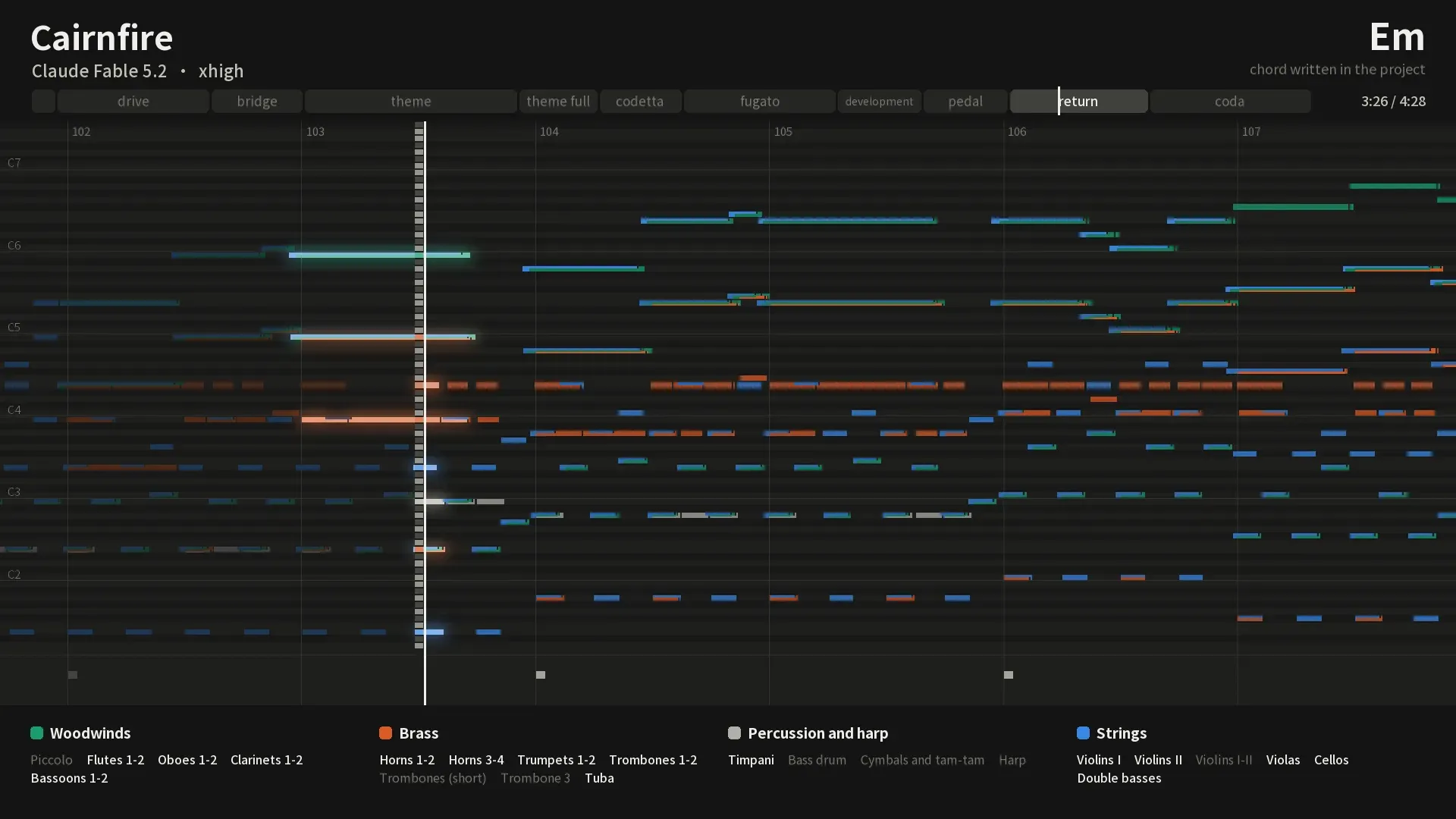
The orchestral banks cover strings by section, brass, woodwinds, harp, timpani and percussion. The example overture Cairnfire uses 36 parts, and the README lists its render time from scratch on a 24-thread laptop at 108 seconds. Orchestral and organ projects can skip the compressors, and with mix rules version 2 a project can set how near the orchestra is heard through the mix.c80_db clarity value (orchestration guide).
Electronic music, beats and chiptune
Electronic parts use the built-in synthesizers and drum machines or Surge XT presets, and the mix can add sidechain ducking, tempo-synced delays, filter sweeps and a loud club master. Examples in the repository include city pop, a lo-fi hip-hop loop and an 8-bit chiptune; studio.py sounds filters patches by measured brightness and attack.
Revising one note and hearing the difference
The before-and-after example raises one flute note in an eight-bar piece and renders both versions. Only the flute is synthesized again; the other parts come from the cache, and compare shows every file the change reached, including the bus, the reverb tail and the master. Requests such as simplifying a busy melody in bar 33 follow the same revision round.
Exporting MIDI and stems
Every render includes the MIDI and one stem per part alongside the MP3 and WAV, and a user can ask the agent to send them. Similar entries on iThub include the agent skills Taste Skill and video-shotcraft, and the desktop audio applications LMMS and Audacity.
Install
npx skills add owoevan-dev/music-skillReviews of Music Skill
Be the first to share your experience with Music Skill.
Write a review
Loading review form…
Found Music Skill useful? Upvote it todayYour vote helps other IT teams find it in the daily ranking.