On this page
- Where does the theory of constraints come from?
- What is the core idea behind the theory of constraints?
- What are the five focusing steps?
- How does drum-buffer-rope work?
- What do throughput, inventory and operating expense mean?
- What are the TOC thinking processes?
- How does the theory of constraints apply to software development and DevOps?
- How do you find the constraint in a software delivery system?
- What are common constraints in software teams?
- How would the five focusing steps fix a slow release pipeline?
- What mistakes do teams make with the theory of constraints?
- Sources
The theory of constraints (TOC) is a management approach which holds that the output of any system is limited by at least one constraint: the step, resource or rule with the least capacity relative to the demand placed on it. Improve that constraint and the whole system delivers more; improve anything else and very little changes (TOC Institute).
The idea began on factory floors, yet it fits software delivery uncomfortably well. A release pipeline is a chain of stages from code to production, and one of those stages decides how fast changes reach users. This guide explains the theory, then shows how IT, DevOps and software teams use it to find the stage that holds them back.
Where does the theory of constraints come from?
Eliyahu M. Goldratt, an Israeli physicist turned management thinker, introduced the theory in The Goal, a business novel he wrote with Jeff Cox and published in 1984. It follows Alex Rogo, a plant manager with three months to rescue a factory that loses money even though its machines and people are always busy.
One scene carries most of the theory. On a scout hike, Rogo notices that the line of boys keeps stretching out and that the group can only move as fast as Herbie, the slowest walker. Pushing the fast kids harder does nothing for the group's arrival time. Putting Herbie at the front, lightening his pack and stopping the others from running ahead does.
Goldratt extended the method in later books: The Race described a scheduling system called drum-buffer-rope, It's Not Luck presented the Thinking Processes, and Critical Chain applied the same logic to project management.
What is the core idea behind the theory of constraints?
Every system that produces something has at least one constraint that limits how much the system as a whole can produce. A chain is only as strong as its weakest link, and a pipeline only flows as fast as its slowest stage. Several consequences follow, and most of them run against everyday management habits:
- Time lost at the constraint is lost for the whole system. An hour of idle time at the bottleneck cannot be made up anywhere else.
- Time saved elsewhere is mostly an illusion. Speeding up a step that is not the constraint only produces more work that waits in front of the constraint.
- Busy is not the same as productive. When every station runs flat out, output stays the same and the pile grows.
- The constraint is not always a machine or a person. It can be a policy, such as a rule that all changes ship once a week, or the market, when the system can produce more than customers will buy. In IT, a weekly change approval meeting limits delivery just as surely as a slow test suite.
What are the five focusing steps?
Goldratt turned the idea into a repeatable procedure, the five focusing steps, also known as the process of ongoing improvement (TOC Institute). They are meant to be run in order, again and again.
- Identify the constraint. Find the step that limits the throughput of the whole system. In practice it is usually the place where work waits the longest.
- Exploit the constraint. Get the most out of it with what you already have. Remove anything that wastes the constraint's time: rework, interruptions, waiting for inputs, tasks someone else could do.
- Subordinate everything else to the constraint. Set the pace of every other step by what the constraint can absorb. Release work at that rate, keep the constraint supplied with good inputs and accept that other steps will sometimes be idle.
- Elevate the constraint. Only now add capacity: more people, new tooling or a redesign of the process. This step costs money, which is why it comes fourth.
- Repeat, and do not let inertia become the constraint. Once the constraint is broken, another step becomes the limit. Go back to step one, and drop the rules and habits that were created to protect the old constraint.
The TOC Institute warns that organizations tend to jump straight to step four. In software, that means paying for a bigger CI plan or hiring another tester before checking how much existing capacity goes to waste.
How does drum-buffer-rope work?
Drum-buffer-rope (DBR) is the scheduling method Goldratt derived from the five focusing steps and described in The Race. It has three parts:
- The drum Is the constraint. Its pace sets the beat for the whole system.
- The buffer Is a small, deliberate stock of work placed in front of the constraint, so that it never sits idle because an upstream step had a bad day.
- The rope Ties the release of new work at the start of the line to the drum's pace. Work enters the system only as fast as the constraint can finish it.
Mapped onto the hike from The Goal, Herbie would be the drum, a little slack in front of him the buffer, and whatever stops the faster boys from racing ahead the rope. A software team that limits work in progress and keeps a short queue of ready work in front of its slowest stage is running DBR, whether or not it uses the name.
What do throughput, inventory and operating expense mean?
Goldratt also proposed three measures to replace cost accounting figures that, in his view, rewarded local efficiency. As The Goal defines them:
- Throughput Is the rate at which the system generates money through sales. Later TOC writing refines this to sales minus truly variable costs.
- Inventory Is all the money the system has invested in things it intends to sell. Later texts often call it investment.
- Operating expense Is the money the system spends turning inventory into throughput.
In software, partially finished work behaves like inventory. Unbuilt specifications, long-lived branches and finished but unreleased features all cost money and earn nothing until they reach users. David J. Anderson's book Agile Management for Software Engineering, subtitled Applying the Theory of Constraints for Business Results, works through this throughput accounting view for software teams (InformIT). Anderson later became one of the best-known figures behind the Kanban Method.
What are the TOC thinking processes?
When the constraint is a policy or a conflict rather than a physical step, the Thinking Processes help. They are logic diagrams built around three questions: what to change, what to change to, and how to cause the change (TOC Institute).
- A current reality tree traces visible problems, such as missed releases and weekend hotfixes, back through cause and effect to a few core causes.
- An evaporating cloud lays out a conflict, for example "release often to reduce risk" against "release rarely to reduce risk", and exposes the assumptions behind each side.
- A future reality tree checks whether a proposed change removes the undesirable effects without creating new ones.
- Prerequisite and transition trees turn the chosen change into obstacles, intermediate goals and concrete actions.
Few software teams draw these trees formally, but the cloud helps in arguments about release cadence, where both camps want the same outcome.
How does the theory of constraints apply to software development and DevOps?
The bridge from factories to IT departments is a novel too. The Phoenix Project by Gene Kim, Kevin Behr and George Spafford, published by IT Revolution in 2013, follows Bill Palmer, newly put in charge of IT operations at a car parts company, through a failing project and a stream of outages (IT Revolution). His mentor teaches him the theory of constraints and the four types of work: business projects, internal IT projects, changes and unplanned work. Its best-known constraint is Brent, the engineer every project, change and outage seems to need, and much of the plot turns on protecting his time.
The Three Ways that underpin DevOps carry the same thinking (IT Revolution). The First Way, flow and systems thinking, asks teams to optimize the whole value stream rather than any single silo, to avoid passing known defects downstream and to prevent local gains from degrading the system. The Second Way amplifies feedback loops, and the Third Way builds a culture of experimentation and learning.
The vocabulary maps across fairly directly:
| Manufacturing term | Software delivery equivalent |
|---|---|
| Work center | A stage in the delivery pipeline: coding, review, CI, testing, approval, deployment |
| Work in process inventory | Open pull requests, unmerged branches, tickets in progress, unreleased features |
| Throughput | Changes that reach users and deliver value, not story points or commits |
| Constraint | The slowest stage, the most loaded person or a limiting policy |
| Buffer | A short queue of ready work in front of the constraint |
| Rope | Work in progress limits and pull-based intake |
| Setup time | Environment provisioning, context switching, slow build start-up |
Kanban is a common way for software teams to install the rope. The Kanban Guide requires teams to explicitly control the number of work items between start and finish, and to track four flow metrics: WIP, throughput, work item age and cycle time (Kanban Guide). DORA's guidance on WIP limits adds a practical rule: base limits on real capacity, and when people are idle, fix whatever blocks the flow instead of raising the limit (DORA). A board in WeKan or another of the project management tools on iThub is enough to start, as long as every column has a limit.
How do you find the constraint in a software delivery system?
In software, the pile of waiting work hides in pull request lists, ticket columns and release branches, so you have to look for it on purpose.
Look where work waits. The constraint is usually the stage with the longest queue in front of it and the oldest items in that queue. Items that sit untouched for days point straight at it.
Map the value stream. DORA recommends gathering people from every part of delivery, breaking the flow into 5 to 15 process blocks and recording for each one its lead time, its process time and how often the work it receives is complete and accurate (DORA). A block whose lead time is far longer than its process time has a waiting problem. A block that receives a lot of unusable work points to a quality problem upstream. The same page warns that optimizing blocks that are not the bottleneck has little effect on overall lead time, which is the theory of constraints in one sentence.
Read the DORA metrics as system-level signals. DORA's original four keys were deployment frequency, lead time for changes, time to restore service and change failure rate. The 2023 report replaced time to restore with failed deployment recovery time, which only counts failures caused by a change, and the 2024 report added deployment rework rate as a fifth metric (DORA). DORA now groups the five into throughput and instability (DORA):
- Change lead time Time from a commit to that change running in production.
- Deployment frequency How often you deploy, or the time between deployments.
- Failed deployment recovery time Time to recover from a deployment that fails and needs immediate intervention.
- Change fail rate Share of deployments that need immediate intervention.
- Deployment rework rate Share of deployments that are unplanned and happen because of a production incident.
None of these metrics names the constraint; they tell you where to look. Long lead times with infrequent deployments usually mean work is waiting in queues or batching behind a release ritual. A rising change fail rate or rework rate means defects return as unplanned work, which eats into whatever stage is already the constraint. Slow recovery points toward on-call, observability and rollback. Most of the data already lives in your version control, CI and monitoring and observability tools.
What are common constraints in software teams?
Some constraints turn up in team after team:
- Code review queues. Pull requests wait for one or two reviewers who also write code, and large pull requests get postponed until someone has a free afternoon. Opening repositories to contributions from other teams, as in InnerSource, spreads review work but needs trusted committers with time set aside for it.
- CI time. A pipeline that takes most of an hour to go green limits how many changes a team can merge in a day and encourages batching. Check caching, parallel jobs and test selection in your CI/CD tooling before paying for more runners.
- Flaky tests. A test that fails at random burns CI capacity on reruns and teaches people to ignore red builds. Automatic retries hide the problem rather than fix it. Lint rules such as landmines flag retries, fixed sleeps and raised timeouts in test code, so masking becomes visible in review.
- Manual QA. One tester or a small QA team running a regression pass before each release is a classic physical constraint.
- Change approval boards. A weekly approval meeting caps deployment frequency at the meeting cadence and pushes teams toward large, riskier batches.
- A single senior engineer. The person who understands the legacy billing system or holds production access becomes the team's Brent, and every task that needs them waits.
- On-call and unplanned work. When the same people carry the pager and the roadmap, interruptions decide throughput. Sensible alert routing and escalation, of the kind covered in our Better Stack overview, protect the constraint's time.
Catalogs of testing and QA tools help once you know which of these is yours. Picking a tool first and looking for the constraint afterwards is the order TOC warns against.
How would the five focusing steps fix a slow release pipeline?
The team below is hypothetical. It exists to show the reasoning, not to report measured results.
Eight developers ship a web application once a week. Every change goes through code review, a CI pipeline, a manual regression pass by the team's only QA engineer and then deployment. Developers blame slow CI, and managers want more frequent releases.
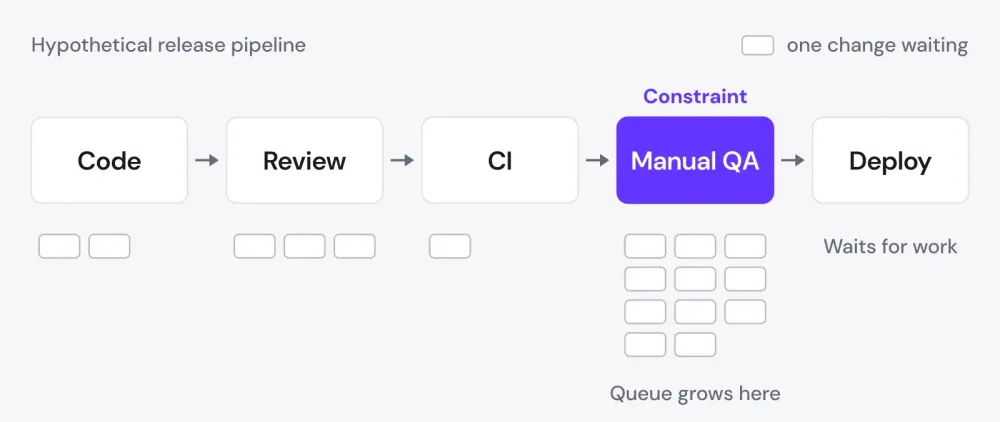
The team counts what is waiting at each stage for two weeks. Review and CI hold a few items each. The "ready for QA" column holds far more, with the oldest items on the board. The constraint is manual QA, not CI.
| Step | Action in this pipeline | What to watch |
|---|---|---|
| Identify | Count waiting items and their age at each stage. Manual QA has the longest and oldest queue. | Work item age in "ready for QA" |
| Exploit | Stop sending builds that fail CI to QA. Move release notes and test environment setup to developers. Give the QA engineer uninterrupted testing time. | Share of QA time spent actually testing |
| Subordinate | Put a WIP limit on "ready for QA". When it is full, developers stop starting features and instead pair with QA, write automated checks or fix flaky tests. | Queue size stays within the limit |
| Elevate | Automate the most repeated regression checks, let developers test their own changes exploratively, and only then consider a second tester. | Change lead time and deployment frequency |
| Repeat | When the QA queue stays short, measure again. The weekly release slot or CI duration may now be the limit. | Where the longest queue moves |
The exploit step is mostly about quality in front of the constraint: every broken build that reaches QA wastes the scarcest time in the system. The subordinate step is the uncomfortable one, because it asks developers not to start work they could start; skip it and the queue in front of QA simply grows faster. The elevate step then changes the system enough that the constraint will probably move. Once regression checks run in CI, CI duration and flaky tests matter far more than before. If the team moves to more frequent releases, a software launch checklist covers what has to be ready beyond the pipeline.
What mistakes do teams make with the theory of constraints?
Optimizing locally. Making developers code faster while QA is the constraint only enlarges the queue in front of QA. Judge every improvement by its effect on the whole pipeline, not on one stage.
Measuring utilization instead of flow. A team in which everyone is fully booked usually has long queues and slow delivery. Only the constraint needs to be busy all the time. Track lead time, throughput and work item age rather than hours logged.
Elevating first. Hiring, buying tools or adding CI runners before exploiting and subordinating often buys capacity the system cannot use, because the real limit sits somewhere else.
Losing track of a moving constraint. A team that keeps tuning test automation long after the approval process became the limit has fallen into the inertia the fifth step warns about.
Treating the constraint as a person to blame. When one engineer is the constraint, the problem is how work gets routed to them, not their performance. Protect their time and move routine work and knowledge elsewhere.
Sources
- Theory of Constraints of Eliyahu M. Goldratt, Theory of Constraints Institutetocinstitute.org
- Five Focusing Steps, a Process of On-Going Improvement, Theory of Constraints Institutetocinstitute.org
- Agile Management for Software Engineering: Applying the Theory of Constraints for Business Results, David J. Anderson, Prentice Hallinformit.com
- The Phoenix Project: A Novel About IT and DevOps, Gene Kim, Kevin Behr and George Spafford, IT Revolutionitrevolution.com
- The Three Ways: The Principles Underpinning DevOps, Gene Kim, IT Revolutionitrevolution.com
- The Kanban Guide, Kanban Guideskanbanguides.org
- DORA's software delivery performance metrics, DORAdora.dev
- A history of DORA's software delivery metrics, DORAdora.dev
- Capabilities: Work in process limits, DORAdora.dev
- Capabilities: Visibility of work in the value stream, DORAdora.dev
Frequently asked questions
Is the theory of constraints the same as lean?
No, although the two work well together. Lean grew out of the Toyota Production System and looks for waste across the whole value stream. The theory of constraints concentrates improvement on the one step that limits output and treats gains elsewhere as low priority. Many teams use lean's value stream mapping to find the constraint and the five focusing steps to decide what to do about it.
Can a system have more than one constraint at the same time?
TOC says every system has at least one. In practice one constraint usually dominates at a given moment, with others close behind. If two stages look equally limiting, start with the one whose queue holds the oldest work, and expect the other to take over once the first is relieved.
What is critical chain project management?
It is Goldratt's application of the theory of constraints to projects, described in his book Critical Chain. Task estimates are cut to realistic durations without hidden padding, the safety time is pooled into a shared project buffer at the end, and the plan accounts for people who are needed on several tasks at once. Progress is tracked by how fast the buffer is being consumed.
How often should a team look for its constraint again?
After every change that adds capacity at the constraint, and whenever flow metrics such as lead time or work item age shift noticeably. A full value stream mapping exercise does not need to happen that often; DORA suggests repeating it on a regular schedule, for example every six months.
Does the theory of constraints work for small teams and solo maintainers?
Yes. In a very small team the constraint is often one person's attention: review time, issue triage or the context switching between support and development. The same steps apply. Protect that time, stop accepting new work faster than it can be finished, and automate or delegate what does not need that person.
Should DORA metrics be used as targets for teams?
They work better as signals for finding the constraint and checking whether a change helped. When a metric becomes a target, teams can move the number without improving delivery, for example by splitting one release into several deployments. Compare a team with its own history rather than ranking teams against each other.
Do I need to read The Goal to use the theory of constraints?
No, but it is the quickest way to absorb the thinking, because the novel shows the mistakes before it shows the fixes. The Phoenix Project tells a similar story in an IT department and is the more direct read for DevOps and operations teams.
Tools in this article

Facts link to their official sources. Product details can change after publication: report an error or read the editorial methodology.

Written by
Emanuel DE ALMEIDA
Geneva-based entrepreneur, IT consultant and creator of SuniPDF and SuniCapture. Emanuel shares practical IT, cybersecurity and software insights on iThub.