
What is Claude Forge?
Claude Forge is an MIT-licensed bundle of agents, slash commands, skills, hooks, rules and MCP server settings for Claude Code, Anthropic's terminal coding assistant. It is maintained by Sangrok Jung, credited in the README to QJC (Quantum Jump Club), and hosted at sangrokjung/claude-forge on GitHub. The project describes itself as oh-my-zsh for Claude Code: one installation adds a prepared set of specialist subagents, workflow commands and background checks to the ~/.claude directory that Claude Code reads. The repository was created in February 2026 and v1.0.0 was released on February 24, 2026.
On the main branch (last commit September 3, 2026) the repository contains 16 agent definitions, 35 command files, 33 skill folders, 22 hook scripts plus 9 opt-in .example hooks, 14 rule files and a default MCP configuration with four servers. These match the counts in the README and the plugin manifest. The GitHub repository description still cites 32 skills and 21 safety hooks, the totals from v4.0, and the onboarding site, an interactive setup walkthrough in 13 languages, shows the same earlier figures.
The release marked Latest on GitHub is v4.1.0 of August 25, 2026, which added the harness-diet skill for measuring and reducing always-loaded context. Version 4.0.0 of August 19, 2026 introduced the adversarial verification loop, in which a second agent that did not write a change and never sees the first agent's reasoning has to approve it, together with a reliability pack, a debugging escalation chain, task-grade routing and Korean prose guardrails. The README and plugin.json on main declare version 4.3.0: 4.2.0 added a session-time-report hook and 4.3.0 lets it read Codex rollout logs, but neither version has a Git tag or a GitHub release. Upgrade notes are in MIGRATION.md.
There are two installation paths. The Claude Code plugin marketplace route adds the commands and part of the skills. The full install runs install.sh on macOS, Linux and WSL or install.ps1 on Windows; it links or copies the bundle's folders into ~/.claude and replaces the user's ~/.claude/settings.json with the project's own file, so it changes the existing Claude Code configuration, including permissions and hooks. According to INSTALL.md there is no uninstall command yet. The full install requires Claude Code 2.1.110 or later plus node, jq and git.
Claude Forge is a set of Markdown, JSON and shell files rather than a separate application or service; model usage goes through the user's own Claude Code setup. Several agents and skills target specific stacks, such as TypeScript builds, PostgreSQL and Supabase reviews and Playwright tests, and three skills deal with Korean text. The README states that the v4.0 reliability hooks were built and verified on macOS only. Other Claude Code extensions on iThub include Superpowers, Waza and Ponytail.
Key capabilities
- Sixteen agent definitions The
agents/folder holds planner, architect, code-reviewer, security-reviewer, tdd-guide and database-reviewer, which the README assigns to the most capable model, plus build-error-resolver, e2e-runner, refactor-cleaner, doc-updater and verify-agent on a faster model. Version 4.0 added adversarial-reviewer, skeptical-auditor, systematic-debugger, rca-debugger and escalation-fixer. The frontmatter follows a v2 schema documented inreference/agent-schema.json. - Adversarial verification loop The
adversarial-revieweragent runs in a fresh context with read-only tools (Read, Grep, Glob, Bash) and returns exactly one verdict: APPROVE, REQUEST_CHANGES or UNVERIFIED. The bundled rule treats a behavioural change as done only after APPROVE for the current revision; any later edit voids it, and changes touching authentication, payments, secrets or destructive data need two separate checker lanes. A worked example is in VERIFICATION-LOOP.md. - Thirty-five slash commands Commands cover the core workflow (
/plan,/tdd,/code-review,/handoff-verify,/commit-push-pr,/auto), exploration, testing, documentation sync, project setup, Git worktrees and maintenance such as/forge-updateand/show-setup./guidestarts an interactive tour for first-time users. - Thirty-three skills Skills include
review-loop,loop-forgefor turning a repetitive task into a guarded slash command,harness-diet,relayfor handing a session across/compact,security-pipeline,team-orchestratorandsession-wrap. Eight former commands moved toskills/in v3.0, andinstall.sh --upgradecreates compatibility links for them, which the README says are kept until April 1, 2027. - Security hooks
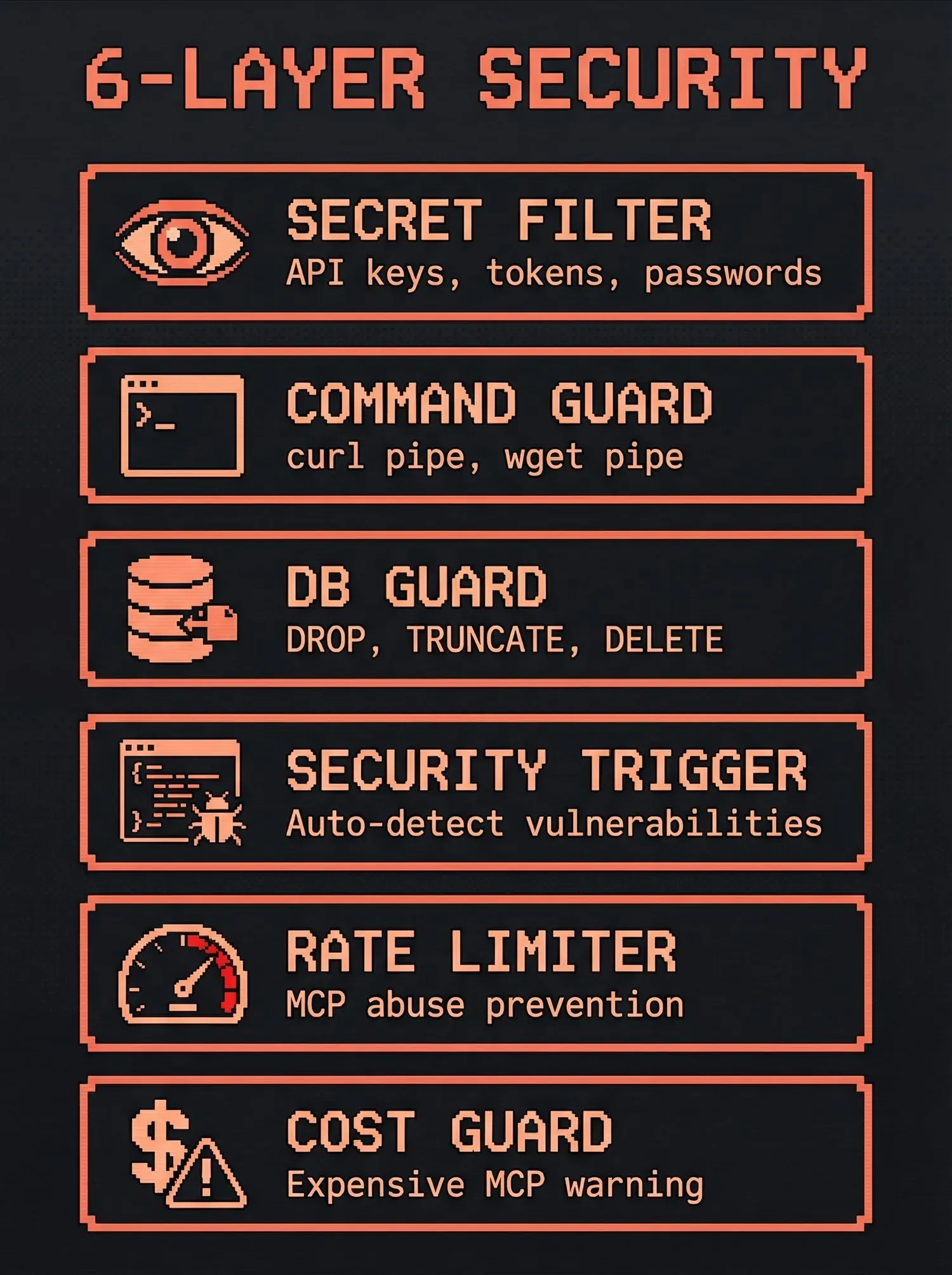
output-secret-filter.shchecks tool output for API keys, tokens and passwords,remote-command-guard.shblocks curl and wget pipes, anddb-guard.shtargets DROP, TRUNCATE and DELETE without WHERE.security-auto-trigger.shreacts to file edits andrate-limiter.shlimits MCP calls; the README figure shows these, with a cost guard for expensive MCP calls, as six security layers. - Reliability hooks Added in v4.0,
api-error-auto-resume.shschedules an unattended resume after a retryable API error,loop-detection.shreacts to repeated edits of the same file andauto-verify-fix.shruns a quick check after edits to TypeScript, JavaScript or Python files. A snapshot and restore pair carries the relay pointer across context compaction. The wiring is described in RELIABILITY.md. - End-of-session time report On main,
session-time-report.shrecords each session at SessionEnd and prints the end time, duration and prompt, tool and file-change counts at the next SessionStart. It reads only the transcript withpython3, appends to~/.claude/work-log/session-times.jsonlwith mode 600, can be turned off withFORGE_SESSION_TIME_REPORT=0, and also parses Codex rollout logs, although Codex wiring is added by hand. - Utility hooks and opt-in examples Further hooks suggest documentation sync and session wrap-up, check for a newer Claude Forge release at session start, remind about code quality after edits, warn about costly MCP calls and log work to
~/.claude/work-log. Nine.examplefiles cover events such as SubagentStart, TaskCreated and WorktreeCreate and are activated by renaming them and registering them in settings. - Fourteen rule files The
rules/folder defines coding style, security, testing, Git workflow, verification, adversarial review, task-grade routing, API error recovery and Korean writing quality, among others. Rules are read at the start of every session, and theharness-dietskill measures how much always-loaded context they andCLAUDE.mdoccupy. - Default MCP servers
mcp-servers.jsonlists Playwright, Context7, Jina Reader and Chrome DevTools, each started throughnpxwith a pinned version such aschrome-devtools-mcp@0.23.0. Memory, Exa, GitHub, fetch and other servers moved tomcp-servers.optional.jsonin v3.0. - Bundled settings.json The shipped settings allow tools such as
Bash(*),Read(*),Write(*)andEdit(*), and list 56 deny patterns, among them WebFetch, recursive deletes,sudo, force pushes to main or master and piped remote scripts. They also enable the experimental agent teams variable, set a status line command and register the hooks. Asettings.local.jsontemplate holds personal overrides. - Status line The installer initializes the
cc-chipsGit submodule and copies a customengine.shand theme files over it. The status line shows model detection, the session ID and cache statistics. - Full install on macOS, Linux and WSL
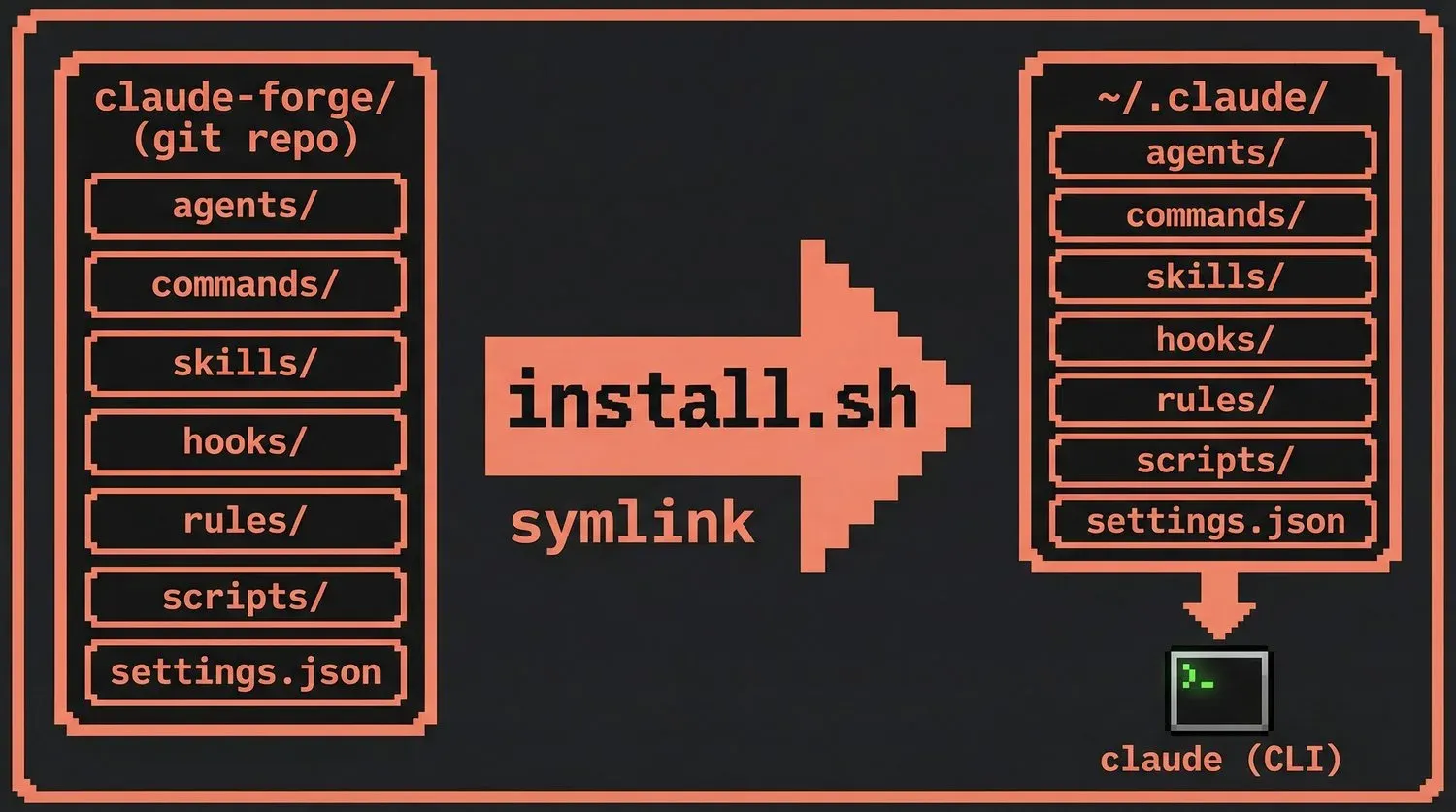
install.shchecks fornode,jqandgit, offers to move an existing~/.claudeto~/.claude.backup.<timestamp>, then replaces ten folders such asagents,hooksandskillsplussettings.jsonin~/.claudewith symlinks to the clone. It writes.forge-meta.jsonand appends the aliasesccandccrto~/.zshrcor~/.bashrc.--dry-runpreviews the changes and--upgradekeeps the existing directory. - Windows install
install.ps1must run in PowerShell as Administrator and copies the files, includingsettings.json, instead of linking them. Updates on Windows therefore require running the script again aftergit pull. - Plugin marketplace install
/plugin marketplace add sangrokjung/claude-forgefollowed by/plugin install claude-forgeadds the commands and most skills without agents, hooks, rules or MCP servers, as listed in PLUGIN-VS-INSTALL-SH.md. Version 4.0.0 fixed a hook load error that had made the plugin fail to load. - Optional extras in the installer After linking,
install.shasks before installing MCP servers, before adding external skills (Superpowers, Humanizer, UI/UX Pro Max and Find Skills throughnpx skills add -g) and before installing the Work Tracker, which logs Claude Code usage locally. - Updates and removal Symlinked installs update with
git pull, and/forge-updatepulls the latest version. INSTALL.md states that there is no--uninstallflag: the links in~/.claudeare removed by hand, and the backup folder exists only after a fresh interactive install, not after--upgradeor a pipedcurl | bashrun. An uninstall script is proposed in an open pull request.
Where Claude Forge fits
Feature work from plan to pull request
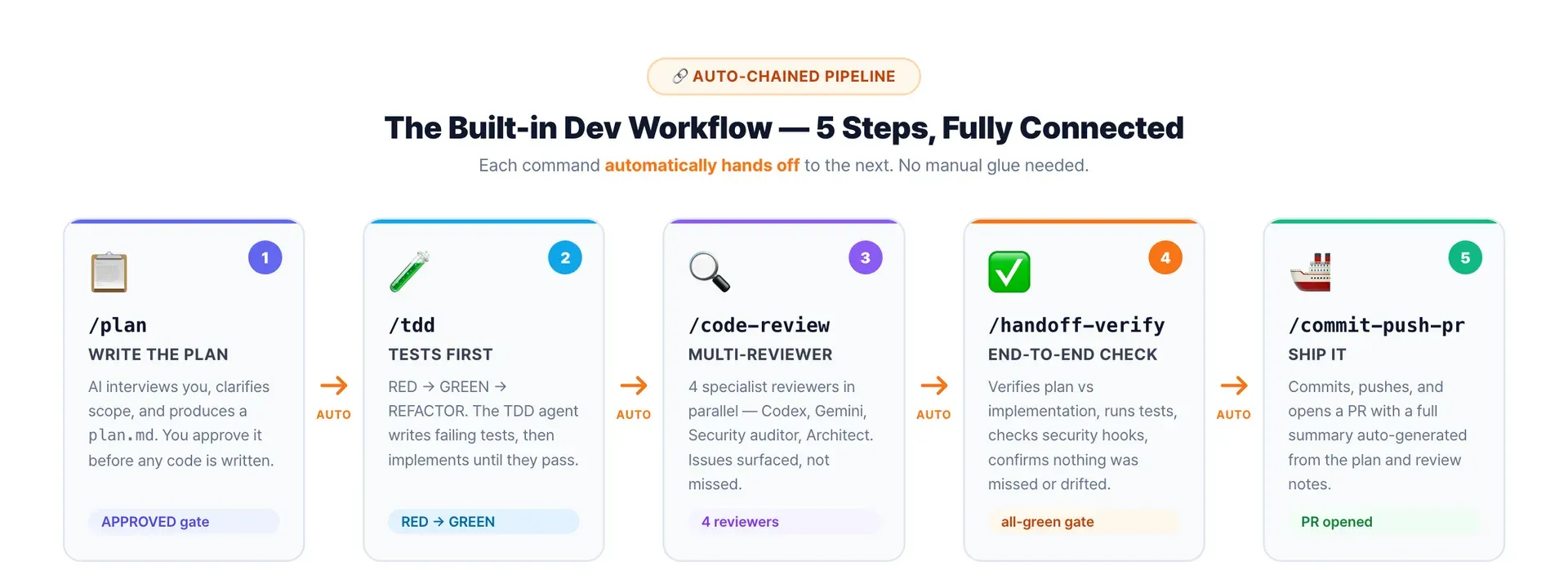
The README's main pipeline is /plan, /tdd, /code-review, /handoff-verify and /commit-push-pr. The plan step waits for approval before code is written, the TDD step writes failing tests first, the verify step runs build, tests and lint in a fresh session, and the last step commits, pushes and opens a pull request. /auto runs the same chain from a short description, for example /auto login page.
Independent review of behavioural changes
The review-loop skill dispatches adversarial-reviewer against the goal, the diff and the execution evidence. REQUEST_CHANGES leads to fixes and a new reviewer instance rather than the same one, UNVERIFIED is retried with another checker, and only APPROVE for the current revision ends the loop. skeptical-auditor separately re-runs steps that another agent reported as passing and compares the real exit codes.
Bug fixing and debugging escalation
For bugs the README lists /explore, /tdd, /verify-loop, /quick-commit and /sync, where /verify-loop retries build, lint and tests up to three times with automatic fixes. Harder failures move from systematic-debugger to rca-debugger and then to escalation-fixer, each step taking over only when the previous one could not close the case.
Security reviews
The documented security sequence is /security-review, which applies CWE Top 25 and STRIDE threat modelling, followed by the stride-analysis-patterns and security-compliance skills for SOC 2, ISO 27001, GDPR and HIPAA checks. In the background, the security hooks filter secrets from output and block piped remote scripts and destructive SQL during the session.
Parallel agent teams
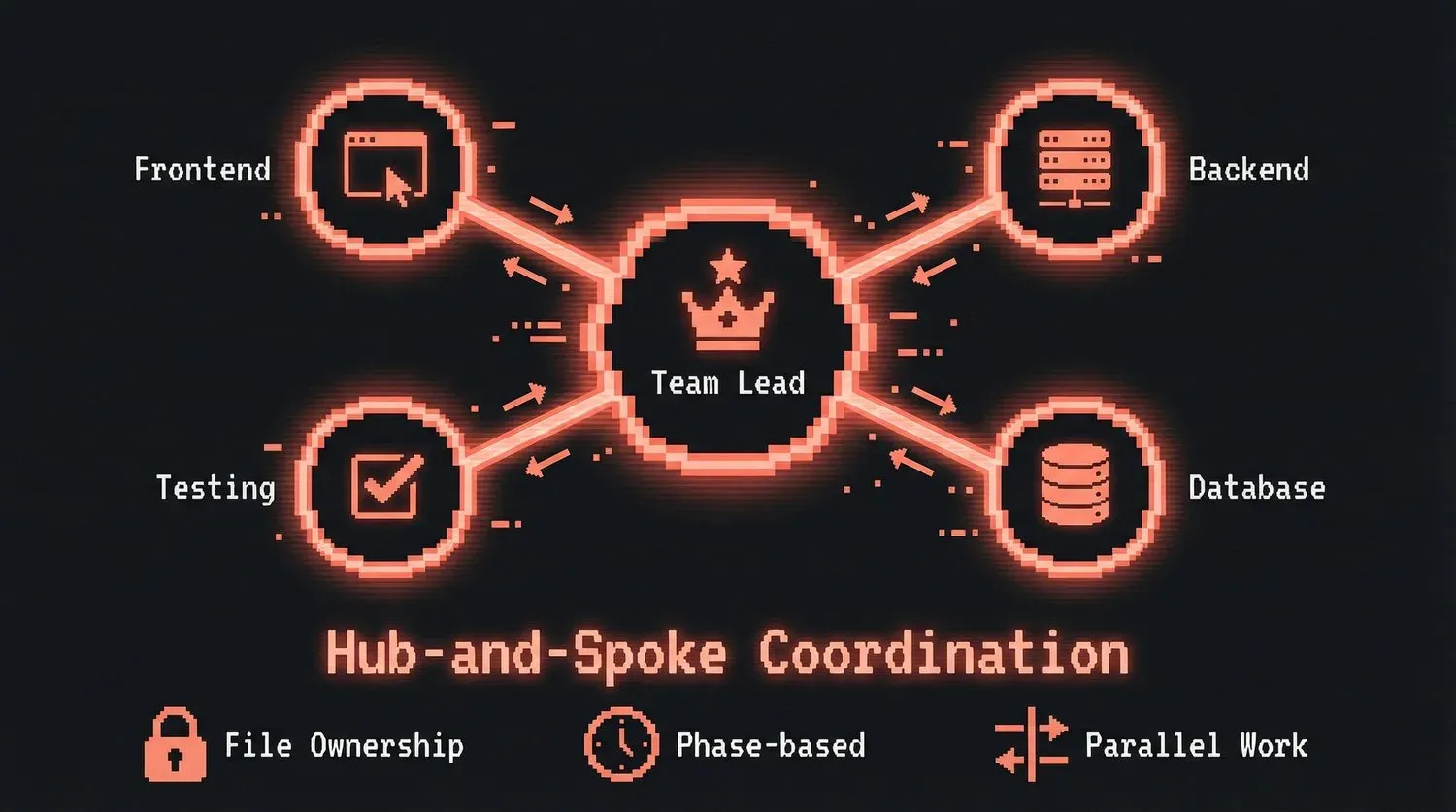
/orchestrate and the team-orchestrator skill split work across Claude Code agent teams in a hub-and-spoke layout with file ownership and phases, using the experimental agent teams setting enabled in the bundled settings.json. /worktree-start and /worktree-cleanup create and remove Git worktrees for parallel branches, and /commit-push-pr closes the work.
Long and unattended sessions
The reliability pack targets sessions that run for hours: the relay skill writes a baton file before /compact and the hooks restore it afterwards, the auto-resume hook restarts a session after a retryable API error under fixed limits, and the loop detector nudges a rethink after repeated edits of one file. The session time report then summarises duration and activity at the next start. Recurring chores can be turned into reusable commands with loop-forge and skill-factory.
Install
git clone --recurse-submodules https://github.com/sangrokjung/claude-forge.git && cd claude-forge && ./install.shReviews of Claude Forge
Be the first to share your experience with Claude Forge.
Write a review
Loading review form…
Found Claude Forge useful? Upvote it todayYour vote helps other IT teams find it in the daily ranking.