

What is Meteroid?
Meteroid is a billing platform for subscription, usage-based and hybrid pricing, developed by the Meteroid team and published in the meteroid-oss/meteroid repository. It ingests usage events, turns them into billable metrics, prices them with versioned plans, and runs the cycle from quote to subscription, invoice, payment and credit note. The README describes it as a cloud-native pricing and billing platform for SaaS, infrastructure and AI companies. The company states on its about page that the founding team started from billing limitations met at a streaming data platform, that it works fully remote, and that the project received French State funding through the France 2030 program.
Meteroid ships in two editions built from the same code and database schema, described on the Editions page. The open-source edition in this repository is licensed under AGPL-3.0 and covers plans, subscriptions, usage metering, prepaid credit in money with portal top-ups, quotes, invoices with e-invoicing, payment reminders, payments, the customer portal and checkout. It runs one organization with one Production tenant and one invoicing entity per tenant. The Enterprise edition adds proprietary modules under the Meteroid Enterprise License: it is free for companies that, with the companies they control or are controlled by, have fewer than 50 employees and less than EUR 2M in annual revenue, and a commercial license is required above those thresholds. Both editions receive every bug fix and security patch, and switching between them only means changing the container images.
Deployment options are Meteroid Cloud, the managed service run by the Meteroid team and hosted in the EU, or self-hosting with Docker Compose on one machine or the Helm chart on Kubernetes. The default images on ghcr.io (meteroid-api, meteroid-worker, metering-api, meteroid-web) run the Enterprise edition; the open-source images are published as meteroid-oss-api, meteroid-oss-worker, meteroid-oss-metering and meteroid-oss-web for amd64 and arm64, and the Dockerfiles in the repository can build them. The README notes that the public repository receives code exported from the repository Meteroid is developed in, one commit per change, and that approved pull requests are replayed upstream.
The current release is v2.2.1, published November 6, 2026, which keeps seats on slot repricing, stops one-time fees from being billed again on a first-period close, and simplifies payment reminders to one switch in the open-source edition. v2.2.0 moved payment reminders, e-invoicing and money top-ups in the portal into the open-source edition, added SSRF protection on outgoing requests and API rate limiting, started publishing the open-source images, and scoped several lookups to the tenant. v2.1.0 published the Enterprise license in the repository and enforced OAuth scopes on Connect tokens. v2.0.0 of November 5, 2026 set a new open-source baseline built from the same codebase as Meteroid Cloud, with credits and wallets, invoices in eight languages, native webhooks replacing Svix, and an officially maintained Helm chart; its migrations cannot be reverted and the upgrade guide covers moving from 0.19 or a 1.0.0 release candidate.
The backend services are written in Rust: an API serving gRPC for the web app and the public REST API, workers for invoicing, payments, emails, webhooks and scheduled jobs, and a metering API that ingests events through Kafka into ClickHouse. The web app uses React and TypeScript. Storage is PostgreSQL 18 with the pgmq extension, ClickHouse, Kafka or a compatible broker such as Redpanda, S3-compatible object storage, and optional Redis and SMTP. Meteroid does not process payments itself: payments run through a connected provider such as Stripe, and entitlement checks return access decisions that the integrating application enforces. Similar billing listings on iThub include Flexprice, and Stripe Billing is part of Stripe.
Meteroid screenshots
Explore the interface. Open a screenshot to view it at full size.
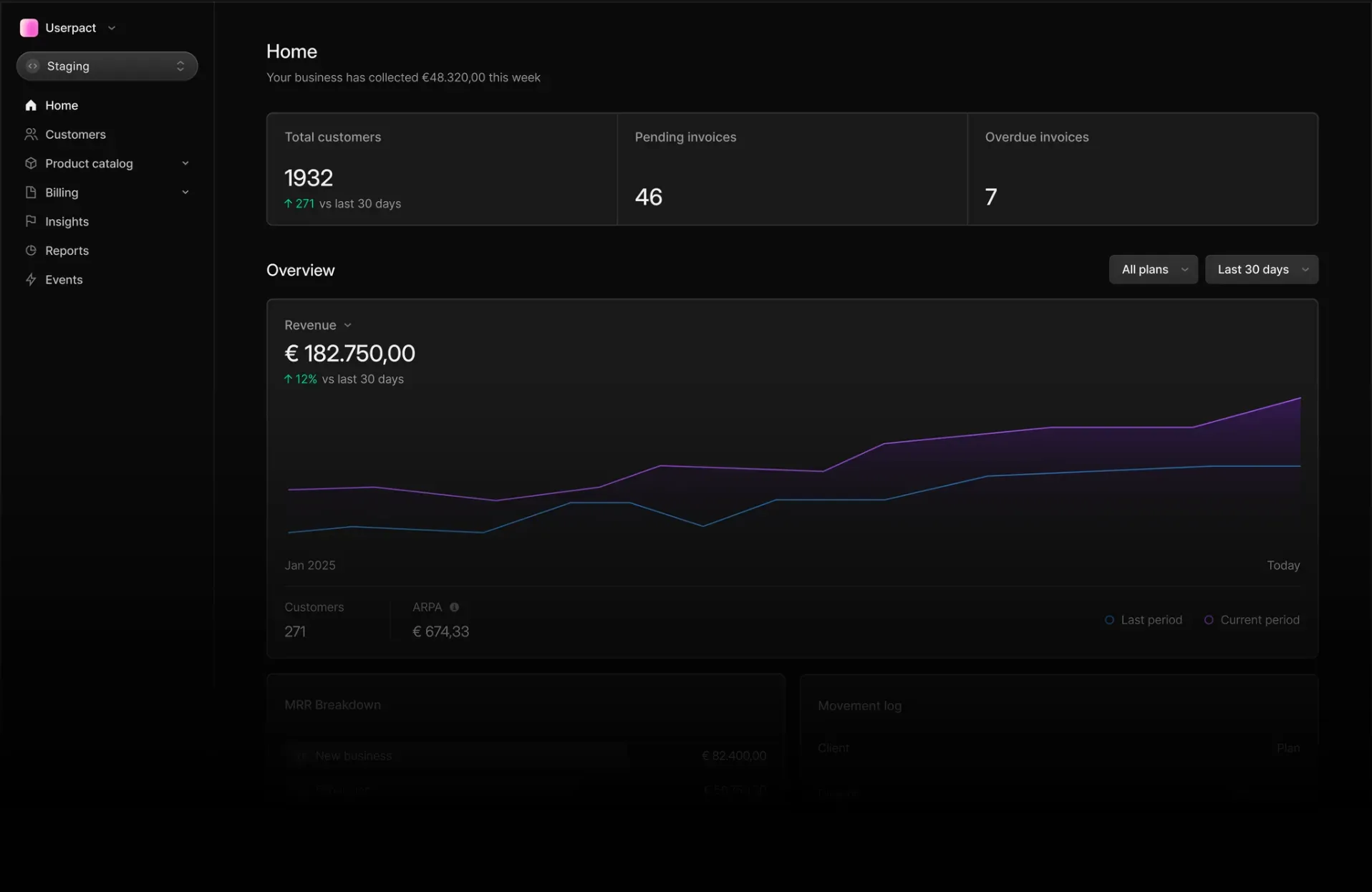
Home dashboard of the Meteroid web app with totals for customers, pending and overdue invoices, and revenue compared with the previous period, using demo data.
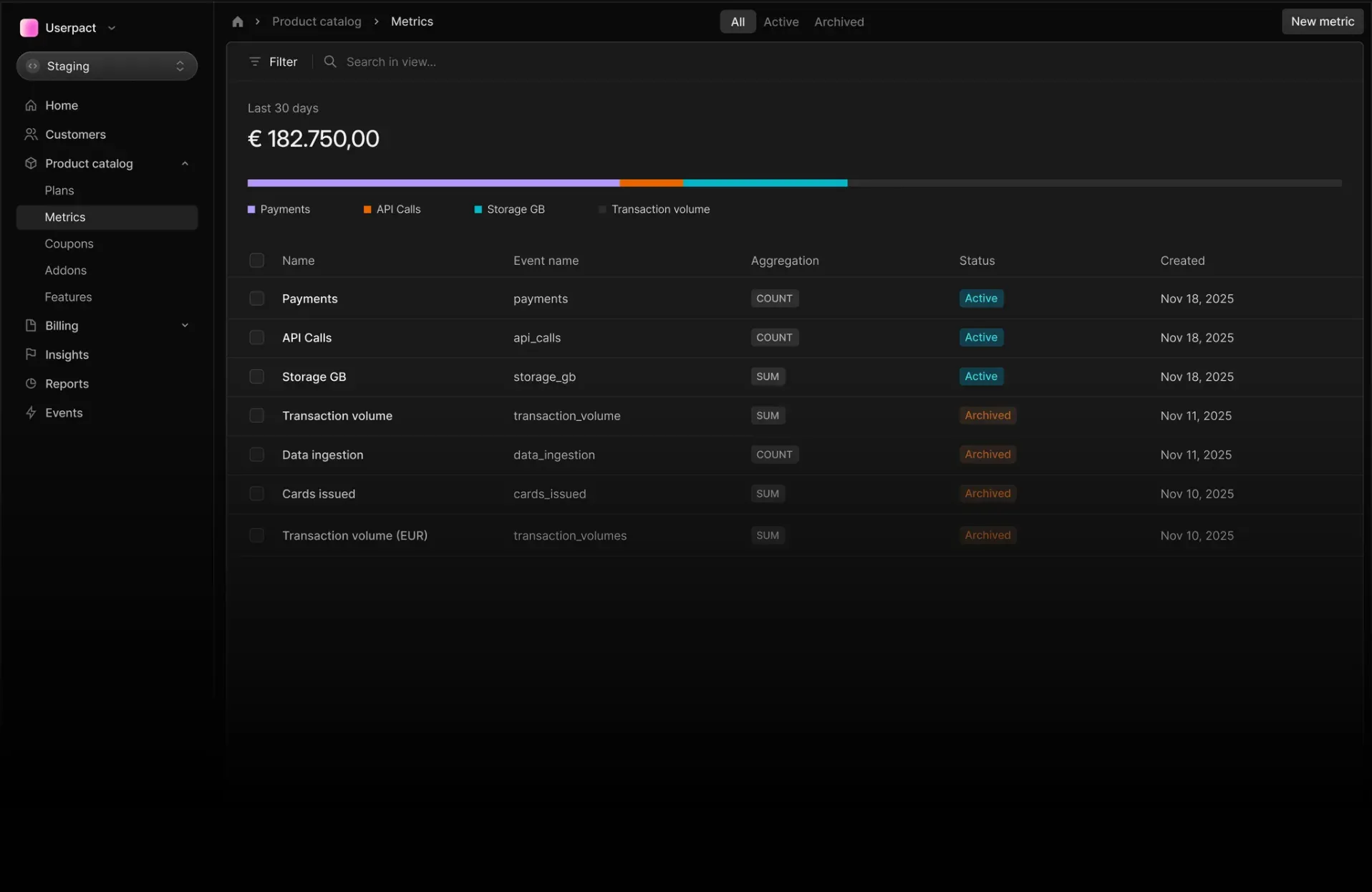
Billable metrics in the product catalog, each tied to an event name and an aggregation type, with a 30-day revenue split by metric.
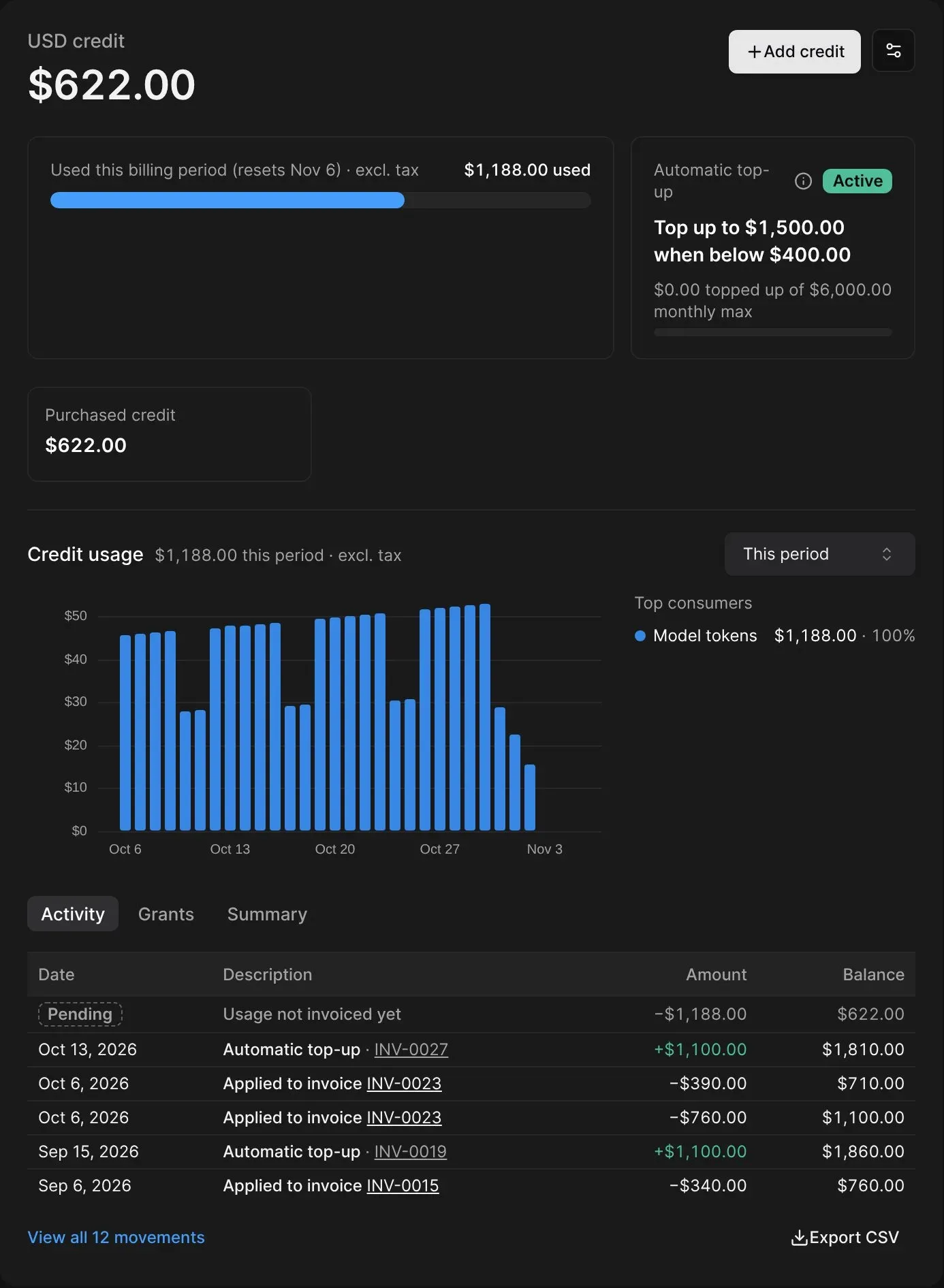
Customer credit tab from the Meteroid docs: wallet balance, usage this billing period, an automatic top-up rule, daily usage and the ledger of top-ups and invoice applications.
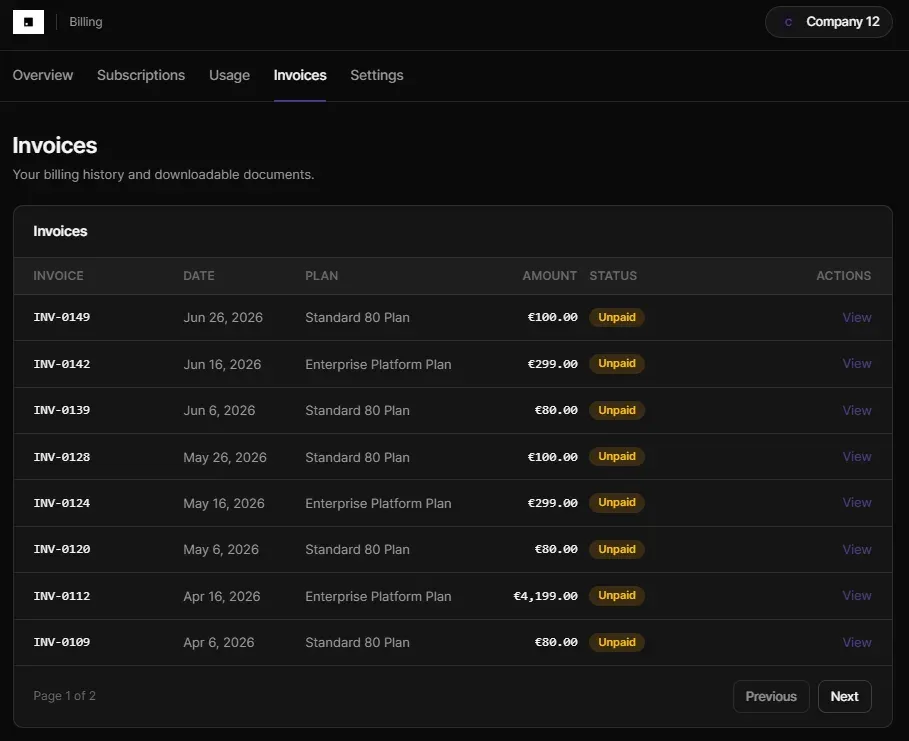
Invoices tab of the customer portal from the Meteroid docs, where an end customer reviews and pays invoices.
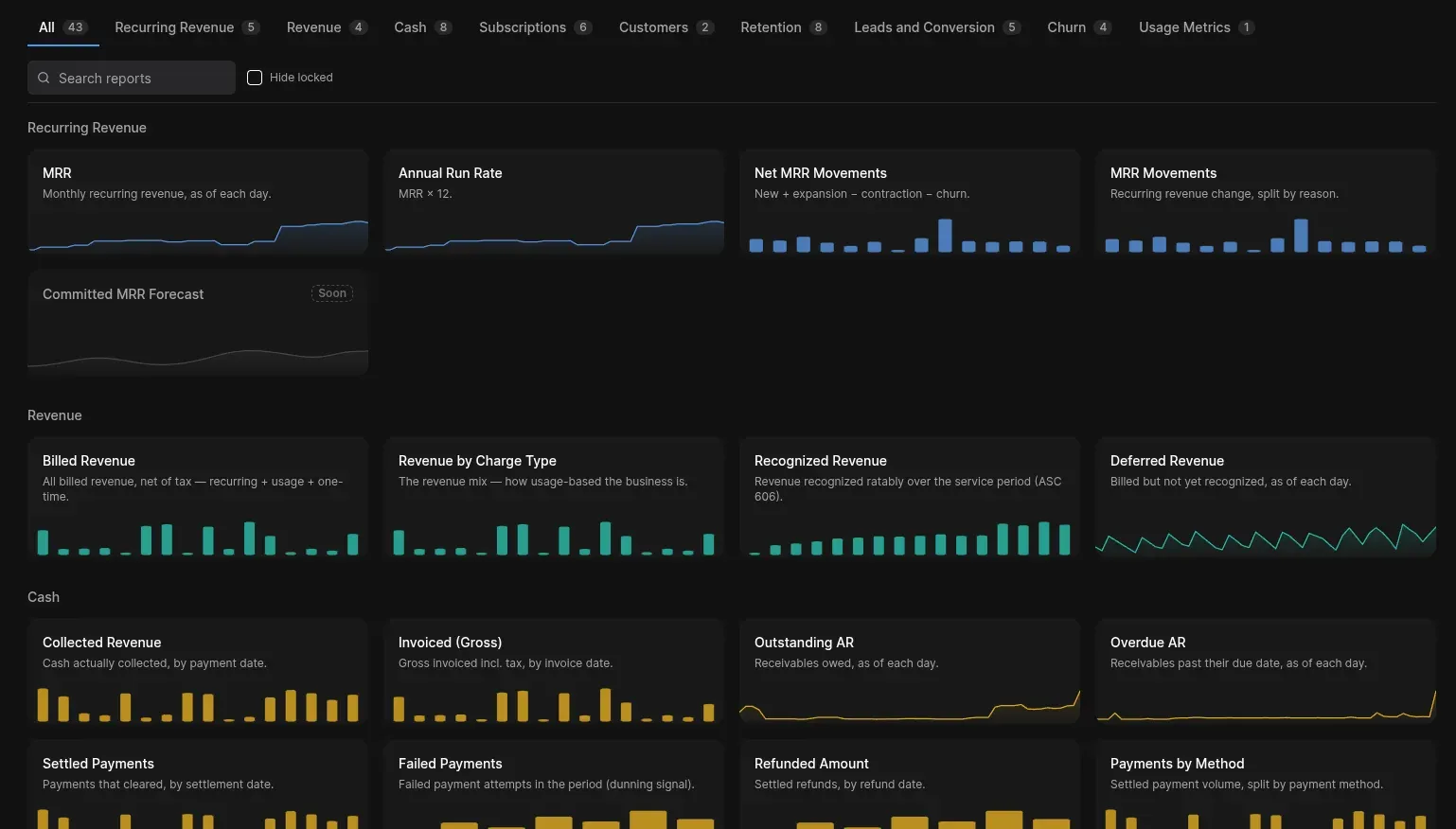
Report catalog of Meteroid Intelligence from the docs, grouped into recurring revenue, revenue and cash metrics; several groups are Enterprise features.
Source: official Meteroid project page.
Key capabilities
- Usage metering Applications send raw events such as API calls, tokens, transactions or storage, and billable metrics aggregate them with Count, Count Distinct, Sum, Mean, Min, Max or Latest. A metric can apply a conversion factor and be segmented on one or two event dimensions for matrix pricing. Events are deduplicated at ingestion, and the docs ask for raw rather than pre-aggregated values because aggregation happens at the end of each billing period.
- Products and pricing models Products hold prices and entitlements and are reused across plans. Documented price components are subscription rate, slot-based, capacity commitment, usage-based, one-time charge and recurring charge, with monthly, quarterly, semiannual or annual cadences; the README lists flat, per-unit, tiered, volume, package, matrix and capacity pricing that can be mixed in one plan. Plans are versioned, so a price change does not alter existing customers unless they are moved.
- Subscriptions A subscription links a customer to a plan, can start now or on a scheduled date, and is invoiced on its own, so a customer with several subscriptions receives several invoices. Trials, coupons, add-ons, mid-cycle upgrades and downgrades with proration, and cancellations that credit prepaid amounts are documented. Adding a slot such as a seat mid-period is prorated and creates a dedicated invoice.
- Quotes and CPQ Sales teams configure a quote, send it for signature, and a signed quote creates the subscription and starts billing automatically. Several signers and purchase orders on quotes are features of the Enterprise edition with a license; the open-source edition no longer includes purchase orders since 2.0.
- Invoicing and credit notes Invoices are generated from plans or created manually, stay editable as drafts and become fixed accounting documents once finalized and sent. Invoices, credit notes and customer emails are available in English, French, German, Spanish, Italian, Dutch, and Brazilian and European Portuguese. Prices can be tax-inclusive or exclusive, and draft invoices are refreshed hourly with late usage until finalized, as described in Managing invoices.
- E-invoicing and reminders Invoices and credit notes can be issued as Factur-X or XRechnung, and the API offers a download of the EN 16931 XML; for Factur-X the same XML is embedded in the PDF. Payment reminders are sent before and after the due date, turned on per invoicing entity in the open-source edition, while reminder sequences per customer group require the Enterprise edition.
- Credits and wallets Each customer has one wallet per currency, made of grants with their own expiry and priority, and every movement is recorded in a ledger that can be exported. Promotional credit is applied before tax like a discount, while paid credit pays the invoice after tax. Credit units such as API credits, credit packs in plans and credit top-ups in those units are free Enterprise features; scoped credit and automatic top-ups need a license.
- Limits, budgets and access checks Three controls decide whether a customer may keep consuming: the plan rule for when credit runs out (invoice the overage, deny access at zero, or invoice overage up to a cap), soft or hard budgets with alert thresholds of 50, 80 and 100 percent by default, and entitlement limits per metered feature. Meteroid never rejects usage events; denial only changes the answer of the access check, which returns LIMIT_REACHED, BUDGET_EXCEEDED or INSUFFICIENT_BALANCE.
- Entitlements Entitlements are global or attached to a product, and can be boolean, metered limits or config entitlements carrying a typed value such as a number, text, JSON object or selection. The docs state that Meteroid exposes entitlement data through APIs and that enforcing access remains the responsibility of the integrating application.
- Payments and checkout Payment providers documented under Integrations are Stripe (cards, SEPA, ACH and Bacs direct debit, Link), GoCardless (SEPA, Bacs and ACH bank debit), Mollie (European cards and SEPA direct debit), Stancer (European card payments) and a test gateway for simulated payments. Connections can be checked, disabled or deleted, and failed payments are retried automatically. A hosted checkout page lets end users subscribe and pay.
- Customer portal Customers manage payment methods, billing details and invoices, pay, top up credit in money and cancel from the portal. Self-service plan, add-on and seat changes and promotion code redemption are free Enterprise features; the open-source portal shows those screens read-only. Embedding the portal in your application and portal theming require a license.
- CRM and accounting connectors The HubSpot integration pushes new customers as company records and subscriptions as deals in one direction and requires HubSpot Sales Hub Enterprise. The Pennylane integration pushes customers and invoices one way and requires the Essential or Premium plan. Both sync only records created after the connection is enabled.
- Revenue analytics Meteroid Intelligence computes metrics from the same subscriptions, invoices, payments and events used for billing, without an external warehouse. MRR and revenue reports are free in the Enterprise edition; advanced analytics, segments, dashboards, customer signals and steering alerts are unlocked by a license. Ranges longer than about three months are charted in weekly buckets.
- REST API and webhooks A public REST API with an API reference covers customers, plans, subscriptions, invoices, credit notes, credit units, coupons, add-ons, checkout sessions and more. Webhook endpoints are signed, retried and logged; a rotated signing secret keeps signing alongside the new one for 24 hours. Since 2.0 webhooks are native instead of going through Svix.
- Docker Compose self-hosting The Compose deployment in docker/deploy runs Meteroid with PostgreSQL, ClickHouse, Redpanda and a local directory for object storage on one machine. Four secrets must be set before the first start: JWT_SECRET, INTERNAL_API_SECRET, a 32-character SECRETS_CRYPT_KEY that encrypts connector credentials, and DATABASE_PASSWORD. The open-source images are selected with the docker-compose.oss.yml override.
- Kubernetes with Helm The Helm chart, versioned with Meteroid, deploys the API, worker, metering API and web app, while PostgreSQL 18 with pgmq, Kafka, ClickHouse with Keeper and S3-compatible storage are provided separately. Meteroid publishes PostgreSQL images with pgmq for CloudNativePG and standard setups. The chart creates Traefik IngressRoutes by default and a standard Ingress on request; setting edition: oss runs the open-source images.
- Telemetry A self-hosted install sends one anonymous daily report with counts such as tenants, customers, active subscriptions and a billed-volume band, without names, emails, identifiers or hostnames, as described on the telemetry page. It is disabled with METEROID_TELEMETRY=off or DO_NOT_TRACK=1, or global.usageTelemetry: false in Helm.
- Meteroid Cloud plans The pricing page lists Pay as you go at 0.5% of managed revenue with no minimum or monthly fee, Volume plans from EUR 219 or USD 225 per month for up to EUR 50k of managed revenue with 0.5% overage, and Enterprise on quote. Pay as you go and Volume include 3M events per month, with additional events at EUR 20 per million. Self-hosting support, SLAs and the Intelligence, Security and Advanced Invoicing modules are listed under Enterprise.
Where Meteroid fits
Usage-based billing for an API or AI product
The product sends raw events, for example tokens per model or API calls, to the metering API. A billable metric filters them by event code, aggregates them and can segment them by model or region for matrix pricing. A plan combines a usage-based component with a subscription rate or a capacity commitment, and invoices are generated at the end of each billing period from the aggregated usage.
Prepaid credit and spend controls
A customer buys credit through an invoice, a charged payment method or a portal top-up, and the wallet ledger records each grant, expiry and movement. The plan decides whether usage beyond the balance is invoiced, capped or denied, budgets alert the customer at set thresholds, and the application calls the access check before serving a request. Credit units, credit packs and live balances are free Enterprise features, and automatic top-ups require a license.
Sales-led contracts with quotes
A sales team prepares a quote from the plans and products in the catalog, sends it for signature, and the signed quote creates the subscription so billing starts without a manual handover. Minimum commitments on quotes, several signers and purchase orders are licensed Enterprise features, while the base quote flow is part of the open-source edition.
European invoicing requirements
Invoicing entities carry a document language and a legal footer per language, statutory tax mentions follow the seller's jurisdiction, and invoices and credit notes can be issued as Factur-X or XRechnung with EN 16931 XML. Tax reports such as a VAT return and EC Sales List are free in the Enterprise edition. The Pennylane connector exports customers and invoices to that accounting tool.
Moving off Stripe Billing
The Stripe migration guide describes seven steps: sandbox setup, importing products and metrics, merchant setup, importing customers and subscriptions with the payment gateway, optional historical usage backfill, real-time ingestion, and a final delta sync before Stripe Billing is deactivated. During tests, customer email delivery is set to Test or Off so no billing emails reach customers. Stripe can remain connected as the payment provider afterwards.
Running Meteroid on your own infrastructure
A single machine runs the Docker Compose stack; a production cluster runs the Helm chart against PostgreSQL, ClickHouse, Kafka and object storage operated separately. The first account created becomes the organization and sign-up then closes, with teammates joining by invitation. Each release moves the version, minor, major and latest image tags, and the documentation asks operators to pin the exact version so every process runs the same release.
Install
git clone https://github.com/meteroid-oss/meteroid.git && cd meteroid/docker/deploy && cp .env.example .env && docker compose up -dReviews of Meteroid
Be the first to share your experience with Meteroid.
Write a review
Loading review form…
Alternatives to Meteroid
 FlexpriceFlexprice meters usage events in real time and turns them into invoices for usage-based, credit-based and hybrid pricing, with entitlements, wallets, SDKs and Stripe and other integrations. Go backend, AGPLv3 open core, Flexprice Cloud or self-hosted.
 ClickHouseClickHouse is an open-source, column-oriented database management system for generating analytical reports in real time, self-hosted or as ClickHouse Cloud.
 Invoice NinjaSource-available invoicing app for freelancers and small businesses: invoices, quotes, recurring billing, expenses, projects and time tracking, a client portal, REST API and apps, hosted or self-hosted.