

What is Cyclic?
Cyclic was a serverless hosting platform operated by Cyclic Software. On April 26, 2024 the company published Cyclic is Shutting Down on its blog. The post states that new signups were disabled immediately, that free tier usage would be turned off from May 10, 2024 and that all usage would be turned off from May 31, 2024. It gives the reason that the company was not able to sell enough to make the service self-sustaining. The service is no longer available.
According to the archived Cyclic documentation, the platform deployed full-stack JavaScript apps, with Python and Go listed in beta on the pricing page, entirely on serverless infrastructure: no servers, containers or images. Apps were connected through the Cyclic GitHub app, and every git push to the default branch triggered a build and deployment, usually completed in about six seconds for apps with few dependencies.
The architecture page describes apps built and deployed into AWS: Cyclic pre-provisioned a serverless stack with CloudFormation and deployed each app's code into an AWS Lambda function behind API Gateway and CloudFront, with Route 53 records, ACM certificates and log groups. Each app also received a DynamoDB table and an S3 bucket. The documentation states that Cyclic could also deploy apps into a customer's own AWS account given a role.
Cyclic Software also published open-source helper libraries on its GitHub organization, including a DynamoDB SDK for Cyclic single table databases, an S3-backed replacement for the Node.js fs module, an Express session store and starter templates for Express, Next.js, Flask, FastAPI and other frameworks. The documentation repository was archived on November 30, 2025 and is read-only.
Similar listings on iThub: Render, Railway and Koyeb for app hosting, and Deta Space, another discontinued developer cloud.
Cyclic screenshots
Explore the interface. Open a screenshot to view it at full size.
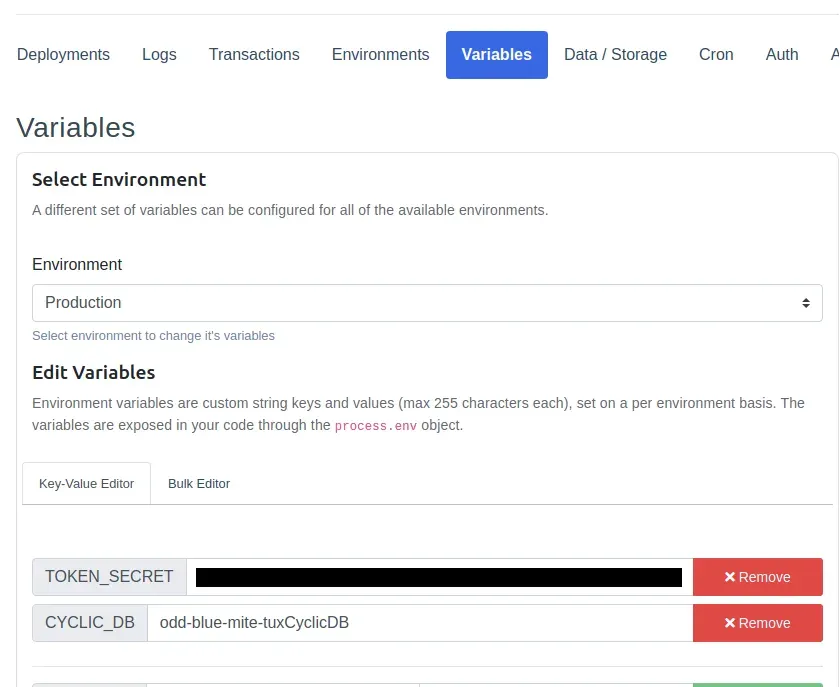
Cyclic dashboard Variables tab, from the archived Cyclic documentation.
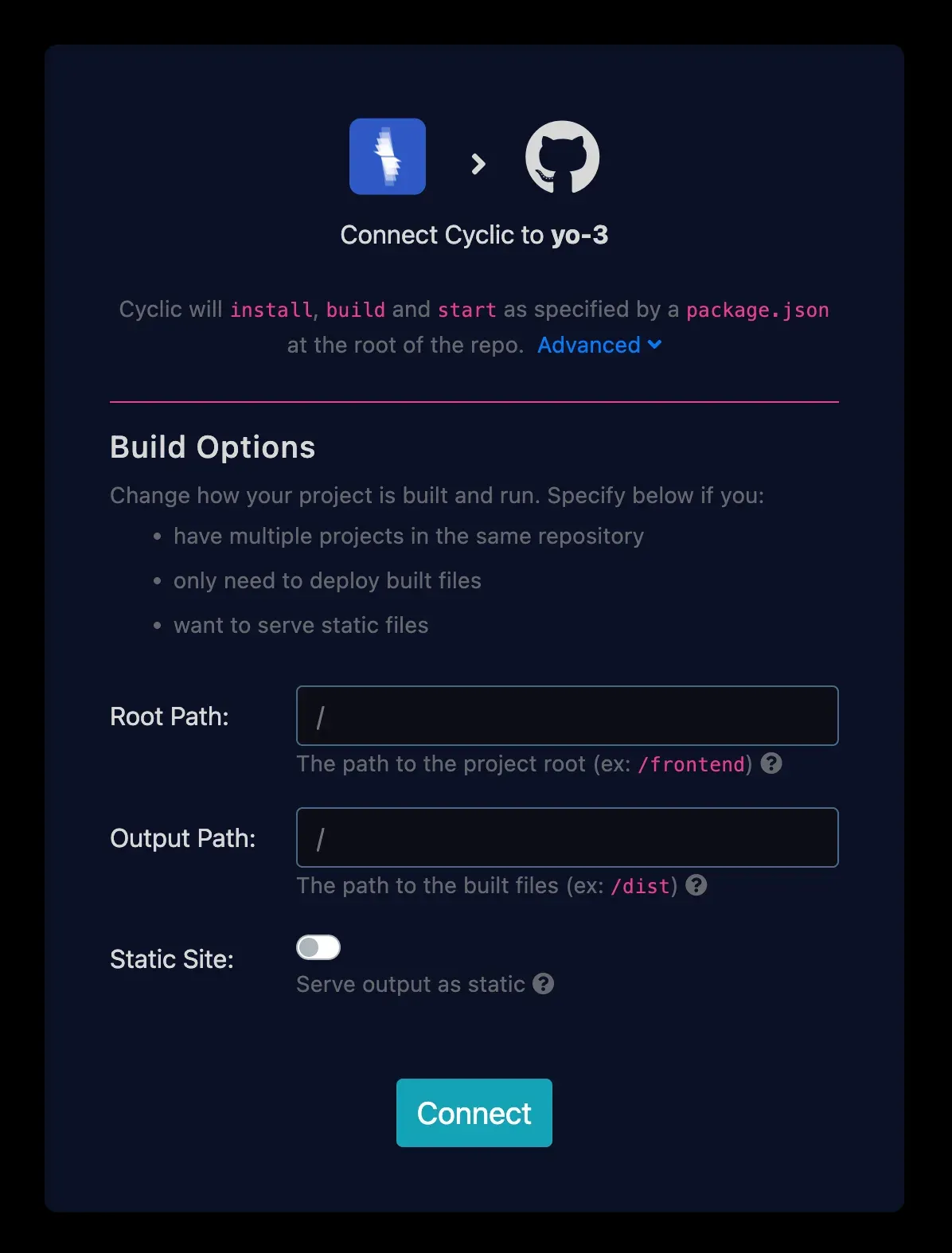
Connecting a GitHub repository with advanced build options.
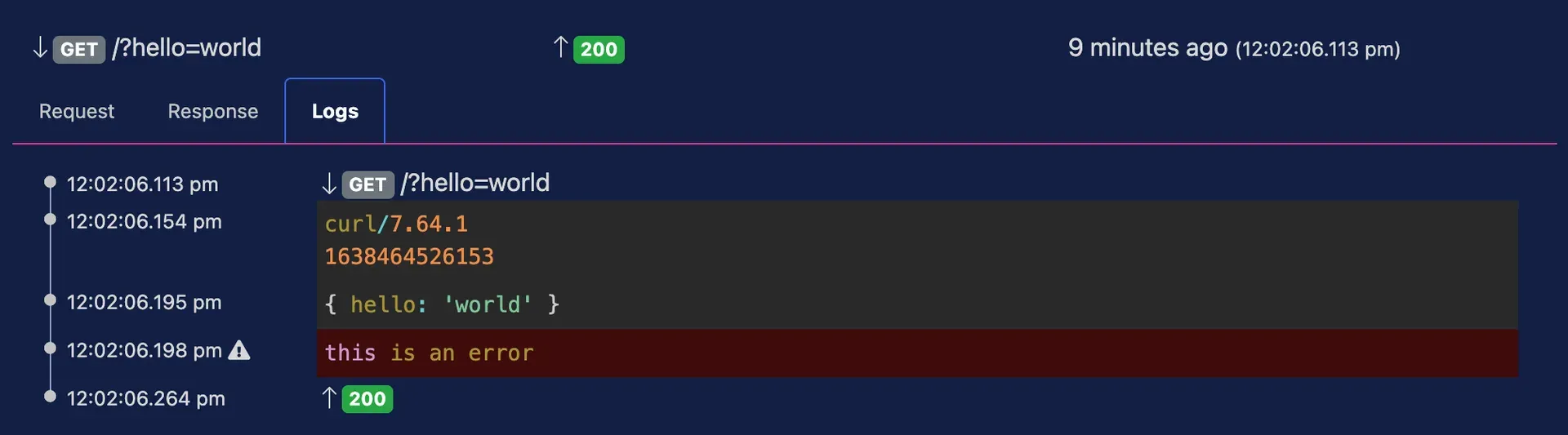
Transaction detail for a single request with its log lines and response status.
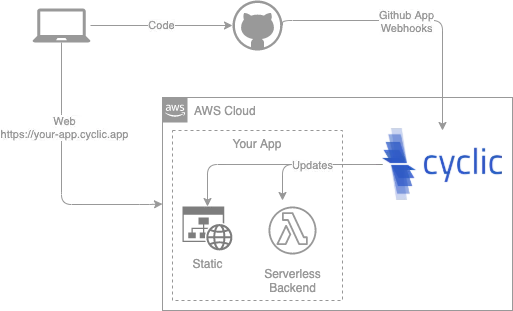
Build and deploy diagram: GitHub webhooks trigger Cyclic, which updates the app's static assets and serverless backend in AWS.
Source: official Cyclic project page.
Key capabilities
- Service status Cyclic is discontinued. The official shutdown post of April 26, 2024 disabled new signups, scheduled the end of free tier usage for May 10, 2024 and the end of all usage for May 31, 2024.
- Git push deployments Apps were deployed from GitHub repositories through the Cyclic GitHub app. Every push or merged pull request on the default branch triggered a deployment, and each deployment was recorded in the GitHub Environments section of the repository with links to logs, the live site and the commit.
- Build process The build documentation describes npm install, npm run build when a build script exists, npm prune to remove devDependencies and a zip of the code and node_modules. Root path, output path and static site options were configurable in advanced build options.
- Serverless runtime on AWS Lambda Each request was handled by a serverless function with 1024 MB of RAM on the free tier. The limits page lists hard limits of Node.js 18.x, 16.x or 14.x, a 30-second maximum request time, 6 MB request and response payloads, no streaming, a 240 MB code bundle and 512 MB of ephemeral disk at /tmp.
- DynamoDB database per app According to the database documentation, every app had a pre-configured DynamoDB table, and external databases could be connected through connection strings in environment variables. The open-source @cyclic.sh/dynamodb package organized items into collections with keys, properties and write-time indexes. The free tier included 1 GB of DynamoDB storage.
- S3 object storage Each app was provisioned with an S3 bucket and read and write access, usable with any S3-compatible client. The free tier included 1 GB of storage and 10 GB of data transfer to the internet per month; temporary local credentials expired after 60 minutes.
- Environment variables Variables were set per app environment in the dashboard through a key-value editor or a bulk editor and exposed to the app at runtime.
- Transactions and logs As described on the transactions page, the Cyclic runtime captured each request as a transaction: the request (URL, method, headers, payload, source IP), app logs from stdout and stderr, exceptions and the response with status code and body.
- Auth toggle An Auth tab enabled authentication at the runtime layer for route patterns written in Express path syntax, with a Basic username and password scheme, before requests reached the app code.
- Custom domains Apps received a random subdomain on cyclic.app that could be changed in the Environments tab. Owned domains were attached with two DNS records, one for ownership validation and one for routing, with SSL certificates issued by AWS; the custom domain guide notes that CAA records had to allow amazon.com or amazonaws.com. Provider guides cover Cloudflare, GoDaddy and Namecheap.
- Private repositories and deploy buttons Private repositories were added from the Link your own tab of the Deploy page by granting the Cyclic GitHub app access. A Deploy to Cyclic button could be placed in a README to fork a repository and deploy it in one action.
- Regions The limits page lists 20 AWS regions in which apps were launched, including us-east-1, eu-central-1, ap-southeast-1 and sa-east-1. The documentation also describes active-active failover across regions.
- Pricing as last published The pricing page in the company's website repository lists a Free Forever tier (1 app, 1,000 API requests per month, 3 cron jobs per app, 7-day log retention), a usage-based tier at $3 per app environment per month plus $0.50 per 10,000 API requests and $0.05 per GB-month of S3 storage, a Team tier at $29 per team member when paid annually, and an Enterprise tier on request.
Where Cyclic fits
Deploying an Express API from GitHub
Developers forked a starter such as express-hello-world or connected their own repository through the Cyclic GitHub app. Cyclic assigned a public URL on cyclic.app, built the code with npm and deployed it to AWS Lambda; later pushes to the default branch redeployed it.
Running a REST API with DynamoDB
The documentation tutorial builds a REST API with Express and the per-app DynamoDB table, using the Cyclic DynamoDB SDK to store items in collections, index properties and query them. Local development used temporary AWS credentials from the app's Data and Storage tab.
Storing files in S3
Apps read and wrote objects in their own S3 bucket with the AWS SDK, using a BUCKET environment variable. The s3fs library provided a drop-in replacement for the Node.js fs module backed by S3.
Hosting bots and scheduled jobs
Starter templates covered Telegram, Discord and Slack bots and Nodemailer, and the pricing page lists precision cron jobs per app. Requests were limited to 30 seconds by the serverless runtime.
Inspecting requests and errors
The Transactions view listed each request with its timestamps, request and response details and the logs and errors produced while handling it, so a failing call could be traced to its log lines.
Attaching a custom domain
A user first changed the generated subdomain or requested a custom domain under Advanced and Custom Domains. Cyclic then showed a validation record and a routing record to add at the DNS provider; once AWS issued the certificate, the app answered on the new domain.
Connecting MongoDB Atlas
The MongoDB guide notes that Cyclic apps had no static IP addresses and no private networking on the free tier, so Atlas access lists had to allow 0.0.0.0/0. It also explains that the connection should be opened before the server starts listening, because serverless instances restart frequently.
Leaving the platform after the shutdown
The shutdown post set May 31, 2024 as the date from which all usage would be turned off. Application code remained in the users' own GitHub repositories, and the open-source starters and libraries remain public on the Cyclic Software GitHub organization.
Reviews of Cyclic
Be the first to share your experience with Cyclic.
Write a review
Loading review form…
Alternatives to Cyclic
 RenderRender is a hosted cloud platform for web services, static sites, private services, background workers, cron jobs, managed Postgres and Key Value, deployed from Git or Docker images and described in render.yaml Blueprints.
 RailwayRailway is a hosted cloud platform that builds and runs services from GitHub repos, Docker images or the CLI, with databases, volumes, private networking, preview environments and metrics. Plans start with a free trial; Hobby has a $5 monthly minimum.
 KoyebKoyeb is a serverless platform that deploys web apps, APIs, workers and AI inference from Git or Docker, running them in microVMs on bare metal.