

What is Gumroad?
Gumroad is an e-commerce platform where creators sell products directly to their audience: ebooks, courses, templates, software with license keys, memberships and other digital goods. It is operated by Gumroad, Inc. at gumroad.com, with a public marketplace called Discover, creator storefronts, embeddable buy buttons and a seller dashboard for products, sales, affiliates and payouts. The repository describes itself as the source code of the Gumroad web application.
The code is published under the MIT license, with the copyright notice of Gumroad, Inc. The repository is a Ruby on Rails application, with Ruby 3.4.12 and Node 22.23.4 pinned in version files, MySQL 8.4, Elasticsearch, Redis, Sidekiq background workers and a small Go service in the go_web directory. Local development needs Docker for supporting services, ImageMagick, FFmpeg, pdftk and wkhtmltopdf. The README explains setup with make local, bin/rails db:prepare and bin/dev, which starts the Rails server, the JavaScript build and a Sidekiq worker.
The service is run as a hosted product. The pricing page lists 10 percent plus 0.50 USD per transaction on direct sales and 30 percent for sales that come through Discover, with no monthly fee, and states that since January 1, 2025 Gumroad acts as merchant of record and handles sales tax collection and remittance worldwide. The latest release, v2026.11.07.32, was published on November 7, 2026 and is an internal change to cache namespaces; the project tags many date-numbered releases per day as it deploys continuously.
Contribution works by email rather than a review queue: the README asks contributors to open a pull request on their own fork and email Gumroad support with the link. This profile is based on the repository, the public website and the help center. The repository does not document how to run a production marketplace of your own.
Gumroad screenshots
Explore the interface. Open a screenshot to view it at full size.
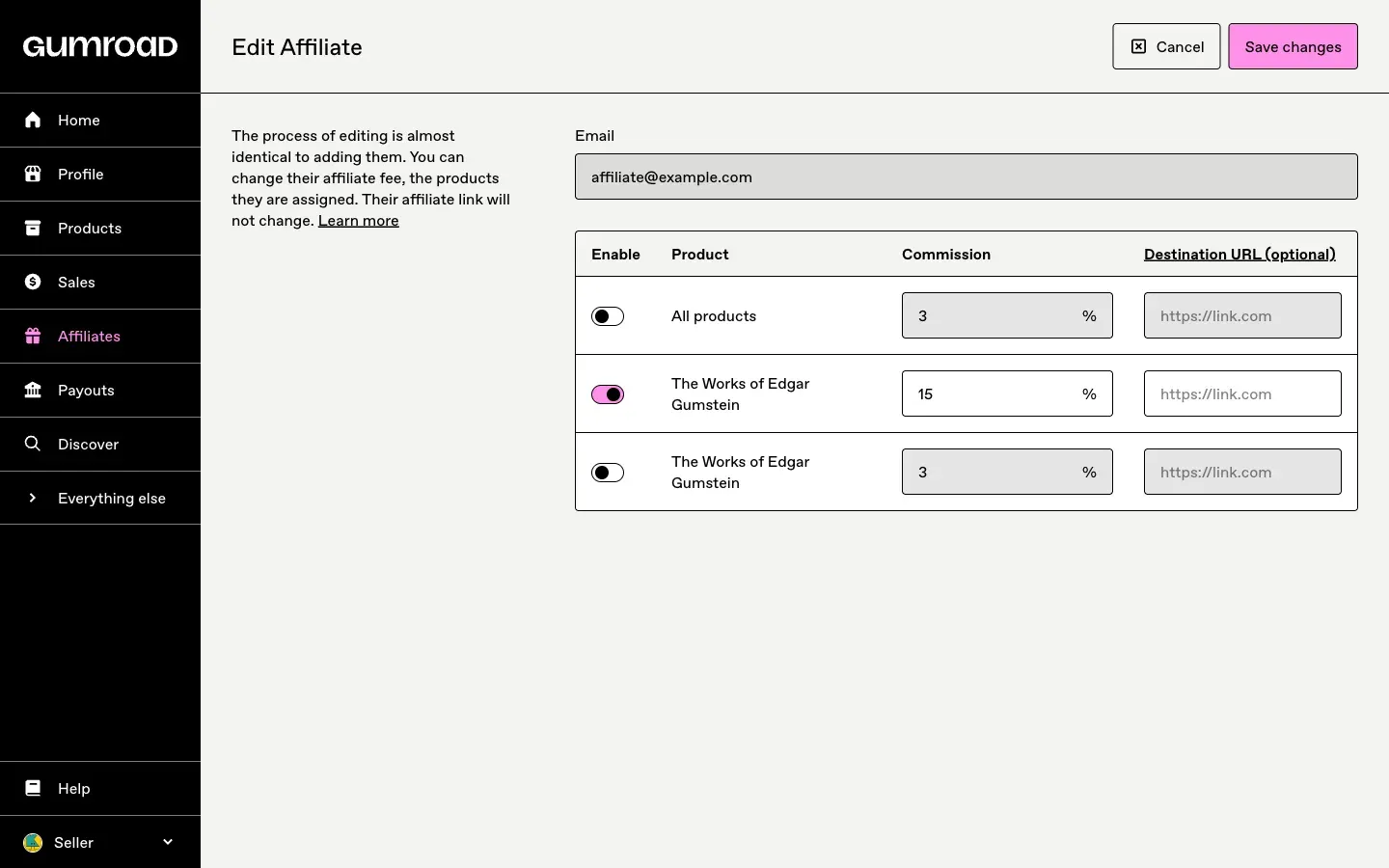
Repository QA screenshot of the Edit Affiliate page, with seed data, showing the dashboard sidebar and per-product commissions.
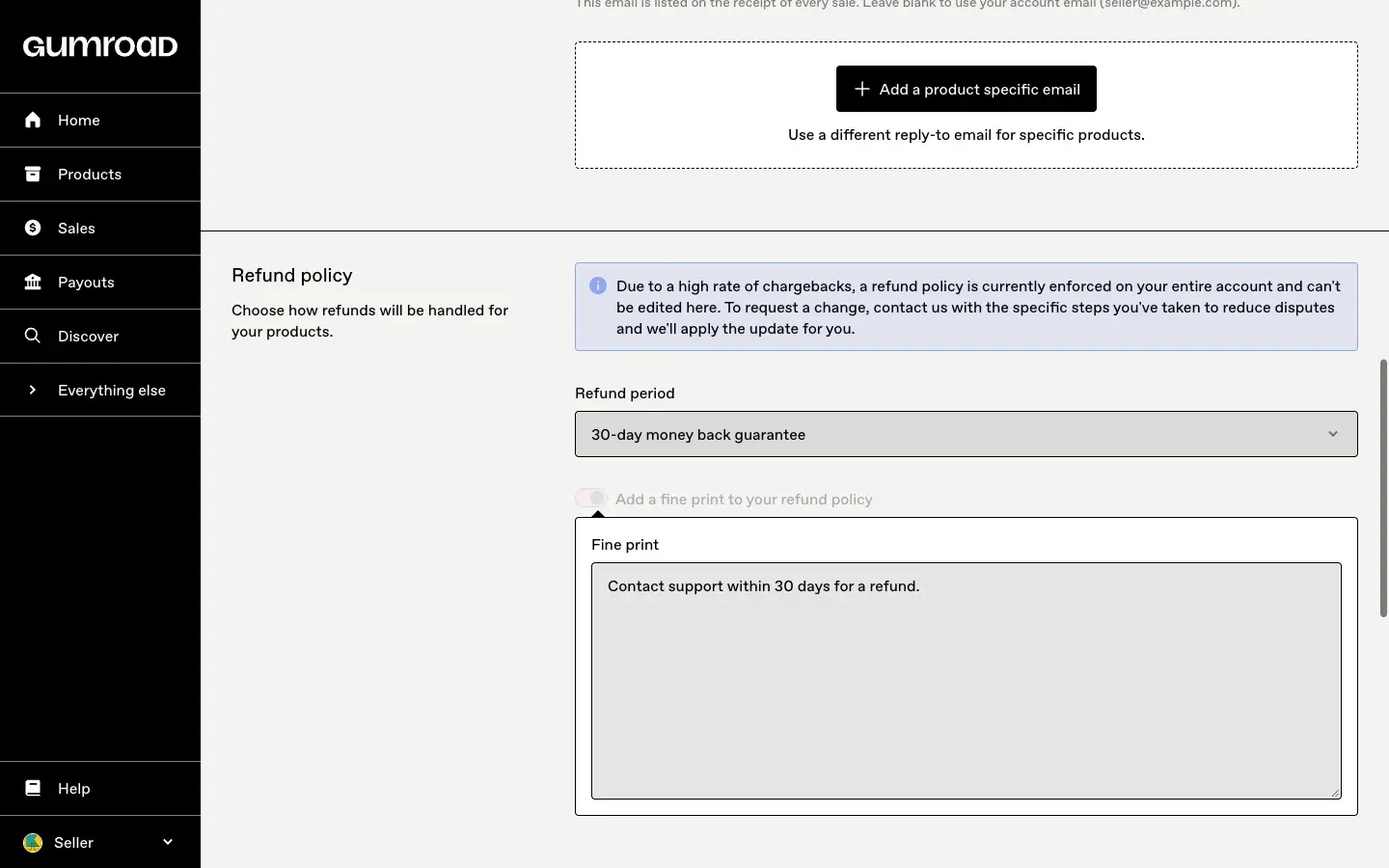
Repository QA screenshot of the refund policy settings, with seed data, including a notice that a policy is enforced.
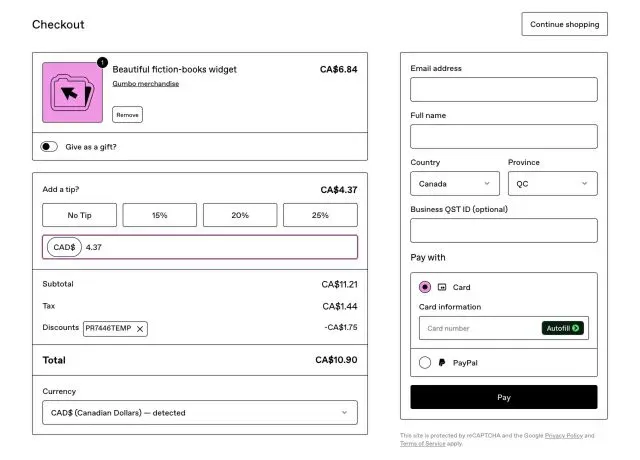
Repository QA screenshot of the checkout in a Canadian dollar test purchase; cropped to the checkout area.
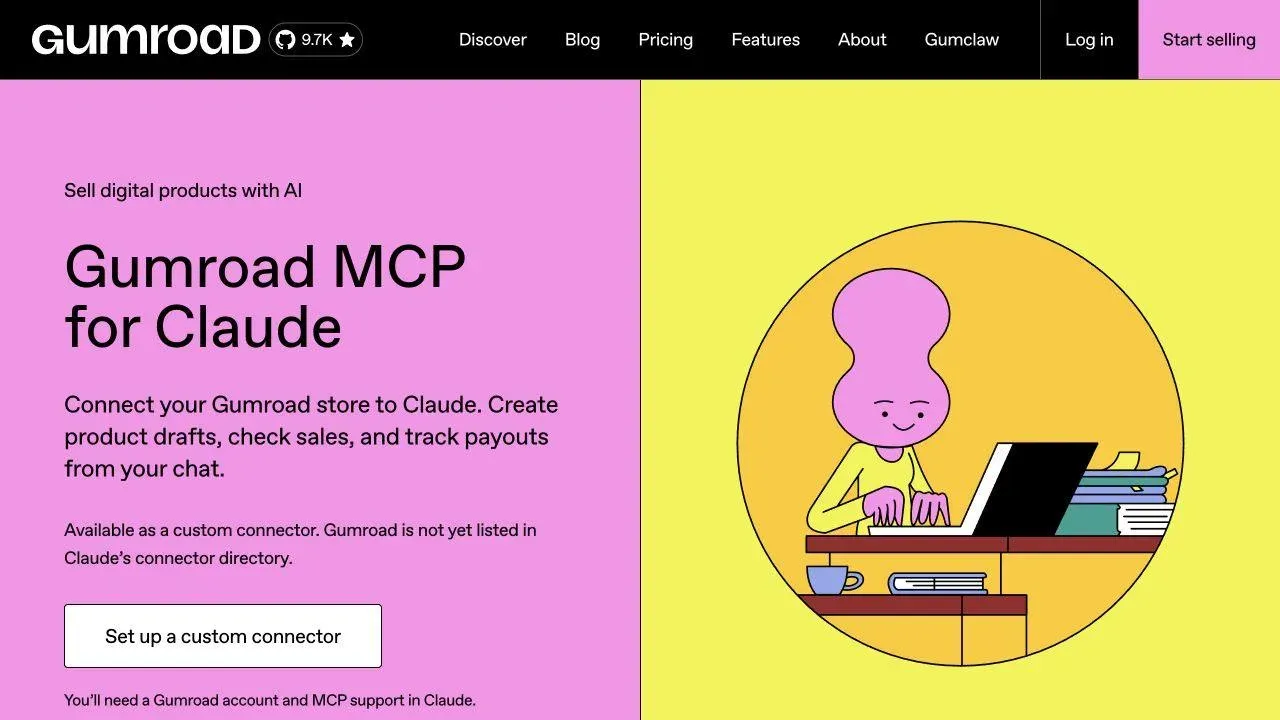
Repository QA screenshot of the Gumroad MCP for Claude page from the public website.
Source: official Gumroad project page.
Key capabilities
- Digital product sales Sellers can list ebooks, courses, tutorials, design assets, music and software. Buyers get files after payment, and products can offer several versions such as PDF and ePub. The pricing page lists digital goods, courses and memberships as supported, while physical goods are not allowed.
- Memberships and subscriptions Recurring products can bill monthly, quarterly, every six months, yearly or on a fixed-length plan, and give members access to a content library while the subscription is active. Pricing options also include pay-what-you-want amounts.
- Checkout with card and PayPal A product page opens a checkout that shows the cart, a tip selector, optional gifting, tax, discounts and a detected currency, with card and PayPal as payment methods in the repository screenshots. Business tax identifiers can be entered in supported regions.
- Merchant of record and tax handling Gumroad collects and remits sales tax worldwide for sales, according to its pricing page, and tax collection settings in the dashboard are disabled as a result. Sellers still need to check how their own income tax and reporting obligations apply.
- Storefronts, profile page and embeds Creators get a profile page with a page editor and can use a custom domain, or embed the checkout overlay and a follow button on an existing site. The features page describes both options.
- Discover marketplace New customers can find products through the Discover marketplace, which is charged at a higher rate than direct sales. Direct links and profile visits keep the lower fee.
- Affiliates Sellers can add affiliates by email, assign products and set a commission per product, with an optional destination URL. The dashboard screenshot in the repository shows editing an affiliate with enabled products and percentages.
- Offer codes, upsells and workflows The v2 API lists controllers for offer codes, upsells, workflows, UTM links and marketing actions. These support discounts, additional offers at checkout, automated follow-up emails and campaign tracking.
- License keys and file protection Software sellers can generate license keys, which are verified through a licenses API endpoint. PDF files can be stamped with the buyer's email, and the README names pdftk for this work.
- Email and customer communication Sellers can send emails to customers and followers, set a reply-to address, and add product-specific reply addresses. Receipts and invoices are generated, and invoice PDFs use wkhtmltopdf according to the setup guide.
- Refund policy settings A seller chooses a refund period such as a 30-day money back guarantee and can add fine print. The repository screenshot shows an account where a policy is enforced because of a high chargeback rate, which a seller cannot change without contacting support.
- Payouts Sellers are paid by bank account or PayPal, with the method depending on country. The dashboard has a payouts section with payout history, and the API has payouts and earnings endpoints.
- Seller dashboard The left navigation covers Home, Profile, Products, Sales, Affiliates, Payouts, Discover and more. Sales and balance data are available inside the dashboard and through the API.
- REST API v2 with OAuth The application exposes a v2 API with controllers for products, sales, subscribers, licenses, offer codes, payouts, files, variants, workflows, product reviews and more. Access uses OAuth scopes; the marketing endpoints require a dedicated scope and reject the broad legacy account scope. The overview is at gumroad.com/api.
- Resource subscriptions (webhooks) A resource subscriptions endpoint lets an application subscribe to sale and other events and receive pings at its own URL. Webhook receivers should verify the request source and handle retries.
- MCP server for AI assistants Gumroad publishes an MCP server at gumroad.com/claude/v1/mcp so an assistant such as Claude can list products, draft products, show recent sales and check payouts after the seller signs in and grants permission. The help page says product files are still added in Gumroad before publishing.
- Local development environment Developers can run the application locally with Docker-backed services and seed data, log in with development accounts, reset Elasticsearch indices and run RSpec and linting. This supports contributions and study, but it is not a production deployment guide.
Where Gumroad fits
Launching a first digital product
Create the product, upload files, set a price or pay-what-you-want minimum, write the page and publish. Buy it yourself with a test purchase where permitted, then confirm that the receipt, file delivery and sales dashboard entry look correct before sharing the link.
Running a membership
Create a membership product with a billing interval and attach the content members receive. Check what happens when a card fails, when a member cancels and when a price changes for existing members, and read the help center on subscription handling before promising specific access rules to customers.
Selling software with license keys
Enable license keys on the product, call the licenses verify endpoint from your application and decide how many activations a key may have. Keep the verification call server-side where practical, and plan for offline use if your product needs it. Test a refunded purchase, since a refund should be reflected in what your application accepts.
Growing with affiliates and discounts
Add affiliates with per-product commission, create offer codes for campaigns and use UTM links to see where sales come from. Compare the fee impact: affiliate commissions and Discover fees both reduce what you keep from a sale. Work out a sample sale at each price point before choosing discounts, because the fixed 0.50 USD part weighs more on low prices.
Automating the store with the API
Request an OAuth token with the narrowest scope, read sales and subscribers, and subscribe to events for fulfilment. Handle the case where a sale is refunded, and avoid storing buyer data you do not need.
Studying or contributing to the code
Follow the README to run the application locally, read the AGENTS.md and CONTRIBUTING files, and fork the repository to propose a change. Expect to include visual evidence and test results with a change, and to email the link, as the README requires. Security issues belong in the process described in SECURITY.md, not in a public pull request.
Reviews of Gumroad
Be the first to share your experience with Gumroad.
Write a review
Loading review form…
Alternatives to Gumroad
 GhostGhost is an open source publishing platform for building a website, sending email newsletters and selling paid memberships, self-hosted or on Ghost(Pro).
 MedusaMedusa is an open-source commerce backend for Node.js with products, carts, orders, payments and inventory as modules, a React admin and Store and Admin APIs. Self-host it with PostgreSQL and Redis or run it on Medusa Cloud.