

What is Fortinet?
Fortinet is a network security and networking vendor whose central products are the FortiGate next-generation firewalls, the FortiOS operating system that runs on them, and the Fortinet Security Fabric that links Fortinet and third-party products under common management and telemetry. According to its about page, Fortinet was founded in the San Francisco Bay Area in 2000 and is led by co-founders Ken Xie and Michael Xie. The contact page gives its headquarters as 909 Kifer Road, Sunnyvale, California.
The same page lists a portfolio of more than 50 enterprise products, more than one million lifetime customers, 1,474 patents and more than 18 million units shipped as of September 30, 2026. Fortinet designs its own security processing units (SPUs), custom ASICs that FortiGate hardware uses to accelerate security and networking functions. FortiGuard Labs supplies the threat intelligence used across the products and, by Fortinet's figure, processes more than 100 billion events per day.
FortiOS is described on its product page as the operating system that converges networking and security and forms the foundation of the Security Fabric. The current major line is FortiOS 8.0; the FortiOS 8.0.2 release notes (build 0251) list supported FortiGate and FortiWiFi desktop and rack models, FortiGate Rugged units, FortiFirewall models and FortiGate VM images for AWS, Azure, Google Cloud, OCI, Alibaba Cloud, IBM Cloud, KVM, Hyper-V and Xen, including ARM64 variants.
Products are delivered as hardware appliances, virtual machines, cloud marketplace images and Fortinet-hosted cloud services such as FortiSASE, FortiGate-as-a-Service and the cloud editions of FortiManager and FortiAnalyzer. Fortinet does not publish list prices: purchases run through partners and sales, and security functions are licensed as FortiGuard service subscriptions, either a la carte or in the ATP, UTP and ENT bundles. FortiOS and the other products are proprietary; documentation is public in the Fortinet Document Library.
Other network security vendors listed on iThub include Palo Alto Networks, Check Point and Sophos.
Fortinet screenshots
Explore the interface. Open a screenshot to view it at full size.
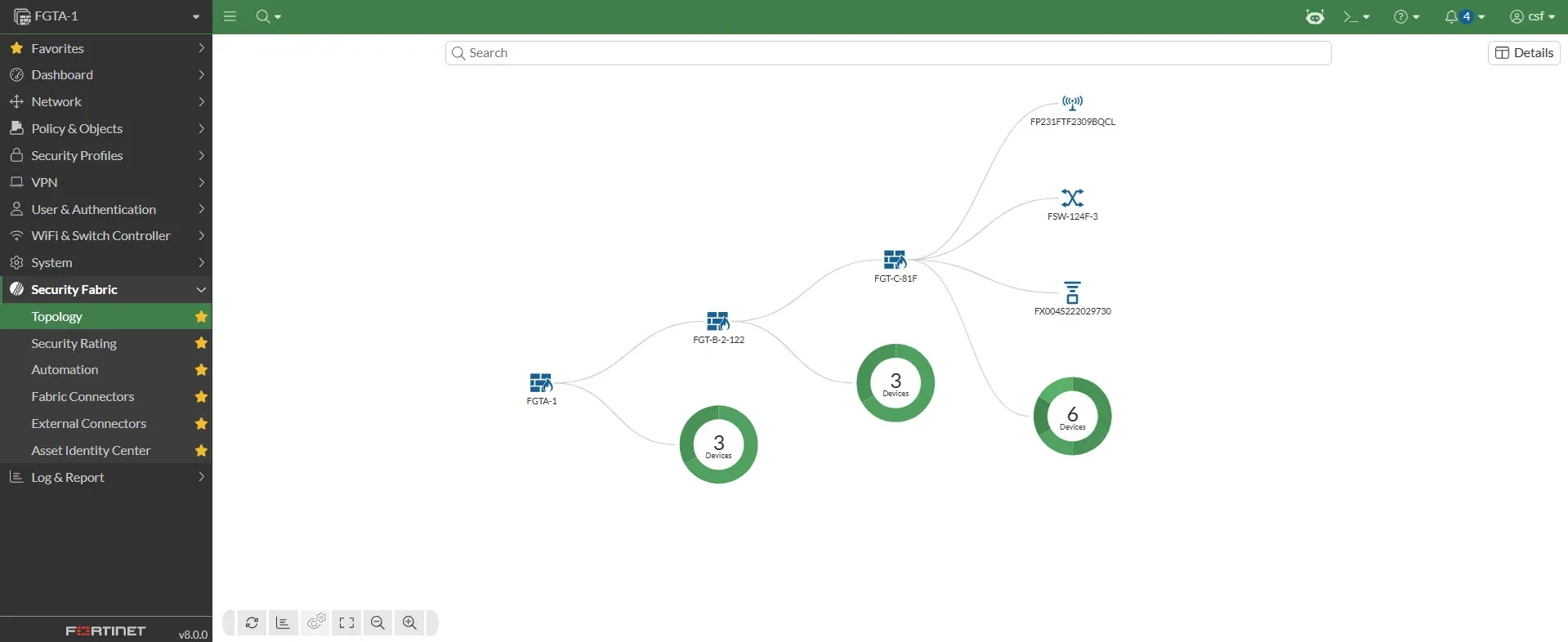
Security Fabric topology in the FortiOS 8.0 GUI, from the FortiOS 8.0.0 New Features guide.
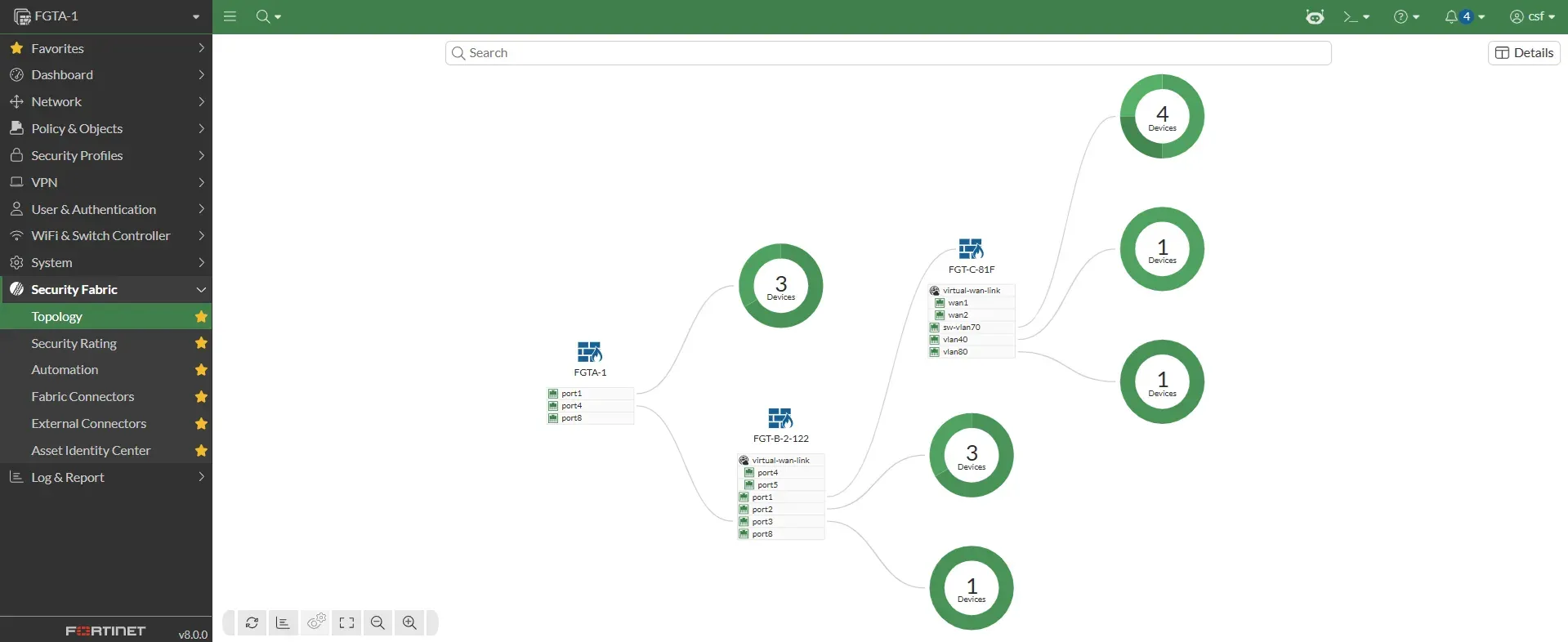
Logical topology view, with downstream devices attached to the interfaces of their parent FortiGate.
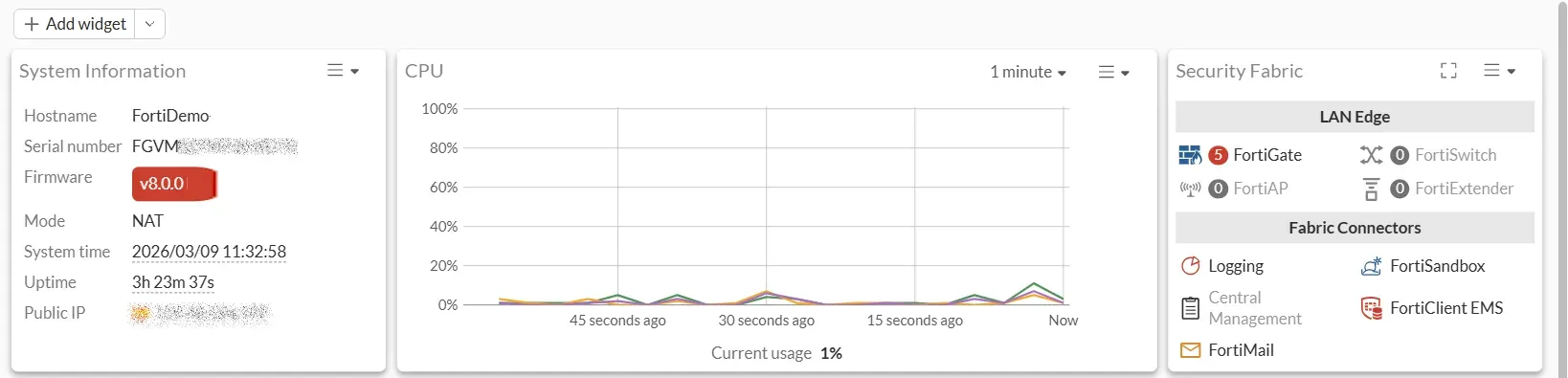
Status dashboard widgets from the FortiOS 8.0.0 Administration Guide; identifiers are blurred by Fortinet.
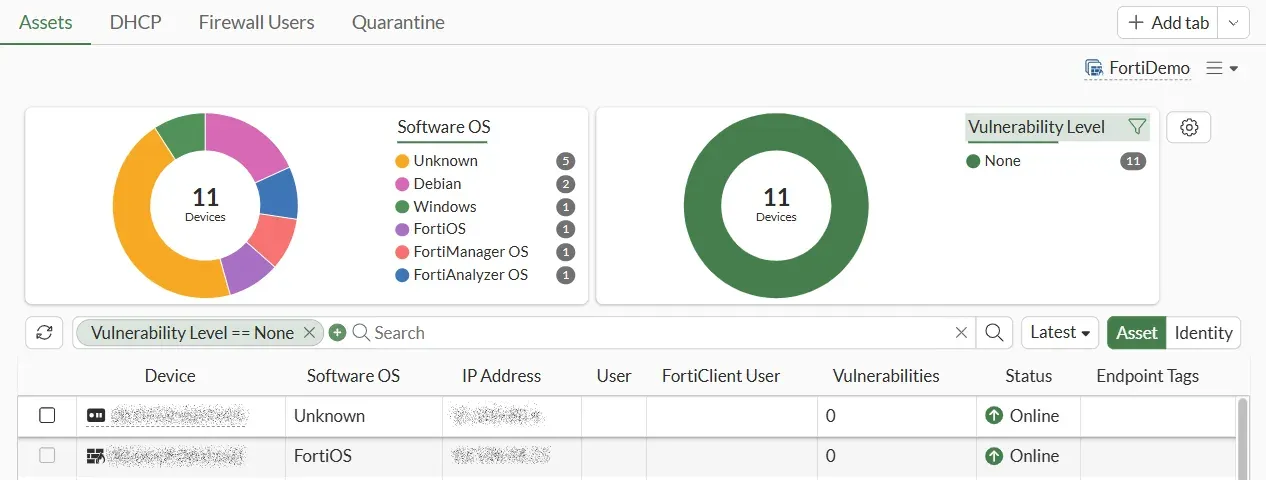
Assets and Identities dashboard from the FortiOS 8.0.0 Administration Guide.
Source: official Fortinet project page.
Key capabilities
- FortiGate next-generation firewalls FortiGate NGFWs are offered for data centers, campus, branch, public and private clouds and harsh environments, with model variants that include Wi-Fi, LTE, PoE, DSL, bypass and ruggedized hardware. The NGFW page lists integrated SD-WAN and built-in ZTNA as standard capabilities.
- FortiOS 8.0 FortiOS runs on FortiGate and the wider FortiOS-based networking line. Version 8.0 adds GenAI application visibility and control, MCP and A2A traffic detection, FortiAI-Assist for FortiGate troubleshooting, OCR in FortiGuard DLP for sensitive data in images, an on-box AI/ML IPS engine on all FortiGate models and OT enhancements aimed at NERC CIP and IEC 62443 compliance.
- Quantum-safe cryptography FortiGate supports quantum key distribution from FortiOS 7.4.2 and post-quantum cryptography for IPsec VPNs from FortiOS 7.6.1. FortiOS 8.0 adds NIST-approved algorithms, crypto-agility, SSL deep inspection and FIPS 204/205-compliant hybrid key exchange for management access and agentless VPNs.
- Security Fabric The Fabric connects FortiGate, FortiSwitch, FortiAP, FortiExtender and other Fortinet products with Fabric connectors for logging, sandboxing, endpoint management and third-party systems. The Security Fabric page describes it as broad, integrated and automated. Physical and logical topology views, Security Rating and Automation pages are available from the root FortiGate.
- FortiGuard AI-Powered Security Services Security functions are licensed as FortiGuard subscriptions. The ATP bundle is the base layer; UTP adds URL and DNS filtering, video filtering and anti-botnet and C2 services; ENT adds DLP, attack surface monitoring and risk scoring, AI-based inline malware prevention and IoT detection. OT device and protocol recognition is a separate OT Security Service.
- Secure SD-WAN Fortinet Secure SD-WAN runs on FortiOS and is managed from one console together with SSE, zero trust, the wireless controller and LTE/5G gateways. The SD-WAN page states that there is no bandwidth licensing or data transfer charge, and it includes digital experience monitoring and unified telemetry.
- FortiSASE FortiSASE is a cloud-delivered service for hybrid workers combining SWG, ZTNA, CASB, FWaaS, SSPM, a secure browser, secure SD-WAN and DEM on one OS and agent. It runs on more than 200 points of presence on Fortinet-owned infrastructure, extended through AWS, Google Cloud and Oracle Cloud. FortiSASE Sovereign is a variant deployed in the customer's own data centers for data residency requirements.
- FortiManager FortiManager and FortiManager Cloud provide central management and zero-touch provisioning with templates for firewalls, SD-WAN and SD-Branch, covering FortiGate VMs, CNFs and hardware as well as FortiSwitch, FortiAP and FortiExtender. FortiAI-Assist adds generative AI help for configuration and diagnostics.
- FortiAnalyzer FortiAnalyzer is a unified data lake that ingests and normalizes logs from Fortinet and multivendor products for NOC and SOC use. It includes detection analytics, automation playbooks and reports maintained by FortiGuard Labs, and a catalog of 18 FortiAI-Assist agents for triage, investigation, threat hunting and impact analysis.
- Security operations products The portfolio includes FortiSIEM, FortiSOAR, FortiEDR/XDR, FortiNDR, FortiSandbox for zero-day analysis, FortiDeceptor for deception-based detection, FortiDLP and FortiRecon. These products feed the Fabric data lake and FortiGuard intelligence.
- LAN edge: FortiSwitch, FortiAP, FortiExtender Ethernet switches, wireless access points and LTE/5G WAN gateways are managed from FortiGate through the WiFi and Switch Controller, which brings them under FortiOS security policy. Industrial and rugged variants are listed for OT sites.
- FortiClient and zero trust access FortiClient is the unified agent for VPN, ZTNA and endpoint telemetry, managed through FortiClient EMS. In FortiOS 8.0 it supports post-quantum cryptography for VPN connectivity, an endpoint risk score for adaptive ZTNA, and detection and control of AI applications.
- Identity and network access control FortiAuthenticator, FortiAuthenticator Cloud and FortiToken cover authentication and MFA, FortiPAM covers privileged access management, and FortiNAC provides visibility and access control for IoT and other network-connected devices.
- Application and cloud security FortiWeb is a web application firewall for web apps and APIs, FortiADC handles application delivery, FortiDDoS protects data centers from DDoS attacks, FortiMail secures email, and FortiCNAPP is the cloud-native application protection platform. FortiGate VM brings the firewall to public and private clouds.
- FortiGate GUI dashboards The FortiOS GUI includes predefined dashboards such as Status, with System Information, CPU, Security Fabric, Policies and Sessions widgets, and an Assets and Identities dashboard with Assets, DHCP, Firewall Users and Quarantine tabs. Dashboards can be edited, and in VDOM mode they are created per VDOM, as the dashboard documentation explains.
- REST API and automation REST API administrator accounts are used for automated configuration, backup creation and monitoring of a FortiGate; only a super_admin can create them. The full API reference is in the Fortinet developer network, which requires an account, per the REST API administrator page.
Where Fortinet fits
Protecting a data center or campus edge
Organisations place FortiGate appliances at the data center or campus perimeter for firewalling, IPS, web filtering, antimalware and SSL inspection, sized from the model range on the NGFW page. FortiGuard subscriptions add the security services, and FortiManager applies consistent policy across multiple units.
Connecting branch offices with SD-WAN
Distributed enterprises run Fortinet Secure SD-WAN on branch FortiGates, with distributed enforcement and local inspection of traffic. Switches, access points and LTE/5G extenders at the branch are managed from the same FortiGate, as described on the SD-WAN product page.
Securing remote and hybrid workers
FortiSASE delivers secure internet, private application and SaaS access to users outside the office through FortiClient or agentless access and Fortinet points of presence. Combined with Secure SD-WAN it forms Fortinet Unified SASE, managed from one console.
Centralised visibility and SOC operations
Logs from FortiGates and other Fabric devices flow into FortiAnalyzer or FortiSIEM, where analytics, playbooks and AI agents support detection and response. The Security Fabric topology views on the root FortiGate show downstream FortiGates, switches, access points and connected devices.
Protecting operational technology
Industrial sites use ruggedized FortiGate and industrial FortiSwitch hardware with OT-specific FortiOS features, such as virtual IP support for encrypted communication to OT servers and the separately licensed OT Security Service for device and protocol recognition.
Securing cloud workloads
FortiGate VM images run in AWS, Azure, Google Cloud, OCI and other platforms listed in the release notes, enforcing the same FortiOS policies as on-premises appliances. FortiCNAPP and FortiWeb cover cloud posture and application protection.
Reviews of Fortinet
Be the first to share your experience with Fortinet.
Write a review
Loading review form…
Alternatives to Fortinet
 Palo Alto NetworksPalo Alto Networks sells next-generation firewalls as PA-Series hardware, VM-Series virtual, CN-Series container and Cloud NGFW for AWS.
 Check PointCheck Point sells Quantum firewalls and the Maestro hyperscale cluster, with SD-WAN, SASE, VPN remote access and threat protection services.
 SophosSophos is a British security vendor selling firewall, endpoint and managed detection and response products, administered through Sophos Central.