

What is Dub?
Dub is a link attribution platform from Dub Technologies, Inc. It started in 2022 as a side project for creating short links and, according to the company page, became a company in 2024. The product today covers short links on custom domains, click analytics, conversion tracking for leads and sales, and partner programs for affiliates, creators and user referrals. The company team is fully remote and its headquarters are not stated on the site.
The code lives at github.com/dubinc/dub.link (the repository was renamed from dubinc/dub) and is a Turborepo monorepo written in TypeScript. The tech stack named in the README is Next.js, Tailwind, Prisma, Upstash Redis for link lookups, Tinybird for analytics, PlanetScale for the database, NextAuth.js, BoxyHQ for SAML single sign-on, Stripe and Resend, deployed on Vercel. The main web application lives in apps/web.
Dub is distributed in two ways: as the hosted service at dub.co and as source code you can deploy yourself using the self-hosting guide. The repository has no tagged GitHub releases, so this profile carries no version number; the changelog records product updates. Server-side SDKs exist for TypeScript, Python, Go, PHP and Ruby, and client-side SDKs for web, iOS and React Native, as listed in the SDK overview.
The license is "open core". About 99 percent of the repository is under AGPLv3, and files in the Enterprise Edition directories, marked ee in the repository, fall under a separate commercial license described in the repository's LICENSE.md. Check which directories a feature you need relies on before planning a self-hosted deployment.
The project's own documentation states that Docker is not supported for self-hosting and that the stack depends on third-party services, so a self-hosted copy is not a single-container install.
Dub screenshots
Explore the interface. Open a screenshot to view it at full size.
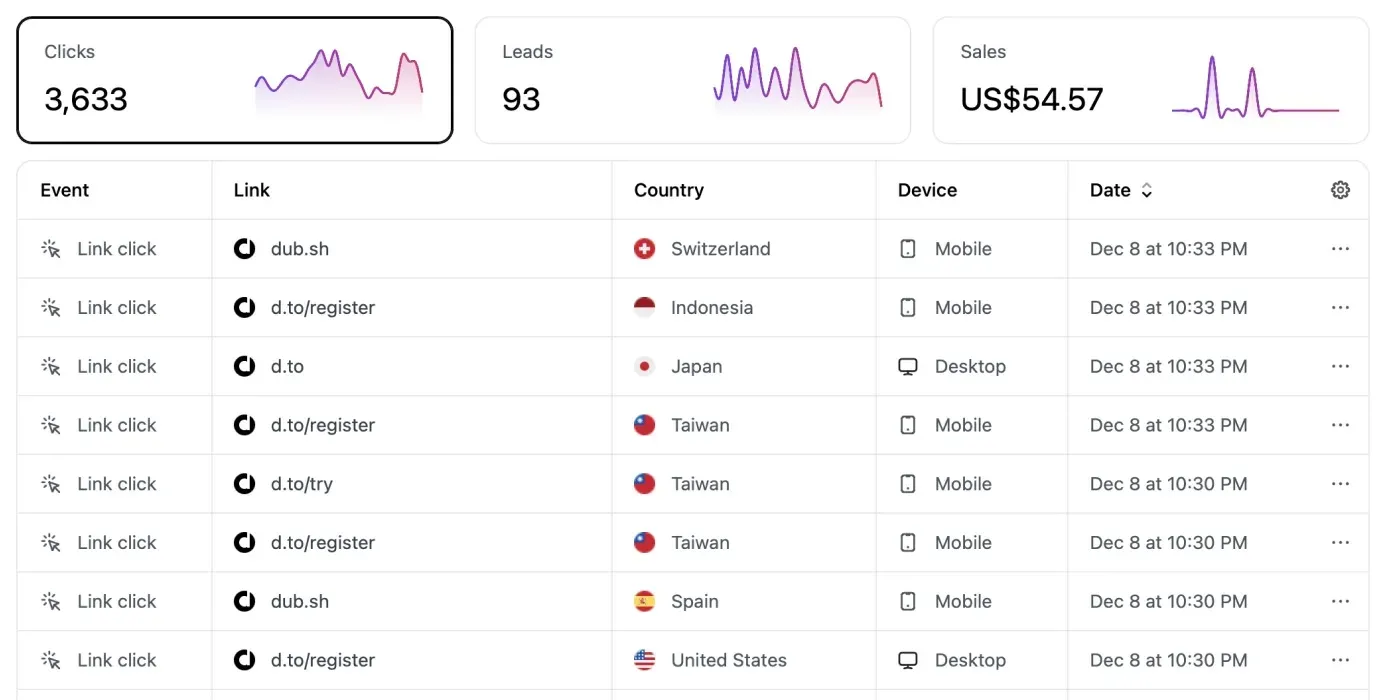
Official Dub image of the events table: totals for clicks, leads and sales above individual link click events.
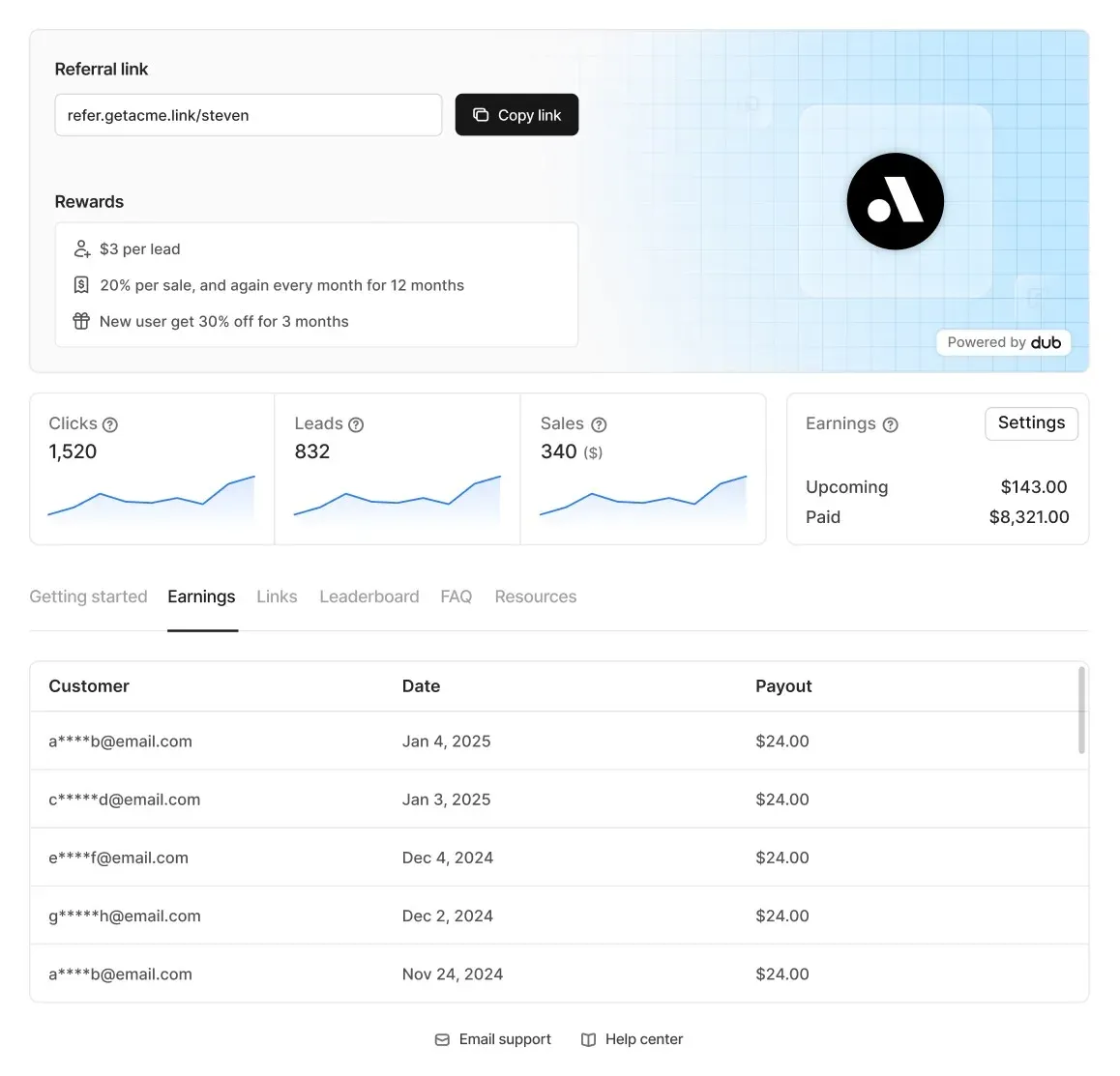
Official Dub image of the embeddable partner dashboard: referral link, reward terms, performance figures and an earnings table.
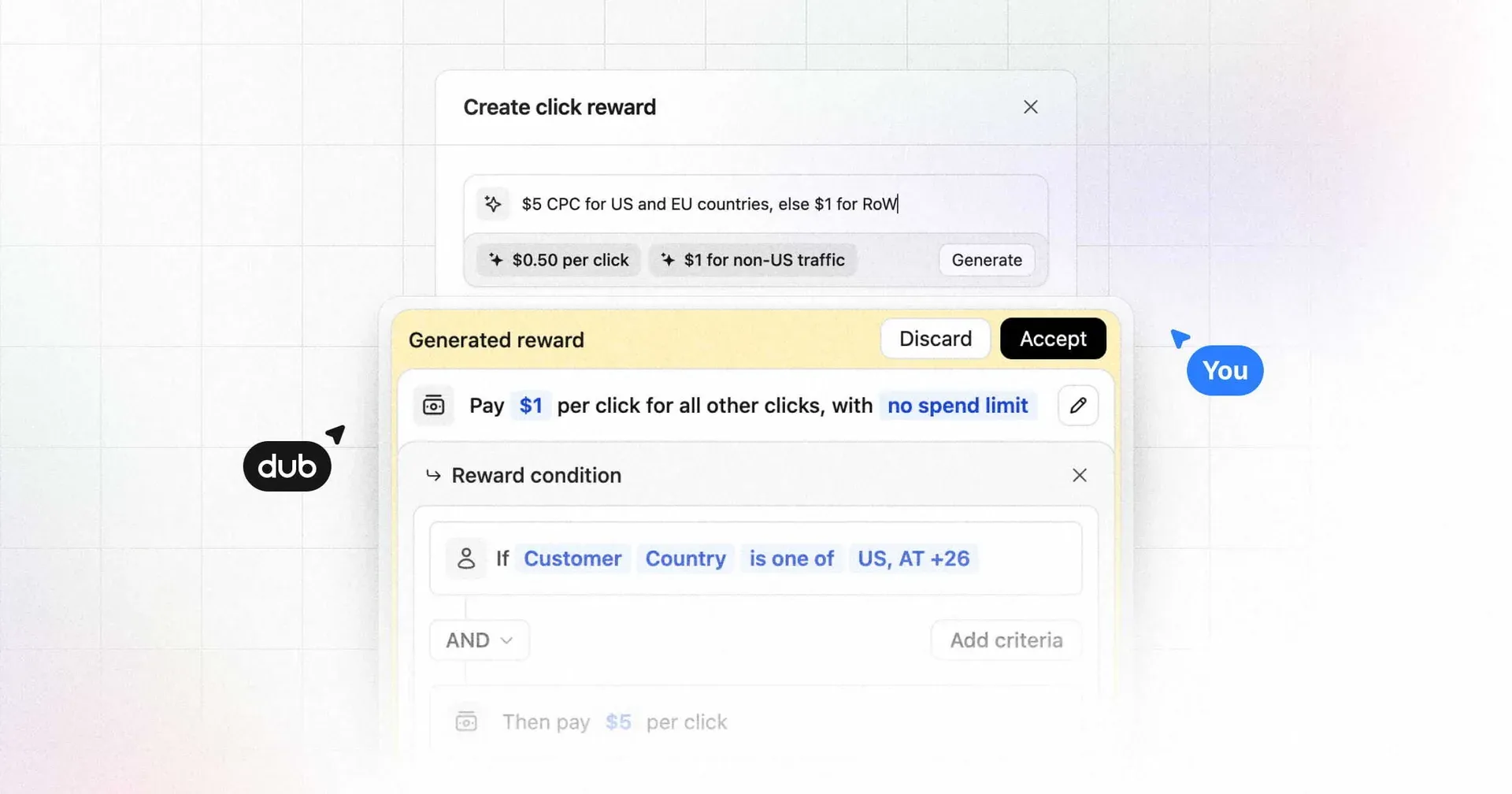
Official Dub changelog image of the AI reward builder turning a plain-language prompt into a click reward with a country condition.
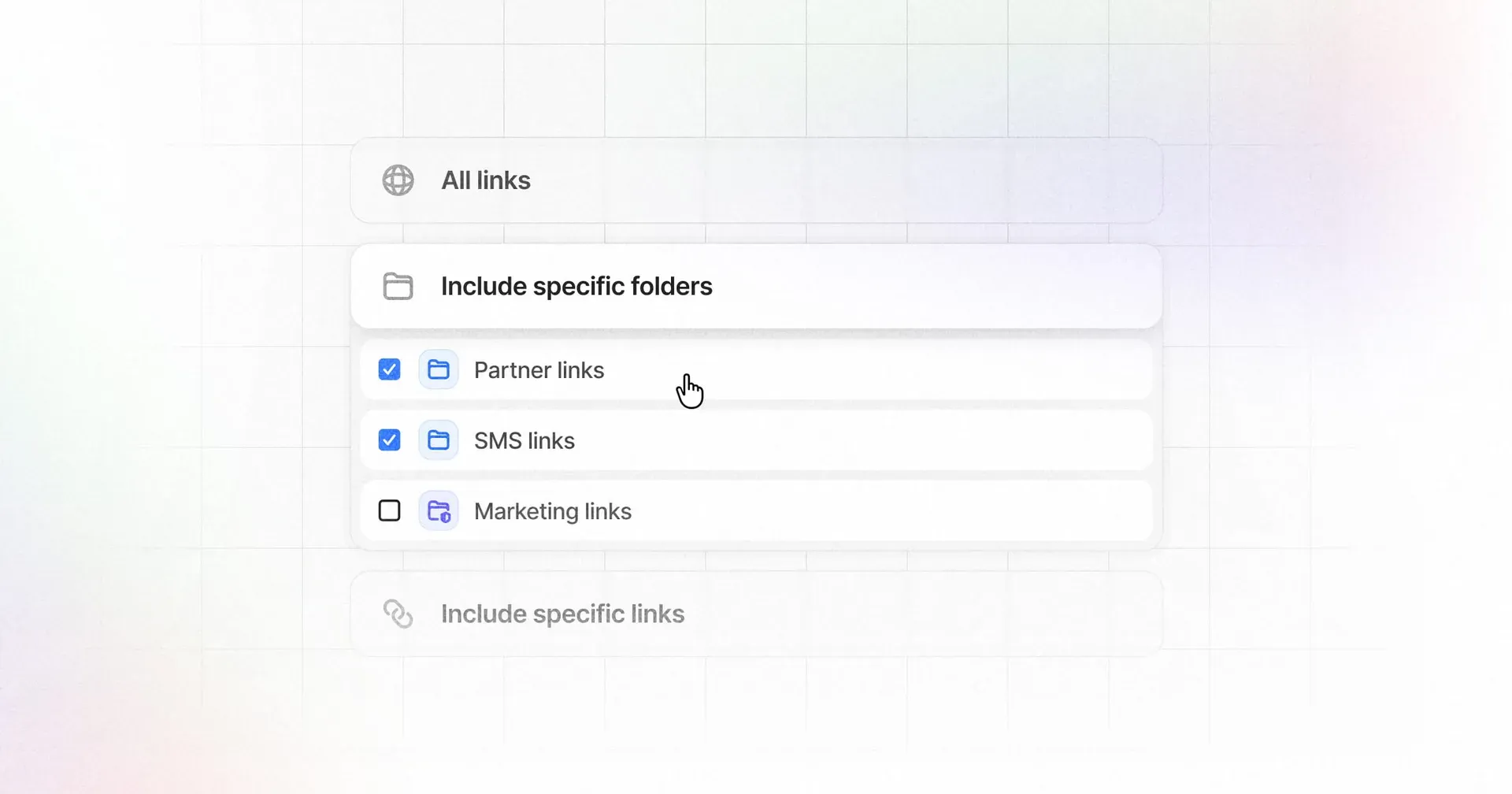
Official Dub changelog image of the link clicked webhook scope: all links, specific folders or specific links.
Source: official Dub project page.
Key capabilities
- Short links on custom domains Create links on your own domains or on Dub's default domains, with custom slugs and destinations. The link model has an id, a destination URL, a domain and a key, and only the destination URL is required when creating a link.
- Bulk link creation Many links can be created or updated in one request, for example for SMS campaigns or affiliate programs. The bulk operations guide describes the endpoints and their limits.
- Click analytics Dashboards show clicks by link, country, city, device, browser, operating system and referrer, with filtering by time range. Click events are stored in Tinybird, which is also a required service for self-hosting. See the analytics page.
- Conversion tracking Dub attributes leads and sales to the click that produced them, so you can see click-to-sale funnels per link. Tracking uses a client-side script or SDK and server-side events, and has Stripe and Shopify integrations. See attribution.
- Events table A table of individual click, lead and sale events lets you inspect where each came from, with country and device columns. Retention depends on the plan, from 3 years on Business to unlimited on Enterprise.
- Partner programs Dub Partners supports affiliate, influencer and referral programs with partner links, reward rules, payouts and an embeddable partner dashboard. Plans list partner payout volume and payout fees, so read them before choosing a plan.
- Reward rules and an AI builder Rewards can be set per click, lead or sale with conditions such as the customer's country. An AI reward builder converts a plain-language description into a rule that you review and accept before it takes effect.
- REST API and SDKs The REST API manages links, domains, tags, folders, analytics and more, with per-plan rate limits, for example 1,200 requests per minute on Business. See the API reference.
- Webhooks Real-time event notifications, such as link clicked, can be sent to your endpoints. A changelog entry describes scoping the link clicked webhook to chosen folders or links. See webhooks.
- Folders and tags Links can be grouped in folders for access control and reporting, and tagged for filtering. Folder counts are capped per plan, for example 20 on Business and 50 on Advanced, while tags are unlimited.
- QR codes and UTM builder Custom QR codes and a UTM builder with templates are listed in all Links tiers on the pricing page. Use them to keep campaign parameters consistent.
- Custom link previews Each link can carry its own social title, description and image, so shared URLs render the preview you want. The self-hosting guide notes that image uploads need S3-compatible storage such as Cloudflare R2.
- Integrations Native integrations include Stripe, Shopify, Google Tag Manager, Zapier, HubSpot and Segment, and the documentation has a quickstart for building your own. Browse the integrations directory.
- Team workspaces and SSO Workspaces support multiple users, with limits per plan, from 10 on Business to unlimited on Enterprise. SAML single sign-on, audit logs and a custom SLA are listed under Enterprise.
- Self-hosting from source The self-hosting guide walks through Tinybird, Upstash, PlanetScale MySQL, a GitHub OAuth app, an R2 bucket and a Vercel deployment. Resend and Unsplash are optional. Cron jobs are removed in the self-hosted setup.
- Free and paid plans The pricing page lists a Free plan at $0, Pro at $27 per month, Business at $81, Advanced at $270 and custom Enterprise pricing, with a 14-day trial on Pro, Business and Advanced. See pricing.
Where Dub fits
Branded short links for marketing campaigns
Connect a custom domain, create links with consistent slugs and UTM parameters, and group them in folders by campaign. Check that the domain's DNS is verified and that link previews render correctly on the platforms you use before sharing.
Measuring revenue from clicks
Install the conversion tracking script, send lead and sale events from your backend or the Stripe or Shopify integration, and compare the funnel in analytics against your own billing numbers. Confirm which attribution window your reports use before judging a channel, and keep a note of which events come from the browser and which from your server.
Running an affiliate or referral program
Define reward rules, partner groups and payout settings, then give partners links and a dashboard. Review the plan limits for partners, payouts and payout fees, and test a payout with a small amount before you launch publicly.
Creating links from your own product
Use the SDK for your language or the REST API to create links when users share content, then listen to the link clicked webhook. Store the API key as a secret, scope it where possible, and handle rate limit responses with a retry, and test link creation from a staging environment before pointing production traffic at it.
Self-hosting for control of data
Read the self-hosting guide and the repository license first. Provision Tinybird, Redis, MySQL, OAuth and object storage, deploy the apps/web directory, and test sign-in, redirects and analytics end to end. Plan for upgrades by tracking commits, since there are no tagged releases.
Auditing a link estate
Export links, review tags and folders, and archive links that no longer point to live pages. Check that every redirect target is HTTPS and that access control on folders matches your teams. Review domain ownership and renewal dates as well, because an expired domain breaks every link on it.
Reviews of Dub
Be the first to share your experience with Dub.
Write a review
Loading review form…
Related to Dub
 LinkyLinky is an MIT-licensed link-in-bio builder. Claim a lin.ky handle, drag in link, media, form and live blocks from Spotify, Instagram, TikTok, Threads and GitHub, pick one of 22 templates, or self-host it on Postgres and Cloudflare Workers.
 OpenSEOOpenSEO is an open-source SEO platform with keyword research, competitor analysis, backlinks, rank tracking and audits, hosted or self-hosted, with MCP access.OOpenGSCOpenGSC is a free, MIT-licensed, self-hosted dashboard that combines Google Search Console, Bing and Yandex data with SEO analysis and AI tools.