What is Archivia?
Archivia is a commercial email-archiving service operated by Suniworks in Switzerland. It gives an IT team an independent place to retain and search business email, including messages from former employees whose Microsoft 365 access is being retired. The archive is accessed through a browser on a computer, tablet or phone.
Read the full overview
The service preserves archived messages, attachments and routing metadata. Search covers email text and extracted attachment content, including supported PDFs and OCR-processed images. Its two plans separate a one-time archive for inactive mailboxes from continuing synchronization and individual employee access for active mailboxes.
Suniworks describes a dedicated instance per customer, with separate application, database, storage and network resources. The provider operates the infrastructure and S3-compatible archive storage in Switzerland. These are the provider's published service characteristics, rather than results of an independent infrastructure inspection.
Archivia is an archive, not a complete messaging-system backup or a mailbox-restoration service. The service terms make that boundary explicit. A successful import must be checked before changing the source account or its license. Microsoft 365 retention and shared-mailbox options still need to be considered alongside an independent archive.
The latest version listed on the public release page is v1.0.3, dated September 3, 2026. This profile reviews the website and published terms on October 15, 2026. It does not claim that the hosted application was independently tested or that a particular customer build was inspected.
 ArchiviaBusiness Software
Swiss-hosted email archiving for former employees and active business mailboxes
Archivia screenshots
Explore the interface. Open a screenshot to view it at full size.
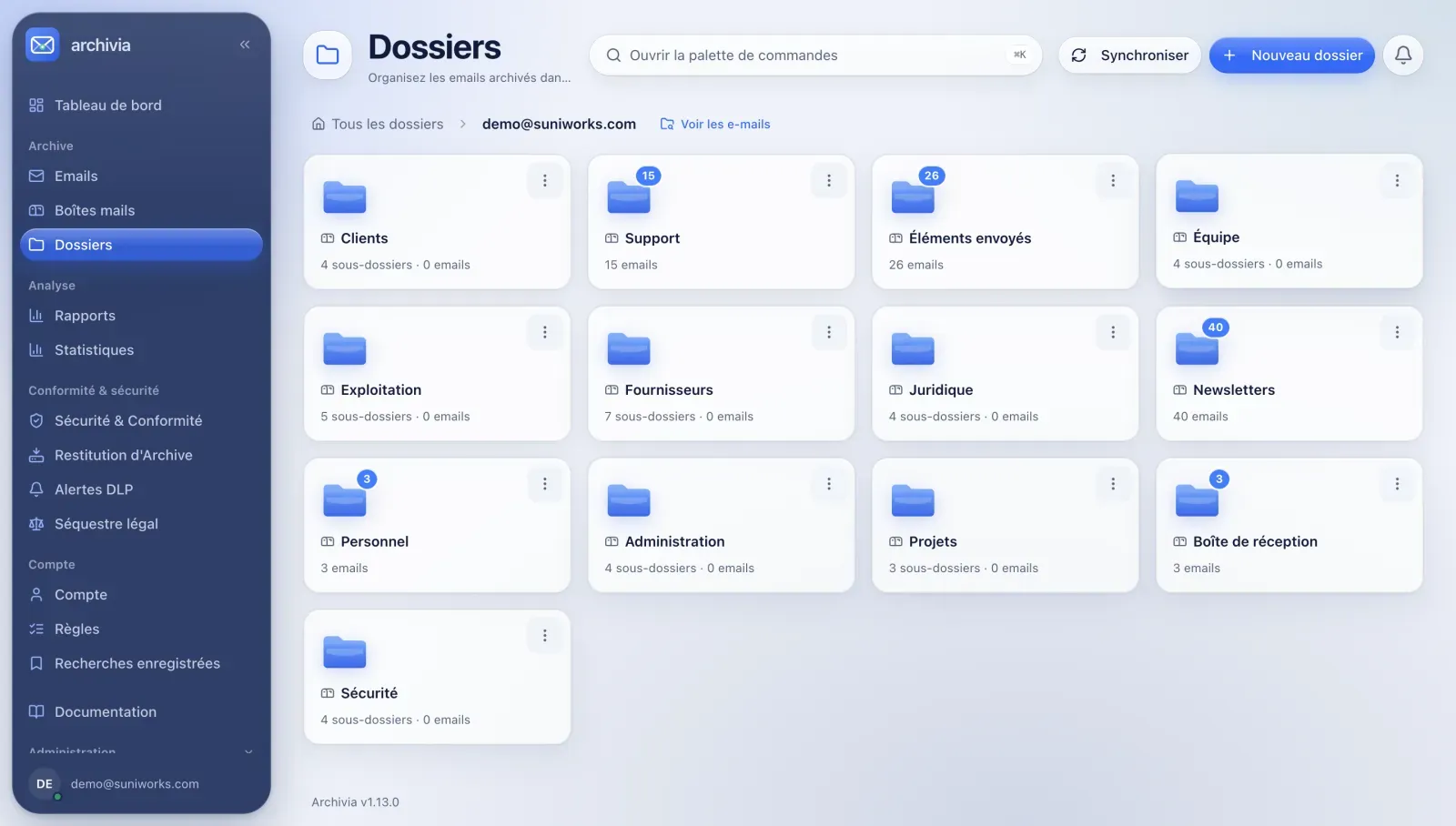
Folder-based navigation through archived business messages; fictional demonstration data.
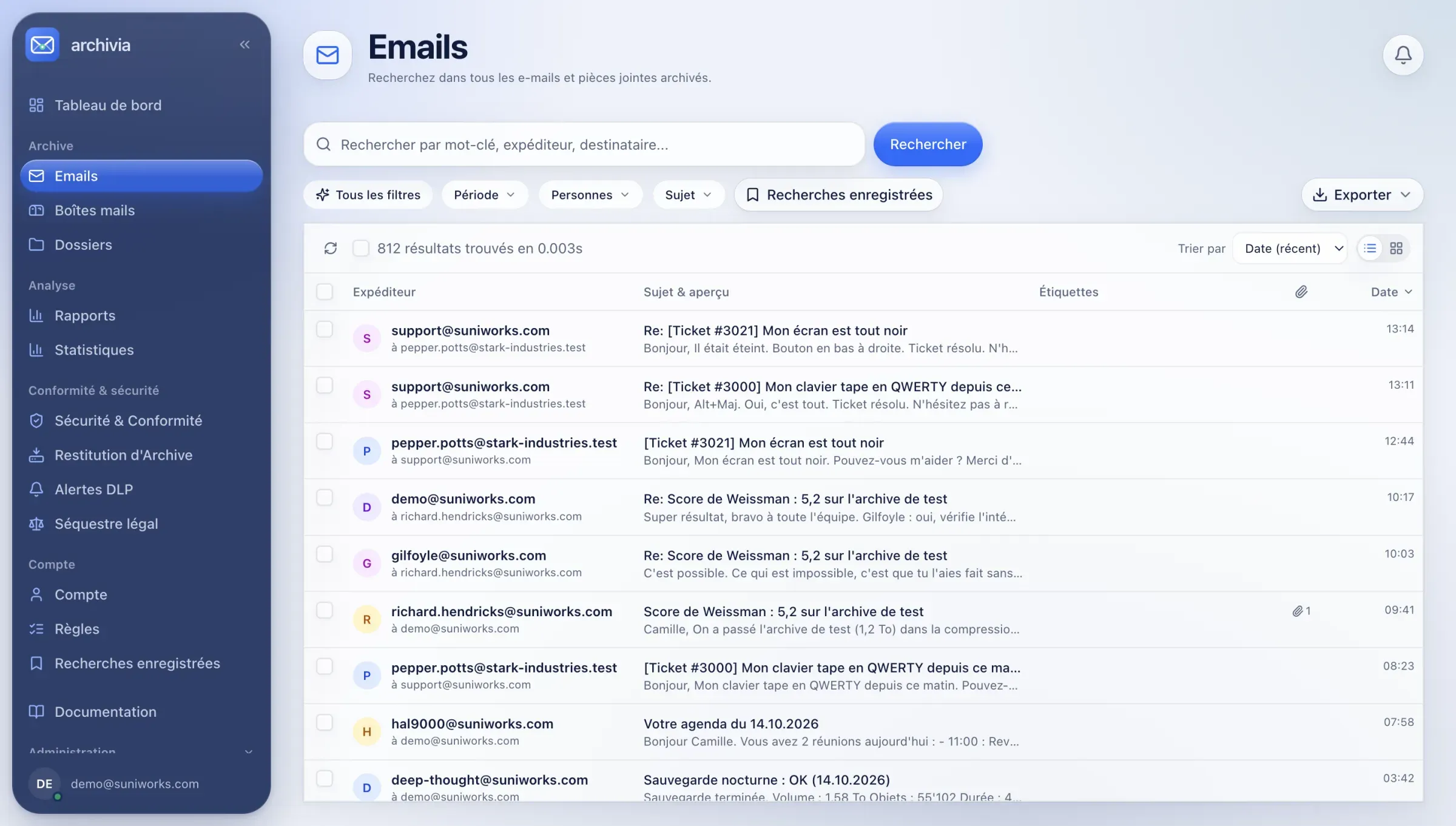
Search and filter the archived message list; fictional demonstration data.
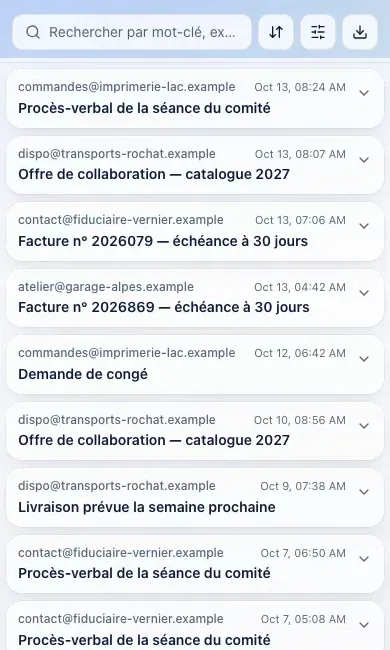
The mobile-browser message list; fictional demonstration data.
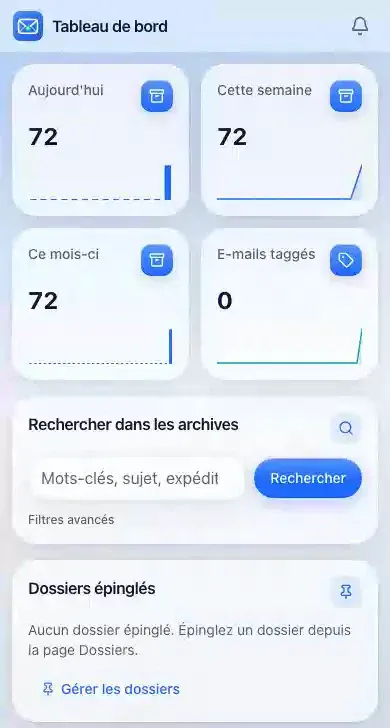
Archive navigation and search on a phone; fictional demonstration data.
Source: official Archivia project page.
Key capabilities
- Inactive-mailbox archiving The Archive seule plan is intended for former employees' mailboxes. It provides a one-time import, preservation, search and export without continuous synchronization or individual employee access. Verify the imported date range, message count and attachments before retiring the original mailbox.
- Continuing mailbox synchronization Protection complète covers active mailboxes, with synchronization advertised every 15 minutes and employee access to their own archive. That interval describes the scheduled workflow; it is not a contractual recovery-point guarantee or proof that every upstream message has already been captured.
- Search across email and attachments Find archived messages through keywords, sender, recipient and filters. The vendor advertises full-text indexing of messages, PDFs and OCR-processed images. Test representative languages and attachment types; encrypted, damaged or unsupported files may require separate handling.
- Retention enforced at storage The provider describes S3 Object Lock in Compliance mode for sealed messages. The terms set a one-year minimum retention floor unless a longer period is contracted. Retention begins when a message is archived, and already sealed messages cannot be released early by reducing a setting.
- Legal holds and an audit journal An administrator can hold mailboxes or saved-search results and inspect a hash-linked audit journal. Saved searches have a 100,000-result cap; newly matching messages join their hold after indexing, with a documented delay of up to 15 minutes. Journal verification does not detect end truncation, and logout is not recorded.
- Open-format export Export selected messages and archives in EML, mbox and CSV formats with a SHA-256 manifest. Active-mailbox users also get direct original-message downloads. A checksum verifies bytes against a reference; completeness and usability still need a separate check.
- Swiss-hosted customer environments The published privacy policy describes separate customer environments, provider-operated storage, local search and text extraction, and authentication through the provider's identity infrastructure. Stripe handles subscription payments. Mail content is not advertised as being sent to an AI-model provider.
- Managed commercial operation Suniworks runs the hosted service and publishes release notes, maintenance and support terms. The offer includes a 14-day trial that continues into paid billing unless cancelled. Messages imported during the trial are still subject to sealing, so a demonstration is the simpler way to explore the interface first.
Where Archivia fits
Preserving a departing employee's correspondence
A departing employee may leave contract discussions, delivery details and attachments that colleagues still need. Archive the approved mailbox scope, verify representative messages and complete the access handover before changing its source account. Keep responsibility for access and retention with a named administrator.
Searching an older business record
An account manager can need an attachment from a completed project without knowing which former employee received it. A central archive can provide a search surface separate from the old Outlook session. Use sender, recipient, dates and distinctive attachment content to test whether the archive answers that actual retrieval task.
Maintaining an archive for active teams
The active-mailbox plan adds continuing capture and employee access. Test permissions with two distinct test users, a newly arrived message and an interrupted source connection. Make the owner of connector failures explicit; a responsive archive interface does not prove that ingestion is current.
Holding a defined set of records
An administrator can apply a legal hold to an entire mailbox or messages returned by a saved search. Document the selection, business authority, scope and release process. The product supplies technical controls; choosing the correct records and duration is an organizational decision rather than an automatic certification.
Preparing an exit or migration
Export representative messages early, open their EML files in another mail tool and verify the manifest. For a full archive, the terms describe an administrator-initiated export and provider assistance on request. Agree who will obtain, verify and store that export before the service account closes.
Positioning and limitations
Archivia fits a business that wants a managed, independently searchable email archive with Swiss data hosting. It is particularly relevant to an IT team evaluating former-employee mail retention and an archive outside the current mail interface. It is supplied as a commercial service, with no public self-hosted offer documented on the product site.
The legal notice says Archivia derives from AGPL-3.0 software and that the affected components retain their original license. Section 17.3 of the terms offers customers corresponding source code on request. The commercial subscription covers the hosted service; component licensing remains a separate part of the offer.
Published monthly rates, excluding VAT, are CHF 1.50 per inactive mailbox for Archive seule and CHF 3.90 per active mailbox for Protection complète. Each subscription starts at ten mailboxes: CHF 15 or CHF 39 per month respectively. The plans include 25 Go or 50 Go per mailbox in a company pool. Annual billing and storage overages have separate terms, and 25 or more mailboxes require a Business quote.
Microsoft 365 provides shared-mailbox and retention workflows. Whether those are sufficient depends on the desired access, licensing, preservation and export model. Archivia provides an independent managed archive with its own search and exit path; compare that operating model with the native options available in the actual tenant.
Messaging backups address a different recovery problem. Veeam and Acronis are listed as related tools for that evaluation, not as interchangeable implementations of the same archive. The Archivia operational guide explains the retention and offboarding decisions in more detail.
An email archive is useful when someone can retrieve the required record after its original owner has left. Storage alone is only one part of that outcome. The team also needs enough import coverage, appropriate access, searchable attachments and an export it can use outside the provider's interface.
The retention setting deserves attention before the first real mailbox is connected. The terms say a sealed message cannot be changed or deleted until its retention period ends, including messages archived during the trial. A one-year floor is configured at provisioning unless a longer period is agreed. This makes selection and retention approval part of onboarding rather than a cleanup task after import.
The privacy policy distinguishes archived content, account details and billing information. Review who can search which mailboxes, which administrators can use technical access and how the organization informs affected employees and correspondents. Swiss hosting describes where the service keeps its archive; it does not by itself establish compliance with every applicable requirement.
Before relying on the service, test an old and a new message, a large attachment, a non-text PDF, a source-connection failure, a role restriction and an export with checksums. Ask about unsupported formats, incomplete imports and the handling of a newly arrived message between synchronization runs. Public screenshots are demonstration data, not a customer-performance result.
Keep the exit process documented. The terms provide 30 days of instance access after the contract ends and describe provider-assisted full restitution within ten working days on request. Section 10.4 bis offers read-only storage access, a decryption key and an offline reader on request, with no post-contract fee until sealing expires. If the provider closes without a successor, section 21.3 requires the customer to copy the archive before shutdown; storage access is not guaranteed afterwards. The service is not certified and has no percentage uptime guarantee in its terms.
“Swiss-hosted email archiving for former employees and active business mailboxes”
Technical details
- Access
- Web platform
- Source model
- Commercial
- License
- Commercial service terms; includes AGPL-3.0 components
- Founded
- Not specified
- Headquarters
- Suisse romande, Switzerland (published operator contact)
- Data location
- Switzerland: provider-operated customer instance and archive storage; Stripe processes subscription payments in the EU
- Pricing model
- Paid
- Pricing details
- Software and service terms ↗
- API
- Not specified
- Version reference
- v1.0.3 (public release page) ↗
- Source checked
- October 15, 2026
- Website
- archivia.suniworks.com ↗
What to verify
Profile audiences: System Administrators, IT Teams.
- Confirm current features, licensing and support terms.
- Validate deployment, data location and access control.
- Test integrations, exports and recovery workflows.
Reviews of Archivia
No published reviews yet.
Loading review form…