

What is Rudder?
Rudder is a system infrastructure automation platform for IT operations teams who want to ensure and improve their security posture. The source is on GitHub under the GPL-3.0 licence, and the project positions it as a way to foster collaboration in Security Operations (SecOps).
A Rudder installation has three parts: a central server with the web interface, the HTTP API and the automation engine; optional relays that act as smart proxies between the server and the agents; and a light agent on every managed system. The agent runs autonomously and checks or changes the system state continuously, every 5 minutes by default. The server can be extended with plugins.
Features include automated systems inventory, patch management, vulnerability management, and system hardening with security standards compliance. Configuration policies can be built in a visual editor or written as YAML. Rudder runs against Cloud, hybrid and on-premise setups on Linux or Windows, and a single server can manage more than 10k systems according to the README.
Rudder Core is available without a subscription. A complete setup that includes the security features needs an active subscription, and a free trial can be requested.
Rudder screenshots
Explore the interface. Open a screenshot to view it at full size.
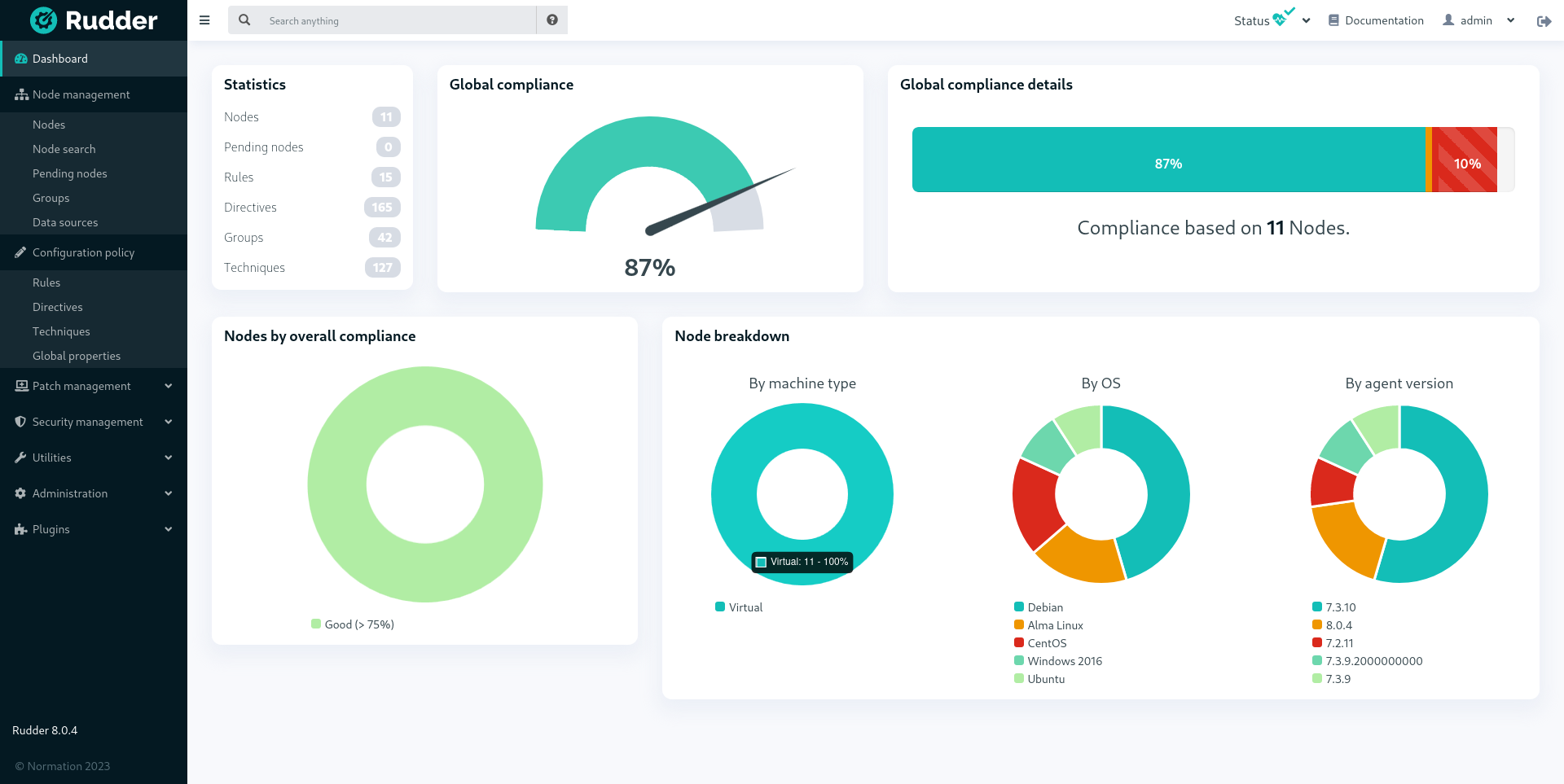
Source: official Rudder project page.
Key capabilities
- Automated systems inventory
- Patch management
- Vulnerability management
- System hardening and security standards compliance
- Configuration policies built in a visual editor or in YAML
- Compliance visualization
- Central server with web interface and HTTP API, plus relays and agents
Where Rudder fits
- Security posture management
- Configuration management with compliance visualization
- Patch and vulnerability management
- Multi-platform support on Linux and Windows
- Scalable architecture with relays
- Plugins and an HTTP API
Reviews of Rudder
Be the first to share your experience with Rudder.
Write a review
Loading review form…
Alternatives to Rudder
 AnsibleAnsible is a free, open source, agentless IT automation engine for provisioning, configuration management, application deployment and orchestration.
 IntuneAutomationIntuneAutomation is a free, MIT-licensed library of PowerShell scripts for Microsoft Intune that use Microsoft Graph. Scripts run locally or as Azure Automation runbooks, with a web catalog, an AI script generator and a hosted MCP server.