

What is OctoAI?
OctoAI, formerly OctoML, was a company in Seattle that offered a generative AI inference platform. Its website as archived on October 24, 2024 carried the headline "OctoAI is now NVIDIA". GeekWire reported the acquisition in September 2024 and reported that OctoAI had emailed customers that it was winding down the commercial availability of its services, effective October 31, 2024. As of November 10, 2026, octo.ai and its documentation addresses redirect to nvidia.com, and no OctoAI service is offered.
Before the shutdown, OctoAI ran a hosted service that served open-source models through an API, with per-token pricing for language models. The archived Text Gen Solution page describes LLM inference with fine-tuning, LoRA swapping at the same per-token price as the base model, embeddings for retrieval-augmented generation, function calling and JSON mode. A Media Gen Solution covered image generation models such as Stable Diffusion XL and FLUX.1 [Schnell].
The company also sold OctoStack, a serving stack that ran in a customer's VPC, cloud account or on-premises hardware. OctoAI stated that its platform was built on systems and compilation technologies its team had launched, namely XGBoost, Apache TVM and MLC/MLC-LLM, and that the hosted service was SOC 2 Type II certified.
This profile is kept for reference. Existing integrations that pointed to OctoAI endpoints no longer work. Active inference services listed on iThub include DeepInfra, Together AI and Fireworks AI.
OctoAI screenshots
Explore the interface. Open a screenshot to view it at full size.
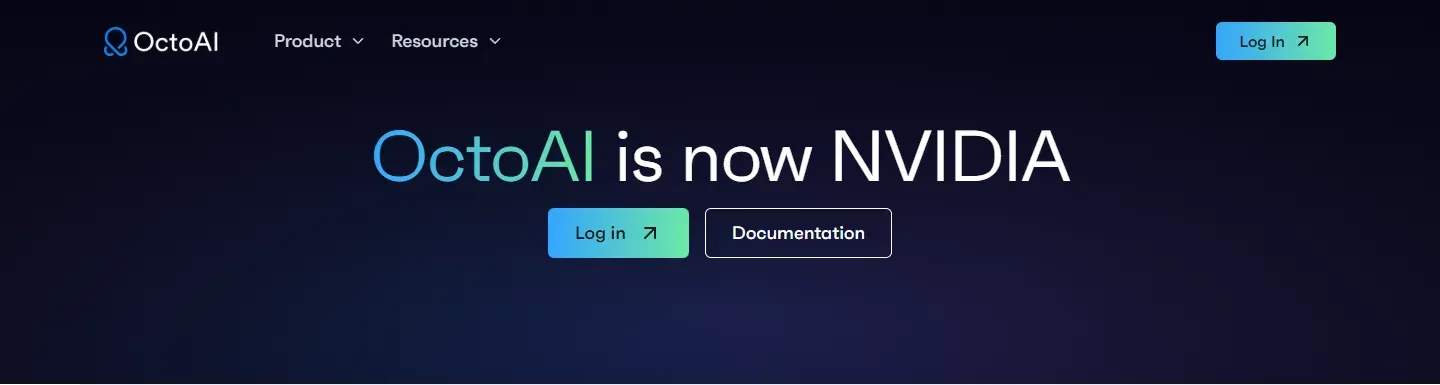
OctoAI homepage as archived by the Internet Archive on October 24, 2024, one week before the service shutdown.
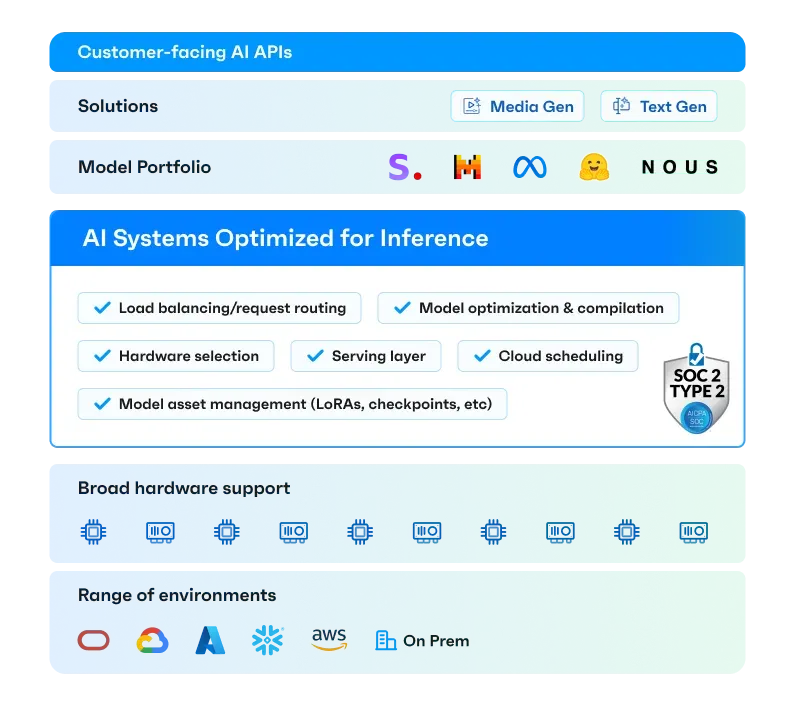
Official OctoAI platform diagram from the archived octo.ai website (Internet Archive copy).
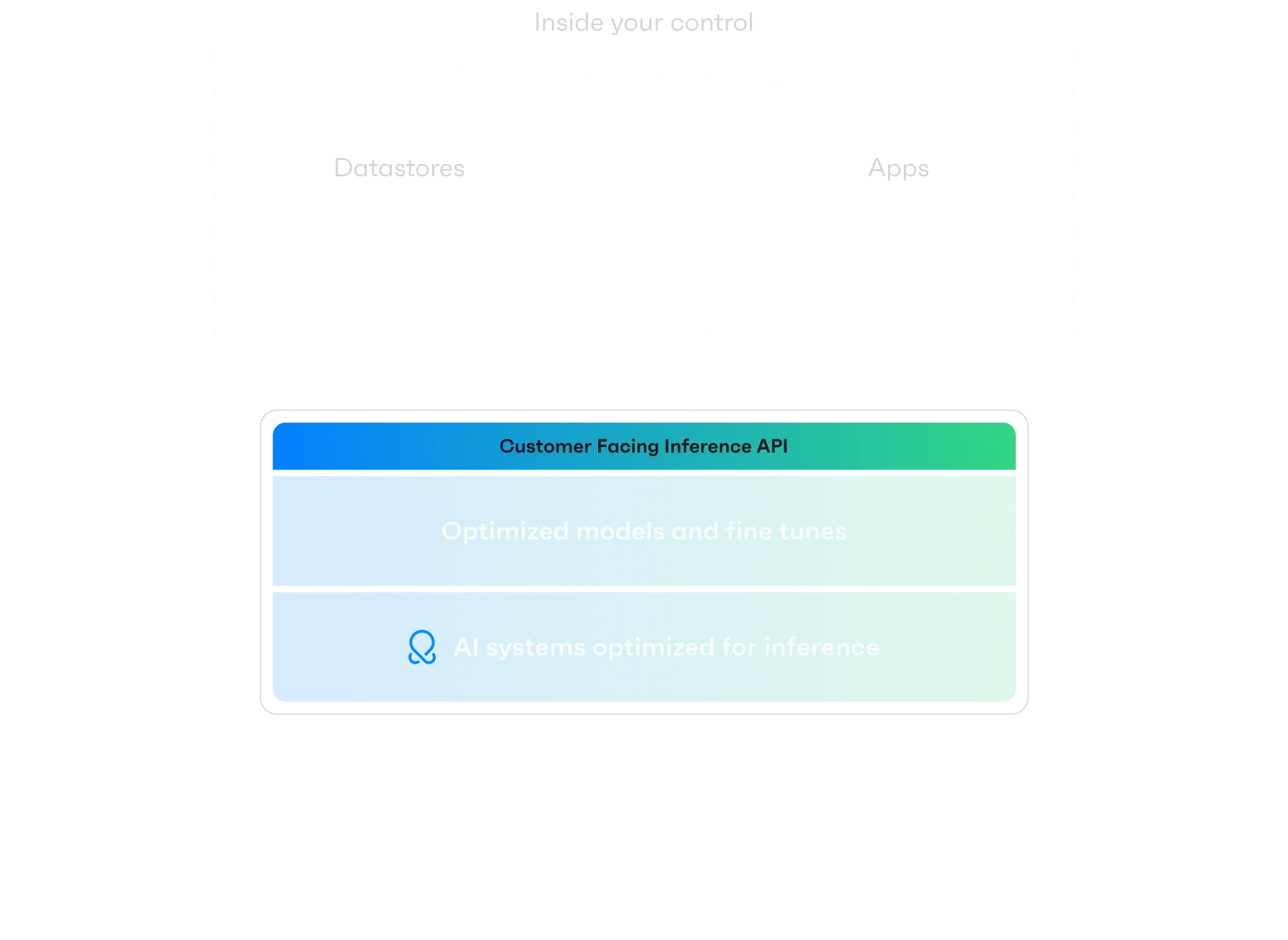
Official OctoStack architecture diagram from the archived octo.ai website (Internet Archive copy).
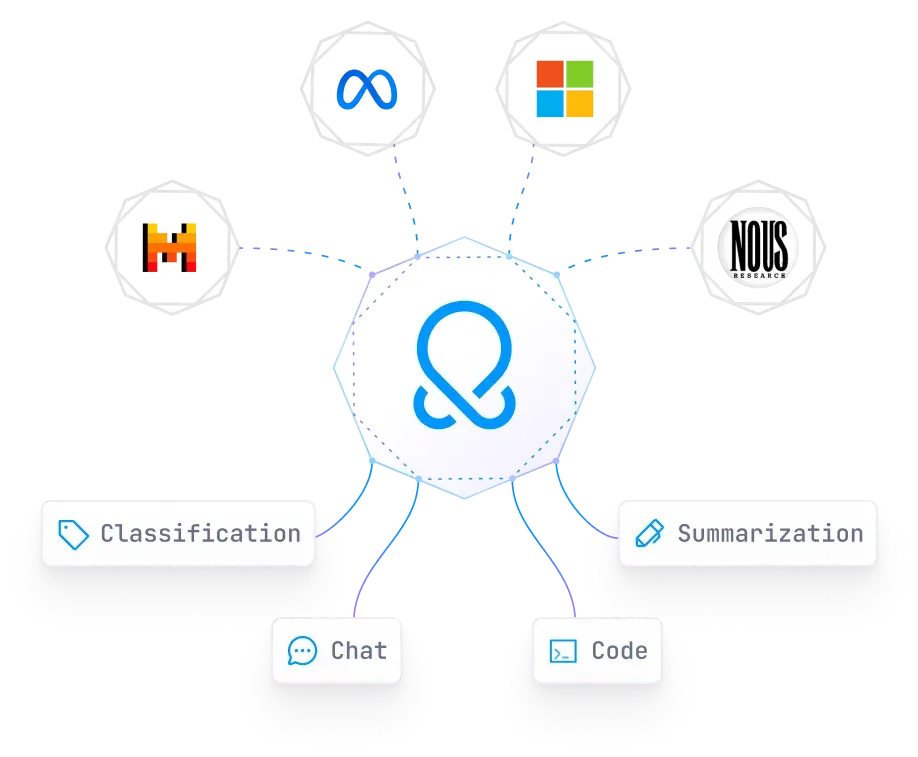
Official Text Gen Solution illustration from the archived octo.ai website (Internet Archive copy).
Source: official OctoAI project page.
Key capabilities
- Service status Discontinued. OctoAI's commercial services ended on October 31, 2024, following the acquisition by NVIDIA, and octo.ai now redirects to nvidia.com. The items below describe the product as documented on the archived official website before the shutdown.
- Hosted model inference The hosted service ran open-source language and image models behind an API, with a model catalog that in autumn 2024 listed models such as Llama 3.1 Instruct, Mistral NeMo, Phi 3.5-Vision and FLUX.1 [Schnell]. The archived homepage linked a web chat demo and an image generation demo on octoai.cloud.
- Text Gen Solution Language model inference was billed per token. Fine-tuned variants served through LoRA swapping were billed at the same per-token price as the base model, according to the archived product page.
- Fine-tuning and LoRAs Customers could fine-tune models for specific use cases and serve many LoRA adapters from a single endpoint. The product page described evaluation of quality across fine tunes.
- Embeddings and RAG Embedding models were offered for retrieval-augmented generation workflows, and a Snowflake integration ran RAG with OctoStack inside Snowpark.
- Function calling and JSON mode Function calling supported tool-using agents, and JSON mode returned structured outputs for integration with other systems.
- Media Gen Solution Image generation covered Stable Diffusion XL and FLUX.1 [Schnell], among other models, with image fine-tuning used by customers named on the website.
- OctoStack OctoStack was a turnkey serving stack that ran in the customer's environment: a VPC on AWS, Microsoft Azure, Google Cloud, OCI, CoreWeave, Lambda Labs or Snowflake, or on-premises. Supported hardware included NVIDIA and AMD GPUs, Google TPUs and AWS Inferentia, as stated on the archived OctoStack page.
- Serving optimizations The OctoStack page described optimizations that customers could switch on or off, including load balancing and request routing, model optimization and compilation, hardware selection and model asset management for LoRAs and checkpoints.
- Security claims The website stated that the platform was SOC 2 Type II certified and that customer data was not used for training.
- Uptime commitment The archived homepage advertised 99.999 percent uptime with latency SLAs for the hosted service.
- Open-source lineage OctoAI stated that its stack built on XGBoost, Apache TVM and MLC/MLC-LLM, compiler and machine learning projects its team had launched. Those open-source projects continue independently of the discontinued service.
- Stated performance figures The OctoStack page stated that its optimizations, which could be switched on or off per deployment, gave 4x to 5x improvements in low-concurrency use and up to 10x or more for deployments with tens to hundreds of concurrent users, and up to 4x better GPU utilization. The Text Gen page claimed up to 25x lower cost with fine-tuned open models than GPT-4o. These are OctoAI's own benchmark statements.
- Expert services and resources The site listed OctoStack Expert Services, an OctoStack info brief from May 2024, webinars on running GenAI in a private environment and on Snowflake data, and demos on fine-tuning LLMs, building agents with function calling and choosing a model for production.
- Cloud partnerships The archived homepage quoted product leaders from AWS and Google Cloud on partnerships to serve generative AI models on their infrastructure, and described Mistral NeMo as built in collaboration with NVIDIA.
Where OctoAI fits
Serving open-source LLMs through an API
Developers called hosted open-source language models such as Llama 3.1 and Mistral NeMo through the OctoAI API, paying per token. The service has ended, so the API endpoints and API keys no longer work.
Deploying fine-tuned variants
Teams fine-tuned base models and served LoRA variants from one endpoint at the base model's per-token price, as described on the archived Text Gen Solution page. Model weights and adapters stored on OctoAI were part of the discontinued service.
Generating images
Image applications used hosted Stable Diffusion XL and FLUX.1 [Schnell] models, with fine-tuned image variants for custom styles. Customer stories on the website included NightCafe, an AI art service that reported faster image generation on OctoAI.
Running inference in a private environment
Enterprises used OctoStack to run optimized models in their own cloud account, VPC or data center, close to their data, on NVIDIA or AMD GPUs, Google TPUs or AWS Inferentia. The archived OctoStack page also describes a Snowflake deployment for RAG over Snowflake data.
Building RAG and agent features
Applications combined embeddings, function calling and JSON mode to build retrieval-augmented assistants and tool-using agents on open models. Similar capabilities are documented by active providers such as DeepInfra.
Customer deployments named by OctoAI
The archived website quoted customers that ran production workloads on the service. Latitude stated that Mixtral on OctoAI served the majority of inferences for its AI Dungeon game, Capitol AI and OthersideAI described evaluating and serving fine-tuned model variants, and Apate AI described running customized models with OctoStack in an environment it controlled.
Reviews of OctoAI
Be the first to share your experience with OctoAI.
Write a review
Loading review form…
Alternatives to OctoAI
 DeepInfraDeepInfra is an AI inference cloud that serves 200+ open and hosted models through OpenAI- and Anthropic-compatible APIs, billed per token or execution time, plus dedicated GPU deployments, GPU instances, sandboxes and batch jobs.
 Together AITogether AI provides serverless and dedicated inference, fine-tuning and post-training, and GPU clusters for teams running open-source models.
 Fireworks AIFireworks AI runs open models through pay-per-token serverless inference, reserved throughput and inference inside your own cloud, plus training and routing.