

What is DeepInfra?
DeepInfra is an AI inference cloud operated by Deep Infra Inc., a Delaware corporation. The about page states that the company was founded in September 2022 and names Nikola Borisov as founder and CEO, with Georgios Papoutsis and Yessenzhar Kanapin as founders. On May 4, 2026 DeepInfra announced a $107 million Series B co-led by 500 Global and Georges Harik, with participation from A.Capital Ventures, Crescent Cove, Felicis, NVIDIA, Peak6, Samsung Next, Supermicro and Upper90; the announcement states that token volume grew 25 times since the Series A.
The service exposes a catalog of more than 200 models, including text generation, embeddings, rerankers, text to image, text to video, text to speech, speech recognition and zero-shot image classification. Model families listed on the site include DeepSeek, Kimi, GLM, Qwen, Llama, Mistral, Nemotron and Flux, as well as Claude and Gemini models served through their vendors. Applications call the models through an OpenAI-compatible endpoint at api.deepinfra.com/v1/openai, an Anthropic-compatible Messages endpoint at api.deepinfra.com/anthropic or the DeepInfra native inference API, as described in the documentation.
Pricing is published per model on the pricing page. Many language models are billed per million input and output tokens, with lower rates for cached input; most other models are billed for inference execution time. Priority scheduling costs 1.5 times the base price and Flex scheduling 0.8 times, and the Batch API is billed 20 percent below real-time prices. An account needs a card or a prepaid balance before use, and a spending limit can be set. There is no free tier; the DeepStart program offers credits to startups that meet its funding and age criteria.
Beyond shared model endpoints, DeepInfra offers dedicated deployments of custom or fine-tuned models on A100, H100, H200, B200 and B300 GPUs billed per GPU-hour, GPU instances with SSH access, sandboxes for running untrusted code, hosted agent instances and DeepCluster, a dedicated NVIDIA B300 cluster offer on multi-year terms. The site states that DeepInfra runs on its own inference infrastructure in US-based data centers and is SOC 2 and ISO 27001 certified.
DeepInfra is a closed, hosted service and cannot be self-hosted; the models it serves keep their own licenses. Similar services listed on iThub include Together AI, Fireworks AI and Replicate.
DeepInfra screenshots
Explore the interface. Open a screenshot to view it at full size.
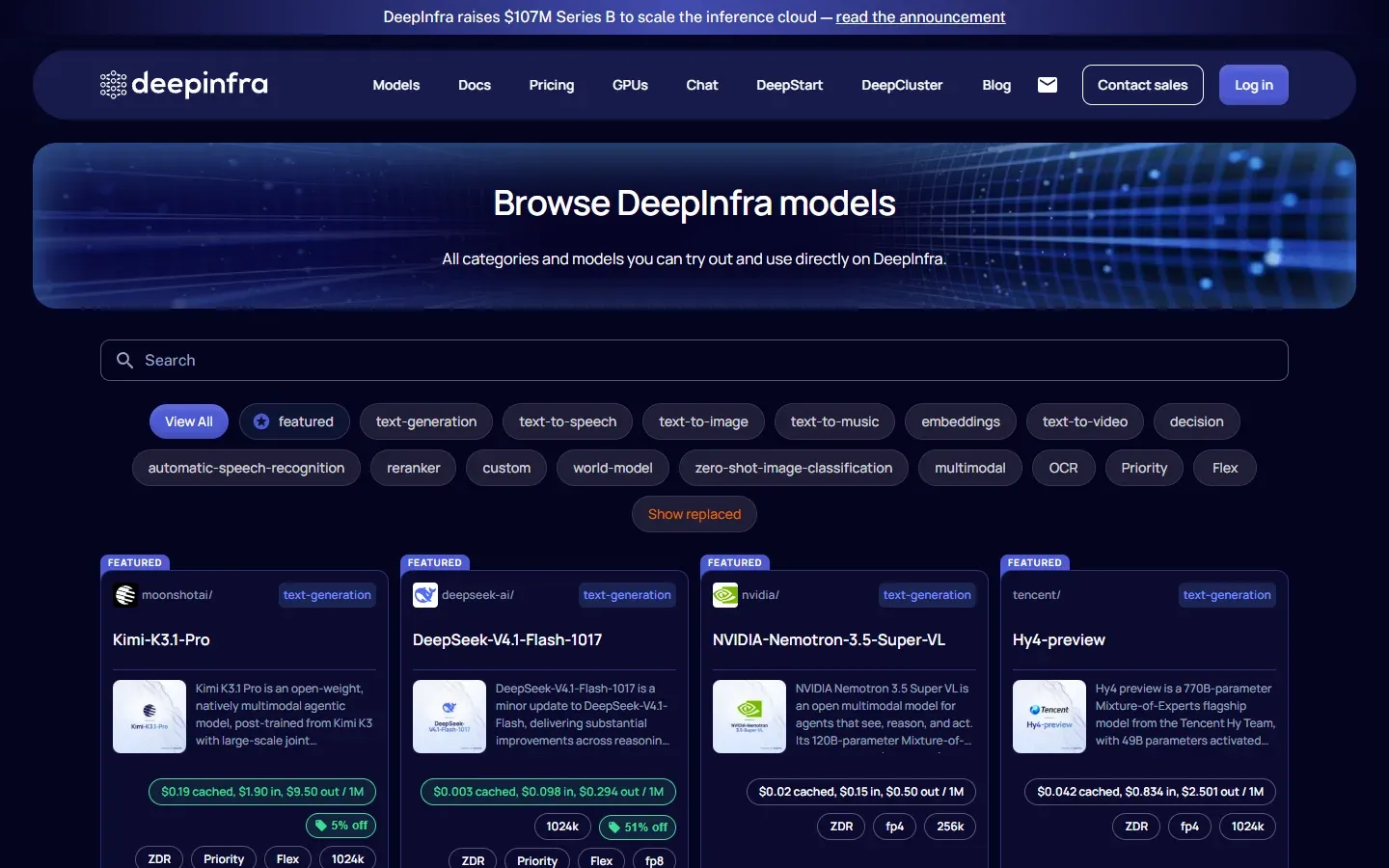
Capture of the public DeepInfra model catalog page on deepinfra.com, November 10, 2026.
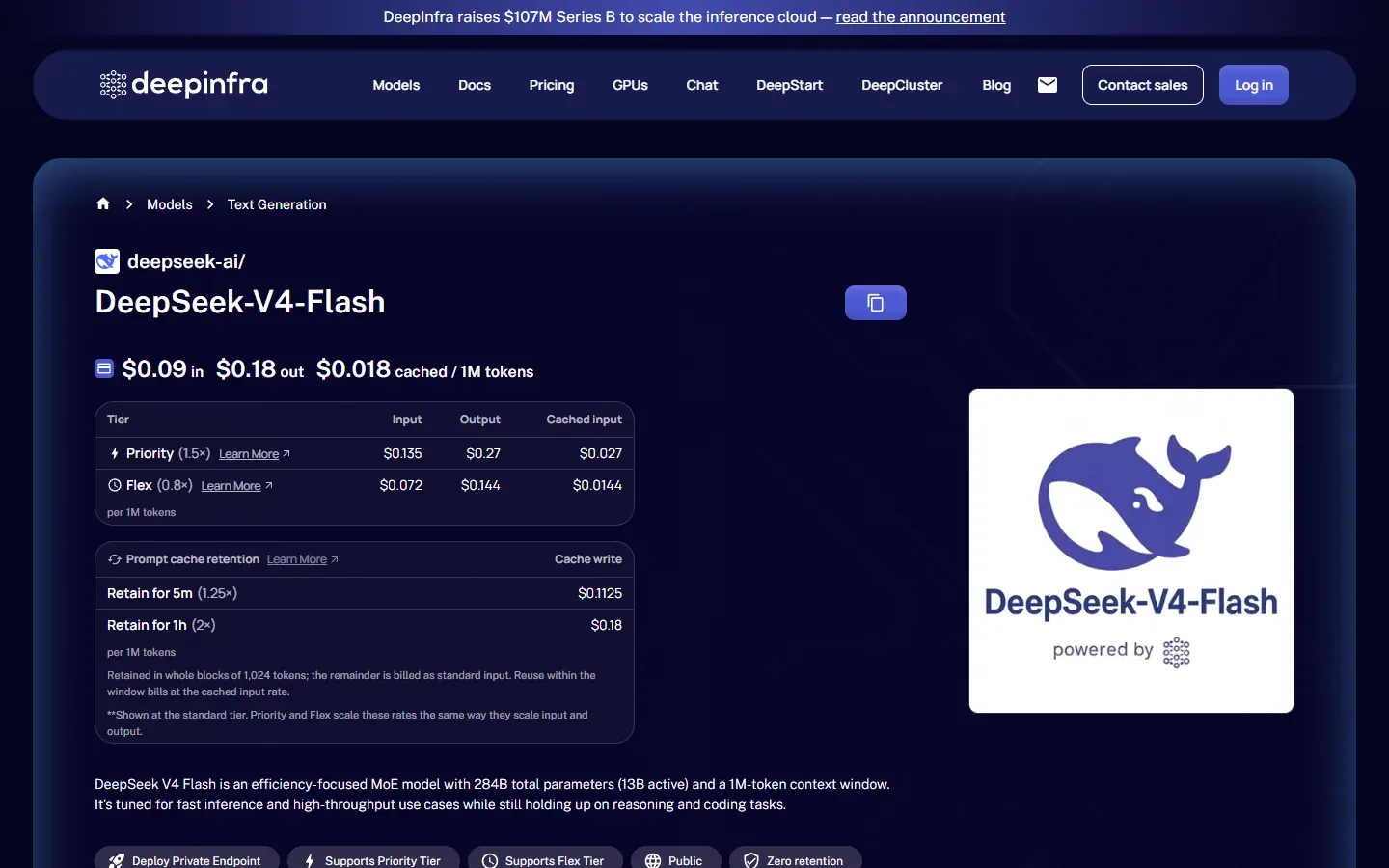
Capture of the public DeepSeek-V4-Flash model page on deepinfra.com, November 10, 2026.
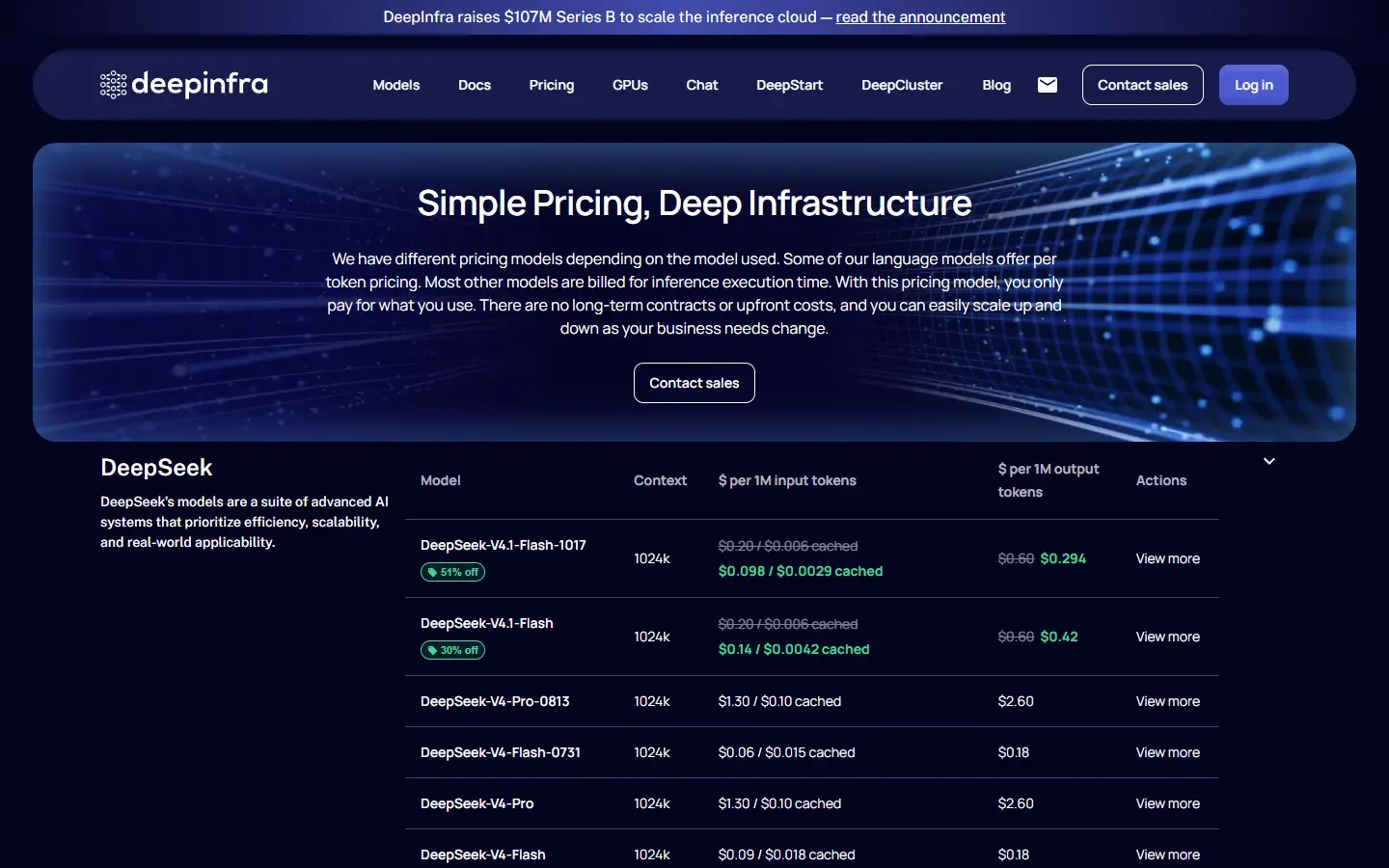
Capture of the public DeepInfra pricing page, November 10, 2026.
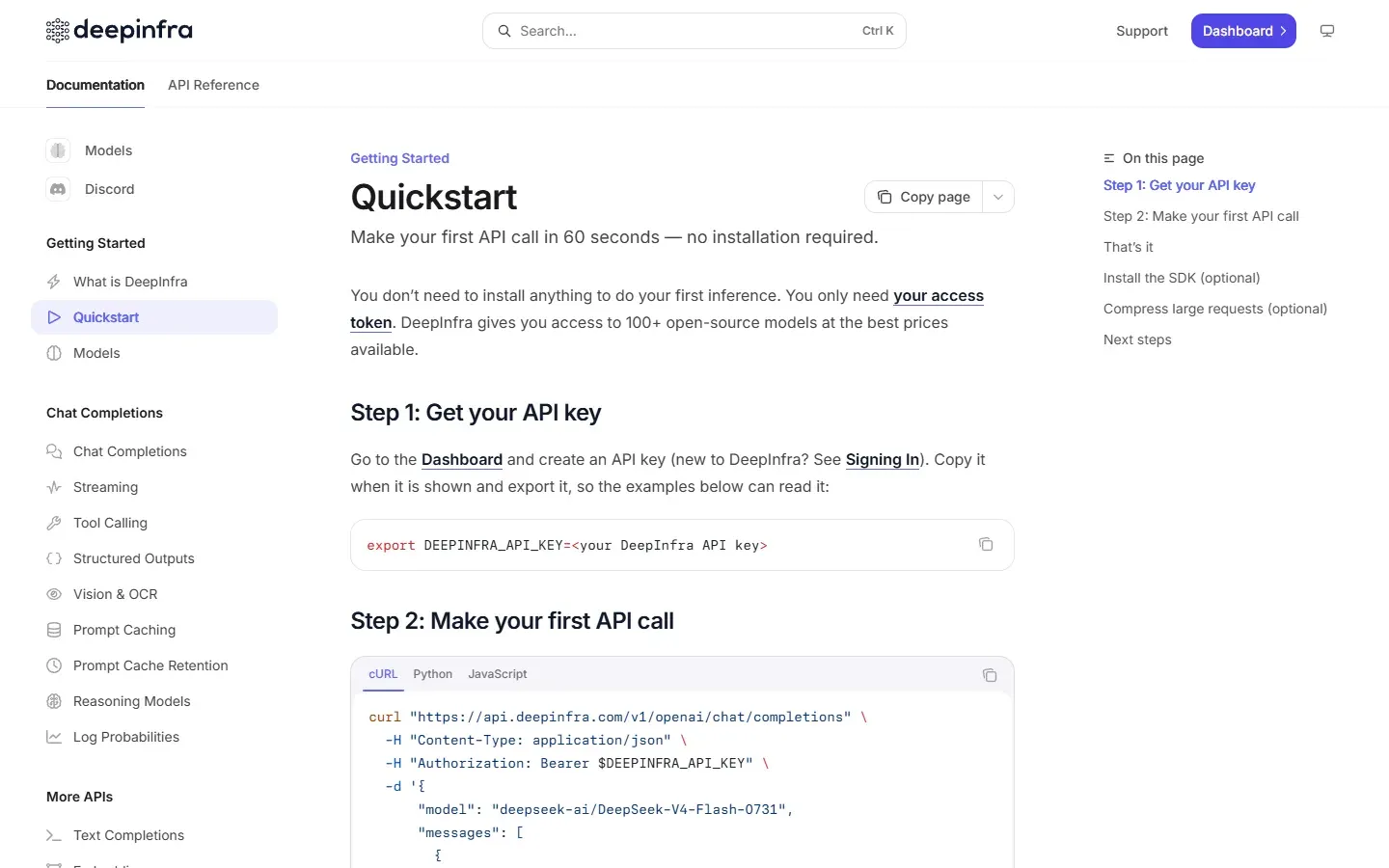
Capture of the DeepInfra documentation quickstart page, November 10, 2026.
Source: official DeepInfra project page.
Key capabilities
- OpenAI-compatible chat completions Existing OpenAI SDK code works after changing the base URL to https://api.deepinfra.com/v1/openai and the model name. The documented chat features include streaming over server-sent events, tool calling, structured outputs through response_format, reasoning controls, log probabilities and the legacy completions API, listed in the chat completions guide.
- Anthropic-compatible Messages API DeepInfra exposes POST /anthropic/v1/messages and a token-counting endpoint at api.deepinfra.com/anthropic. Tools that target the Anthropic API, including Claude Code and the Anthropic Python and TypeScript SDKs, can point at this endpoint to use the open models in the catalog.
- Native inference API The native endpoint api.deepinfra.com/v1/inference/{model_name} covers every model type, including image generation, speech recognition and zero-shot image classification, and supports webhooks for asynchronous results. A JavaScript client is published as the deepinfra npm package.
- Model catalog The catalog lists more than 200 models across text generation, embeddings, rerankers, text to image, text to video, text to music, text to speech, speech recognition and world models. Each model page shows context length, per-token or execution prices, supported tiers and a zero-retention label where it applies.
- Per-model pricing Prices are listed per model, for example DeepSeek-V4-Flash at $0.09 per million input tokens and $0.18 per million output tokens on the pricing page checked on November 10, 2026. Discounts on selected models are shown with the original price, and cached input is billed at a lower rate.
- Service tiers Standard is the default scheduling. Priority is scheduled ahead of standard traffic for faster time to first token at 1.5 times the base price, and Flex costs 0.8 times the base price for non-production and asynchronous work with slower responses. The tier is selected per request with the service_tier parameter, and availability varies by model.
- Prompt caching Repeated prompt prefixes are cached to reduce latency and cost. Prompt cache retention can keep a prefix for 5 minutes or 1 hour, billed as a cache write, so later requests skip prefill and pay the cache-read rate.
- Batch API The OpenAI-compatible Batch and Files APIs accept a JSONL file of requests and return results within 24 hours at 20 percent below real-time pricing. Supported endpoints are chat completions, completions and embeddings; image, moderation, responses and video endpoints are rejected, according to the Batch API introduction.
- Embeddings, reranking, images, video and speech Separate guides cover embeddings for text and images, document reranking, OpenAI-compatible image generation, text to video, Whisper and other speech recognition models, and text to speech. Image generation outputs are stored briefly so they can be retrieved, unlike text inputs and outputs.
- Custom LLM deployments A public or private Hugging Face model can be deployed on dedicated A100-80GB, H100-80GB, H200-141GB, B200-180GB or B300 GPUs with an OpenAI-compatible endpoint. Deployments set the GPU type, GPU count and maximum batch size, and scale between minimum and maximum instances, including scale to zero. They are billed per GPU-hour regardless of traffic; listed rates run from $1.49 per GPU-hour for an A100 to $5.89 for a B300.
- LoRA adapters LoRA fine-tuned language models can be deployed on supported base models, and LoRA adapters for text-to-image generation can be loaded from Civitai models. Adapters are managed through dedicated API endpoints.
- GPU instances Dedicated B200 GPU containers with SSH access are rented by the hour, with configurations such as 1x or 8x B200-180GB. A custom Docker image or the DeepInfra image can be used, and billing runs only while the container is running, as described in the GPU instances guide.
- Sandboxes Sandboxes are isolated Linux microVMs for running untrusted code, created through the dashboard, the Python SDK or the HTTP API. Only the /workspace directory survives a stop and start cycle, sandboxes accept no inbound connections, and billing is per second with no minimum while a sandbox is active.
- Hosted agents Managed virtual machines run the open-source OpenClaw or Hermes-Agent frameworks, wired to a dedicated DeepInfra API key. Plans range from tiny (2 vCPU, 1 GB RAM) to standard (2 vCPU, 4 GB RAM), with compute billed per hour and model usage billed at token prices.
- Framework integrations The documentation includes guides for LangChain, LlamaIndex, the Vercel AI SDK, CrewAI, Microsoft Agent Framework, AutoGen, Pi, Hermes Agent and NVIDIA OpenShell.
- Data handling The data privacy page states that inputs are held only in memory during inference, outputs are deleted after delivery, request content is not logged and data is not used for training. Exceptions apply to Google and Anthropic models, whose vendors store data under their own policies, and to bulk inference, where data may be stored encrypted on disk for a short period.
- Accounts, authentication and limits Sign-in supports Google, GitHub, email and password, and corporate SSO including Okta. API keys can be scoped, and scoped JWTs grant limited third-party access. Each account has a default limit of 200 concurrent requests per model, with HTTP 429 returned above it and increases requested from the dashboard.
- Billing and startup credits Prepaid accounts draw down a balance and invoiced accounts are billed at the start of the following month. The DeepStart program offers about 50 billion tokens at DeepSeek V4 Flash prices to startups founded in the last two years that have raised between $250,000 and $10 million; credits expire one year after approval.
Where DeepInfra fits
Replacing a closed model API with open models
Applications that use the OpenAI SDK switch to DeepInfra by changing the base URL to api.deepinfra.com/v1/openai, supplying a DeepInfra API key and choosing a model from the catalog. The quickstart shows the first call with cURL, Python and JavaScript. Applications built on the Anthropic SDK or Claude Code use the Anthropic-compatible endpoint instead.
Building retrieval and search pipelines
Embedding models produce vectors for documents and queries through the OpenAI-compatible embeddings API, and reranker models reorder retrieved documents by relevance. The LangChain and LlamaIndex integrations connect these models and the chat models to retrieval frameworks.
Processing large datasets offline
Non-urgent workloads such as embedding a corpus or classifying a dataset are written as JSONL requests, uploaded through the Files API and submitted as a batch that completes within 24 hours at 20 percent below real-time pricing. For synchronous bulk work, the documentation describes keeping requests under the limit of 200 concurrent requests per model.
Serving a fine-tuned or private model
A model from a public or private Hugging Face repository is deployed on dedicated GPUs with chosen GPU type and count, and exposed through an OpenAI-compatible endpoint. Minimum and maximum instance counts control autoscaling, with zero minimum instances allowed. LoRA adapters are an alternative for supported base models, as described in the custom LLM guide.
Running agents and generated code
Agent frameworks such as CrewAI, AutoGen or Microsoft Agent Framework call DeepInfra models for reasoning and tool calls, and generated code can run inside DeepInfra sandboxes that are created and torn down through the API. Hosted agent instances provide managed OpenClaw or Hermes-Agent setups with their own API key.
Training and experiments on dedicated GPUs
GPU instances provide B200 containers with SSH access for fine-tuning, training or research, billed by the hour only while running. Larger and long-term capacity is offered through dedicated instances, DGX clusters and the DeepCluster B300 program by contacting DeepInfra sales.
Reviews of DeepInfra
Be the first to share your experience with DeepInfra.
Write a review
Loading review form…
Alternatives to DeepInfra
 Together AITogether AI provides serverless and dedicated inference, fine-tuning and post-training, and GPU clusters for teams running open-source models.
 Fireworks AIFireworks AI runs open models through pay-per-token serverless inference, reserved throughput and inference inside your own cloud, plus training and routing.
 ReplicateReplicate runs public and custom machine learning models through an API, billed by usage, with Cog as the open-source tool for packaging your own models.