

What is Sellbird?
Sellbird, formerly Harvey, is an open-source outreach agent that finds companies matching a customer profile, identifies the person who decides, checks their email address, writes each one a short personal cold email, sends it and handles the replies. The self-hosted version runs on the user's own computer and thinks through the Claude Code CLI on a Claude Pro or Max plan, or the Codex CLI on a ChatGPT plan, so there is no model API key or per-token bill. By default every outgoing email waits for approval in a local dashboard. The code is in the ethanplusai/sellbird repository and the project site is sellbird.ai.
Harvey was renamed Sellbird in version 0.4.0, released on November 6, 2026. The release notes and the Harvey is now Sellbird page state that the name Harvey belongs to another AI company; the project and its history stayed the same, and old github.com/ethanplusai/harvey links redirect. Existing configuration and data move to the new file names on first run, HARVEY_* variables still work, and the harvey command keeps working until February 2027. The same release changed the license from MIT to the GNU AGPL v3.0; releases up to 0.3.x stay MIT.
Sellbird is a Python 3.11+ application installed from a git checkout with pip install -e ., or through a guided setup in which Claude Code follows the repository's CLAUDE.md. Docker Compose is documented for native Linux. There are no binary packages; the sellbird package on PyPI is a 0.0.1 name placeholder. A heartbeat wakes every 15 minutes by default, checks quiet hours and the subscription budget, and picks the next job deterministically: replies, sending, writing, prospecting or analysis. Five agents (Scout, Writer, Sender, Handler and Analyst) share an editable Markdown skills library, facts are stored as observations in SQLite, and the dashboard is a FastAPI service with plain HTML, CSS and JavaScript.
0.2.0 (September 13, 2026) added the four-stage prospecting pipeline with free OpenStreetMap discovery and native mail sending. 0.2.1 (October 13, 2026) was a security release that runs every Claude call with no tools, after a private report showed that text in replies or scraped pages could steer a tool-enabled model, and 0.3.0 the same day added Codex as an opt-in provider. Besides the rename, 0.4.0 added the Microsoft 365 provider, the optional Precleared check, a do-not-contact list, sending in each recipient's office hours, a warmup ramp, startup and hiring discovery presets, and a visible approval or autopilot switch. The changelog lists every change.
The self-hosted version is free; costs come from the user's subscription, a mailbox (the README cites about $7 a month for Google Workspace) and any paid discovery source, from about $0.37 per 1,000 businesses. A hosted version at sellbird.ai, with domains, inboxes and warmup managed, is in early access with pricing shared before any charge; it has no AI of its own and connects to the customer's agent over remote MCP. Related projects on iThub include Comp AI CRM and Relaticle, and Sellbird can use Codex CLI as its model provider.
Sellbird screenshots
Explore the interface. Open a screenshot to view it at full size.
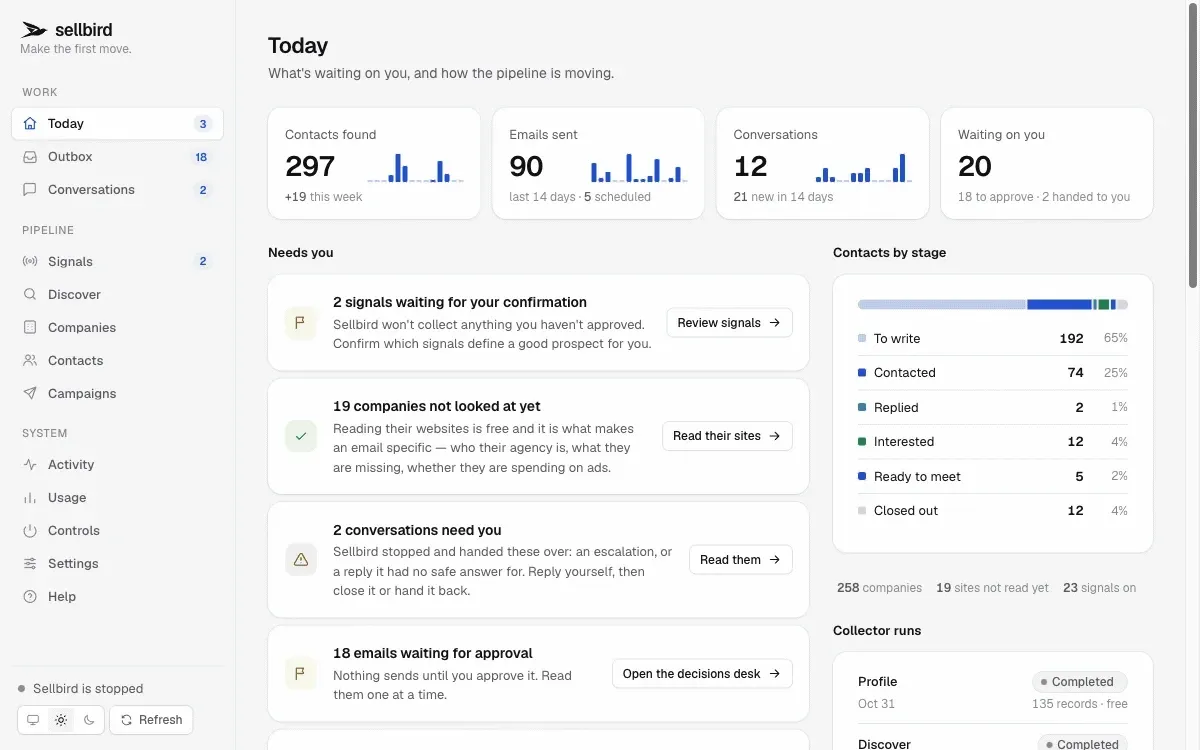
Today screen of the Sellbird dashboard, frame from the official demo recording (invented demo data).
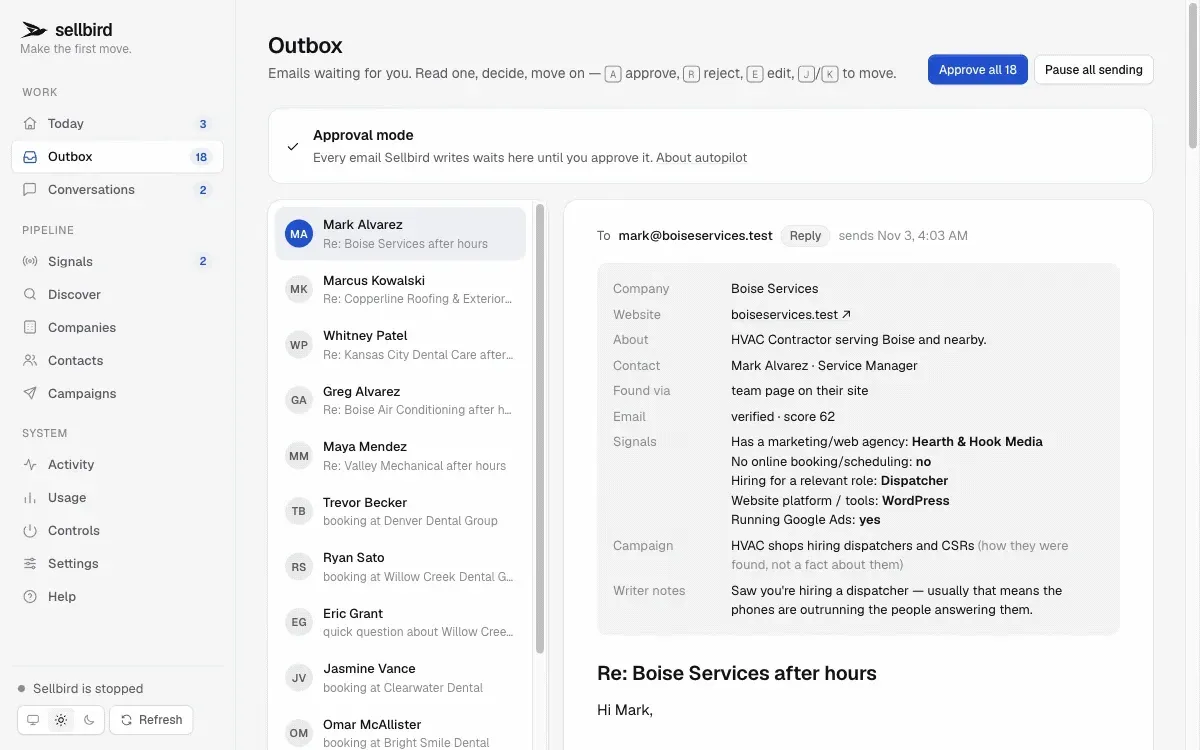
Outbox decisions desk in approval mode, with the research behind a draft (invented demo data on .test domains).
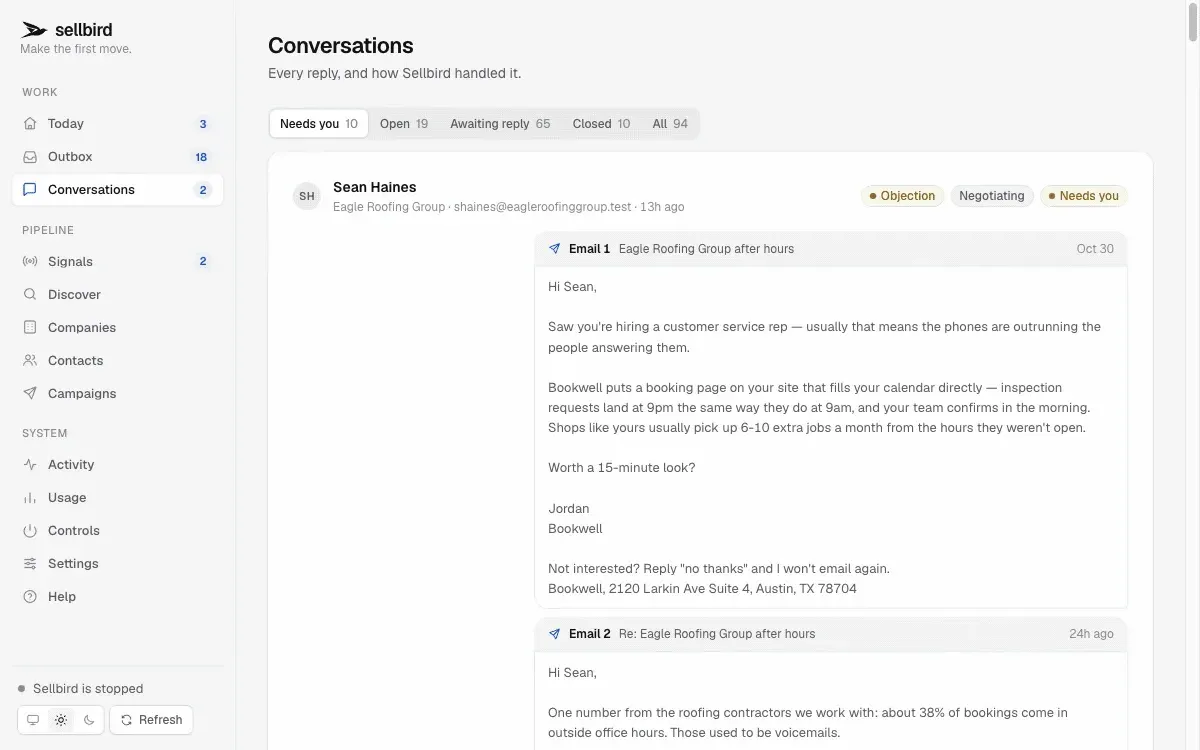
Conversations tab with a thread handed to the user and the sent sequence (invented demo data).
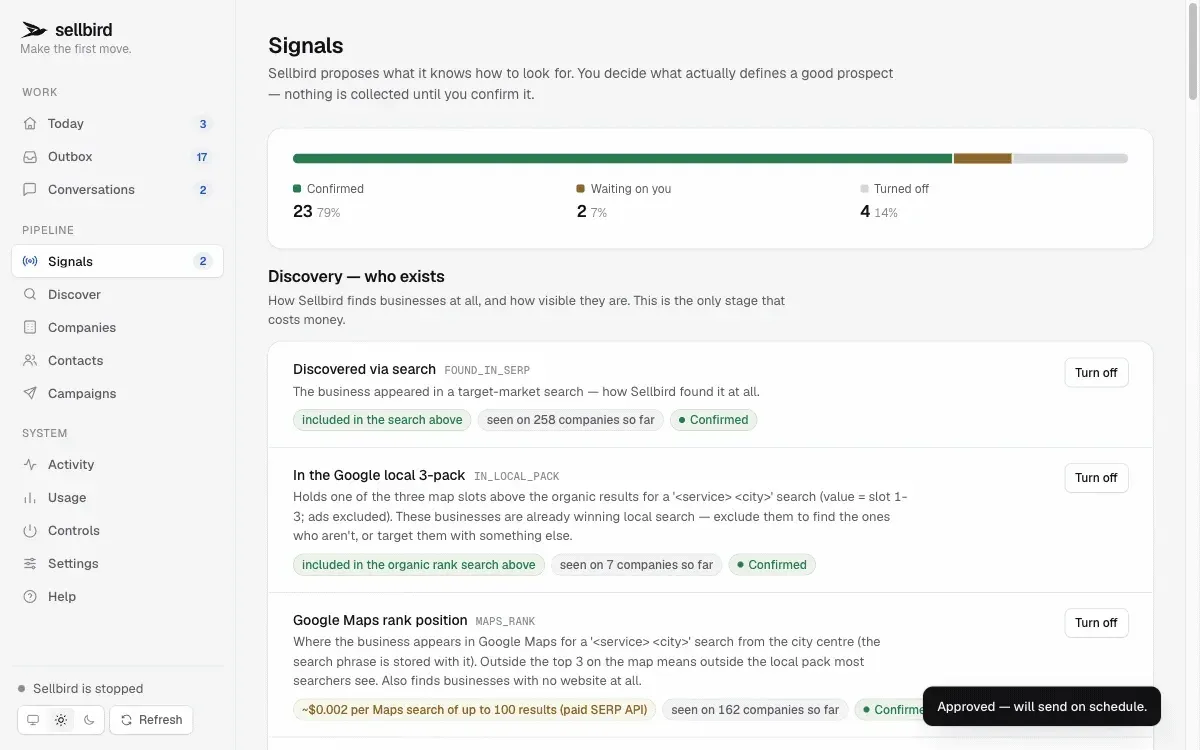
Signals confirmation gate: nothing is collected until a signal is confirmed, from the official demo recording.
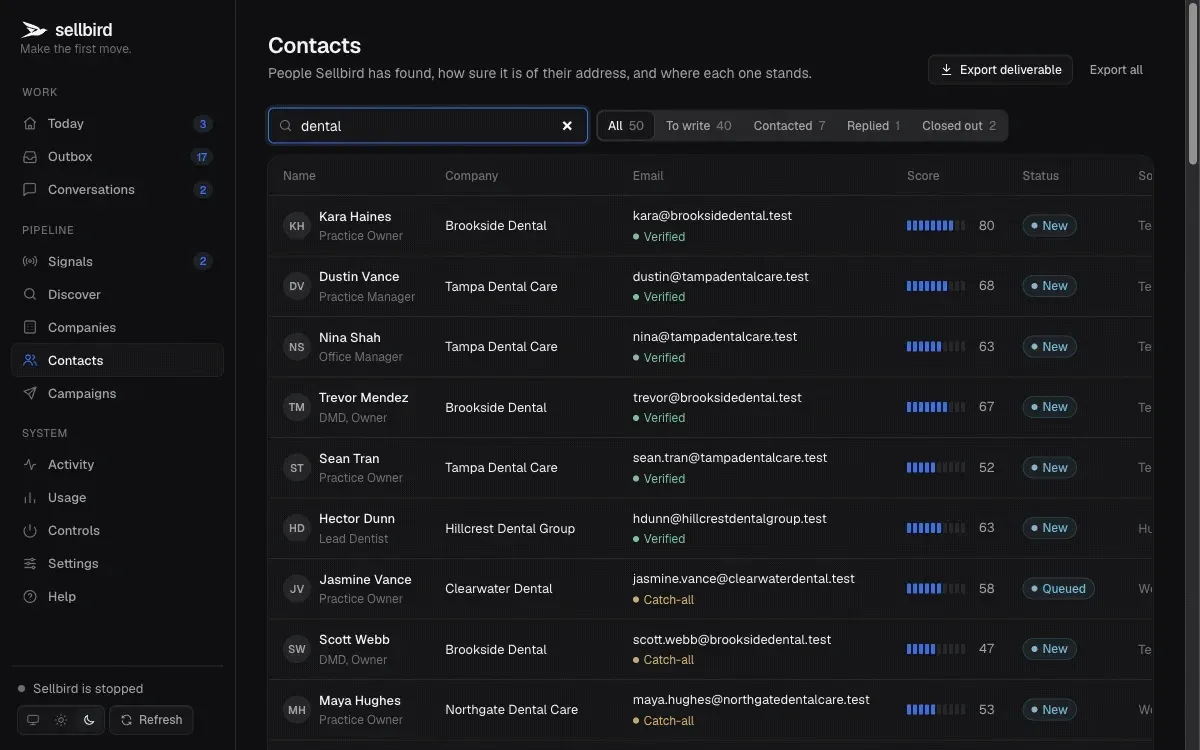
Contacts in dark mode with address verification status and fit score (invented demo data on .test domains).
Source: official Sellbird project page.
Key capabilities
- Install from a git checkout The documented steps are git clone, a Python 3.11+ virtual environment, pip install -e ., a .env file from .env.example, then sellbird train with the product's website, sellbird signals, sellbird discover, sellbird dashboard and sellbird run. sellbird setup starts an interactive wizard.
- Guided setup through Claude Code Asking Claude Code to set up Sellbird in the cloned repository uses its CLAUDE.md as a setup guide that checks the current state, installs what is missing, asks for credentials and trains Sellbird on the product.
- Docker Compose on Linux The Docker guide runs the dashboard with host networking so it stays bound to 127.0.0.1:5555 and reuses the host's Claude sign-in. It supports native Linux only, the image does not include Codex, and the container runs as the user's own UID rather than root.
- Claude Code as the default model provider Model calls go through the claude CLI with none of the user's own setup (no CLAUDE.md, hooks, skills, plugins, MCP servers or tools) in an empty temporary folder. This needs a Claude CLI with --safe-mode; with an older CLI Sellbird pauses instead of sending prompts unisolated. Usage is throttled to max_daily_claude_percent (80 by default) of the plan's quota, with a daily call budget as fallback when quota cannot be read.
- Codex on a ChatGPT plan Setting brain.provider to codex uses an isolated codex app-server with every tool-providing feature disabled and verified before each prompt. The Codex guide requires Codex CLI 0.159.3 exactly, a ChatGPT sign-in (API-key logins are refused) and macOS or Linux; Windows is refused for Codex. There is no automatic fallback between Claude and Codex, and setup suggests the gpt-5.5 model.
- Discovery sources with prices shown first OpenStreetMap is the default source: free, unlimited and without an account, though the docs note thin coverage for trades without a storefront. TinyFish is also free; paid options include DataForSEO Business Listings, SERP and Google Maps, Serper and Scavio, each listed with its price and free tier. sellbird discover --estimate shows projected spend, and no paid call runs until the user starts it.
- 29 signals confirmed by the user Sellbird can collect 29 signals, from search and map rank, missing online booking, incumbent agency, ad pixels and open roles to YC backing and announced funding rounds. None is collected until the user confirms it; sellbird signals --confirm free turns on the 26 that cost nothing. A cohort builder then combines required, excluded and ranged signals into a target set, as described in the signals guide.
- Free website profiling The profile stage reads each company's homepage, robots.txt, sitemap and team or careers pages with plain HTTP requests and no model call. Footer agency credits are scored, and low-confidence matches are not recorded. Requests are limited to public addresses: local, private, link-local and metadata IPs are rejected after every DNS answer and redirect.
- Decision makers and address checks Sellbird reads up to six of a company's own pages for named owners and managers and keeps at most two people per company, falling back to a published general mailbox such as office@ or info@. It learns the company's address pattern from published addresses and verifies one candidate, optionally through Reoon, ZeroBounce or Hunter keys. Every address is marked verified, risky (catch-all), guess or invalid; guesses and invalid addresses are never sent to, and catch-all addresses only when send_to_risky is turned on.
- Writer and editable skills library The Writer drafts three-email sequences with a first email under 75 words, built from a skills folder of plain Markdown playbooks (email frameworks, signal playbook, objection handling, lead qualification and others). sellbird train generates product knowledge and competitive intelligence files from the user's website, both gitignored. A custom writer.email_rules file can replace the built-in email shape, but the send gate still limits every email to 220 words and one link.
- Outbox approval and autopilot Every email waits in the Outbox until approved, with keyboard shortcuts to approve, edit, reject and move through the queue. Autopilot is switched on explicitly in Settings or with require_approval: false, and switched off with one click. Even on autopilot, an email is held for review if it links to a domain that is not the sender's, gives an unknown phone number, asks for money or quotes Sellbird's own instructions.
- Sending limits and pre-send gate A deterministic gate with no model involved rejects unfilled merge tags, banned phrases, overlong emails, extra links, HTML bodies and undeliverable addresses. Defaults include max_daily_sends of 50, 30 cold emails per inbox per day, a warmup ramp that, once a start date is set, sends no cold email for 14 days and then starts at 5 a day and adds 3 a day, and a kill switch that pauses sending above a 5% bounce rate. An optional send window delivers cold email only from 08:00 to 17:00 on weekdays in each recipient's time zone.
- Gmail, Microsoft 365, SMTP and more inboxes Mail goes through the Gmail API with one-time OAuth, Microsoft 365 through Microsoft Graph with an Entra app registration and PKCE sign-in, or SMTP with IMAP; Instantly remains as a legacy provider. Extra inboxes keep their sign-ins in the system keychain and have their own daily caps.
- Reply handling and opt-outs The Handler reads replies, classifies intent, drafts an answer through the same approval queue, sets auto-replies aside and stops follow-ups; a reply from anyone at a company stops the sequence for everyone there. Opt-outs are immediate and permanent, and English, Spanish, French and Hebrew opt-out phrases are caught by rule without the model. Legal threats and replies without a safe answer go to the user.
- Compliance settings Every cold email carries an opt-out line and the postal address set in compliance.postal_address, and Sellbird warns until that address is set. A do-not-contact list of addresses and domains is checked as each email leaves, and the optional Precleared check asks whether cold email to a new recipient is allowed under that country's rules, with 10 free checks a day without a key. The legal and deliverability guide covers CAN-SPAM, GDPR and PECR, states that the user is the sender and that it is not legal advice, and instructs the agent to answer truthfully when asked whether it is an AI.
- Deliverability checks Sellbird warmup checks SPF, DKIM and DMARC, domain age, blocklists, warmup progress and bounce rate, and ends with READY or NOT READY. It can read warmup status from a connected TrulyInbox account without changing anything there. The docs describe a dedicated sending domain, 2 to 4 weeks of warmup and 10 to 20 emails a day per inbox at first; the README discloses that its TrulyInbox links are affiliate links.
- Local dashboard and tray icon Sellbird dashboard serves the interface at 127.0.0.1:5555, accepts loopback hosts only and unlocks with a random token printed in a private link; remote use goes through an SSH tunnel. Its screens are described in the dashboard guide, with light and dark appearance. sellbird tray adds a macOS menu-bar or Windows tray icon to start, stop and pause sending.
- MCP access for a coding agent Sellbird mcp install adds Sellbird to Claude Code or Codex after showing the config change. The agent uses its own token to read pipeline data, the Outbox, signals and usage, estimate a discovery run and pause sending. It cannot approve or send email, resume sending, confirm signals, start discovery, change settings or delete anything.
- Exports, extensions and LinkedIn Sellbird export writes a sequencer-ready CSV of deliverable prospects that excludes opted-out contacts, and sellbird companies exports the company register with fit scores. Extensions are separate Python packages that can add dashboard routes, heartbeat steps, commands and send rules that may hold but never release an email. A LinkedIn channel exists but is off by default; the docs state that its browser automation violates LinkedIn's terms of service.
Where Sellbird fits
Upgrading an existing Harvey install
A Harvey checkout is updated with git pull, pip install -e . to get the new sellbird command, and sellbird dashboard. Configuration, data, the dashboard sign-in and the light or dark choice carry over, nothing moves while a Harvey process is still running from the folder, and edits to the tracked harvey.yaml are carried into sellbird.yaml through git stash. Docker users stop the stack, pull, rebuild and start the service now named sellbird. The steps are listed in the README upgrade section.
Building a verified prospect list without sending
The pipeline can stop after verification. After training on the product website and confirming signals, sellbird discover finds businesses, profiling reads their sites at no cost, enrichment names up to two decision makers per company and verification tags each address. sellbird export then writes a CSV for another sequencer, leaving out opted-out contacts, and the cohort builder in the dashboard shows which confirmed signals put each company in a target set.
Running an approval-based cold email campaign
With a Gmail, Microsoft 365 or SMTP mailbox connected, the Writer drafts a sequence per person from the signals found, and each email waits in the Outbox beside the company details, how the address was verified and the signals it draws on. Approved emails leave within the daily cap, the warmup ramp and, when configured, the recipient's office hours. The approval guide notes that a claim such as "no online booking" rests on an automated read of one page, and that Claude Code can be asked to review drafts against the live sites without approving or rejecting them.
Handling replies and opt-outs
Each heartbeat reads every connected inbox before sending, so a reply cancels queued follow-ups first. Out-of-office messages are set aside, opt-outs are recorded permanently, and objections or questions get a drafted answer in the Outbox. Threads that Sellbird hands over, such as a request for a contract or a legal complaint, appear under Needs you in Conversations with options to hand them back or close them. The Contacts screen shows why someone was opted out and can undo a mistaken opt-out.
Prospecting startups and companies that are hiring
Built-in presets search for companies whose own sites say they are backed by Y Combinator or another listed accelerator, or that announced a funding round in the last 18 months, and a hiring preset finds companies whose careers pages list the roles set in icp.hiring_signals. These presets use a web search provider such as Serper or DataForSEO SERP. The pipeline guide states that Sellbird never reads ycombinator.com, accelerator directories, Crunchbase, PitchBook or LinkedIn, and that an older or undated raise alone does not bring in the startup writing playbook.
Connecting a coding agent to a running Sellbird
After sellbird mcp install, Claude Code or Codex can ask what is waiting today, list campaigns, prospects and conversations, read the Outbox, estimate the cost of a discovery run and pause all sending. Approvals, sending, resuming and settings changes stay with the person at the dashboard, enforced by an allowlist that answers 403 to the agent's token for other routes. The configuration guide also documents --print for adding the entry to other MCP clients by hand.
Reviews of Sellbird
Be the first to share your experience with Sellbird.
Write a review
Loading review form…
Related to Sellbird
 Comp AI CRMOpen-source, single-tenant CRM from Comp AI built on Next.js, NestJS, Postgres and the eve agent framework. It reads Gmail or Outlook, enriches records from cited evidence and runs agents you describe in one sentence.
 RelaticleAGPL-3.0 CRM on Laravel and Filament for companies, people, opportunities, tasks and notes, with custom fields, a REST API, an MCP server for Claude and ChatGPT and the Rela assistant. Self-host with Docker for free or use Relaticle Cloud.