

What is ServiceRadar?
ServiceRadar is an open-source IT operations and network management platform with built-in observability and security analytics. It is built in the open by Carver Automation Corporation, which also provides support and services and is preparing a hosted ServiceRadar Cloud. The platform is designed to monitor infrastructure and services in hard-to-reach places or constrained environments, with cloud-based alerting that keeps teams informed during network or power outages. Discovery, monitoring, flow analysis, security posture and camera operations share one inventory, one query language (SRQL) and one agent.
The architecture combines lightweight Go agents on monitored hosts, an agent gateway, an Elixir control plane, a LiveView web UI and NATS JetStream for ingestion. Inventory lives in CloudNativePG, the topology graph in Dgraph, and telemetry optionally in a StarRocks warehouse. Agents keep executing signed schedule leases while offline and deliver records over mTLS. Discovery uses SNMP, LLDP and CDP, and telemetry intake covers OTLP, syslog, GELF, SNMP traps, BMP, NetFlow, sFlow and IPFIX. Custom checks run as WebAssembly plugins with no filesystem or raw socket access.
ServiceRadar is Apache 2.0 licensed and is self-hosted with Docker Compose or an official Helm chart on Kubernetes. Build images, plugins and add-ons are signed, and an SBOM ships with every build. It also offers a JSON HTTP API, a built-in MCP server, a Dashboard SDK and Ansible AWX/AAP automation, and a public live demo is available.
ServiceRadar screenshots
Explore the interface. Open a screenshot to view it at full size.
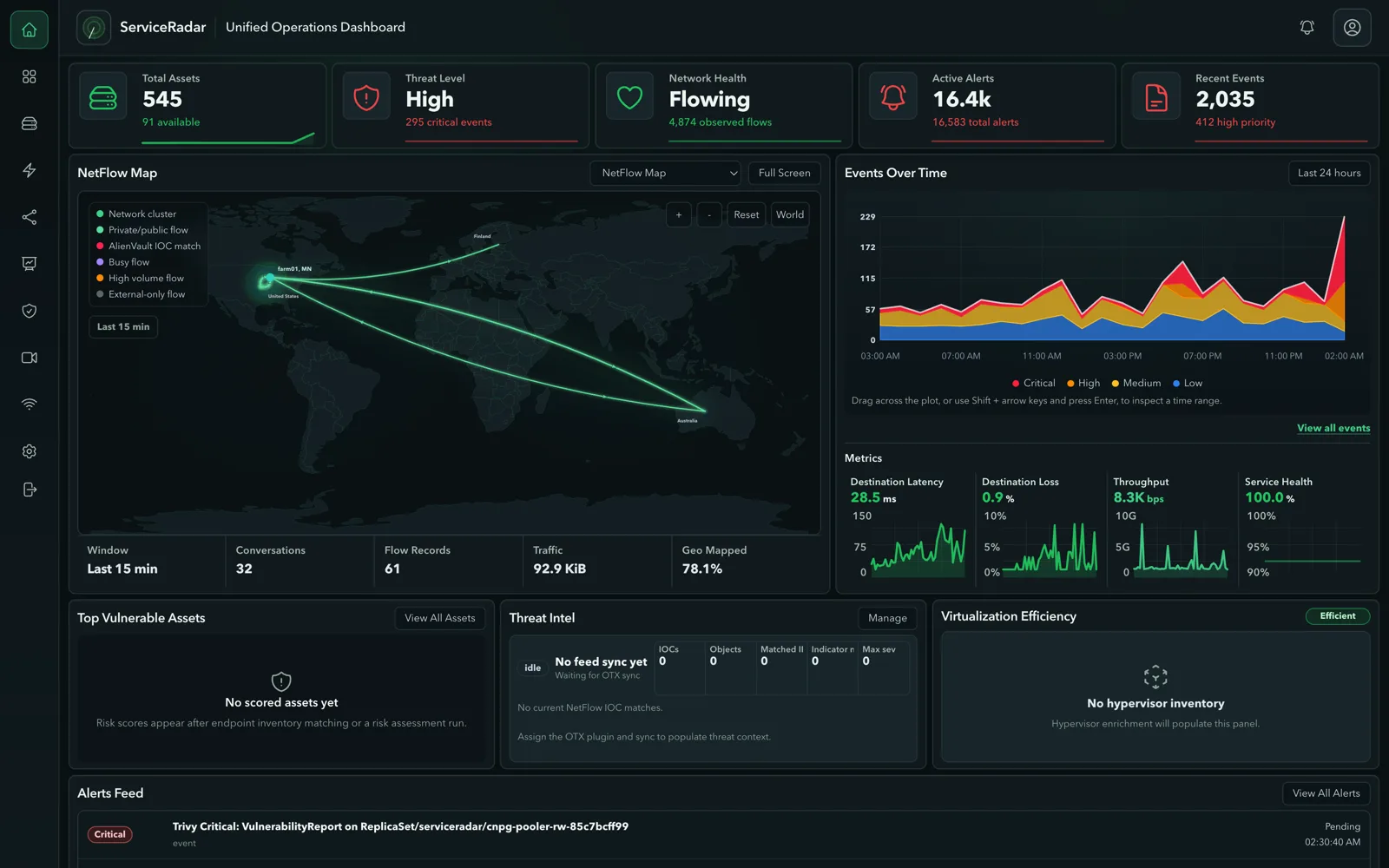
Source: official ServiceRadar project page.
Key capabilities
- Discovery and inventory A living inventory of devices, interfaces, services and installed software from SNMP, LLDP, CDP, Proxmox and UniFi.
- Monitoring ICMP and TCP checks from multiple vantage points, with agents placed in edge or segmented networks.
- Flow analytics NetFlow, sFlow and IPFIX attributed to processes, containers and Kubernetes workloads, enriched with ASN, GeoIP and threat feeds.
- Security findings Falco and Trivy findings, DNS RPZ hits and vulnerability matches against NVD, CISA KEV and VulnCheck, stored as OCSF events.
- Atlas topology map Every device in the inventory on one server-computed map that queries filter in place.
- Notifications Routes, escalation policies and channels for Slack, Discord, email and webhooks.
- Camera operations IP camera inventory, events and live view, with plugins for UniFi Protect, Axis and generic RTSP.
Where ServiceRadar fits
- SRQL One query language across inventory, telemetry, flows and security findings, with saved queries driving alerts and dashboards.
- Edge agents Go agents that keep collecting offline and deliver records over mTLS into NATS JetStream.
- Wasm plugins Custom checks in Go or Rust run in a capability-based sandbox, with networking proxied by the agent.
- Anomaly engine Time series scoring at the edge and in core, with seasonal baselines and capacity runway.
- Dashboard SDK React dashboards that receive SRQL-backed data frames and run inside ServiceRadar.
- AI access A built-in MCP server where agents sign in through your SSO and run queries under the same RBAC as the UI.
- Automation AWX/AAP playbooks run against devices in the inventory with per-host run telemetry.
Reviews of ServiceRadar
Be the first to share your experience with ServiceRadar.
Write a review
Loading review form…
Alternatives to ServiceRadar
 ChronosphereChronosphere is an observability platform built for Kubernetes that its site says is now Cortex XCOR by Palo Alto Networks, with telemetry cost controls.
 CoralogixCoralogix provides log, metrics and APM observability built on a streaming analytics architecture that avoids traditional indexed hot storage, with a 14-day free trial and usage-based pricing.