

What is Harness?
Harness is a commercial software delivery platform that its website calls the Autonomous SDLC Platform. It groups continuous integration, continuous delivery and GitOps, infrastructure as code management, database DevOps, an artifact registry, security testing, runtime protection, resilience testing, feature management, an internal developer portal and cloud and AI cost management under one account, one UI and one pipeline engine, with AI agents embedded across these stages.
According to the company page, Harness was launched in San Francisco in 2017, has more than 1,200 employees and more than 1,000 enterprise customers, and has raised $570 million in total funding. The home page states volumes of 5.7 million deployments, more than 1.5 trillion feature flag evaluations and more than 250 billion protected API calls per month across its customers.
The platform page organises the product into agents. The Software Delivery Agent covers deployments, builds, infrastructure, databases, artifacts, repositories and code review; the Security Testing Agent covers AI SAST, AI SCA, supply chain security and security testing orchestration; the Runtime Protection Agent covers API posture, API advanced protection, AI posture and an AI firewall; the Cost Management Agent covers AI and cloud costs and engineering efficiency; and the newer Cosmos Software Factory Agent takes engineering work from ticket to code. A Software Delivery Knowledge Graph maps pipeline history, deployment topology, security findings and cost signals for these agents.
Harness is primarily delivered as SaaS at app.harness.io. Work in customer environments is executed by the Harness Delegate, a service installed in the customer network or VPC that connects outbound to Harness over HTTPS and secure WebSockets. A Self-Managed Enterprise Edition installs the platform on the customer's own Kubernetes infrastructure with Helm, including air-gapped environments, and is sold as an add-on to the Enterprise plan. Separately, Harness Open Source is a free, self-hosted product combining source code management, CI/CD pipelines, Gitspaces development environments and artifact registries.
The SaaS platform has no single version number: the release notes state that changes are deployed to Harness SaaS clusters progressively, and security advisories for each release are available through the Harness Trust Center. Similar delivery tools listed on iThub include Jenkins, Argo, CircleCI and Octopus Deploy.
Harness screenshots
Explore the interface. Open a screenshot to view it at full size.
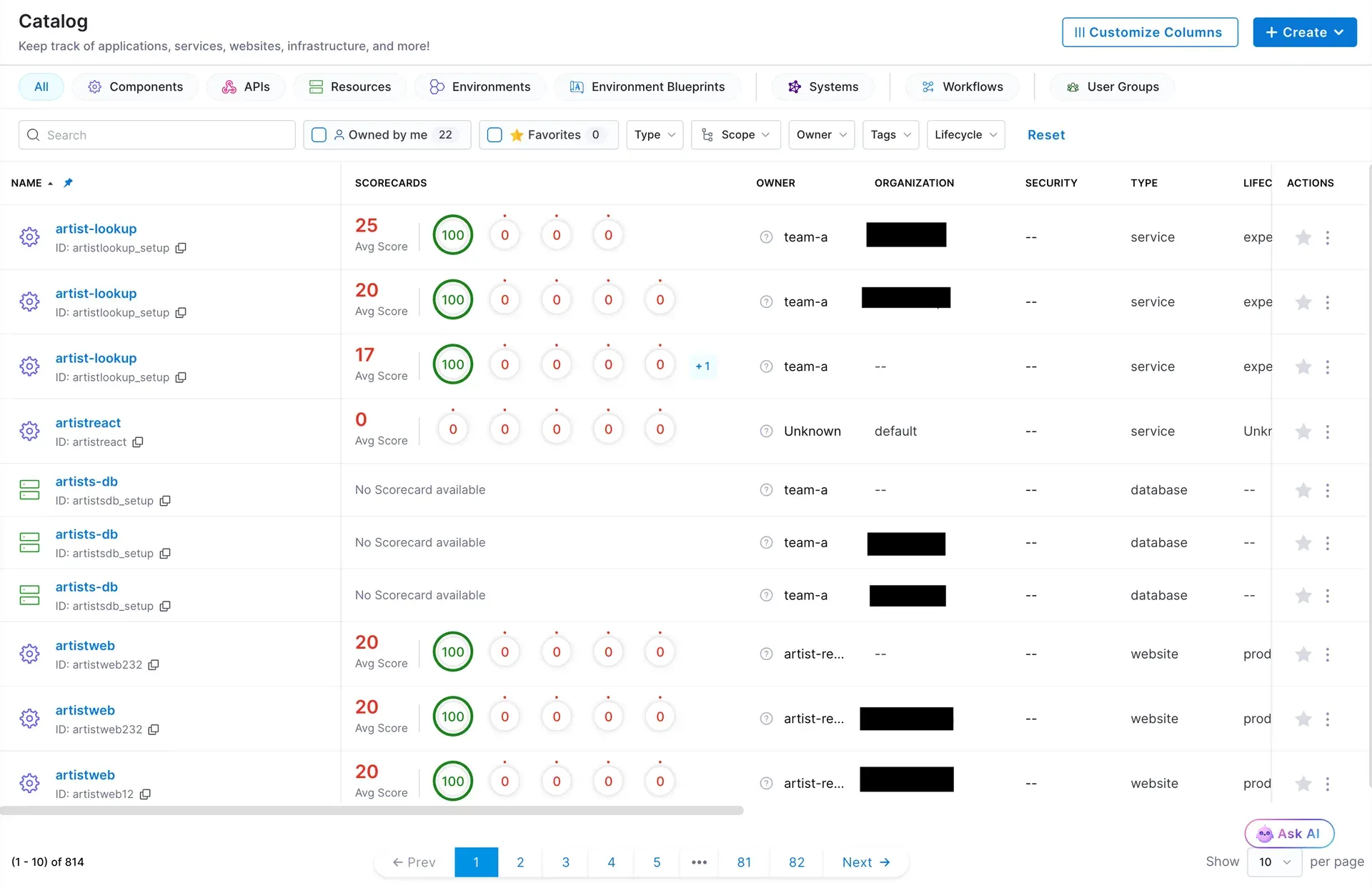
Official documentation screenshot of the Internal Developer Portal catalog with scorecards.
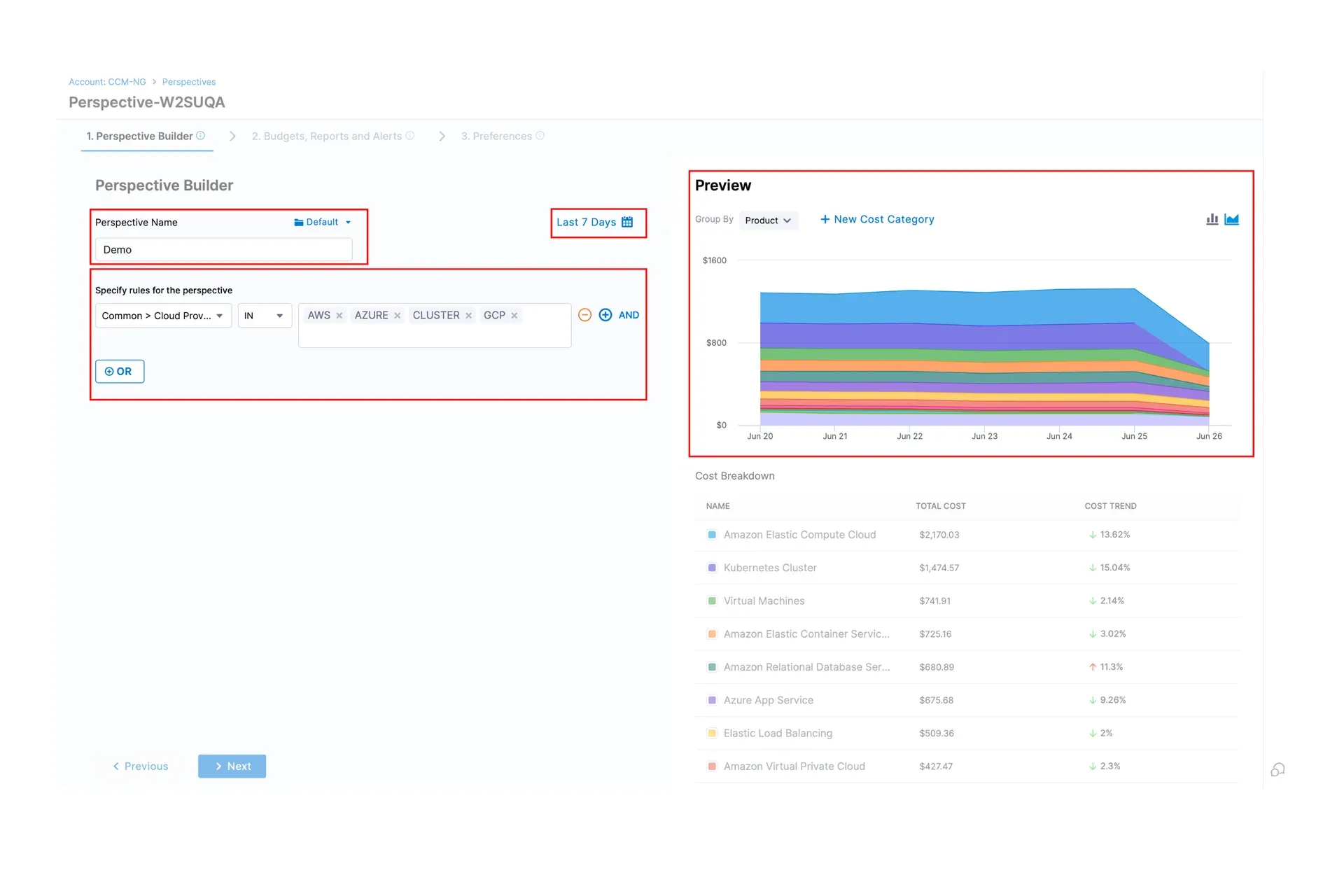
Official documentation screenshot of a Cost Management perspective with a cost breakdown by product.
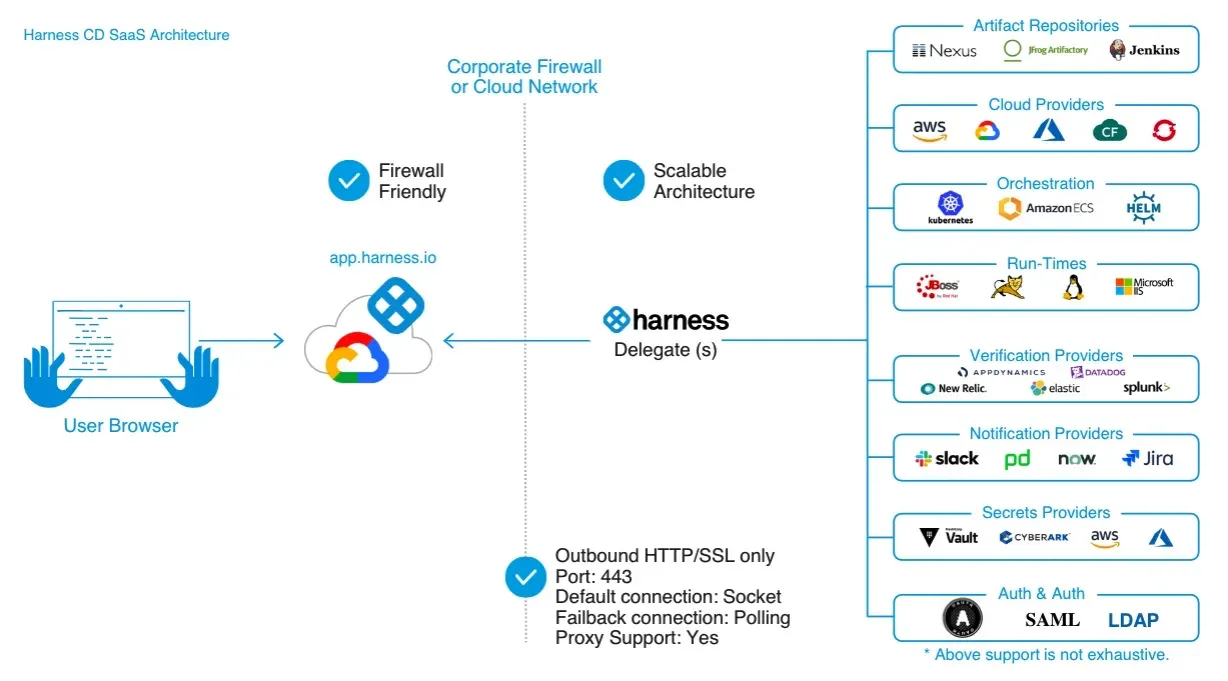
Official documentation diagram of the SaaS architecture with delegates making outbound connections on port 443.
Source: official Harness project page.
Key capabilities
- Continuous Delivery and GitOps Pipelines take changes from commit to production with canary rollouts and automated verification, deployment templates, deployment freeze windows and pipeline chaining. The pricing page states that all plans support deployments to AWS, Azure, Google Cloud, on-premises infrastructure and private clouds.
- Continuous Integration Builds run on Harness Cloud machines or self-hosted runners, with build caching and test selection that runs only the tests relevant to a change. Harness Cloud documentation covers VM images, bring-your-own images, PrivateLink, VPN and egress controls for hosted build VMs.
- Code Repository Hosted Git repositories with pull requests and AI code review are part of the Software Delivery Agent; the Essentials and Enterprise plans list 250 GB of repository storage.
- Infrastructure as Code Management IaCM provisions, configures and governs infrastructure from the same control plane, combining governance, AI workflows and IaC tools, with an IaCM remediation worker agent among the listed worker agents.
- Database DevOps Schema changes are gated, versioned and rolled out together with application deployments as part of a pipeline.
- Artifact Registry A registry stores, versions and scans container images, packages, binaries and models. The open-source Harness CLI includes an artifact registry client (
harness-har). - Security testing The Security Testing Agent provides AI-assisted SAST and SCA, supply chain security and Security Testing Orchestration, which aggregates scanner results into pipelines and dashboards.
- Runtime protection Web Application and API Protection covers API posture, advanced API protection, AI posture and an AI firewall for applications in production.
- Resilience Testing Chaos experiments test how services behave under failure. The free plan includes Litmus Chaos.
- Feature Management and Experimentation Feature flags and experiments control rollouts at runtime; a Feature Flag Cleanup worker agent removes stale flags.
- Internal Developer Portal A software catalog of components, APIs, resources, environments, environment blueprints, systems and workflows with scorecards is documented in the IDP catalog guide.
- Cloud and AI Cost Management Perspectives group AWS, Azure, GCP and Kubernetes costs by rules, with budgets, reports, alerts and anomaly detection, as shown in the perspective guide.
- AI agents and Knowledge Graph Expert agents for DevOps, AppSec, IDP, test, SRE, release, FinOps and reliability plan work, while worker agents such as Autofix, Code Review, Manifest Remediator, Code Coverage and Kubernetes Manifest Remediation execute it through governed workflows.
- Governance Policy as Code, custom roles, templates, audit logs and secrets integrations with HashiCorp Vault, AWS and Azure Key Vault are available at platform level; plan limits apply to roles and dashboards.
- Harness Delegate The delegate runs in Kubernetes or another target environment and calls app.harness.io and Google's Stackdriver Logging API by default. Remote logging can be turned off with
STACK_DRIVER_LOGGING_ENABLED=false. - Harness CLI The Harness CLI uses a
harness <action> <resource>pattern to list and execute pipelines, manage secrets and connectors and query audit logs. It is open source on GitHub and distributed for macOS, Linux (amd64 and arm64) and Windows, installed by script, Homebrew or release archive. - API A public REST API is documented at apidocs.harness.io, alongside agent-oriented API quickstarts for individual modules.
- Plans and limits The pricing page lists a Free plan (Harness Open Source, Litmus Chaos, community support), an Essentials bundle of CI, CD and GitOps, Code Repository, IaCM and Security Testing Orchestration, and a modular Enterprise plan; both paid plans are priced through sales. Essentials allows up to 500 users, one organization, 6 months of pipeline history and 60 concurrent pipeline executions and has no on-premises option; Enterprise has unlimited users and organizations, up to 500 concurrent CD executions, 25 months of history as an add-on and the self-managed platform as an add-on.
- Self-Managed Enterprise Edition The self-managed documentation covers Helm installation and upgrades, air-gapped installs, external databases, FIPS, monitoring and backup and restore.
- Harness Open Source The free self-hosted edition runs as a single Docker container serving the UI on port 3000, with repositories, pull requests, pipelines, Gitspaces and artifact registries, and data stored under /data by default.
Where Harness fits
Building and deploying services to Kubernetes and clouds
Teams define pipelines with CI and CD stages, install a delegate in their cluster or VPC, and deploy to targets such as Kubernetes, Helm and Amazon ECS on AWS, Azure, Google Cloud or on-premises infrastructure. Rollouts can use canary strategies with automatic verification, using data from verification providers such as Datadog, New Relic, AppDynamics, Elastic or Splunk, and source code can come from GitHub, GitLab or Bitbucket.
Shift-left security in the pipeline
Security Testing Orchestration adds SAST, SCA and container scans as pipeline steps, and collects the results in security dashboards. Supply chain security covers artifacts produced by builds, and the platform page shows SBOM attestation as part of a standard build.
Platform engineering with a developer portal
Platform teams register services, APIs and infrastructure in the IDP catalog, assign owners, track scorecards and publish workflows and environment blueprints in the same catalog.
Controlling cloud and AI spend
FinOps teams connect cloud accounts and Kubernetes clusters to Cost Management, build perspectives that group costs by product, team or provider, and set budgets, reports and anomaly alerts.
Running delivery inside a restricted network
Organisations that cannot use SaaS install the Self-Managed Enterprise Edition on their own Kubernetes infrastructure with Helm charts, including in air-gapped environments, with external databases and backups under their control.
Small teams on free tooling
The free plan includes Harness Open Source and Litmus Chaos with community support. Harness Open Source starts from one docker run command and provides Git hosting, pipelines and development environments on a single host, as described in its quick start. The paid Essentials plan, with up to 500 users and one organization, and the modular Enterprise plan are sold through Harness sales.
Install
docker run -d -p 3000:3000 -p 3022:3022 -v /var/run/docker.sock:/var/run/docker.sock -v /tmp/harness:/data --name opensource --restart always harness/harnessReviews of Harness
Be the first to share your experience with Harness.
Write a review
Loading review form…
Alternatives to Harness
 JenkinsJenkins is a self-hosted automation server that runs CI/CD pipelines defined as code (Jenkinsfile), extended through a large plugin ecosystem.
 ArgoArgo is a CNCF graduated family of open source Kubernetes tools: Argo CD for GitOps delivery, Workflows, Rollouts and Events.
 CircleCICircleCI runs pipelines defined in repository configuration, in its cloud, on self-hosted runners or on CircleCI Server, with a free plan.