
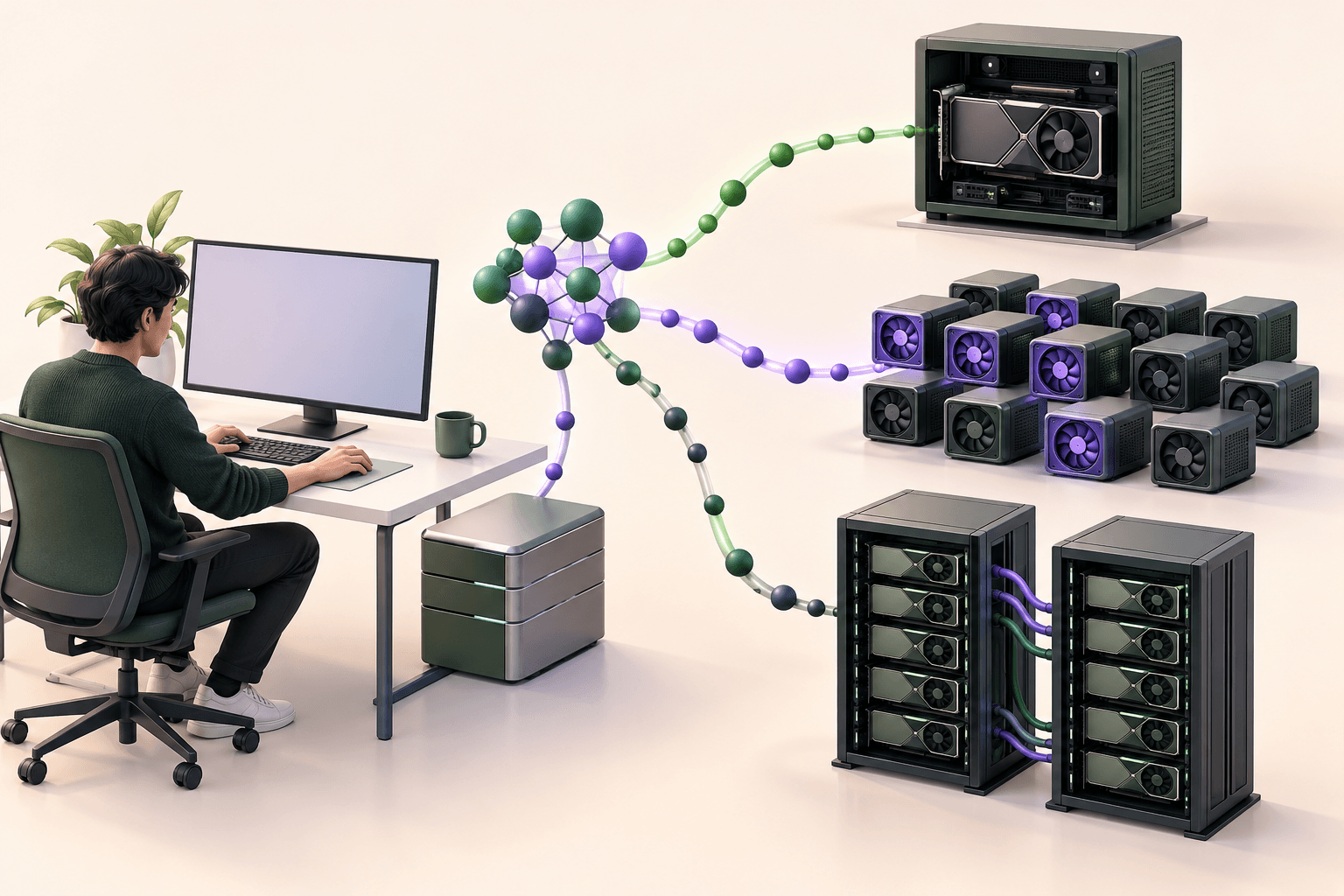
Runpod provides cloud GPU capacity for developing, training, and serving AI models. Choose Pods when you need a persistent environment, Serverless when inference should follow incoming demand, and Clusters when a job must span multiple machines. The useful starting point is your workload's execution pattern, rather than the GPU name alone.
For developers and infrastructure teams, these options raise different operational questions: who controls the runtime, what remains running between requests, and whether the application needs coordinated execution across nodes. Runpod describes these product roles on its platform overview.
Match the deployment model to the application
Pods for persistent environments and container control
Pods give you a dedicated GPU instance with control over its container, attached storage, and runtime configuration. Runpod supports custom Docker images and identifies Linux GPU frameworks such as PyTorch, TensorFlow, and JAX as supported workloads. Its Cloud GPUs page also describes access through an API, command-line tooling, and SDKs.
A Pod is the natural option to evaluate for an interactive development environment, a long training run, or an application that needs to remain active. The important distinction is continuity: you are choosing an instance whose environment you manage, rather than submitting inference work to an autoscaling endpoint.
As a hypothetical example, a developer repeatedly adjusting model dependencies could start by evaluating a Pod with a custom image. The evaluation should check whether the image starts correctly, whether the model fits, and how outputs survive the intended stop or termination workflow. These are acceptance tests to perform, not assumed deployment results.
Runpod also offers interruptible Spot capacity. Its product page warns that eviction is possible when demand increases. Consider that option only when the application can tolerate interruption; a lower advertised rate should not substitute for checking recovery behavior.
Serverless for request-driven inference
Runpod Serverless supplies GPU endpoints that automatically adjust worker capacity and can reduce it to zero. The platform overview describes a managed queue that distributes work, alongside logs and monitoring. This makes Serverless a candidate for inference APIs whose demand changes over time. See Runpod's Serverless overview within its platform page.
Evaluate the endpoint as part of the application, not simply as a replacement GPU rental. A useful trial should exercise model loading, request bursts, quiet periods, and error handling. Measure response times against your application's requirements rather than treating an advertised startup figure as an end-to-end latency guarantee.
For a hypothetical image-generation API with uneven traffic, Serverless would be worth evaluating alongside a continuously running Pod. Compare the same model and representative requests. Keep the quality requirement constant so that a cheaper configuration does not appear preferable merely because it performs a different task.
Clusters for work that crosses machine boundaries
Runpod Clusters connect GPU nodes for coordinated workloads such as distributed training and large batch processing. A Pod can contain multiple GPUs on a single node; the cluster distinction is execution across nodes. Runpod documents that distinction on its Clusters product page.
Use the application's distribution requirements to justify this choice. Needing more GPU memory does not by itself establish that a multi-node design is appropriate. Ask whether the software supports the intended distributed execution, how it exchanges data, and where shared model files will live.
Check orchestration compatibility before planning a migration
Runpod documents Slurm support for Clusters and explicitly states that its Cluster offering is not compatible with Kubernetes. It also supports Docker workloads. These capabilities describe different layers of deployment and should not be treated as interchangeable. The Clusters documentation page is the relevant product reference.
If your application depends on Kubernetes resources or controllers, do not assume that packaging it in a container makes migration to Runpod Clusters straightforward. Review the orchestration dependency separately from the container image. iThub's Docker versus Kubernetes guide provides a related starting point for that distinction.
Cluster size also affects planning. Runpod lists an on-demand entry point of 2 nodes with up to 16 GPUs. Access to configurations reaching 8 nodes and 64 GPUs requires requesting a higher spending limit. Treat that approval as a deployment prerequisite rather than assuming the largest advertised configuration is immediately available to every account.
Runpod says shared Network Storage is integrated where available. Include storage availability in the configuration review, especially when every node must access the same model assets. A product-wide capability does not establish that a particular location has the required combination of compute and storage.
Build the cost estimate around the whole workload
Runpod's pricing page separates dedicated instances, inference workers, multi-node compute, and storage. It also distinguishes self-service consumption from reserved capacity and negotiated contracts. Your estimate should preserve those distinctions instead of applying a single GPU rate to every deployment model.
For Pods, document the expected active runtime and the storage you intend to retain. For Serverless, use a representative request pattern and record the resulting worker consumption. For Clusters, estimate the coordinated run and its storage needs. Compare those scenarios against the same completion or service requirement.
Storage deserves its own budget line. The Cloud GPUs page lists different storage categories and distinguishes running from idle Pod volume pricing. Stopping compute should therefore not be treated as evidence that all associated charges disappear.
Reservations address a different purchasing question from occasional experimentation. Runpod describes reserved Clusters as dedicated capacity with contractual availability and configuration options. Consider that path when planned access to resources matters enough to justify a commitment, after validating the workload on an appropriate configuration.
For the broader hosting decision, iThub's Hetzner versus DigitalOcean comparison offers an adjacent discussion of cloud hosting choices. Keep that decision separate from selecting the execution model for a GPU application.
Evaluate institutional access separately from technical fit
Runpod has an academic research program for universities, departments, and research groups. It describes billing arrangements aligned with grants or shared lab budgets, and access arrangements tailored during institutional onboarding. Individual students and researchers are evaluated case by case rather than receiving unconditional admission.
For a teaching lab, account allocation and invoicing can be as important as the container image. Establish who can provision resources, how spending will be attributed, and what happens when a course or grant ends. Those are questions for the institution's deployment plan, not assumptions to derive from the existence of an education program.
Before committing, write a short acceptance checklist for the chosen Runpod product: container compatibility, required capacity, retained data, interruption tolerance, and a representative cost measurement. Use a trial to answer those questions with the application you actually intend to run.