What is DeepInfer?
DeepInfer is DeepSeek's open-source inference engine for running supported DeepSeek models on accelerator infrastructure. The reviewed source targets DeepSeek-V4.1-Flash and includes model execution, optimized kernels, distributed inference and offline generation examples. It is intended for teams that can provision and operate the required Linux hardware and toolchain.
Read the full overview
The repository separates the available engine from the wider production service described by DeepSeek. A complete online deployment still needs a KV-cache system, the integration for vision, prefill and decode disaggregation, and replica load balancing. Those missing pieces change the adoption decision: cloning the engine does not reproduce the company's managed inference service.
Prefill processes the input context; decode produces output tokens. Their resource demands differ, so the documentation treats parallelism, scheduling and cache behavior as connected design choices. The engine exposes Python generation and sampling interfaces. A complete hosted API gateway, tenant policy and operational service contract are separate concerns.
The reviewed commit is 9bd9cf243fc53ef9afbf8f04d391d989117d6ab9, checked October 22, 2026. The package metadata declares version 0.1.0 and Apache-2.0 licensing; no tagged release was available at review. The diagrams and charts are supplied by DeepSeek, not independently reproduced ITHub measurements.
 DeepInferAI Platforms & Generative AI
Run DeepSeek model inference with an accelerator-focused engine and explicit distributed deployment requirements
DeepInfer screenshots
Explore the interface. Open a screenshot to view it at full size.
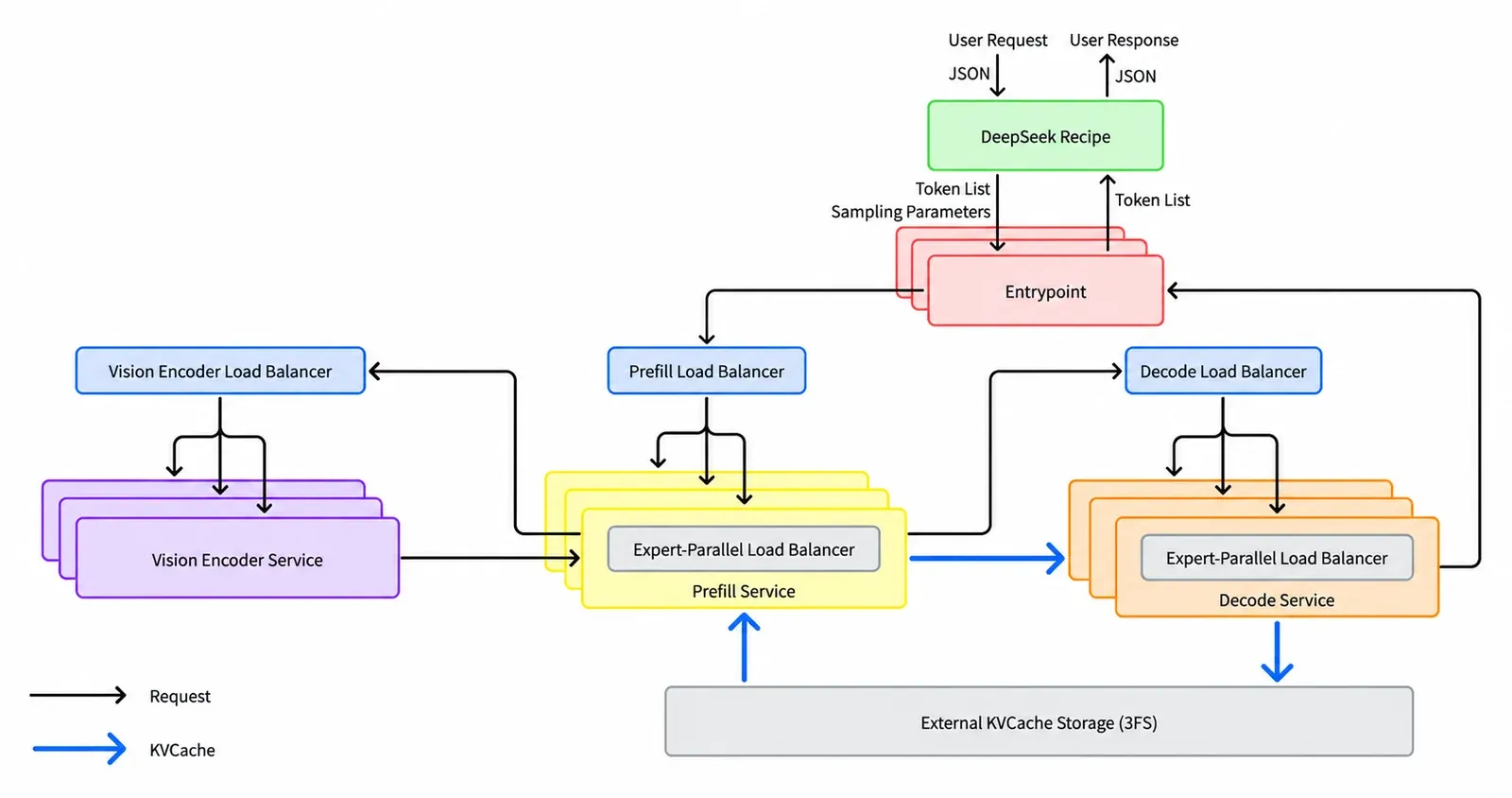
Publisher architecture diagram, not a product dashboard. It includes components that are not fully shipped in the open repository.
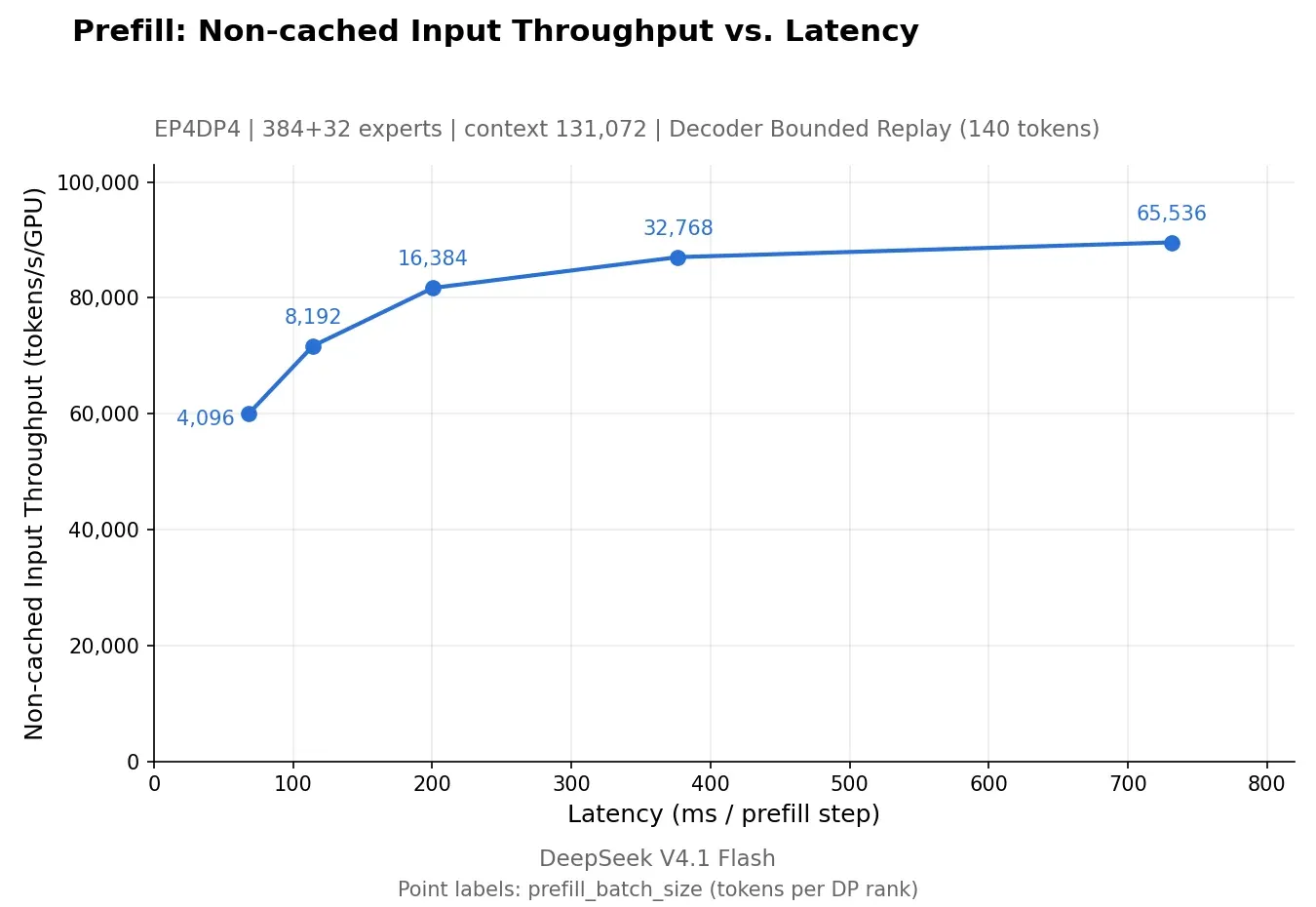
Publisher benchmark using four SM100 GPUs, under the conditions documented in the repository. ITHub has not reproduced it.
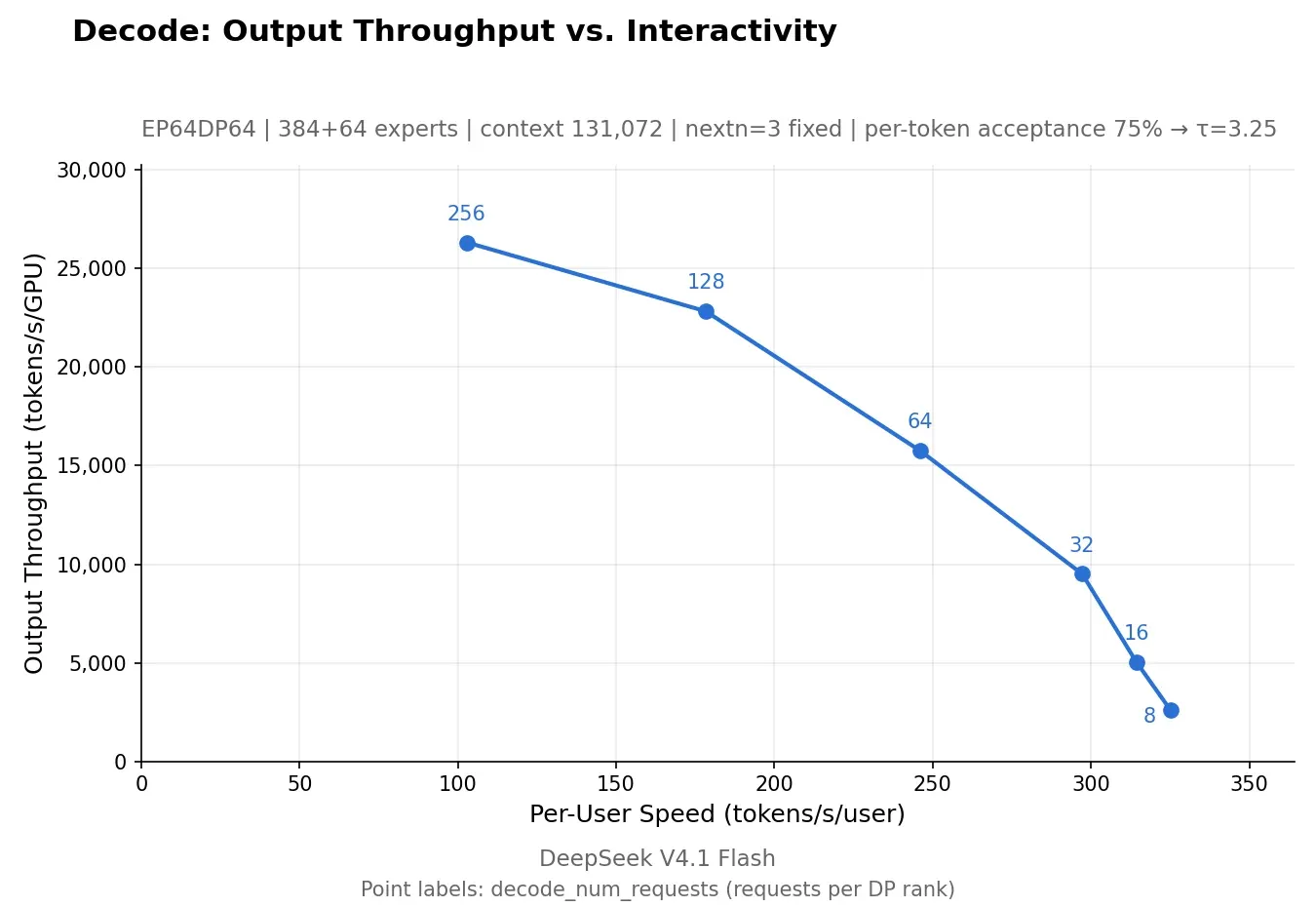
Publisher benchmark using 64 SM100 GPUs in one scale-up domain. It is not an ITHub result or a guarantee for other hardware.
Source: official DeepInfer project page.
Key capabilities
- Explicit accelerator support The checked README names NVIDIA SM100 GPUs and Huawei Ascend 950 NPUs. It does not establish support for every NVIDIA card, laptop GPU or accelerator generation. Match the requested hardware and its interconnect to the documented path before estimating deployment cost or attempting a build.
- A defined Linux build environment The getting-started instructions specify Python 3.12 and GCC 13 or later. NVIDIA uses CUDA 13; Ascend uses CANN 9.2. The accelerator selection controls the build path. Review the pinned source and its requirements together, because a generic Python installation is not the complete runtime environment.
- Model and kernel execution The engine uses DeepSeek kernel projects such as FlashMLA, DeepGEMM and DeepEP, alongside other documented kernels. Their role is to implement computation and communication for the supported model. Compatibility, build settings and library versions matter more than treating the repository as a model-agnostic inference drop-in.
- Distributed parallelism The examples expose expert, data and context parallel settings. Expert parallelism distributes mixture-of-experts work across devices; expert load balancing addresses uneven expert activity. Selecting those settings requires enough device memory and an appropriate topology. The example guide provides reproducible command shapes and configuration boundaries.
- Speculative decoding and scheduling DSpark and confidence-scheduled verification use draft tokens to reduce decoding work under supported configurations. Asynchronous scheduling overlaps host scheduling with device execution. These are engine mechanisms, not a universal latency guarantee. Measure their interaction with your input lengths, batch composition and sampling settings.
- Constrained and reproducible generation The source documents regex, JSON-schema and EBNF constraints for structured outputs. Batch invariance and deterministic sampling have their own NVIDIA-only conditions and configuration requirements. A fixed seed alone is not the entire reproducibility contract; use the documented settings and check the generated result.
- Offline examples and checkpoint selection The sample workflow can download its default checkpoint into the Hugging Face cache or use a local model directory. A local checkpoint avoids that particular model download. It does not automatically remove network access from the operating environment or supply the missing online-service infrastructure.
Where DeepInfer fits
Evaluating a supported DeepSeek model
Begin with the exact checkpoint, accelerator type and source revision you intend to operate. Run the documented offline example before designing a service around it. Verify generated text, structured-output behavior and memory consumption on your own configuration. A successful small run establishes that configuration, not the capacity of an entire production cluster.
Planning an inference service
Draw the boundary between engine execution and request handling. Decide where tokenization, admission, cache storage, routing, authentication and accounting will live. The deployment Q&A describes DeepSeek's wider architecture, while identifying infrastructure that is not fully released. Use it as design evidence rather than a complete deployable stack.
Comparing throughput and latency
Keep the model, input length, output length, precision and parallel scale explicit. Separate prefill latency from output-token speed and aggregate throughput. The supplied benchmark sweep can help reproduce a defined experiment. Do not compare a multi-supernode publisher chart with a single-server test without preserving those conditions.
Building structured-output workloads
Use the documented sampling interface to request a constrained result, then validate the result against the actual schema your application needs. Include long inputs, cancellation and malformed downstream handling in the application evaluation. Grammar-constrained generation narrows output structure; it does not make the generated facts correct.
Positioning and limitations
DeepInfer fits infrastructure and model-serving engineers working on supported accelerator platforms. Its published source is useful when control over execution, parallelism and kernel integration matters. The operational burden is substantial: hardware access, model storage, build compatibility and service assembly remain the operator's responsibility.
Apache licensing applies to the engine source. Model weights, third-party kernels and deployment services have their own terms. A zero software-license price is not a zero-cost inference platform. Budget for accelerator capacity, networking, storage and the engineering work needed to connect the engine to a usable service.
Strata and Ollama address different local-model workflows and hardware expectations. Their presence in the directory does not imply direct feature equivalence or interchangeable model support. Start with the checkpoint and hardware requirement before comparing user interfaces or a generic tokens-per-second number.
The MLOps category covers broader model operations, and the self-hosted collection helps compare ownership of the surrounding platform. DeepInfer should be evaluated as one engine within that platform, with the unreleased or external components kept visible in the plan.
Inference efficiency is a systems problem. Model kernels, request composition, communication and cache reuse can move the bottleneck between stages. DeepInfer exposes a concrete implementation and examples for studying those interactions on supported hardware, rather than reducing deployment planning to a single headline throughput figure.
The distinction between an engine and a complete service is especially useful here. The architecture diagram names cache and routing responsibilities that still need an implementation around the open engine. Making those responsibilities explicit helps a team estimate what it can adopt directly and what it must design, integrate or operate itself.
A practical proof of concept should record the commit, checkpoint, accelerator topology and generation settings, then measure correctness, memory demand and the latency distribution for representative inputs. Include a failure and restart scenario for the surrounding service. Keep publisher charts as attributed reference evidence until the workload has been measured on your own deployment.
“Run DeepSeek model inference with an accelerator-focused engine and explicit distributed deployment requirements”
Technical details
- Access
- Self-hosted
- Source model
- Open source
- License
- Apache-2.0
- Founded
- Not specified
- Data location
- Operator-controlled Linux accelerator infrastructure; model downloads use the selected checkpoint provider unless a local copy is configured
- Pricing model
- Open source
- API
- Available
- API documentation
- Read API documentation ↗
- Version reference
- 0.1.0 (source snapshot) ↗
- Source checked
- October 21, 2026
- Website
- github.com ↗
- GitHub
- Source repository ↗
What to verify
Profile audiences: DevOps Engineers, Developers.
- Confirm current features, licensing and support terms.
- Validate deployment, data location and access control.
- Test integrations, exports and recovery workflows.
Reviews of DeepInfer
No published reviews yet.
Loading review form…