What is NetBird?
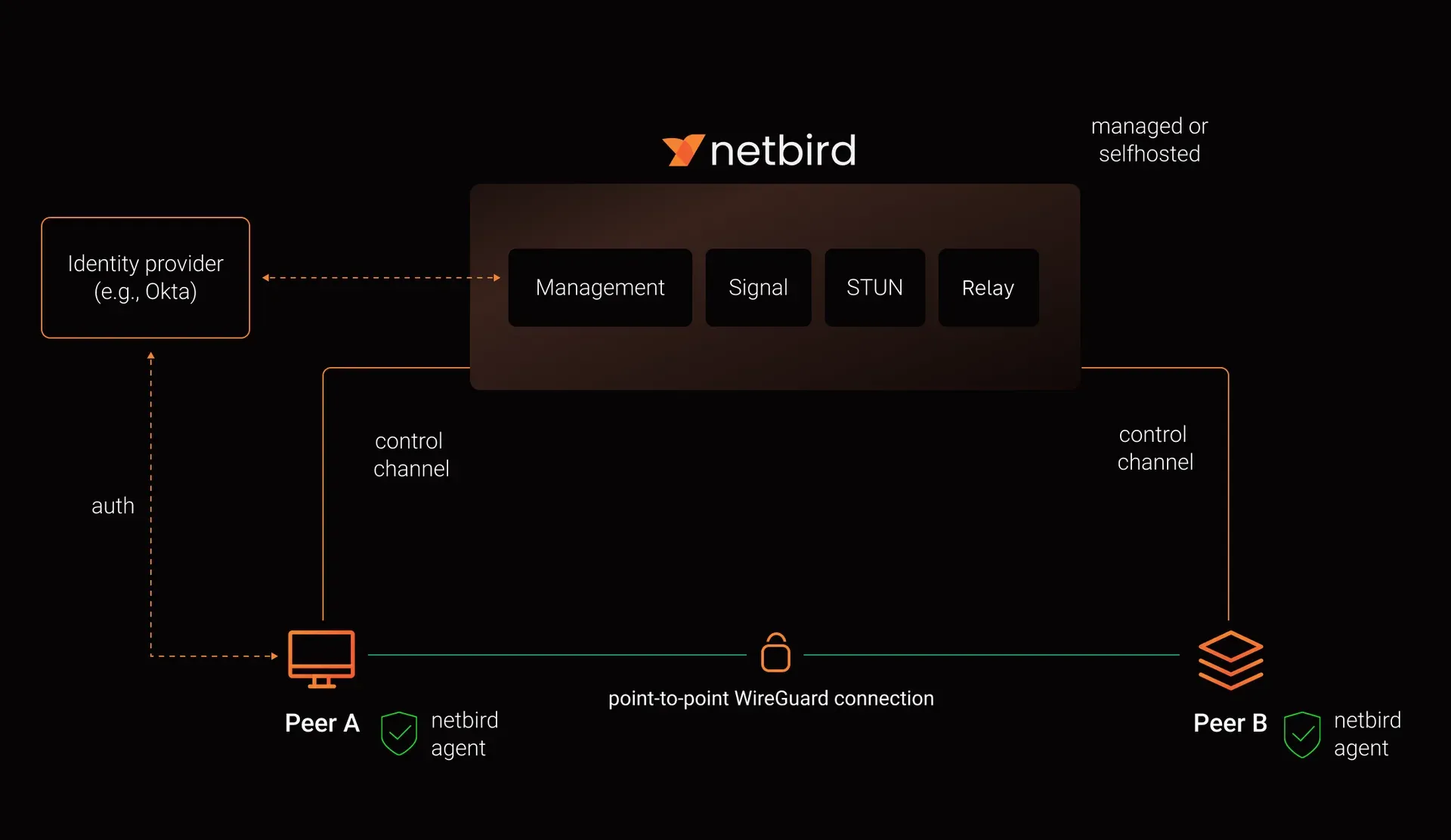
NetBird combines a peer-to-peer private network with a centralized access control system. Every machine runs the NetBird agent, which manages a WireGuard interface and builds encrypted tunnels to other peers without opening inbound ports or running a VPN gateway. Access is defined centrally through groups and policies, and users authenticate through an identity provider with SSO and MFA. The project is developed by NetBird GmbH, whose imprint lists a Berlin address and registration at the Berlin-Charlottenburg local court. The README states that NetBird joined the StartUpSecure program of the German Federal Ministry of Education and Research in November 2022, working with the CISPA Helmholtz Center for Information Security.
The architecture has four server-side parts. The Management Service holds network state, assigns peer IPs and distributes updates to agents. Agents discover connection candidates with ICE (Pion ICE) and STUN, and exchange end-to-end encrypted candidate messages through the Signal Service. When NAT traversal fails, for example behind carrier-grade NAT, traffic falls back to the Relay Service, still inside a WireGuard tunnel. The web dashboard is maintained in a separate repository, and an optional quantum-resistance mode builds on Rosenpass.
NetBird is available as NetBird Cloud, a managed service at app.netbird.io, or self-hosted. The self-hosting quickstart requires a Linux VM with at least 1 CPU and 2 GB of memory, public TCP ports 80 and 443 and UDP port 3478, a public domain name, Docker with the Compose plugin, jq and curl; a script then generates a Docker Compose installation. Clients are distributed for Linux, macOS, Windows, Android, iOS, Android TV, Apple TV and FreeBSD, for router and NAS platforms such as pfSense, OPNsense, MikroTik RouterOS, OpenWRT, Synology, TrueNAS and Proxmox, and as a container.
The code is written mainly in Go in the netbirdio/netbird repository, created in April 2021. The repository is licensed under BSD-3-Clause, except the management/, signal/ and relay/ directories, which are under AGPLv3. The latest GitHub release is v0.82.1, published on November 10, 2026, a patch release with SSH server and firewall fixes. Release v0.82.0 added latency-aware selection between highly available routing peers, a netbird status --table view and a separate database option for reverse proxy access logs. The README also announces NetBird Agent Network, a beta for identity-aware access by AI agents to LLM APIs and private resources, documented at netbird.ai.
Similar projects on iThub include Tailscale, ZeroTier, Netmaker, Firezone and Defguard.
Key capabilities
- WireGuard peer-to-peer connections The agent uses kernel WireGuard where available and connects peers directly after NAT traversal with ICE and STUN. Each peer receives an address in the NetBird overlay network, and an IPv6 dual-stack overlay is documented. When a direct path is not possible, a relay carries the WireGuard traffic.
- Access control with groups and policies Peers and users are placed in groups, and policies define which groups may reach which other groups, with protocol and port restrictions. Without policies no peer can reach another (deny by default); a Default policy allowing all peers to communicate is created automatically for new accounts and can be removed.
- Posture checks Posture checks evaluate a device before access is granted: NetBird client version, country and region, peer network range, operating system version, running processes and certificates. The pricing page lists device posture checks, MDM and EDR device controls and device approvals in the Business plan.
- SSO, MFA and identity provider integration Users sign in through an identity provider. NetBird Cloud supports social SSO on the free plan and enterprise IdP SSO from the Team plan. Self-hosted deployments document integrations with several identity providers, and IdP group sync with JWT and SCIM provisioning are available.
- Networks, routes and exit nodes Routing peers give access to subnets and resources that do not run the agent, such as a cloud VPC or an office LAN. Domain-based DNS routes, exit nodes for sending all traffic through a chosen peer, and highly available routing peer groups are documented.
- Private DNS NetBird distributes DNS settings to peers, including nameserver groups, DNS aliases for routed networks and custom DNS zones. Peers can be reached by name inside the overlay.
- NetBird SSH and browser access NetBird SSH applies central access policies to SSH sessions on peers. A browser client provides SSH and RDP from the web dashboard.
- Reverse proxy The reverse proxy, currently in beta, exposes internal services on peers to the internet with TLS termination, optional authentication and access restrictions. Self-hosted deployments must use Traefik as their external reverse proxy for this feature, and it does not currently support Rosenpass.
- Setup keys and automation Setup keys register machines without interactive login, for servers and bulk provisioning. The public API, a Terraform provider and an Ansible collection manage peers, groups, policies and routes.
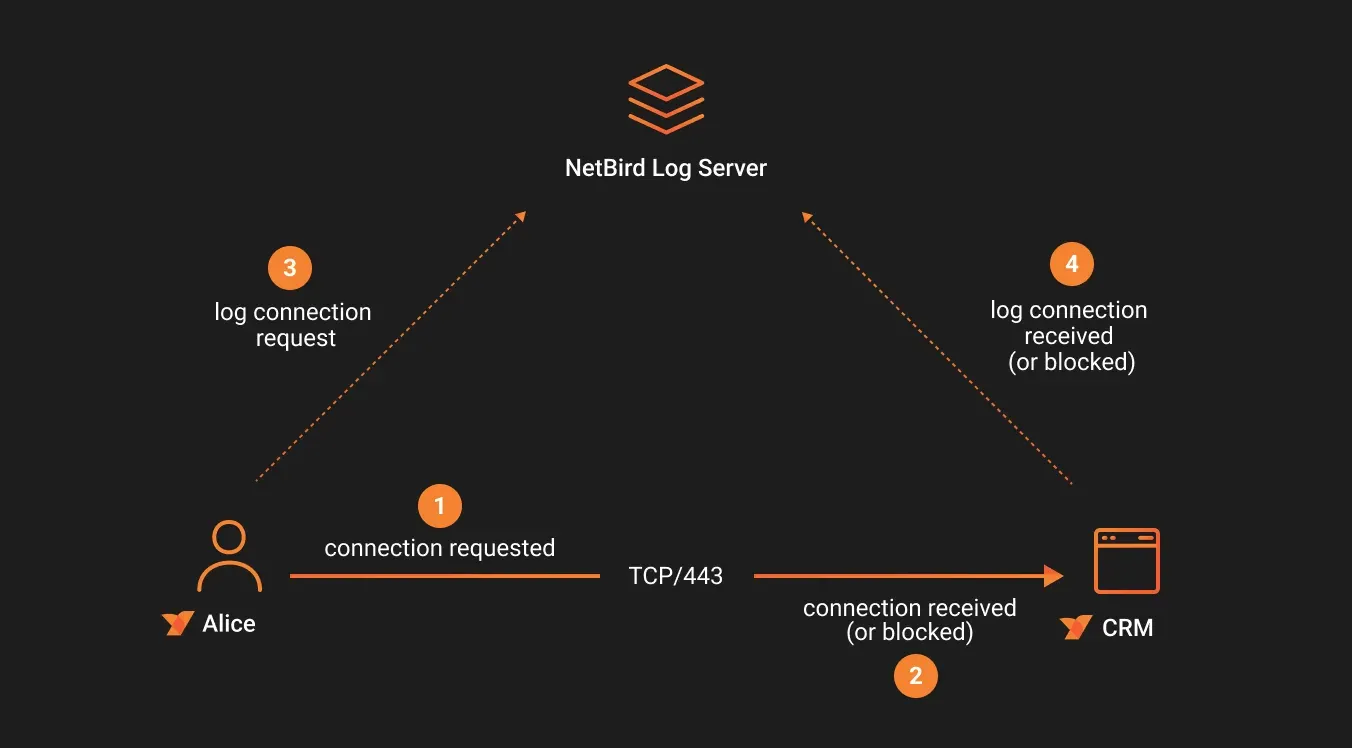
- Activity and traffic logging Audit events record administrative changes, and traffic events log allowed and blocked connections between peers and routed resources. Audit and traffic event streaming is listed in the Business plan.
- Desktop and CLI clients The
netbirdCLI providesup,status, debug bundle and profile commands, and multi-account profile switching. The Linux desktop app introduced in v0.75.0 uses a GTK 4 WebKit webview and requires GTK 4.10 or newer and WebKitGTK 6.0. - Platform coverage Official clients cover Linux, macOS, Windows, Android, iOS, Android TV, Apple TV and FreeBSD, plus pfSense, OPNsense, MikroTik RouterOS, OpenWRT, Synology, TrueNAS, Proxmox, Raspberry Pi, serverless functions and Docker containers.
- Quantum resistance with Rosenpass An optional mode adds Rosenpass post-quantum key exchange on top of WireGuard between peers, as described on the NetBird website and in the README feature list.
- NetBird Cloud plans The pricing page lists Free at 0 EUR for up to 5 users and 100 machines, Team at 6 EUR per user per month and Business at 12 EUR per user per month (both with 100 machines plus 10 per user, extra machines 0.50 EUR per month), and Enterprise with custom invoicing. Only active users and machines are billed.
- Self-hosted deployment
curl -fsSL https://github.com/netbirdio/netbird/releases/latest/download/getting-started.sh | bashgenerates a Docker Compose deployment of management, signal, relay and dashboard with a reverse proxy selection (Traefik is the default option). The Cloud vs self-hosted page compares the two. - Client installation on Linux
curl -fsSL https://pkgs.netbird.io/install.sh | shinstalls the client, and APT and RPM repositories at pkgs.netbird.io and release tarballs on GitHub are also documented in the Linux guide.
Where NetBird fits
Remote access for employees
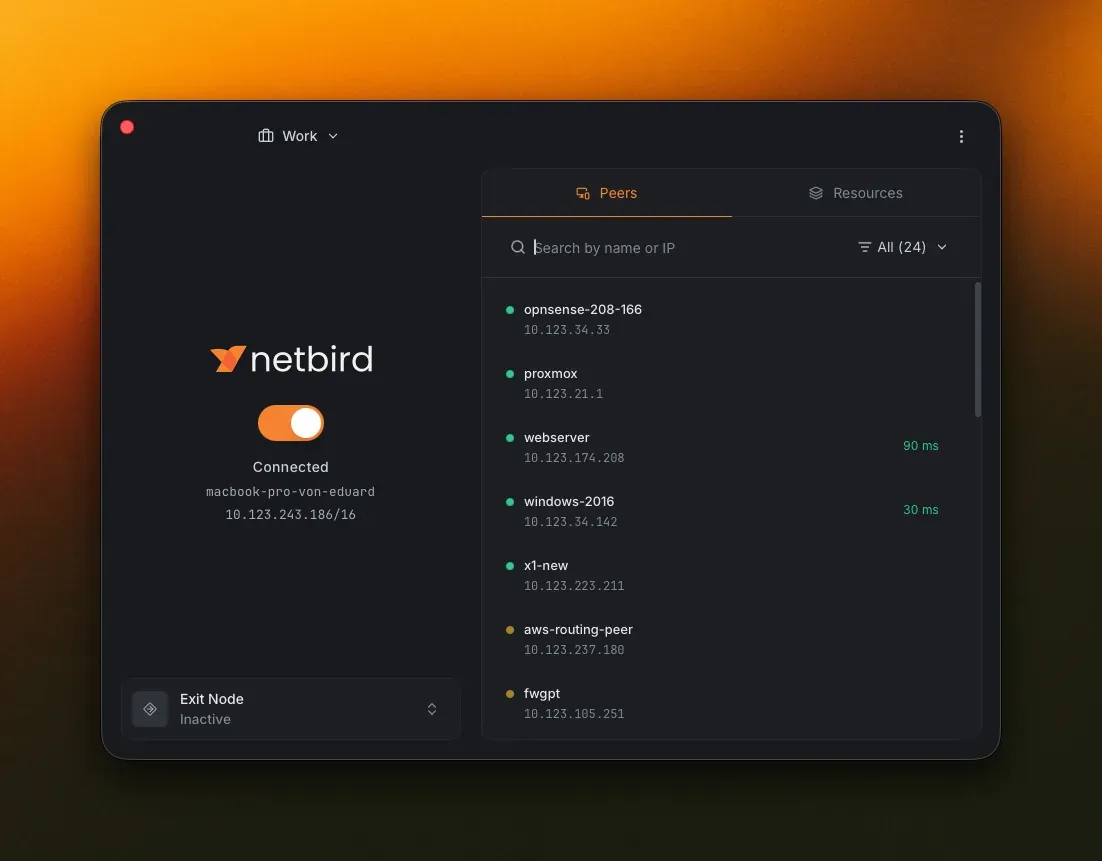
Employees install the NetBird client on laptops and phones and sign in through the company identity provider. Policies grant groups such as Engineering or IT Administrators access to specific servers and services, and posture checks can require a minimum client version, operating system version or country before a connection is permitted.
Access to cloud VPCs and private subnets
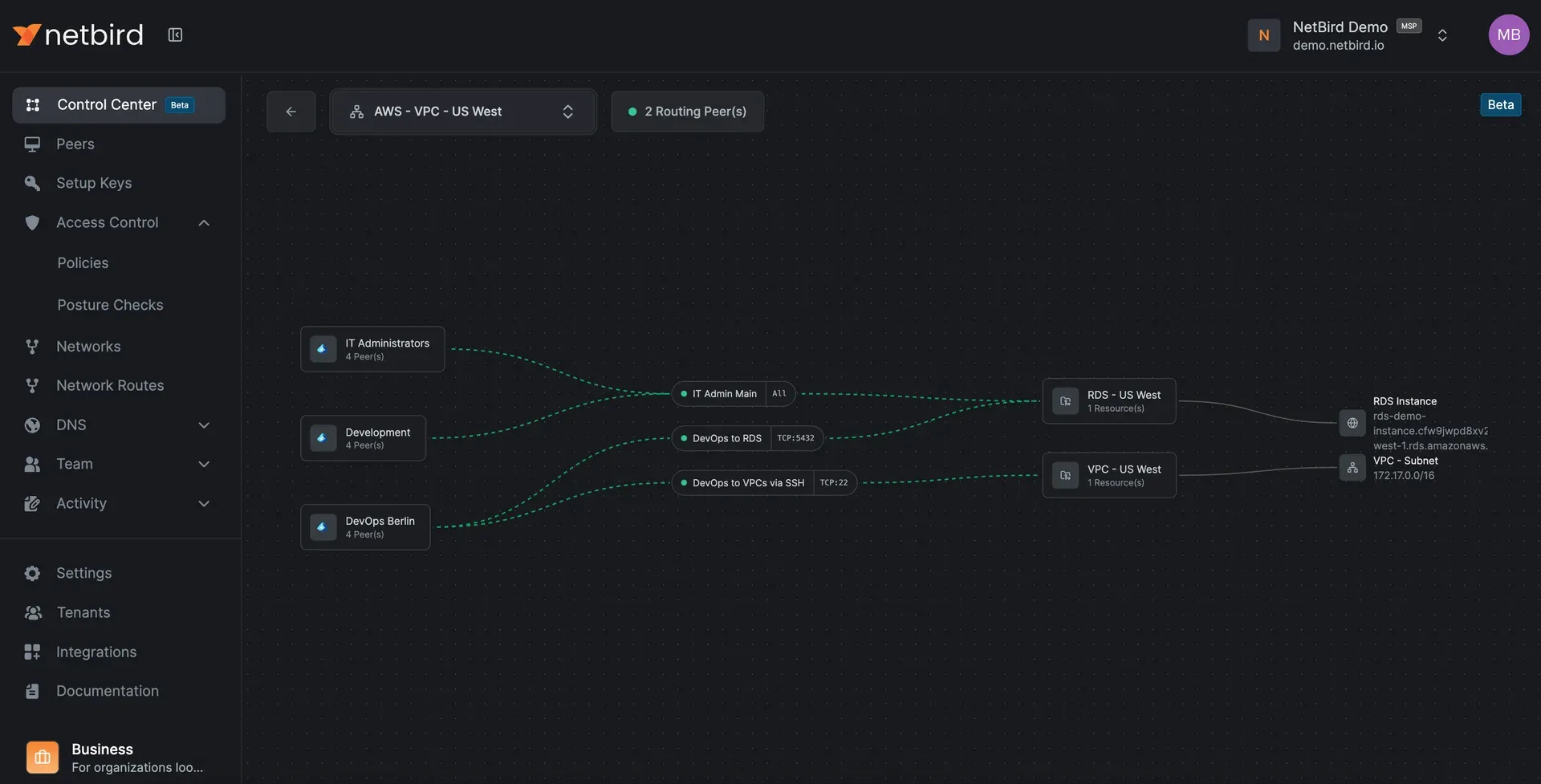
A routing peer inside a VPC or office network advertises a subnet or resource. Users reach databases and hosts behind it without installing an agent on each target, and policies limit access per port, for example TCP 5432 to a database or TCP 22 for SSH. High-availability routing peer groups select a peer by latency.
Site-to-site and server mesh
Servers, containers and router platforms register with setup keys and connect peer to peer. The same overlay links data centers, cloud regions, homelab systems and network appliances such as OPNsense or MikroTik, with relay fallback when no direct path exists. The self-hosting quickstart covers running the management, signal and relay services on a single Linux VM.
Infrastructure access with SSH and RDP
NetBird SSH applies central policies to SSH sessions, and the browser client opens SSH or RDP sessions from the dashboard. Activity logs record administrative changes and traffic events record connections.
Publishing internal services
The beta reverse proxy exposes a service running on a peer to the public internet with automatic TLS and optional authentication, routed through the NetBird mesh rather than through an opened inbound port on the service host.
Managing the network as code
The REST API, Terraform provider and Ansible collection create groups, policies, routes, DNS settings and setup keys, so a network definition can be stored in version control and applied to NetBird Cloud or a self-hosted management server.
Install
curl -fsSL https://pkgs.netbird.io/install.sh | shReviews of NetBird
Be the first to share your experience with NetBird.
Write a review
Loading review form…
Found NetBird useful? Upvote it todayYour vote helps other IT teams find it in the daily ranking.