

What is Atlantis?
Atlantis is a self-hosted Go application for Terraform pull request automation. It listens for pull request events from a Git host through webhooks, runs terraform plan, import and apply on its own server, and comments the output back on the pull request. It works with Terraform and, through a distribution setting, with OpenTofu. The source is published in the runatlantis/atlantis repository under the Apache License 2.0, and documentation lives at runatlantis.io/docs.
The project was released as open source on September 11, 2017; the introduction post states it had been in use at Hootsuite for over a year before that. Today it is a community project: the README points to community meetings on the Linux Foundation LFX platform, the #atlantis and #atlantis-contributors channels on CNCF Slack, and GitHub issues. There is no hosted Atlantis service and no paid edition.
According to the requirements page, Atlantis integrates with GitHub (including Enterprise), GitLab, Gitea and compatible forks such as Forgejo, Bitbucket Cloud, Bitbucket Server and Azure DevOps. It supports every Terraform state backend except local state, because Atlantis has no permanent storage and does not commit state files to version control. It has no external database: plan files are stored on disk, and locks are kept in BoltDB or Redis.
The latest release is v0.49.0, published on October 25, 2026 with binaries for Linux (386, amd64, arm, arm64), macOS (amd64, arm64) and Windows (386, amd64). It is marked as a breaking release: the official Docker images no longer bundle Terraform or OpenTofu, so the server needs --default-tf-version to download a binary at startup. It also fixes 12 security advisories, among them a critical clone URL host check that could bypass the fork check, and binds each apply to a hash of the reviewed plan so a changed plan file is rejected.
The deployment guide covers the official Helm chart, Kubernetes manifests and Kustomize, OpenShift, AWS Fargate, Google Kubernetes Engine and Compute Engine, Docker, Microsoft Azure and custom installs. The official image is ghcr.io/runatlantis/atlantis, published in Alpine and Debian variants. Related listings on iThub: Terraform, Spacelift and GitHub.
Key capabilities
- Plan and apply from pull request comments Commenting
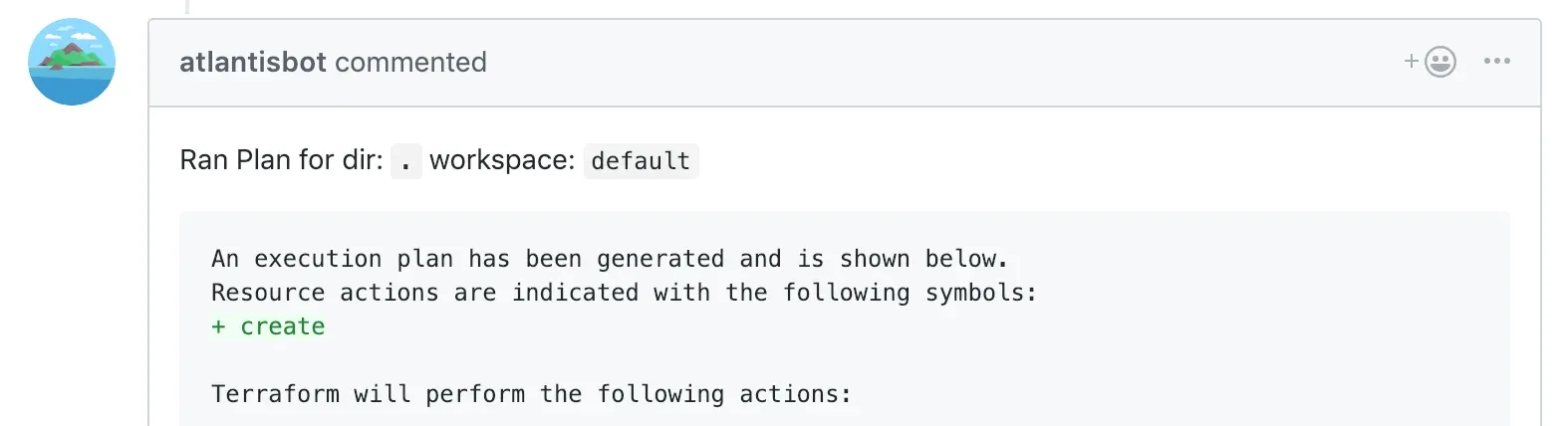
atlantis planoratlantis applyon a pull request runs the command on the Atlantis server and posts the output as a comment. Further commands documented in Using Atlantis includeimport,state rm,unlock,cancel,approve_policies,versionandhelp. Extra Terraform flags can be passed after--, with several state-related flags blocked since v0.49.0. - Autoplanning When a pull request is opened or updated, Atlantis runs
planautomatically for projects whose files changed, as described in the autoplanning documentation. Module changes can trigger plans for the projects that use them with--autoplan-modules, and plans can run in parallel. - Project and workspace locking Running
planlocks the directory and Terraform workspace until the pull request is merged or closed or the plan is deleted. Another pull request that tries to plan the same project gets a comment linking to the one holding the lock. Only the directory and workspace are locked, not the whole repository, per the locking documentation. - Apply requirements Server or repository configuration can require that a pull request is approved, mergeable or undiverged before
apply, as listed under command requirements. Since v0.49.0, approval checks on GitHub and Gitea use each reviewer's latest review, and requirements also apply tostate rm. - Repository and server-side configuration An
atlantis.yamlfile in the repository defines projects, workspaces, Terraform versions and workflows. A server-side repo config sets what each repository may override, such as allowed workflows and apply requirements, and the--repo-allowlistflag restricts which repositories Atlantis accepts. - Custom workflows and hooks Custom workflows replace or extend the default init, plan and apply steps with custom
runcommands and environment variables. Pre-workflow and post-workflow hooks run commands before or after Atlantis processes a pull request, for example to generate the repositoryatlantis.yamldynamically. - Conftest policy checking With
--enable-policy-checks, Atlantis runs server-side conftest policies against the plan output. Failed policies block apply until fixed in a new commit or approved by the owners of the policy set; policy approvals are separate from pull request approvals. - Terraform and OpenTofu versions Each project can pin
terraform_version, and the server downloads the version it needs.--default-tf-distribution opentofuswitches to OpenTofu. Since v0.49.0 the server must have--default-tf-versionset, or a binary must be mounted into the image when downloads are blocked. - Supported Git hosts GitHub (public, private or Enterprise, with a user token or a GitHub App), GitLab (public, private or enterprise), Gitea and compatible forks including Forgejo, Bitbucket Cloud, Bitbucket Server and Azure DevOps. GitLab 15.6 and later provide the detailed merge status that Atlantis uses for mergeable checks.
- HTTP API and drift detection The API endpoints include
POST /api/planandPOST /api/applyfor running commands without a pull request, protected by--api-secretand theX-Atlantis-Tokenheader. Experimental drift detection endpoints detect and remediate drift, and/api/locks,/status,/healthzand/readyzreport state and health. - Web UI for locks A built-in web page lists current locks and lets operators open a lock and discard it. The web UI can be protected with basic authentication, whose credentials are compared in constant time since v0.49.0.
- Streaming logs and notifications Plan and apply output can be followed live through streaming logs in the web UI. Atlantis can also send notifications to any HTTP endpoint or directly to a Slack channel for apply and drift events.
- Metrics Atlantis exposes statistics for monitoring, documented on the stats page, covering errors, successes and latencies for each operation, with Statsd and Prometheus output.
- Security guidance The security page describes the risks of running Terraform from pull requests, including malicious code in forks, and the controls Atlantis offers: repository allowlists, webhook secrets, fork restrictions, apply requirements and disabling custom workflows from repository configuration. Version 0.49.0 also rejects webhooks whose clone URL host does not match
--gh-hostname. - Deployment packages Release archives are published on GitHub releases for Linux, macOS and Windows with a checksums file. The
ghcr.io/runatlantis/atlantisimage comes in Alpine (default tag) and Debian variants and includes git, git-lfs, conftest, curl and dumb-init. An official Helm chart is maintained in the runatlantis/helm-charts repository. - Terraform Cloud and remote state Atlantis works with any remote state backend, and the documentation describes integration with Terraform Cloud and Terraform Enterprise in Terraform Cloud. Local state is not supported.
Where Atlantis fits
Reviewing infrastructure changes in pull requests
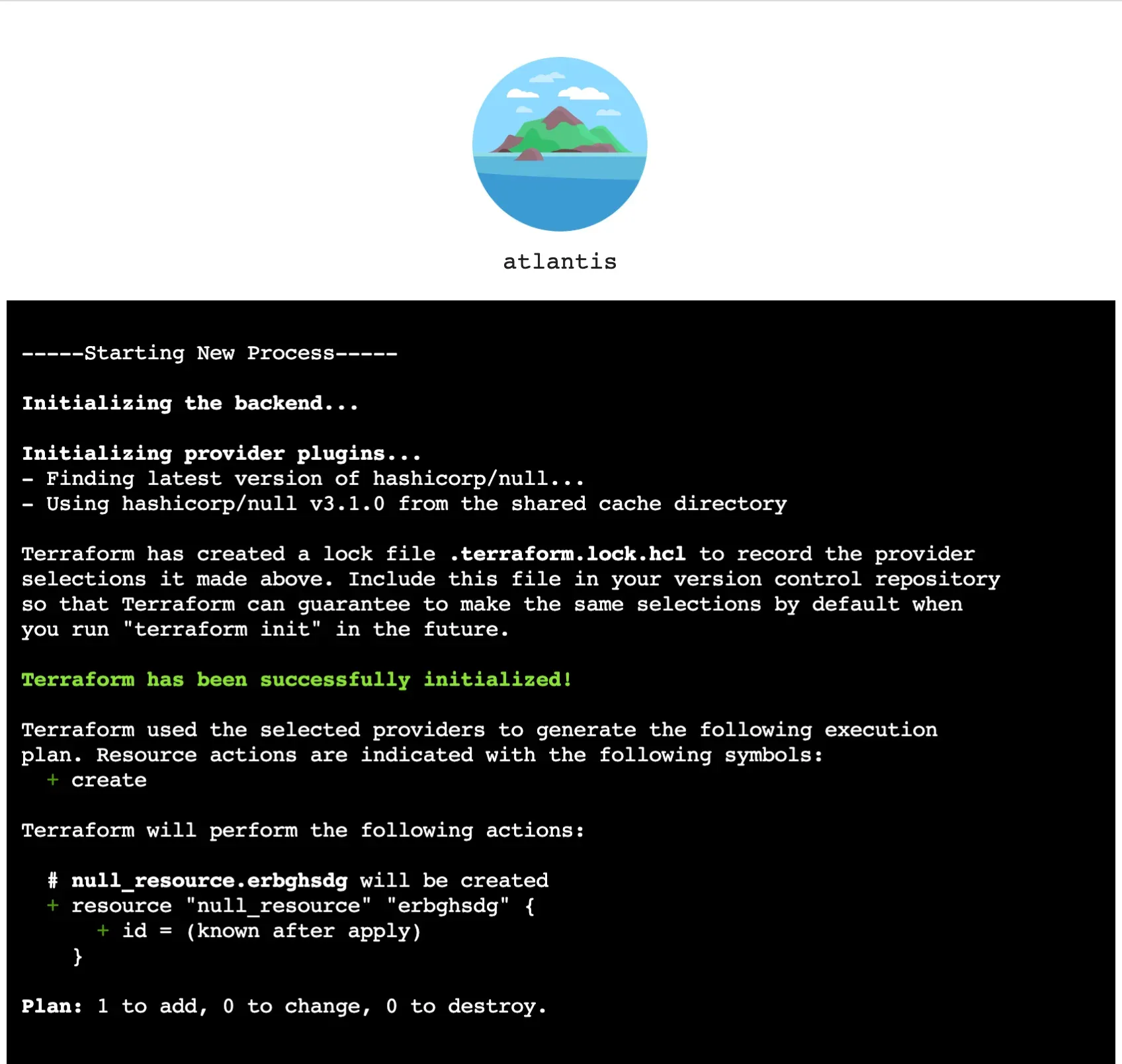
A developer opens a pull request that changes Terraform code. Atlantis autoplans the affected projects and posts each plan as a comment, and the commit status shows whether all projects planned successfully. Reviewers read the plan next to the code diff, and once requirements such as approval are met, someone comments atlantis apply. The getting started guide walks through this flow.
Preventing conflicting changes to the same project
Because the directory and workspace stay locked from the first plan until merge, two pull requests cannot plan and apply the same project at the same time. The second pull request receives a comment that names the pull request holding the lock, and locks can be released from the web UI or by deleting the plan.
Managing many projects in a monorepo
An atlantis.yaml file lists projects by directory and workspace, with per-project Terraform versions, workflows and autoplan triggers. Parallel plan and apply options and module-aware autoplanning are documented for repositories with many projects.
Enforcing policies before apply
Platform teams define conftest policies, for example to deny certain modules or catch unintended deletions. Atlantis evaluates them against each plan and blocks apply on failure until a policy owner approves with atlantis approve_policies or a new commit fixes the issue.
Running Atlantis on Kubernetes
The official Helm chart deploys Atlantis into a cluster, and the deployment guide recommends a persistent disk because plan files are stored locally. Credentials for the Git host and cloud providers are supplied as secrets, and the Terraform version or OpenTofu distribution is set in the chart values. The deployment guide also covers plain manifests, Kustomize and other platforms.
Detecting drift through the API
Scheduled jobs can call the plan API without a pull request, or use the experimental drift detection endpoints to find projects whose real infrastructure differs from code and trigger a remediation plan or apply. Results are available from the drift status endpoint.
Install
helm repo add runatlantis https://runatlantis.github.io/helm-chartsReviews of Atlantis
Be the first to share your experience with Atlantis.
Write a review
Loading review form…
Found Atlantis useful? Upvote it todayYour vote helps other IT teams find it in the daily ranking.