What is ZITADEL?
ZITADEL is an open-source identity and access management platform developed by the company of the same name, which its about page says was founded in Switzerland. It provides single sign-on, multi-factor authentication, passkeys, OpenID Connect, OAuth 2.0, SAML 2.0 and a SCIM 2.0 server, with user, organization and project management exposed through typed APIs. The server is written in Go, stores its data in PostgreSQL 14 or later and ships with a web Console for administration and a separate Login V2 application built on Next.js. The project lists itself as OpenID Connect certified on the OpenID Foundation certification page.
The same codebase runs as ZITADEL Cloud, the vendor's managed service, and as self-hosted software. ZITADEL Cloud is offered with data residency in the EU, the US, Switzerland and Australia. Self-hosted installations use the container image published on the GitHub Container Registry, the official Helm chart for Kubernetes, a Docker Compose file from the repository, or the release binaries for Linux, macOS and Windows on amd64 and arm64, plus a separate login package. The deployment overview states that a test environment runs on 1 CPU and 512 MB of memory next to a PostgreSQL instance.
The current release is v4.20.2, published on November 9, 2026. It retries proto plugin downloads during builds, expires Redis cache index keys, treats a rejected session cookie token in the login as no session, and skips the password-change mail when no notification policy exists. Version 4.20.1 (November 3, 2026) applied log level and masking to OpenTelemetry log export, kept the Login V2 sessions cookie within the browser size limit and made email addresses case insensitive. Version 4.20.0 (October 22, 2026) moved the build to Go 1.26.10, which rejects certificate chains through the compromised eMudhra intermediate CAs for outbound TLS, and signs the Login V2 device code check with the session cookie secret.
The repository is licensed under AGPL-3.0-only. Its licensing policy lists exceptions: the proto/ and apps/docs/ directories are under the Apache License 2.0, and apps/login/, packages/zitadel-client/ and packages/zitadel-proto/ are under the MIT License. Community contributions are accepted only under Apache 2.0, and the vendor offers commercial licenses for users who do not want AGPL obligations. The Enterprise plan lists a commercial license among its terms.
Separately from the main server, the vendor publishes an alpha preview called Zitadel Next (repository zitadel/nextgen). It starts a project-local runtime through npx @zitadel/cli@alpha, scaffolds a login flow for Next.js, with React, Vue, Angular and Nuxt adapters, and supports username/password and passkey sign-in. The vendor states that the preview does not yet connect to ZITADEL Cloud and that SAML, external identity providers and custom templates are planned for later. Other open-source identity servers in this directory include Keycloak and authentik.
Key capabilities
- OpenID Connect and OAuth 2.0 ZITADEL acts as an OpenID Provider and OAuth 2.0 authorization server with authorization code, PKCE, client credentials and device authorization flows. Applications are registered per project in the Console with their redirect URIs, token types and lifetimes. The OIDC implementation is listed as certified by the OpenID Foundation.
- SAML 2.0 identity provider Applications that only speak SAML can use ZITADEL as a SAML 2.0 identity provider. The SAML endpoint reference documents metadata, single sign-on and certificate endpoints. SAML applications sit inside the same projects and role model as OIDC clients.
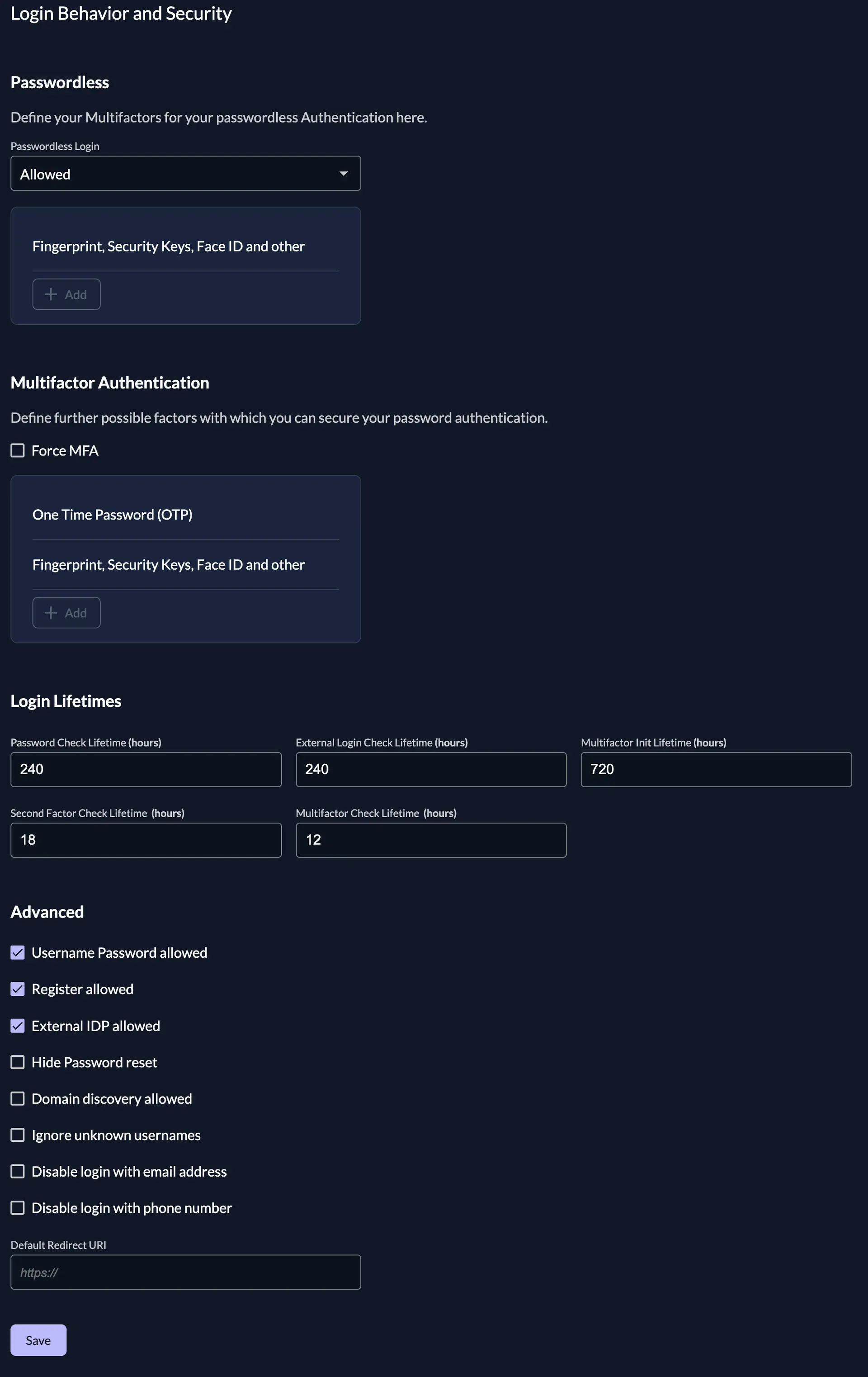
- Passkeys and multi-factor authentication Users can register passkeys (FIDO2 and WebAuthn) for passwordless login. Second factors include time-based OTP, U2F security keys, OTP by email and OTP by SMS. The login policy can allow or force MFA and sets lifetimes for password, external login and multi-factor checks, as shown in the Console login settings.
- Identity brokering and LDAP Organizations can let users sign in through external identity providers such as enterprise OIDC or SAML providers, social logins and LDAP directories. Pre-built templates exist for common providers. Users can be created or linked automatically when they first sign in through a provider.
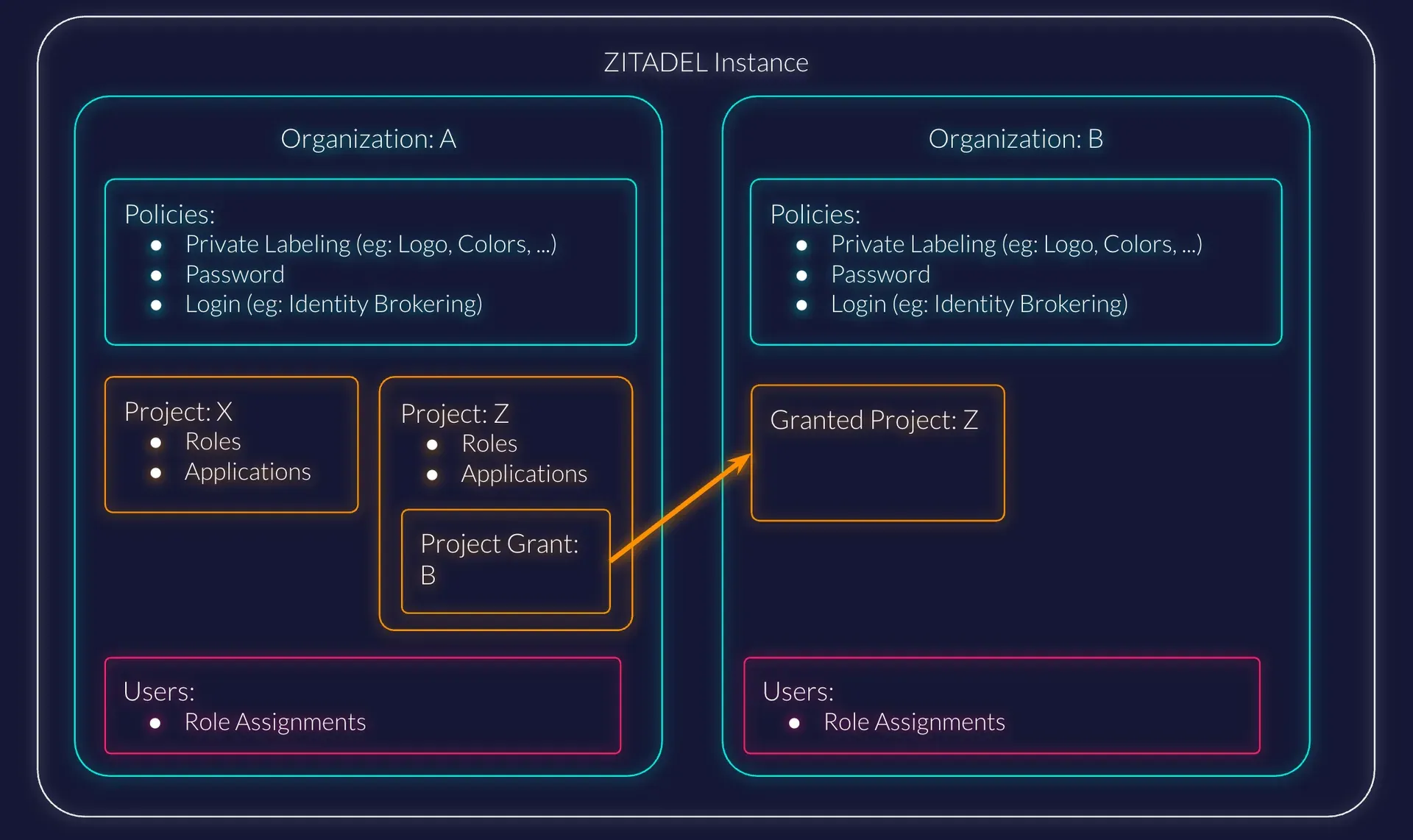
- Instances, organizations and projects The data model is a hierarchy: an instance holds organizations, and each organization holds users, projects, applications and its own policies. A project can be granted to another organization, which then assigns the project roles to its own users. ZITADEL Cloud and self-hosted installations can run several instances on one deployment.
- B2B onboarding and delegated administration Customer organizations can be onboarded with self-service registration, their own identity providers and domain discovery, which routes a user to the correct organization based on the email domain. Role management can be delegated to administrators of the granted organization. The B2B onboarding guide describes the setup.
- Machine users and service accounts Service accounts authenticate with JWT profile keys, personal access tokens or client credentials. They can be given administrator or project roles to call the APIs from scripts, backends or agents. The pricing page lists service users and agents as part of the free plan.
- Token exchange and impersonation ZITADEL implements OAuth 2.0 token exchange, which lets a trusted service exchange one token for another, including impersonation of a user when impersonation is enabled and permitted. The token exchange guide describes the required settings and permissions.
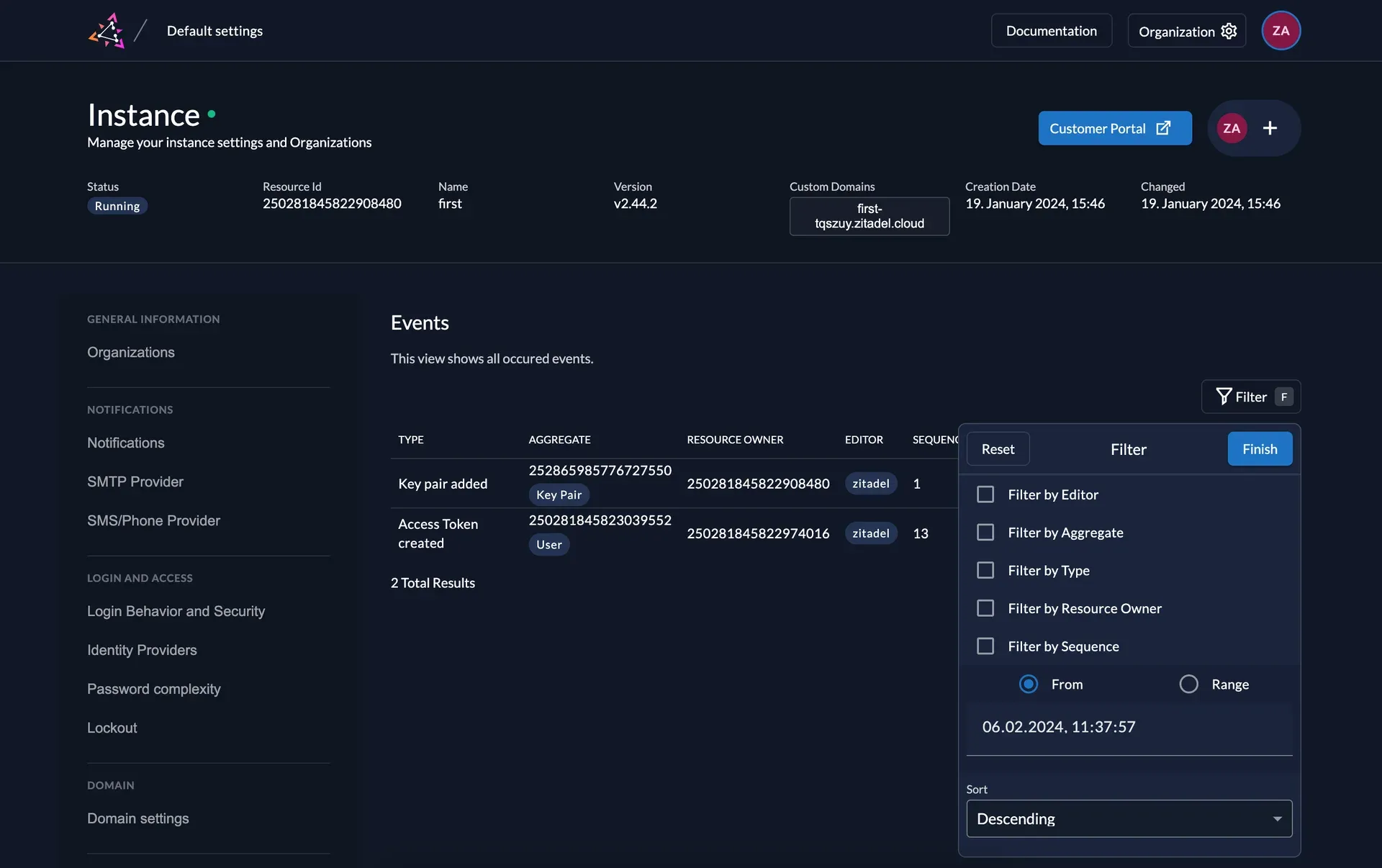
- Event-sourced audit trail Every change is written as an immutable event, and the event stream is the basis of the audit trail. Administrators can browse events in the Console by type, aggregate, editor, resource owner and sequence, and the events can be queried through the API or forwarded to SIEM and SOC systems through webhooks.
- Actions v2 and webhooks Actions v2 call an external HTTP endpoint (a target) when an execution condition matches: a request, a response, a function such as token enrichment, or an event. Targets can validate input, add metadata, assign roles or provision users to other systems. Actions v1 still run in addition to v2, and a migration guide exists.
- gRPC, connectRPC and REST APIs Every resource is available through gRPC, connectRPC and HTTP/JSON APIs, and the V2 APIs cover users, sessions, organizations, settings and more. The API introduction lists the services and the authentication methods. The proto definitions are published under Apache 2.0.
- SCIM 2.0 server A SCIM 2.0 service provider endpoint at
/scim/v2/{orgId}supports creating, reading, replacing, patching, deleting and searching users, plus bulk operations. The documentation marks it as a preview, lists the supported filter attributes and limits list responses to 100 users by default. - Hosted Login V2 and custom login UIs Login V2 is a Next.js application released with each version as the
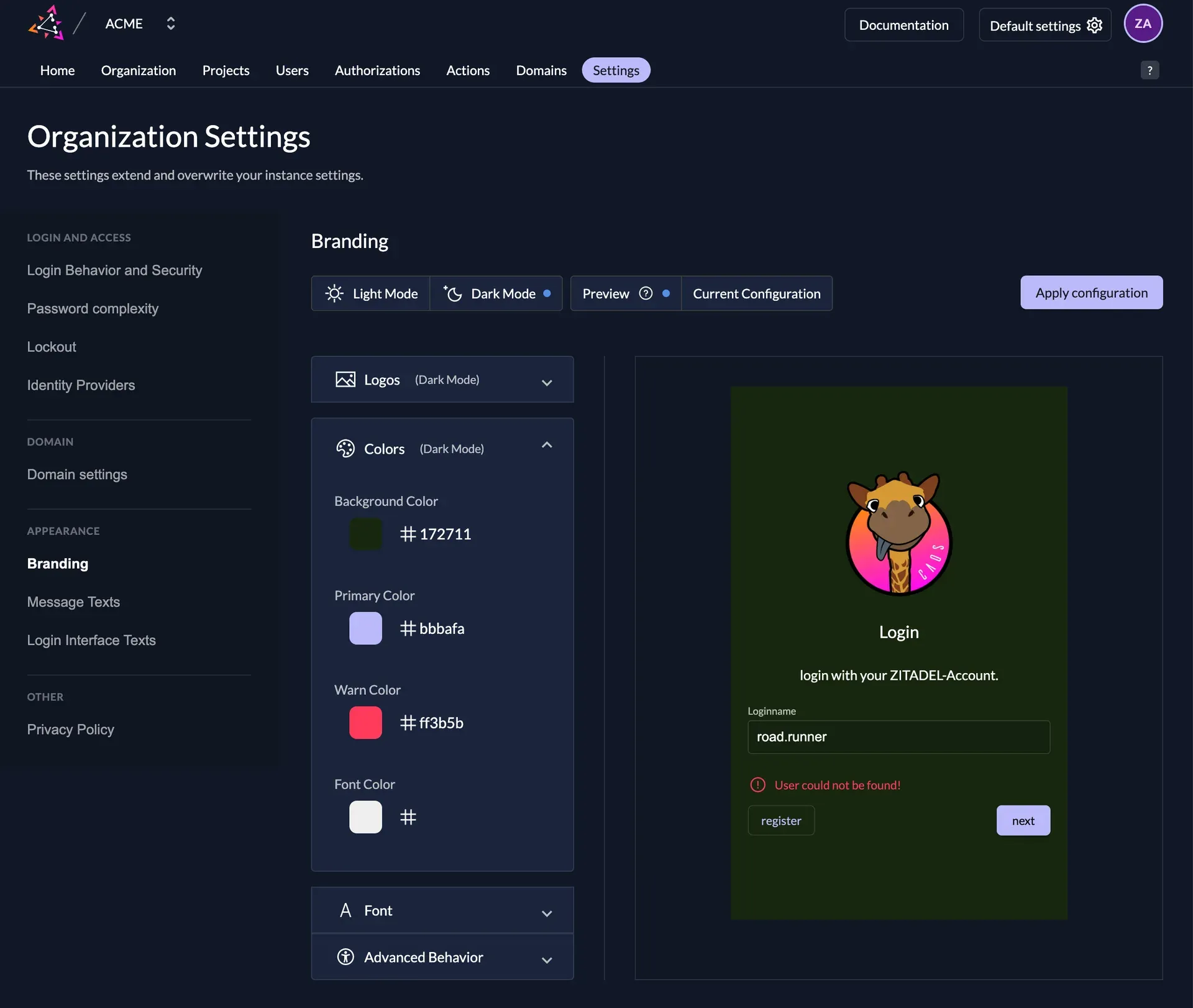
zitadel-loginpackage. Teams can use the hosted login, or build their own login screens against the Session API for flows beyond OIDC and SAML. The login application is MIT licensed. - Branding and texts per organization Each organization can set its own logos, colors and fonts for light and dark mode, with a live preview in the Console before the configuration is applied. Login interface texts and notification message texts can be customized per language, and SMTP and SMS providers are configured at instance level.
- Docker Compose and Kubernetes deployment The README includes a Docker Compose quick start that downloads
docker-compose.ymland an.envexample from the repository. For Kubernetes 1.30 or later, the official Helm chart fromhttps://charts.zitadel.comcan deploy an optional PostgreSQL subchart that the documentation describes as for quickstart use only. A masterkey encrypts sensitive data at rest. - Scaling and updates ZITADEL documents zero-downtime updates and horizontal scaling without an external session store. Redis can be used as a cache, and logs and traces can be exported through OpenTelemetry. The vendor publishes technical advisories for issues that affect security or stability in production.
- SDKs and examples Official SDKs and example applications cover frontend and backend frameworks, listed on the SDK and examples page. The TypeScript client and proto packages in the repository are MIT licensed.
- ZITADEL Cloud plans The pricing page lists a Free plan at US$ 0 per month with unlimited users and organizations, 100 daily active users and 3 identity providers, and a Pro plan from US$ 100 per month with 25,000 daily active users per month, 3 identity providers and a custom domain included. The Enterprise plan has custom pricing, runs in the cloud or on the customer's infrastructure and includes unlimited daily active users and a commercial license.
Where ZITADEL fits
Login for a SaaS product
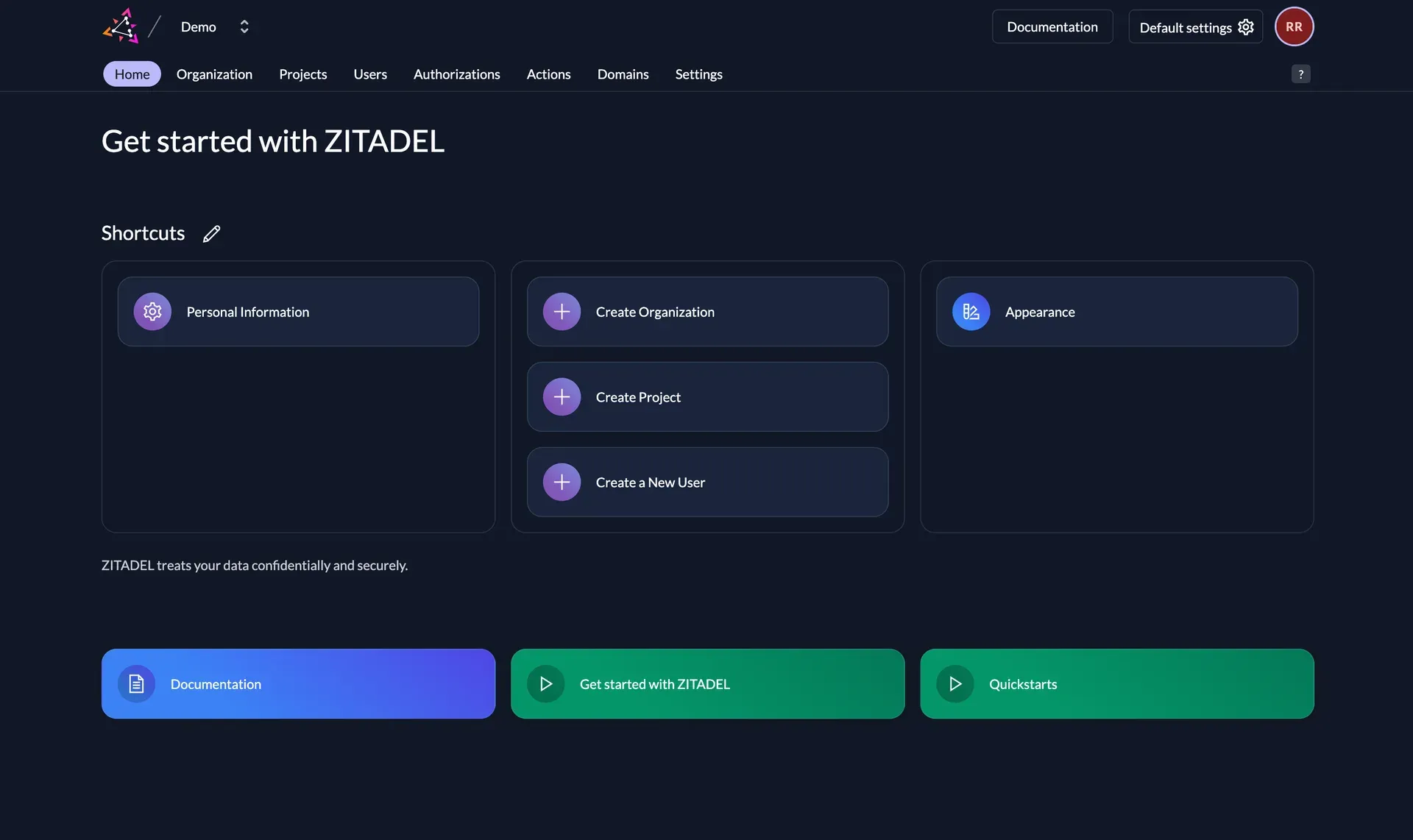
A SaaS team registers its web or mobile app as an OIDC application in a ZITADEL project, defines roles and reads the role claims from the tokens. Users sign in through the hosted Login V2 with a password, a passkey or a social provider. The quick start guide walks through creating the project and application.
Multi-tenant B2B applications
Each business customer becomes an organization with its own users, branding, password policy and identity providers. The vendor grants its project to the customer organization, whose administrators then assign roles to their own staff. Domain discovery sends users to their organization's login settings based on their email domain.
Enterprise single sign-on
Internal applications can use ZITADEL as the central OIDC or SAML identity provider, while employees authenticate against an existing directory through LDAP or an upstream enterprise identity provider. MFA can be forced through the login policy, and user provisioning from other systems can run through the SCIM 2.0 endpoint.
Machine-to-machine authentication
Backends, jobs and AI agents use service accounts with JWT profile keys, personal access tokens or client credentials to obtain tokens. Token exchange covers delegation and impersonation cases between services, documented in the service account guide.
Custom logic and provisioning with Actions
When a user is created, a token is issued or a specific event occurs, Actions v2 call an external endpoint that can validate data, enrich tokens with claims, restrict registration by email domain or copy users to another system. The audit event stream can be forwarded to an external log or SIEM.
Self-hosted identity infrastructure
Operators run ZITADEL with PostgreSQL through Docker Compose, Kubernetes and the Helm chart, or the release binaries, and configure their own domain, masterkey, SMTP provider and TLS. The production setup guide covers the configuration for production use.
Reviews of ZITADEL
Be the first to share your experience with ZITADEL.
Write a review
Loading review form…
Found ZITADEL useful? Upvote it todayYour vote helps other IT teams find it in the daily ranking.